Gender & #jobs: pretty clear who's working only part-time. Follow @OECDlive & #gender tomorrow bit.ly/1BCpQOH http://t.co/arzboo6udl—
(@OECD) March 03, 2015
There are big differences in part-time employment rates across countries
06 May 2015 Leave a comment
in discrimination, gender, labour economics, labour supply, occupational choice Tags: gender wage gap, part-time employment, reversing gender gap
The rise and rise of mothers as breadwinners
05 May 2015 Leave a comment
in economics of love and marriage, gender, labour economics, labour supply, occupational choice Tags: female labour supply, gender wage gap, household division of labour, maternal labour supply
Women are winning the human capital race | Kevin M. Murphy and Robert H. Topel
04 May 2015 Leave a comment
in applied welfare economics, discrimination, economics of education, gender, human capital, labour economics, labour supply, occupational choice Tags: gender wage gap, reversing gender gap

Why have women outpaced men? There’s little cognitive difference between the sexes, and males do better on standardized tests.
But Murphy, Becker, and Hubbard argue that women tend to have better “non-cognitive skills” than men do. Those personal skills and character traits such as persistence, self-control, and conscientiousness may help women excel academically and stay in school until they graduate.
The academic achievement gap actually starts before college: 25 percent more females than males took high-school advanced-placement tests in 2010, the Cleveland Fed economists find.
“There is a substantial gap between the measured high school performance of males and females,” Topel and Murphy write in a 2014 study, noting that female graduating high school seniors have, as a group, higher grade point averages than their male counterparts. “This high school gender gap in academic performance persists in the population that continues on to college.”
via Women are winning the human capital race | The University of Chicago Booth School of Business.
The wage stagnation that dare not speak its name
30 Apr 2015 Leave a comment
in discrimination, gender, labour economics, occupational choice Tags: gender analysis, gender wage gap, media bias, reversing gender gap, wage stagnation

The gender wage gap reverses at below 40 hours a week
30 Apr 2015 Leave a comment
in discrimination, gender, human capital, labour economics, labour supply Tags: gender wage gap

Why is the rapid closing of the gender wage gap in New Zealand not celebrated more?
27 Apr 2015 1 Comment
in discrimination, gender, human capital, labour economics, labour supply, occupational choice, politics - New Zealand Tags: activists, do gooders, gender wage gap, Left-wing hypocrisy, Leftover Left
With the rapid closure in the raw female male wage gap in New Zealand over the last 15 or so years, the lack of celebration of this achievement among equal pay activists is puzzling.
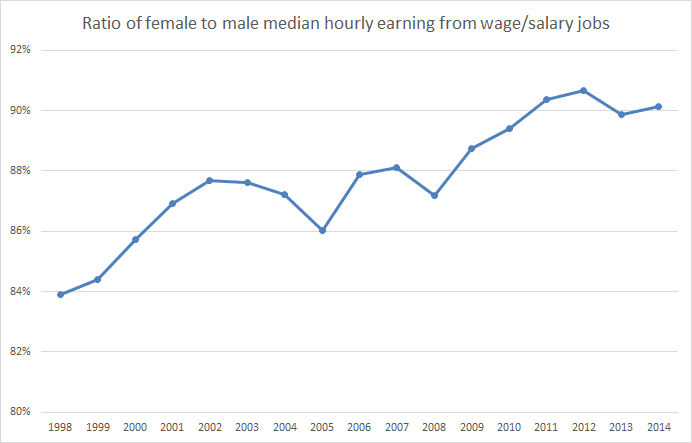
Source: Statistics New Zealand, New Zealand Social indicators, Median hourly earnings.
Thomas Sowell – Gender Bias and Income Disparity: A Myth?
15 Apr 2015 Leave a comment
in discrimination, gender, human capital, labour economics, labour supply, occupational choice Tags: gender wage gap, Thomas Sowell
The raw gender wage gap conceals more than it reveals
15 Apr 2015 Leave a comment
in discrimination, gender, human capital, labour economics, labour supply, occupational choice Tags: gender wage gap, reversing gender gap
FACTS #EqualPayDay http://t.co/KoWZeiIShQ—
Meninist (@MeninistTweet) April 14, 2015
Why aren’t the trends in this chart celebrated on Equal Pay Day?
15 Apr 2015 Leave a comment
in discrimination, gender, human capital, labour economics, labour supply, occupational choice Tags: gender wage gap
Some #EqualPayDay statistics: gender wage gap is narrowest for the young, gets wider with age blogs.wsj.com/economics/2015… http://t.co/rpiWdfOyp2—
Josh Zumbrun (@JoshZumbrun) April 14, 2015
What does the raw gender wage gap mean if it is not this?
15 Apr 2015 Leave a comment
in discrimination, gender, human capital, labour economics, labour supply, occupational choice Tags: Equal Pay Day, gender wage gap
Tomorrow is feminists' make-believe, bogus Equal Pay Day. Look for statistical fraud, best illustrated by this coupon http://t.co/agg2o8n8yU—
Mark J. Perry (@Mark_J_Perry) April 13, 2015
The marriage effect in the labour market
14 Apr 2015 Leave a comment
in discrimination, economics of love and marriage, gender, labour economics, law and economics, occupational choice Tags: asymmetric marriage premium, gender wage gap

Another gender wage gap that dare not speak its name
09 Apr 2015 Leave a comment
in discrimination, gender, labour economics, labour supply, occupational choice Tags: compensating differentials, gender wage gap, part-time work, reversing gender gap


Trends in bachelor degrees conferred on women since 1970
04 Apr 2015 Leave a comment
in discrimination, economics of education, gender, occupational choice Tags: compensating differentials, gender wage gap, reversing gender gap, STEM
A lot of women did information science in the 70s, close to 40% of all information science majors, then women moved away to invest in other majors. It would be laughable to suggest that information science was more welcoming to women in the 1970s but not now. Clearly, a third set of factors is at play unrelated to hostile working environments. Similarly, a large number of women did maths and statistics then that trend petered out in the 1980s.
Hillary Clinton says women earned 2x CS degrees in the '80s as today. Mostly True: politifact.com/truth-o-meter/… #dataviz http://t.co/Zg82d8ZfQh—
Randy Olson (@randal_olson) March 03, 2015
Claudia Goldin on Gender Equality in the Labor Market
02 Apr 2015 Leave a comment
in discrimination, gender, human capital, labour economics, managerial economics, occupational choice, organisational economics, personnel economics Tags: Claudia Goldin, gender wage gap, wage gaps

 Utopia, you are standing in it!
Recent Comments