The rise and fall of global trade: from the Romans to coronavirus
21 May 2020 Leave a comment
in economic history, international economic law, international economics, International law Tags: globalisation
The 1st @PaulKrugman explains globalisation to @SenSanders @JeremyCorbyn
04 Jan 2017 Leave a comment
in applied price theory, comparative institutional analysis, development economics, growth disasters, growth miracles Tags: antiforeign bias, antimarket bias, globalisation, Leftover Left, pessimism bias, The Great Enrichment, The Great Escape, The Great Fact

Source: Enemies of the WTO (1999).
50% of @PaulineHansonOz @OneNationAus votes come from @AustralianLabor voters
22 Sep 2016 1 Comment
in constitutional political economy, politics - Australia, Public Choice Tags: 2016 Australian federal election, antiforeign bias, antimarket bias, expressive voting, free trade, globalisation, left-wing popularism, makework bias, rational irrationality, right-wing popularism
How can Pauline Hanson be an extreme right-winger if half of her votes come from people who 2nd preference the Australian Labour Party? This strong support for her populism has been well-known since she won the safest Labour Party seed in Queensland in the 1996 Australian Federal Election but is hardly ever mentioned by the media or her critics.
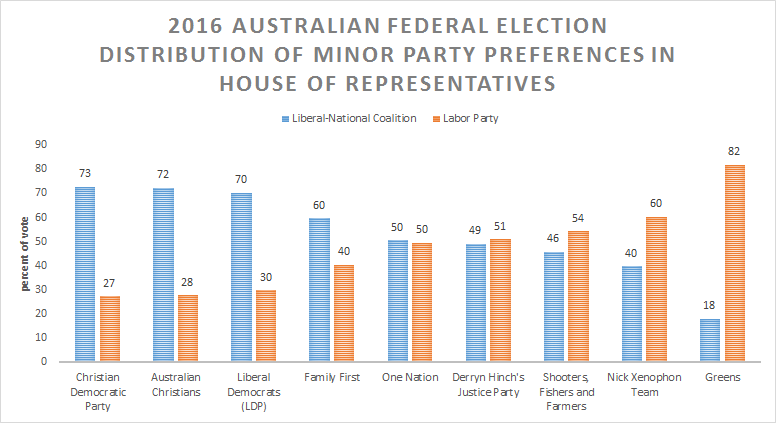
Source: Antony Green’s Election Blog: Preference Flows at the 2016 Federal Election.
It should be therefore no surprise that a lot of her views have popular support because she has support across the political spectrum. Not knowing that will means you will be not very good at combating her views which you simply do not understand where they come from.
Few of her supporters see themselves as extremists and will be insulted when you suggest they are. Listen here dummy is no way to win back votes of people who just voted for you recently.
Hanson’s support among Labour voters is increasing. Only 42% of her voters gave their 2nd preference to Labour in previous federal elections for the House of Representatives.
Why Does 1% of History Have 99% of the Wealth? @Oxfam #TPPANoWay
06 Feb 2016 Leave a comment
in development economics, economic history, growth disasters, growth miracles, history of economic thought, international economics Tags: capitalism and freedom, free trade, global poverty, globalisation, industrial revolution, international technology diffusion, technology diffusion, The Great Enrichment, The Great Fact, TPPA
The 1st @NYTimeskrugman on #TPPANoWay @Oxfamnz #JaneKelsey
30 Jan 2016 Leave a comment
in applied price theory, applied welfare economics, development economics, economic history, growth disasters, growth miracles, international economics Tags: customs unions, free trade agreements, globalisation, Jane Kelsey, Leftover Left, Oxfam, Paul Krugman, preferential trading agreements, rational irrationality, TPP, Twitter left, Yes Minister
https://twitter.com/TPPMediaMarch/status/692055631579185152
If George Bush had not won the 2000 presidential election, Paul Krugman would have taken over as the best communicator of economics since Milton Friedman. Instead, he became patient number no.1 of George Bush derangement syndrome. Ann Coulter was patient no. 1 of Clintons derangement syndrome.

Source: Enemies of the WTO.
Globalisation is Good – Johan Norberg on Globalisation
23 Jan 2016 Leave a comment
in applied welfare economics, development economics, economic history, growth miracles, international economics, Marxist economics Tags: capitalism and freedom, extreme poverty, global poverty, globalisation, The Great Escape, The Great Fact
The case against waiting for trade agreements
05 Jul 2015 Leave a comment
in international economics, politics - Australia, politics - New Zealand, politics - USA Tags: free trade agreements, globalisation, preferential trading agreements, regional trade agreements, trade creation, trade version, unilateral free trade
The largest global exporters
04 Jul 2015 Leave a comment
in international economics Tags: globalisation, overseas trade
The largest global exporters and why everyone is so keen to agree new trade deals econ.st/1eOdcEj http://t.co/TXZCYkUToU—
The Economist (@EconEconomics) June 27, 2015
What does America import and export?
13 Jun 2015 Leave a comment
in international economics, politics - USA Tags: globalisation, international trade
As the House votes on trade, see last month's post on what the US actually imports and exports pewrsr.ch/1Jsonh0 http://t.co/B976iVeDjg—
PewResearch FactTank (@FactTank) June 12, 2015
The scourge of lower prices illustrated
12 Jun 2015 Leave a comment
in applied price theory, applied welfare economics, industrial organisation, international economics, survivor principle Tags: antimarket bias, competition in monopoly, globalisation, import competition, import parity pricing, international trade, The meaning of competition

I, iPhone
30 Jan 2015 Leave a comment
in international economics Tags: division of labour, global value chains, globalisation
It’s not just Ed Miliband. Labour’s on the wrong side of history » The Spectator
21 Nov 2014 Leave a comment
in applied price theory, applied welfare economics, comparative institutional analysis, constitutional political economy, election campaigns, liberalism, macroeconomics, Marxist economics, political change, politics - Australia, politics - New Zealand, politics - USA, public economics, technological progress Tags: free trade, globalisation, market augmenting governments

Politicians can’t be heroes any more. Instead, they have to operate within the tightly drawn tramlines of the global economy.
This is true for those on the left and the right, but the pressure that this places on countries to adopt a low-tax, light-regulation regime is something with which the right is far more comfortable.
via It’s not just Ed Miliband. Labour’s on the wrong side of history » The Spectator.

 Utopia, you are standing in it!
Recent Comments