
Traffic Jam near the Brandenburg Gate as East Germans move into West Berlin after the fall of the Berlin Wall, 1989. http://t.co/hVWT9Mwh4L—
Vexy Vox (@Vexyvox) November 14, 2014
Celebrating humanity's flourishing through the spread of capitalism and the rule of law
10 Jul 2015 Leave a comment
in economic history, economics of media and culture Tags: Berlin wall, Cold War, collapse of communism, East Germany, fall of the Berlin wall, German unification, Germany, Greece, public intellectuals, West Germany
Traffic Jam near the Brandenburg Gate as East Germans move into West Berlin after the fall of the Berlin Wall, 1989. http://t.co/hVWT9Mwh4L—
Vexy Vox (@Vexyvox) November 14, 2014
10 Jul 2015 Leave a comment
in business cycles, currency unions, economic history, economics of regulation, Euro crisis, financial economics, global financial crisis (GFC), law and economics, macroeconomics, monetary economics, property rights Tags: bank runs, banking crises, banking panic, financial crises, Greece, sovereign default
Financial crises surprisingly common, but few countries close their banks pewrsr.ch/1NQyz2P #Greece http://t.co/pK0sfB49Ka—
PewResearch FactTank (@FactTank) July 09, 2015
10 Jul 2015 Leave a comment
in applied price theory, applied welfare economics, comparative institutional analysis, constitutional political economy, currency unions, fiscal policy, global financial crisis (GFC), income redistribution, liberalism, macroeconomics, Marxist economics, Public Choice, public economics, rentseeking Tags: Eurosclerosis, expressive voting, Greece, rational ignorance, rational irrationality, sovereign default
07 Jul 2015 Leave a comment
in currency unions, economic history, Euro crisis, Public Choice Tags: Greece, Greek elections
The Coalition of the Radical Left[(Syriza) was founded in 2004 as a coalition of left-wing and radical left Greek parties.
Figure 1: Syriza vote percentages and Parliamentary seats won in Greek national elections
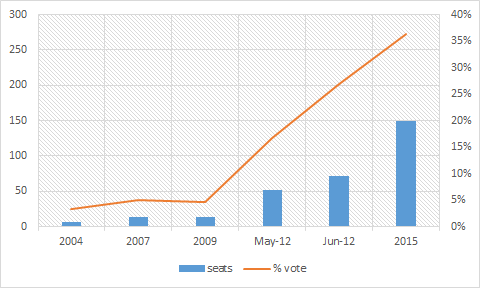
250 seats will be distributed on the basis of proportional representation, with a threshold of 3% required for entry into the Greek parliament. 50 additional seats are awarded as a majority bonus to the party that wins the largest number of votes.
06 Jul 2015 Leave a comment
in applied price theory, applied welfare economics, budget deficits, business cycles, comparative institutional analysis, constitutional political economy, currency unions, economic growth, economic history, Euro crisis, fiscal policy, fisheries economics, global financial crisis (GFC), international economics, macroeconomics, Public Choice, rentseeking Tags: Euro sclerosis, Greece, insurance attacks, sovereign defaults, speculative attacks
The roots of Greece’s crisis are simple. Before Greece joined the Eurozone, investors treated it as a middle-income country with poor governance — which is to say, a credit risk.
After Greece joined the Eurozone, investors thought that Greece was no longer a credit risk — they figured, if push came to shove, other Eurozone members like Germany would bail Greece out. They were wrong.

Michael Dooley put forward a theory of speculative attacks on currencies as insurance attacks on currencies for emerging markets after the East Asian financial crisis:
First generation models of speculative attacks show that apparently random speculative attacks on policy regimes can be fully consistent with rational and well-informed speculative behaviour.
Unfortunately, models driven by a conflict between exchange rate policy and other macroeconomic objectives do not seem consistent with important empirical regularities surrounding recent crises in emerging markets. This has generated considerable interest in models that associate crises with self-fulfilling shifts in private expectations.
In this paper we develop a first generation model based on an alternative policy conflict. Credit constrained governments accumulate reserve assets in order to self-insure against shocks to national consumption. Governments also insure poorly regulated domestic financial markets.
Given this policy regime, a variety of internal and external shocks generate capital inflows to emerging markets followed by successful and anticipated speculative attacks.
We argue that a common external shock generated capital inflows to emerging markets in Asia and Latin America after 1989. Country specific factors determined the timing of speculative attacks. Lending policies of industrial country governments and international organizations account for contagion, that is, a bunching of attacks over time.
His model was not within the context of a currency union but his basic theory is correct.
There are speculative attacks on a currency or a bank run after foreign markets revises their estimates of the available central bank reserves and international lines of credit to bail out the banking systems and/or foreign debt.
Michael Dooley was dealing with the emerging economies of Southeast Asia and their official lines of credit that insure their foreign exchange liabilities and domestic banking system. Greece is about lines of credit for similar purposes to other European union member states.
via 12 charts and maps that explain the Greek crisis – Vox and The Most Important Graphs of 2011 – The Atlantic.
06 Jul 2015 Leave a comment
in budget deficits, business cycles, currency unions, economic growth, Euro crisis, financial economics, fiscal policy, global financial crisis (GFC), macroeconomics Tags: bank runs, banking panics, Eurosclerosis, Germany, Greece, sovereign defaults
Greece is a tiny part of the European economies so it doesn’t matter that much to the rest of the European Union what happens to Greece. The only people will notice the sovereign default of Greece once the breathless journalism has died down are Greeks themselves as they rebuild their banking and monetary system against a background of a government run by coffee shop Marxists.

06 Jul 2015 3 Comments
in budget deficits, business cycles, currency unions, economic growth, Euro crisis, fiscal policy, labour economics, labour supply, macroeconomics, unemployment Tags: Eurosclerosis, Greece
The extreme economic outlier that is Greece, in 7 charts: 53eig.ht/1GMgIFU http://t.co/gb3zkgUqqJ—
(@FiveThirtyEight) July 04, 2015
06 Jul 2015 Leave a comment
in economics of media and culture Tags: Greece, Monty Python
05 Jul 2015 Leave a comment
in applied price theory, applied welfare economics, comparative institutional analysis, constitutional political economy, development economics, economics of crime, economics of regulation, growth disasters, industrial organisation, law and economics, property rights Tags: capitalism and freedom, Greece, rule of law, Russia
Figure 1: Index of Economic Freedom rankings for legal systems and property rights, Greece, Russia and USA, 2012
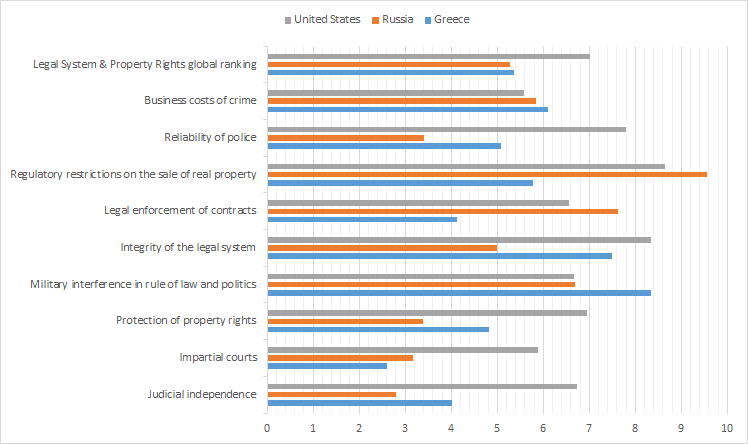
Source: Economic Freedom of the World – Annual Report 2014 | www.freetheworld.com.
Overall, there are not that many differences between Greece and Russia in the quality of their legal systems and property rights. Don’t go to the police in Russia and good luck trying to enforce contracts in Greece.
03 Jul 2015 Leave a comment
in applied price theory, applied welfare economics, currency unions, economic growth, economics of bureaucracy, economics of regulation, Euro crisis, health and safety, income redistribution, industrial organisation, labour economics, law and economics, minimum wage, occupational regulation, property rights, Public Choice, rentseeking, survivor principle, unions, welfare reform Tags: cost of doing business, Eurosclerosis, Greece, Italy, PIGS, Portugal, Spain
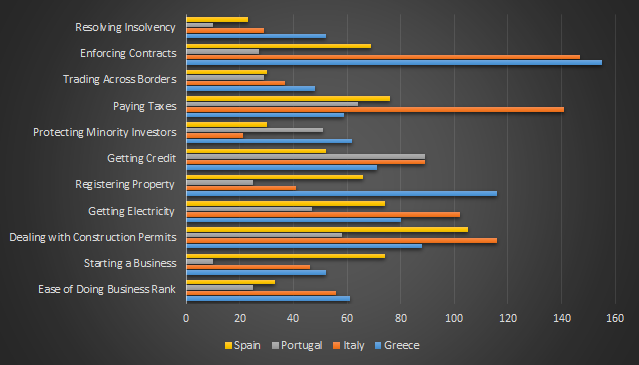
Figure 1: Doing Business rankings, PIGS, 2014
Source: World Bank Doing Business 2015.
All in all, Italy and Greece are a dog of a place to enforce a contract. The long-suffering taxpayer is better off paying taxes in Greece than in Italy! Not surprisingly, trading across borders is the greatest strength in doing business in the PIGS. The European Union does have some benefits.
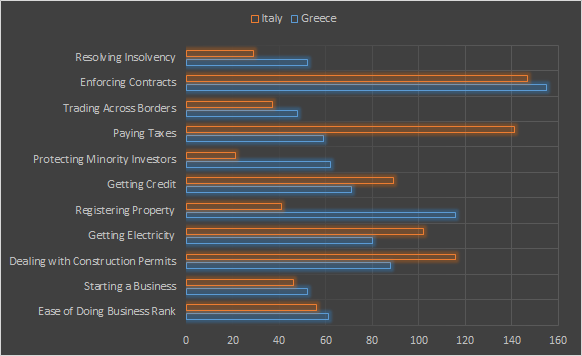
Figure 2: Doing Business rankings, Greece and Italy, 2014
Source: World Bank Doing Business 2015.
All in all, Italy and Greece are equally bad places to do business and Italy is much worse when it comes to taxes. About the only saving graces of Italy is the registration of property and the protection of minority interests in companies.
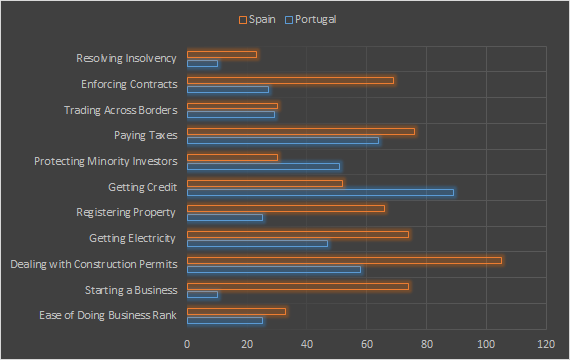
Figure 3: Doing Business rankings, Spain and Portugal, 2014
Source: World Bank Doing Business 2015.
Spain and in particular Portugal are much better places to do business than Italy and Greece.
30 Jun 2015 Leave a comment
in currency unions, Euro crisis, fiscal policy Tags: Euroland, Greece, sovereign defaults
29 Jun 2015 Leave a comment
in business cycles, currency unions, economic growth, Euro crisis, fiscal policy, global financial crisis (GFC), international economic law, international economics, macroeconomics Tags: game theory, Greece, Patrick Kehoe, sovereign default
29 Jun 2015 Leave a comment
in economics of bureaucracy, economics of crime, economics of regulation, industrial organisation, labour economics, law and economics, property rights, Public Choice, rentseeking Tags: cost of doing business, Euroland, Greece, Russia, sovereign defaults, transitional economies, World Bank
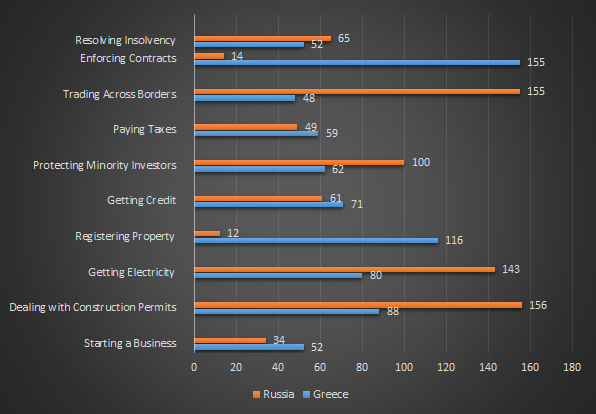
Figure 1: Greek and Russian Doing Business sub-rankings, 2015
Source: World Bank Doing Business 2015.
As long as you’re not in a construction or export business, and don’t mind waiting for your electricity, it’s better to do business in Russia than in Greece! The main difference between Russia and Greece is its membership of the European Union makes it easy to export?
In Russia, it’s easier to start a business, register property and enforce contracts than it is in Greece!
28 Jun 2015 Leave a comment
in currency unions, Euro crisis Tags: bank panics, bank runs, Greece, sovereign defaults
ATM line inside the Greek Parliament –> Περισσότεροι βουλευτές στο ΑΤΜ παρά στη συνεδρίαση protothema.gr/politics/artic… http://t.co/JeusE2pgUu—
Fabrizio Goria (@FGoria) June 27, 2015
Celebrating humanity's flourishing through the spread of capitalism and the rule of law
Scholarly commentary on law, economics, and more
Beatrice Cherrier's blog
Celebrating humanity's flourishing through the spread of capitalism and the rule of law
Celebrating humanity's flourishing through the spread of capitalism and the rule of law
Celebrating humanity's flourishing through the spread of capitalism and the rule of law
Why Evolution is True is a blog written by Jerry Coyne, centered on evolution and biology but also dealing with diverse topics like politics, culture, and cats.
Celebrating humanity's flourishing through the spread of capitalism and the rule of law
Celebrating humanity's flourishing through the spread of capitalism and the rule of law
A rural perspective with a blue tint by Ele Ludemann
DPF's Kiwiblog - Fomenting Happy Mischief since 2003
Celebrating humanity's flourishing through the spread of capitalism and the rule of law
The world's most viewed site on global warming and climate change
Tim Harding's writings on rationality, informal logic and skepticism
A window into Doc Freiberger's library
Let's examine hard decisions!
Commentary on monetary policy in the spirit of R. G. Hawtrey
Thoughts on public policy and the media
Celebrating humanity's flourishing through the spread of capitalism and the rule of law
Politics and the economy
A blog (primarily) on Canadian and Commonwealth political history and institutions
Reading between the lines, and underneath the hype.
Economics, and such stuff as dreams are made on
"The British constitution has always been puzzling, and always will be." --Queen Elizabeth II
Celebrating humanity's flourishing through the spread of capitalism and the rule of law
Celebrating humanity's flourishing through the spread of capitalism and the rule of law
WORLD WAR II, MUSIC, HISTORY, HOLOCAUST
Undisciplined scholar, recovering academic
Celebrating humanity's flourishing through the spread of capitalism and the rule of law
Res ipsa loquitur - The thing itself speaks
Celebrating humanity's flourishing through the spread of capitalism and the rule of law
Researching the House of Commons, 1832-1868
Articles and research from the History of Parliament Trust
Reflections on books and art
Posts on the History of Law, Crime, and Justice
Celebrating humanity's flourishing through the spread of capitalism and the rule of law
Exploring the Monarchs of Europe
Cutting edge science you can dice with
Small Steps Toward A Much Better World
“We do not believe any group of men adequate enough or wise enough to operate without scrutiny or without criticism. We know that the only way to avoid error is to detect it, that the only way to detect it is to be free to inquire. We know that in secrecy error undetected will flourish and subvert”. - J Robert Oppenheimer.
The truth about the great wind power fraud - we're not here to debate the wind industry, we're here to destroy it.
Celebrating humanity's flourishing through the spread of capitalism and the rule of law
Celebrating humanity's flourishing through the spread of capitalism and the rule of law
Economics, public policy, monetary policy, financial regulation, with a New Zealand perspective
Celebrating humanity's flourishing through the spread of capitalism and the rule of law
Restraining Government in America and Around the World

 Utopia, you are standing in it!
Recent Comments