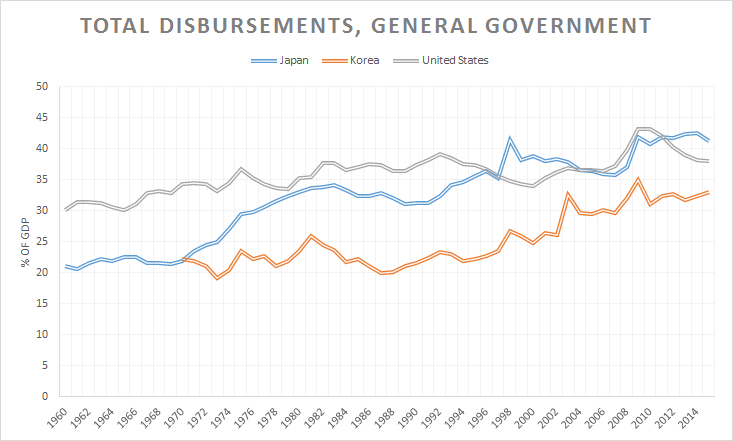
Data extracted on 23 Feb 2016 07:45 UTC (GMT) from OECD.Stats.
Celebrating humanity's flourishing through the spread of capitalism and the rule of law
02 Mar 2016 Leave a comment
in development economics, economic history, growth miracles, Public Choice, public economics Tags: growth of government, Japan, size of government, South Korea
24 Feb 2016 Leave a comment
in development economics, economic history, entrepreneurship, financial economics, growth miracles, industrial organisation, rentseeking, survivor principle Tags: billionaires, China, entrepreneurial alertness, Hong Kong, Japan, superstar wages, superstars, Taiwan
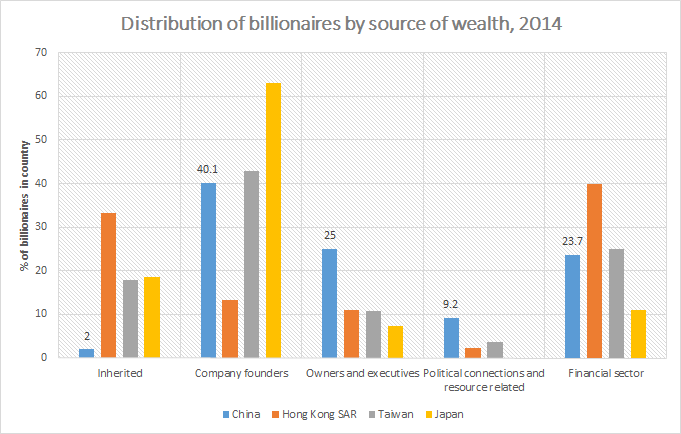
Surprisingly few billionaires in any of the 4 countries obtained their wealth through political connections. Founding a company seems to be still the path of great wealth even in Japan these days. Hong Kong is a financial centre so the large number of billionaires in its financial sector is no surprise.
20 Feb 2016 Leave a comment
in applied welfare economics, economics of regulation, fiscal policy, labour economics, politics - Australia, politics - New Zealand, politics - USA, welfare reform Tags: British economy, Canada, Denmark, Finland, France, Germany, Italy, Japan, Norway, social insurance, Sweden, welfare state
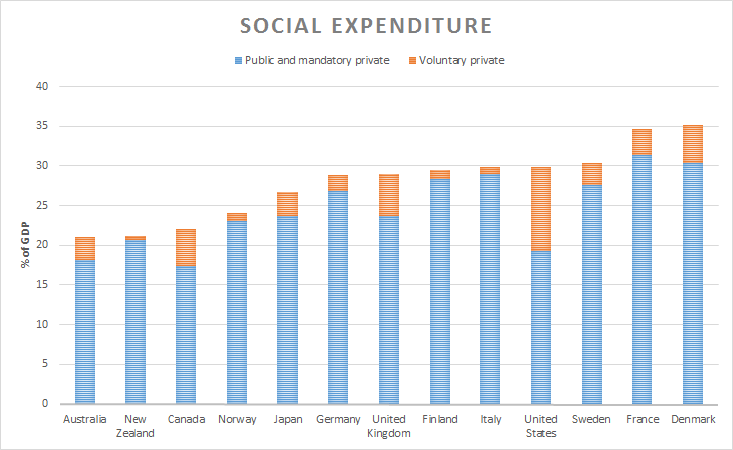
Mandatory and voluntary private social expenditure makes a big difference to the degree of social insurance in some countries but not others. The calculation of these numbers in purchasing power parity would be much more interesting.
Source: OECD Income Distribution database.
20 Feb 2016 Leave a comment
in fiscal policy, income redistribution, labour economics, politics - Australia, politics - New Zealand, politics - USA, Public Choice, welfare reform Tags: British economy, Denmark, Finland, France, Germany, Italy, Japan, Norway, social insurance, Sweden, welfare state
Some welfare states are much more targeted. Australia has the most targeted welfare state in terms of public social benefits paid in cash to the bottom quintile (Q1) of income earners.

Source: OECD Income Distribution database.
06 Feb 2016 Leave a comment
in defence economics, economics of education, liberalism, Marxist economics Tags: China, dissent, Japan, tinpot dictatorships, totalitarian dictatorships
At graduate school in Japan, I was careful to rarely talk politics to Chinese students.
The reason was I assumed they were being spied on by fellow students at the behest of the Chinese security services.
02 Feb 2016 1 Comment
in economic history, politics - Australia, politics - New Zealand, politics - USA, Public Choice, rentseeking Tags: agricultural subsidies, Australia, Canada, cultural economics, Japan
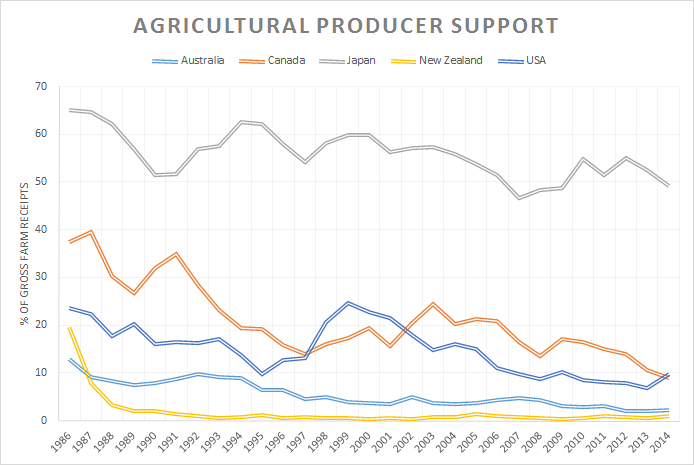
Source: Agricultural policy – Agricultural support – OECD Data.
Agricultural support is defined as the annual monetary value of gross transfers to agriculture from consumers and taxpayers arising from government policies that support agriculture, regardless of their objectives and economic impacts.
02 Feb 2016 Leave a comment
in development economics, economic history, growth miracles Tags: East Asian Tigers, Japan
01 Feb 2016 Leave a comment
in politics - Australia, politics - New Zealand, politics - USA, public economics Tags: Australia, Canada, Denmark, France, Germany, Italy, Japan, Social Security taxes, taxation and labour supply, the dish economy
31 Jan 2016 Leave a comment
in politics - Australia, politics - New Zealand, politics - USA, public economics Tags: Australia, British economy, Canada, Denmark, France, Germany, Italy, Japan, New Zealand, social insurance, Social Security taxes, taxation and labour supply
Ordinary French, Germans, Italians and Danish pay much higher marginal tax rates and that is before their high rates of GST.
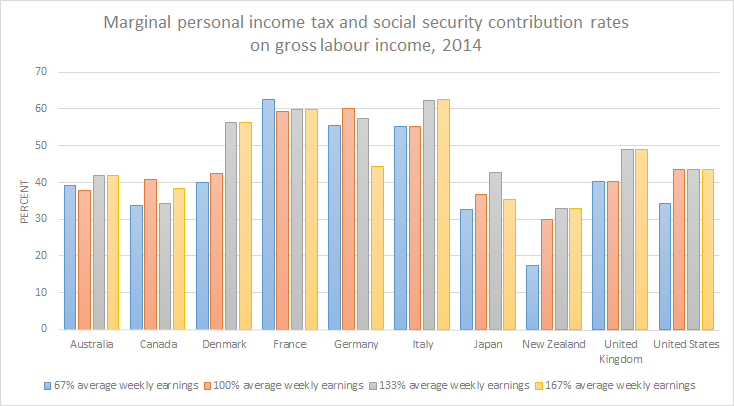
Data extracted on 30 Jan 2016 03:08 UTC (GMT) from OECD.Stat.
09 Jan 2016 Leave a comment
in economics of media and culture, transport economics Tags: Japan
…ridership at the Kami-Shirataki station had dramatically fallen because of its remote location, and freight service had ended there as well.Japan Railways was getting ready to shut the station down for good—until they noticed that it was still being used every day by the high-schooler. So they decided to keep the station open for her until she graduates.
The company’s even adjusted the train’s timetable according to the girl’s schedule. The unnamed girl is expected to graduate this March, which is when the station will finally be closed.
Source: Japan Keeps The Defunct Kami-Shirataki Train Station Open for Just One High-School Girl – CityLab
31 Dec 2015 Leave a comment
in economic history, population economics Tags: Japan
08 Nov 2015 1 Comment
in health economics Tags: Denmark, economics of obesity, Finland, Japan, Norway, Scandinavia, Sweden
05 Nov 2015 1 Comment
in development economics, economic history, growth miracles Tags: East Asian Tigers, Hong Kong, Japan, Singapore, South Korea, Taiwan
Japan has gone first to be last having been just overtaken in the last year or two by South Korea on a per capita real GDP basis, PPP. The Lost Decade certainly has taken its toll on Japanese relative prosperity. Singapore overtook Japan in the 1970s – a testament to the Singapore miracle. Hong Kong too overtook Japan on a purchasing power basis in the mid-1990s followed not long after by Taiwan. Singapore is seriously rich.
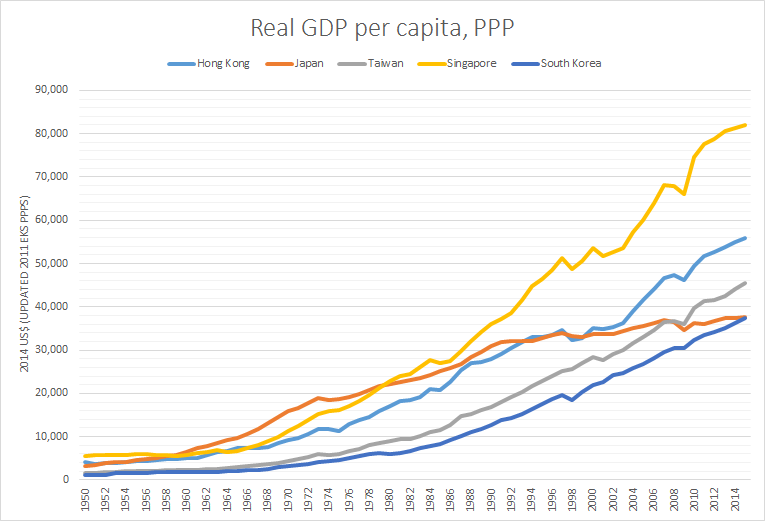
Source: The Conference Board. 2015. The Conference Board Total Economy Database™, May 2015, http://www.conference-board.org/data/economydatabase/
23 Oct 2015 Leave a comment
in discrimination, economic history, gender, human capital, labour economics, labour supply, occupational choice Tags: compensating differentials, gender wage gap, Japan
The unadjusted gender pay gap is still large in Japan but is declining slowly.

Celebrating humanity's flourishing through the spread of capitalism and the rule of law
Scholarly commentary on law, economics, and more
Beatrice Cherrier's blog
Celebrating humanity's flourishing through the spread of capitalism and the rule of law
Celebrating humanity's flourishing through the spread of capitalism and the rule of law
Celebrating humanity's flourishing through the spread of capitalism and the rule of law
Why Evolution is True is a blog written by Jerry Coyne, centered on evolution and biology but also dealing with diverse topics like politics, culture, and cats.
Celebrating humanity's flourishing through the spread of capitalism and the rule of law
Celebrating humanity's flourishing through the spread of capitalism and the rule of law
A rural perspective with a blue tint by Ele Ludemann
DPF's Kiwiblog - Fomenting Happy Mischief since 2003
Celebrating humanity's flourishing through the spread of capitalism and the rule of law
The world's most viewed site on global warming and climate change
Tim Harding's writings on rationality, informal logic and skepticism
A window into Doc Freiberger's library
Let's examine hard decisions!
Commentary on monetary policy in the spirit of R. G. Hawtrey
Thoughts on public policy and the media
Celebrating humanity's flourishing through the spread of capitalism and the rule of law
Politics and the economy
A blog (primarily) on Canadian and Commonwealth political history and institutions
Reading between the lines, and underneath the hype.
Economics, and such stuff as dreams are made on
"The British constitution has always been puzzling, and always will be." --Queen Elizabeth II
Celebrating humanity's flourishing through the spread of capitalism and the rule of law
Celebrating humanity's flourishing through the spread of capitalism and the rule of law
WORLD WAR II, MUSIC, HISTORY, HOLOCAUST
Undisciplined scholar, recovering academic
Celebrating humanity's flourishing through the spread of capitalism and the rule of law
Res ipsa loquitur - The thing itself speaks
Celebrating humanity's flourishing through the spread of capitalism and the rule of law
Researching the House of Commons, 1832-1868
Articles and research from the History of Parliament Trust
Reflections on books and art
Posts on the History of Law, Crime, and Justice
Celebrating humanity's flourishing through the spread of capitalism and the rule of law
Exploring the Monarchs of Europe
Cutting edge science you can dice with
Small Steps Toward A Much Better World
“We do not believe any group of men adequate enough or wise enough to operate without scrutiny or without criticism. We know that the only way to avoid error is to detect it, that the only way to detect it is to be free to inquire. We know that in secrecy error undetected will flourish and subvert”. - J Robert Oppenheimer.
The truth about the great wind power fraud - we're not here to debate the wind industry, we're here to destroy it.
Celebrating humanity's flourishing through the spread of capitalism and the rule of law
Celebrating humanity's flourishing through the spread of capitalism and the rule of law
Economics, public policy, monetary policy, financial regulation, with a New Zealand perspective
Celebrating humanity's flourishing through the spread of capitalism and the rule of law
Restraining Government in America and Around the World
 Utopia, you are standing in it!
Recent Comments