Los Angeles city and regional planners are just as responsible for the Palisades, Eaton, and other fires that have burned in the past few days as if they had poured gasoline on the homes and lit the matches. The destruction of these homes, including, for what it is worth, homes … Continue reading →
Smart Growth Burns Thousands of Homes
Smart Growth Burns Thousands of Homes
11 Jan 2025 1 Comment
in economics of bureaucracy, economics of natural disasters, economics of regulation, environmental economics, law and economics, property rights, Public Choice, urban economics Tags: land use planning, unintended consequences, zoning
.@PhilTwyford @JulieAnneGenter finest hour on housing affordability
10 Sep 2017 Leave a comment
in economics of regulation, politics - New Zealand, urban economics Tags: housing affordability, land use planning, zoning
The key role of housing costs in disaster recovery @ericcrampton @JordNZ #nzeq
16 Nov 2016 Leave a comment
in applied price theory, economic history, economics of natural disasters, economics of regulation, politics - New Zealand, politics - USA, urban economics Tags: land supply, land use planning, NYMBYs, RMA, zoning
The evidence abroad after earthquakes, hurricanes, flooding, tornados, and wartime bombing is that for growing cities, disasters, including carpet bombing and atomic bombs, are only temporary set-backs with few long-run economic and population consequences. A few years after a disaster, these cities even recover the industries they had before their calamities.
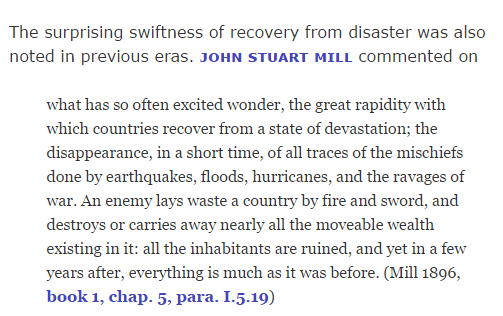
For growing cites, the loss of housing and other destruction does not affect the underlying demand from workers and businesses to be at the location. Florida has prospered despite over twenty hurricanes striking since 1988 and five of the six most damaging Atlantic hurricanes of all time striking since 1988.
Cities that are already in decline drop down onto an even faster downward population and economic trend after a major natural disaster. A large scale destruction of housing takes away the one compensating feature of these declining cities, which was cheap housing.
Housing prices in declining cities are usually well below construction costs. Low living costs partly offset the relative lack of local economic opportunity in these cities. New Orleans is an example of a declining city that did not recover fully from a disaster for this reason.
After Hurricane Katrina, New Orleans had much higher costs of housing because of flood damage but there were limited local economic opportunities to attract back old and new residents. About 20 per cent of the Katrina evacuees did not return.
Natural disasters be they earthquakes or hurricanes turn declining cities and towns from a dump with cheap housing to a dump with expensive housing. They can be a killer blow.
The main policy enabler of growing cities in the USA has been the avoidance of land use regulations that raise housing costs. Over the past 20 years, the fastest growing U.S. regions have not been those with the highest income or most attractive climates.
Flexible housing supply is the key determinant of regional growth. Land use regulations drive housing supply and determine which regions are growing. A regional approach to enabling increases in land and housing supply might reduce the tendency of many localities to block new construction.
Meet San Francisco’s YIMBYs @PhilTwyford @dbseymour
29 Jun 2016 Leave a comment
in economics, economics of regulation, law and economics, urban economics Tags: land supply, land use planning, NIMBYs, zoning
And the beat goes on – housing prices since 1975 @PeterDunneMP @PhilTwyford
24 Apr 2016 Leave a comment
in applied welfare economics, politics - New Zealand, Public Choice, rentseeking, urban economics Tags: Auckland, housing affordability, land supply, land use planning, NIMBYs, Resource Management Act, urban limits, zoning
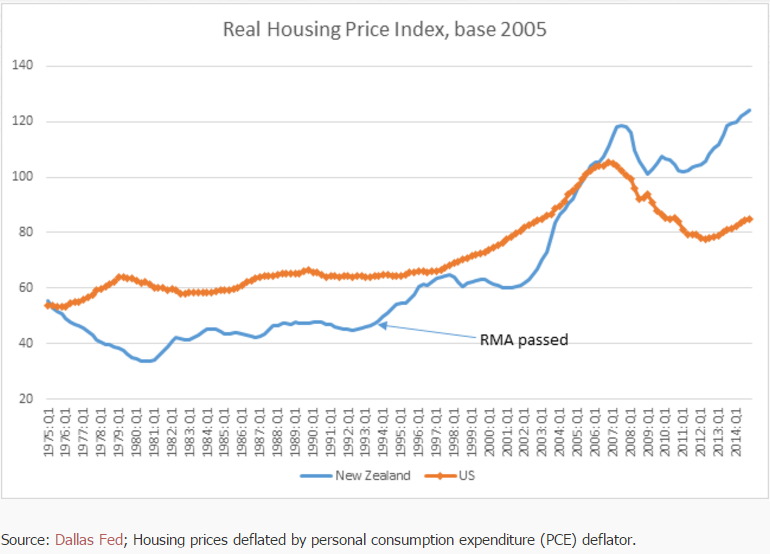
New Zealand housing prices were pretty flat up for the two decades until the passage of the Resource Management Act (RMA) in 1993. They then soared well before any foreign buyers such as from China entered the market.
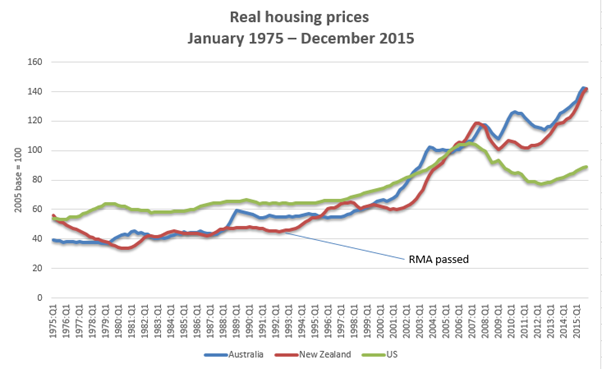
Source: International House Price Database – Dallas Fed December 2015; nominal housing prices for each country is deflated by the personal consumption deflator for that country.
Most of the housing price rises were under the watch of a Labour Government – a party which is supposed to look out for working families.
The failure of the Labour Party to nip the problem in the bud when they had a working majority in Parliament means future solutions run into the political problem that any significant increase in supply of land may push many with recent mortgages such as in Auckland into negative equity.
Since they left office in 2008, leaving land supply regulation in a mess, the approach of Labour has been political opportunism rather than supporting RMA reform.
Labour recently admitted the need to increase the supply of land, but have not put forward practical ideas to increase the supply of land.
The National Party is not much better in terms of real solutions to regulatory constraints on the supply of land.
Las Vegas population since 1900
18 Mar 2016 Leave a comment
in economic history, economics of regulation, population economics, urban economics Tags: land supply, land use planning, Las Vegas, zoning
The Las Vegas population doubled in the 60s doubled again between 1970 and 1990 and almost doubled again by 2000.
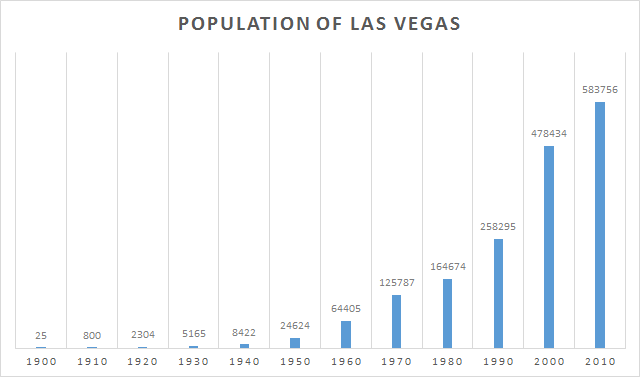
Source: Insiderviewpoint.com Las Vegas Population.
Between 1990 and 2000 despite the doubling of population, housing prices only increased by 25%.
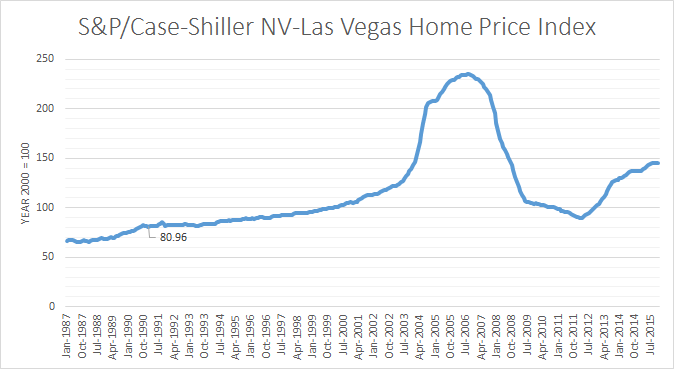
Source: Insiderviewpoint.com S&P/Case-Shiller Las Vegas Home Price Index – S&P Dow Jones Indices.
Land supply must be pretty easy in Las Vegas at least up until 2000.
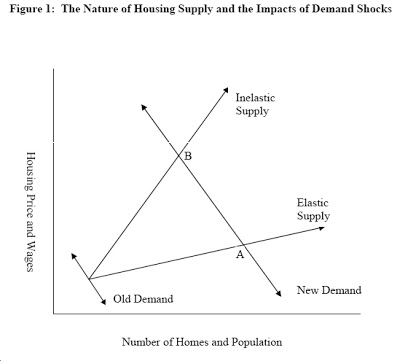
Source: Economics of Contempt: Land Use Regulations and the Housing Bubble.
Jason Furman on residential housing supply, NIMBYism, and economic growth
05 Jan 2016 Leave a comment
in economics of regulation, environmental economics, politics - New Zealand, politics - USA, Public Choice, rentseeking, urban economics Tags: housing affordability, land use planning, RMA, zoning
German, French and Italian real housing prices since 1975
19 Oct 2015 Leave a comment
in applied price theory, applied welfare economics, economic history, economics of regulation, rentseeking, urban economics Tags: France, Germany, housing affordability, housing prices, Italy, land supply, land use planning, zoning
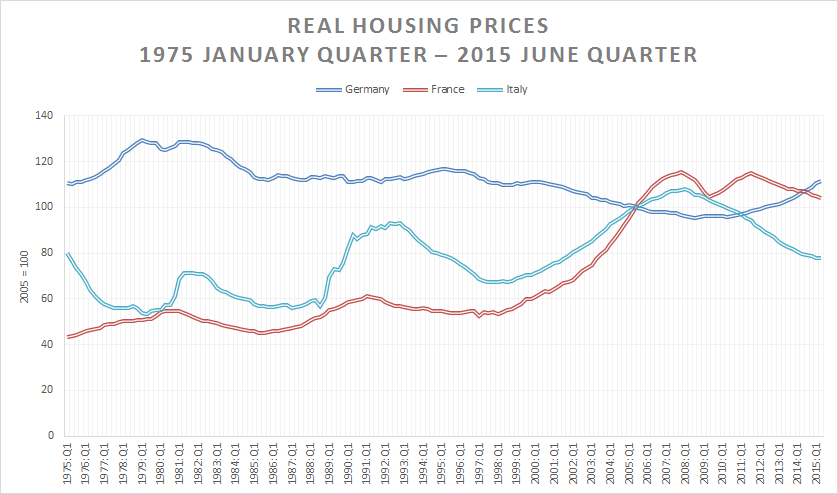
Source and notes: International House Price Database – Dallas Fed June 2015; nominal housing prices for each country is deflated by the personal consumption deflator for that country.
British and Irish real housing prices since 1975
18 Oct 2015 Leave a comment
in applied price theory, applied welfare economics, economic history, economics of regulation, urban economics Tags: British politics, housing prices, Ireland, land supply, land use planning, zoning
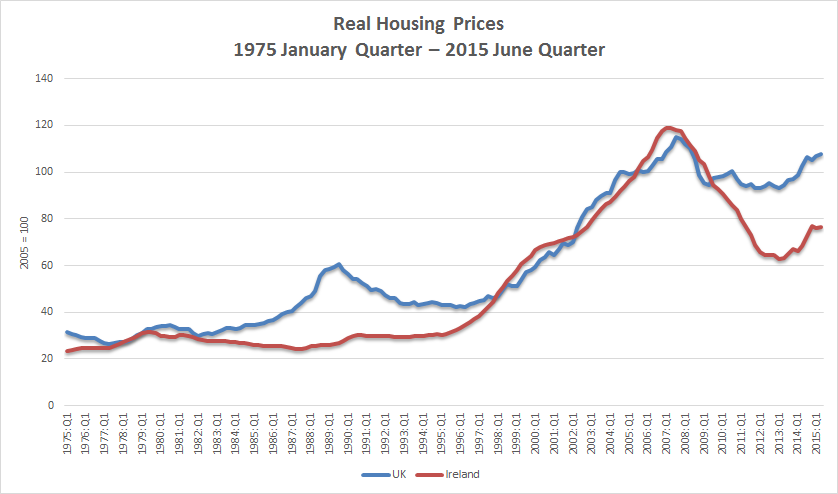
Source and notes: International House Price Database – Dallas Fed June 2015; nominal housing prices for each country is deflated by the personal consumption deflator for that country.
@nzlabour @metiria It’s impossible to build affordable housing
17 Oct 2015 2 Comments
in applied price theory, economics of regulation, politics - New Zealand, Public Choice, rentseeking, urban economics Tags: land supply, land use planning, New Zealand Greens, New Zealand Labour, RMA, zoning
The Labour Party and the Greens both plan to build 100,000 affordable houses as a way of offsetting soaring housing prices in Auckland and other New Zealand cities. These plans were announced in the 2014 Election in New Zealand.
A trite but insurmountable objection to the proposal to build 100,000 affordable houses is there are no plans to increase the supply of land. That would require RMA reform which both Labour and the Greens oppose. They oppose RMA reform partly for ideological reasons and partly to cultivate middle-class home owner votes.
Unless there is an increase in the supply of land in Auckland and the other New Zealand cities, the government under the plans of the Labour Party and the Greens are building houses the private sector would have built anyway but for the government bought from the same new supply of land released every year by local councils.
The proposals of Labour and the Green to build affordable houses simply changes the identity of who builds the same number of new houses in New Zealand. There is no net increase in this supply of houses so there will not be any improvement in housing affordability.
If the supply of land were to be increased through RMA reforms, there be no need to for the government to build the houses. This is because the market will take care of building the houses on the additional land released by local councils if there is a demand for them and they’re obviously is.
Attempts by a Labour and Green Government to build affordable houses is no more than displace the efforts of private developers to supply houses but in configurations more closely aligned with market demand in terms of the quality and size of the house.
Another insurmountable but still minor objection to supplying 100,000 affordable houses is Friedman’s second law of economics: you can’t give anything away for free because people will queue up for access.
If the government is selling cheap houses to ordinary families, people change that circumstances to make themselves more eligible for the house, which presumably will be targeted by income. Easiest way to do that is to fund a low income family member such as a student to buy the house and sell it to you. Alternatively, you could make an advanced of them against their inheritances as a way of them buying a house.
The classic New Zealand example of the inability to give anything away for free was the introduction of school zoning. People now pay hundreds of thousands of dollars more for a house if it is in a favourable school zone.
A more serious objection that can never be overcome is as soon as the lucky ordinary family buys the affordable house, they will renovate it to the proper standing reflecting the underlying value of the land. Affordable houses under the plans of the New Zealand Labour Party and the Greens is to build a cheap house on expensive land in Auckland. Land in Auckland is 60% of the price of a house. Land use to be 40% of the value of the house in Auckland.

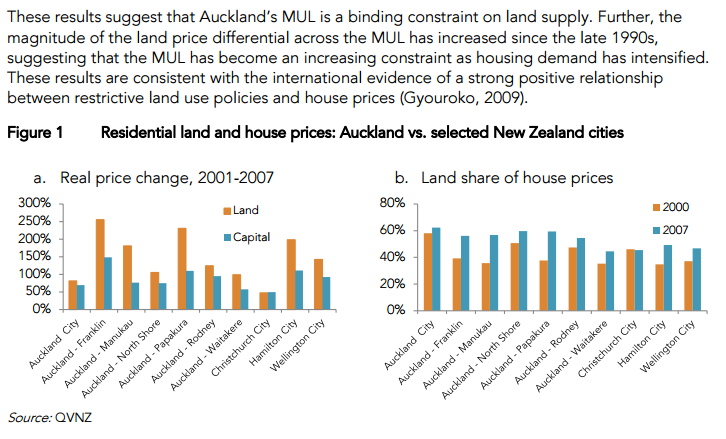
Source: New Zealand Productivity Commission (2013).
Plenty of people are in the game of home renovation; some do it as a full-time occupation. They buy an old rundown house on good land and a good location and renovate the house to match the value of the underlying land and location.
The possibility of subsequent renovation to the cheap house on the good land is the death knell of any attempt to sell affordable housing in Auckland or the other New Zealand cities where house prices are spiralling upwards because of restrictions on the supply of land.
Building 100,000 affordable houses were simply present 100,000 renovation opportunities to entrepreneurs. The families who are lucky enough to be first to buy the affordable house will get a marvellous windfall. There will be no long-term impact on the price of land in Auckland because you can’t give anything away for free. Any undervalued good as quickly resold at a profit by budding entrepreneurs after renovating the house to bring it up to market standard given the value of the underlying land.
If the Labour Party and the Greens want more affordable housing, they must support RMA reforms that will increase the supply of land. They won’t do out of sheer political expediency. Labour and the Greens want to win the votes of disgruntled National party voters who already own homes.
Increase in the Cost of Housing in the US 1901-2002
12 Oct 2015 Leave a comment
in economic history, politics - USA, urban economics Tags: housing affordability, housing prices, land prices, land supply, land use planning, zoning
Increase in the Cost of Housing in the US 1901-2002 bit.ly/195NbKb http://t.co/kt7pmOFPVi—
Catherine Mulbrandon (@VisualEcon) August 25, 2014
Will Auckland become like San Francisco?
10 Oct 2015 1 Comment
in economic history, economics of regulation, environmental economics, politics - New Zealand, politics - USA, urban economics Tags: Auckland, housing affordability, land supply, land use planning, RMA, San Francisco, zoning
https://twitter.com/JoshZumbrun/status/652517712070082561/photo/1
"Your neighborhood could be next." San Francisco-wide mailer in support of Prop I, the Mission housing moratorium. http://t.co/PtN38JTaUM—
Jed Kolko (@JedKolko) October 10, 2015
@sival84 @MarketUrbanism @SFyimby More for thought: Permits vs prices for top ten tech hubs trulia.com/blog/trends/pr… http://t.co/yRvjVWDova—
Ralph B. McLaughlin (@housingnomix) October 01, 2015
Generation Rent comes to Scandinavia in lockstep – real housing prices in #Finland, #Sweden & #Norway since 1975
17 Sep 2015 Leave a comment
in economic history, urban economics Tags: Finland, Generation Rent, housing affordability, housing prices, land supply, land use planning, NIMBYs, Norway, Sweden, zoning
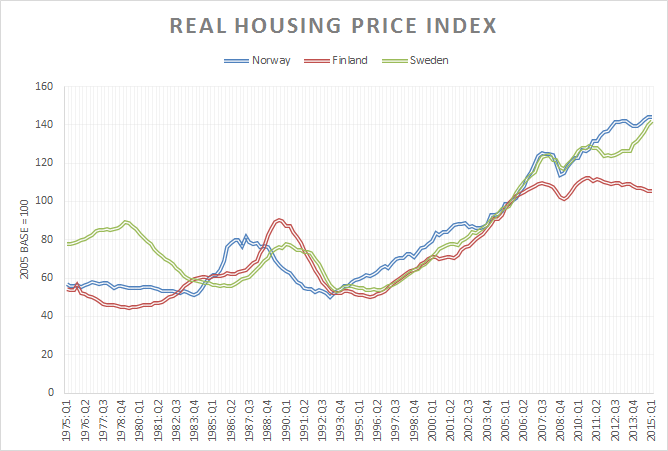
Source: International House Price Database – Dallas Fed
Note: The house price index series is an index constructed with nominal house price data. The real house price index is an index calculated by deflating the nominal house price series with a country’s personal consumption expenditure deflator.
No Generation Rent in #Nihon – real housing prices in #Japan and #SouthKorea since 1975
16 Sep 2015 Leave a comment
in development economics, economic history, growth miracles, urban economics Tags: Generation Rent, housing affordability, housing prices, Japan, land supply, land use planning, NIMBYs, South Korea, zoning
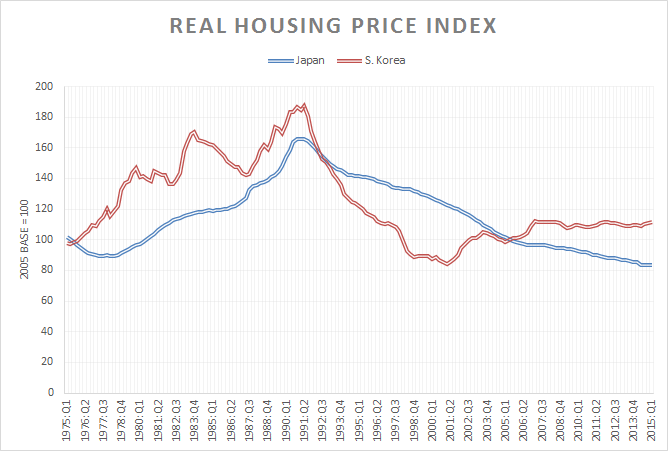
Source: International House Price Database – Dallas Fed
Note: The house price index series is an index constructed with nominal house price data. The real house price index is an index calculated by deflating the nominal house price series with a country’s personal consumption expenditure deflator.
Real housing prices in Australia and New Zealand since 1975
15 Sep 2015 Leave a comment
in politics - Australia, politics - New Zealand, urban economics Tags: Australia, housing affordability, housing prices, land supply, land use planning, NIMBYs, zoning
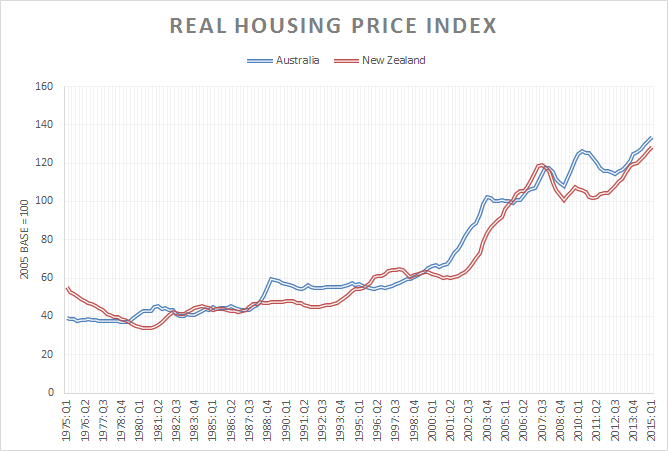
Source: International House Price Database – Dallas Fed
Note: The house price index series is an index constructed with nominal house price data. The real house price index is an index calculated by deflating the nominal house price series with a country’s personal consumption expenditure deflator
 Utopia, you are standing in it!
Recent Comments