% of Americans in Poverty since 1960s bit.ly/195NbKb http://t.co/F2E6qUfRVP—
Catherine Mulbrandon (@VisualEcon) October 28, 2014
Poverty in America since 1960
19 Nov 2015 Leave a comment
by Jim Rose in economic history, labour economics, labour supply, politics - USA, poverty and inequality, welfare reform Tags: child poverty, family poverty, social insurance, welfare reform, welfare state
Distribution of the male American, British and German number of working hours
15 Nov 2015 Leave a comment
by Jim Rose in labour economics, labour supply, occupational choice Tags: British economy, compensating differentials, Germany, health insurance, labour force participation, male labour force participation, Obamacare, part-time work, social insurance
Few men work part-time. Many that do are teenagers. Two-thirds of male workers in America, Britain and Germany work at least 40 hours a week and another quarter worked 35 to 40 hours a week except in the USA. A surprising number of Americans, 11%, worked 20 to 29 hours. If they work that 30th hour, the employer must provide them with health insurance under Obamacare.
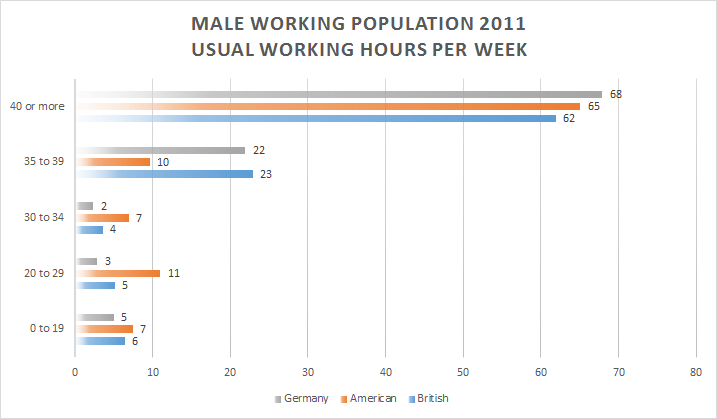
Source: OECD Family Database.
Rate this:
The minimum wage and poverty
14 Nov 2015 Leave a comment
by Jim Rose in labour economics, minimum wage, politics - Australia, politics - New Zealand, politics - USA, poverty and inequality Tags: child poverty, family poverty, family tax credits, in-work tax credits, social insurance, welfare state
Rate this:
Social Security income replacement rates across the OECD
13 Nov 2015 Leave a comment
by Jim Rose in labour economics, labour supply, politics - Australia, politics - New Zealand, politics - USA, poverty and inequality Tags: income insurance, poverty traps, social insurance, Social Security, welfare state
Rate this:
Some countries go to the doctor a lot more
13 Nov 2015 Leave a comment
by Jim Rose in health economics Tags: health insurance, social insurance
Rate this:
How in-work family tax credits help
06 Nov 2015 Leave a comment
by Jim Rose in applied price theory, labour economics, labour supply, public economics, welfare reforms Tags: family tax credits, female labour force participation, in-work tax credits, maternal labour supplier, social insurance, welfare state
Rate this:
@Greencatherine 1996 US welfare reforms and the employment of single mums who were high school dropouts
31 Oct 2015 Leave a comment
by Jim Rose in labour economics, labour supply, politics - USA, poverty and inequality, welfare reform Tags: 1996 US welfare reforms, paternal labour supply, single mothers, single parents, social insurance, welfare state
https://twitter.com/hamiltonproj/status/659776768094547968
There was a step increase in the employment rate of single parents and in particular high school dropouts straight after the implementation of the 1996 US federal welfare reforms.
These single mothers who dropped out of high school were thought to be least employable and most at risk to the 1996 US welfare reform. There was a large increase in their employment and this massive improvement in their rates of employment is enduring to this day.

Rate this:
@BernieSanders @HillaryClinton working 40 hour on #minimumwage doesn’t leave you in poverty in America
31 Oct 2015 Leave a comment
by Jim Rose in applied welfare economics, labour economics, labour supply, minimum wage, politics - USA, welfare reform Tags: 2016 presidential election, earned income tax credit, family tax credits, in-work tax credits, living wage, social insurance, welfare state
Rate this:
No country for gender equality – the Swedish gender pay gap at 10th, 50th and 90th percentile since 1980
22 Oct 2015 Leave a comment
by Jim Rose in discrimination, gender, labour economics Tags: compensating differentials, gender wage gap, maternity leave, social insurance, Sweden
Whatever else a generous welfare state, high taxes and lavish maternity leave may do, they haven’t made more than a scratch on the Swedish gender pay gap for 35 years at least.
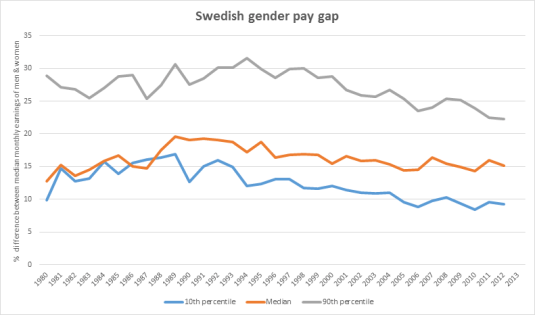
Source: OECD Employment Database.
Rate this:
Poverty traps in America
17 Oct 2015 Leave a comment
by Jim Rose in labour economics, labour supply, minimum wage, politics - USA, poverty and inequality Tags: offsetting behaviour, poverty traps, social insurance, Social Security, taxation and labour supply, The fatal conceit, unintended consequences, welfare state
Rate this:
Does socialised medicine reduce denial of service
13 Oct 2015 Leave a comment
by Jim Rose in applied price theory, economics of bureaucracy, health economics, politics - USA, Public Choice Tags: health insurance, social insurance, universal health insurance
Dear Bernie,
This is why we shouldn't have socialized medicine.
#tcot http://t.co/okrOYAlx9p—
Students of Liberty (@StudyingLiberty) October 01, 2015
Rate this:
Who does not have health insurance in the USA?
01 Oct 2015 Leave a comment
by Jim Rose in health economics, politics - USA Tags: economics of health insurance, health insurance, Obamacare, social insurance
Who are the 33 million Americans still don't have health insurance?
53eig.ht/1jpQpAu http://t.co/mldpCg0Aqs—
Ben Casselman (@bencasselman) September 28, 2015
2. Nearly 4mm poor Americans fall into "Medicaid gap" in states that didn't expand Medicaid.
53eig.ht/1jpQpAu http://t.co/AMx85ntF8v—
Ben Casselman (@bencasselman) September 28, 2015
But that still leaves more than 14 million uninsured who aren't easily explained.
53eig.ht/1jpQpAu http://t.co/h0MtAtpTZN—
Ben Casselman (@bencasselman) September 28, 2015
Rate this:
Life expectancy vs. health care spending
29 Sep 2015 Leave a comment
by Jim Rose in health economics Tags: health insurance, life expectancy, social insurance, welfare state
Life expectancy vs health care spending
Source: bit.ly/1DEUSWk http://t.co/cTxA0x9hHu—
Max Roser (@MaxCRoser) June 07, 2015
Rate this:
The Australian tax – transfer system after 30 years of heartless neoliberalism
25 Sep 2015 Leave a comment
by Jim Rose in economic history, income redistribution, politics - Australia, Public Choice, public economics Tags: Australia, incidence of taxation, social insurance, taxation and entrepreneurship, taxation and investment, taxation and labour supply, top 1%, top tax rates, welfare state
https://twitter.com/JohnDaley_/status/646505463710773248/photo/1
So the top 20% pay more of the income tax – but they earn a much bigger share of the income than elsewhere #afrtax http://t.co/9UL0FSZIuK—
John Daley (@JohnDaley_) September 23, 2015
Some facts on the level of Australian taxes (3): Australian taxes on income are not particularly high http://t.co/xFCNANIycu—
John Daley (@JohnDaley_) September 23, 2015
Some facts on the level of Australian taxes (2): The top rate of marginal tax is not particularly high http://t.co/TAbCKylQZv—
John Daley (@JohnDaley_) September 23, 2015
Rate this:
The Great Escape and old age pension duration
19 Sep 2015 Leave a comment
by Jim Rose in economic history, health economics, public economics Tags: ageing society, British economy, British history, demographic crisis, life expectancies, old age pensions, social insurance, The Great Escape
https://twitter.com/ONS/status/641644852925566976/photo/1
#Pensions now need to last approx 20yrs compared to 9yrs when they were first introduced ow.ly/RZx1M http://t.co/vCUPiqffzY—
(@ONS) September 09, 2015
Rate this:
Recent Comments