Progress and Incidence: The incidence of a capital-income tax
08 Oct 2019 Leave a comment
in applied price theory, income redistribution, labour economics, labour supply, Public Choice, public economics Tags: tax incidence
Who Really Pays Business Taxes?
06 May 2017 Leave a comment
in applied price theory, Milton Friedman, Public Choice, public economics Tags: tax incidence
Why is GST but not company tax incidence so easy to understand
28 Apr 2016 Leave a comment
in public economics Tags: company tax, rational irrationality, tax incidence, taxation and entrepreneurship, taxation and investment
 The tax incidence of sales taxes is understood by everybody but who pays company tax is stubbornly misunderstood. The seller is sending the tax cheque to the taxman does not fool anyone regarding who ultimately pays sales taxes.
Everyone expects that sales tax increases such as of the GST or VAT will be passed on to buyers but sometimes a little bit is absorbed in terms of lower profits by sellers if it is more than the market can bear.
When it comes to company taxes, this intuitive understanding of the economics of the incidence of taxes completely disappears. There is a strong belief that only investors pay the company tax in the form of dividends.
The notion that investors may reduce their investment and therefore the amount of capital with which workers can work is stoutly denied as is the implications for lower than otherwise wages because of this.
The possibility that the entire company tax may show up as lower wages when capital is internationally mobile is just not even contemplated. This is despite foreign direct investment being welcomed on the grounds that more capital means higher wages for local workers.

Likewise, when a factory is re-located offshore, it is understood that that will harm wages. That understanding does not carry through to company tax incidence when the factory relocates offshore because of low company taxes rather than import competition.
What 3 skills do public policy analysts need?
27 Apr 2016 Leave a comment
in applied price theory, business cycles, economics of bureaucracy, economics of regulation, fiscal policy, macroeconomics, monetary economics Tags: anti-market bias, antiforeign bias, expressive voting, lags on monetary policy, makework bias, rational rationality, tax incidence, The fatal conceit, The pretense to knowledge
I used to argue that the quality of public policy making would double if public policy analysts remembered the first 6 weeks of microeconomics 101 but on reflection more than that is required.
Could we economists today ever show such self-restraint about our own expert recommendations? https://t.co/2UE12JuIgn—
William Easterly (@bill_easterly) November 24, 2015
I picked up my initial insight out when working as a graduate economist in the Australian Department of Finance. That was a few years ago.
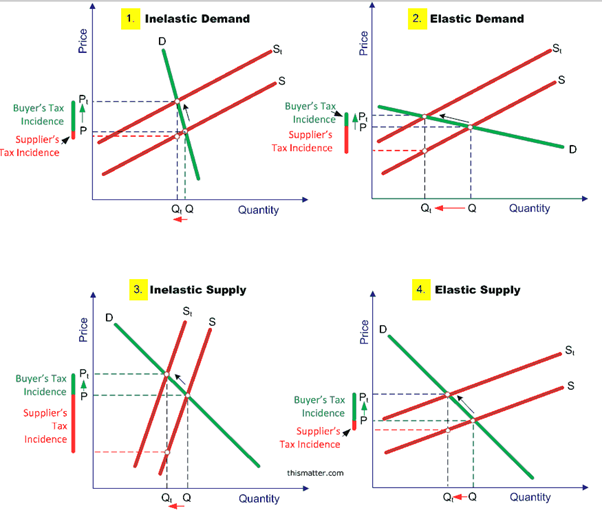
I am now concluded that policy analysts also need to know the basics of the economics of tax incidence. Who pays the tax depends on the elasticities of supply and demand rather than who writes the check to the taxman.
The number of times that I have read media and public policy analysis saying who pays the tax is the writer of the cheque to the taxman is beyond counting.
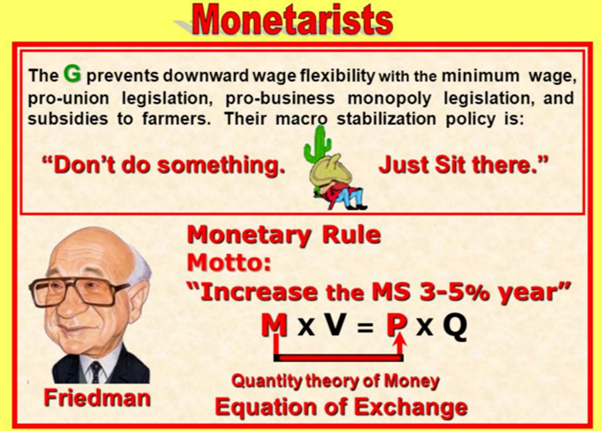
There is also what to do about unemployment and inflation. Do not just do something, sit there might be good advice on most occasions. As Tim Kehoe and Gonzalo Fernandez de Cordoba explain in the context of first do no harm:
Looking at the historical evidence, Kehoe and Prescott conclude that bad government policies are responsible for causing great depressions.
In particular, they hypothesize that, while different sorts of shocks can lead to ordinary business cycle downturns, overreaction by the government can prolong and deepen the downturn, turning it into a depression.

Who Pays the Tax?
18 Mar 2016 Leave a comment
in applied price theory, economics, public economics Tags: tax incidence
US income taxes are highly progressive
19 Jun 2015 Leave a comment
in politics - USA, public economics Tags: earned income tax credit, family tax credits, progressive income taxes, tax incidence, top 1%, welfare state
Average tax rates on consumption, investment, labour and capital in USA, UK and Canada, 1950-2013
17 Apr 2015 5 Comments
in business cycles, economic growth, economic history, fiscal policy, global financial crisis (GFC), great recession, macroeconomics, politics - USA, public economics Tags: British economy, Canada, sick man of Europe, tax incidence, tax reform
Income taxes in the USA and UK didn’t change all that much after the mid-70s. Prior to that, income tax rose quite steadily in the UK in the 1950s and 1960s and not surprisingly, Britain was the sick man of Europe in the 1970s. Income taxes rose quite steadily in Canada for most of the post-war period up until 1990 and then levelled out for most of that decade before a small tapered downwards.
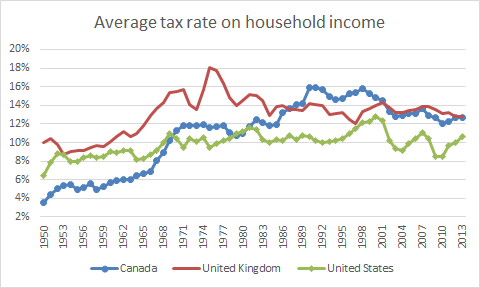
Source: Cara McDaniel.
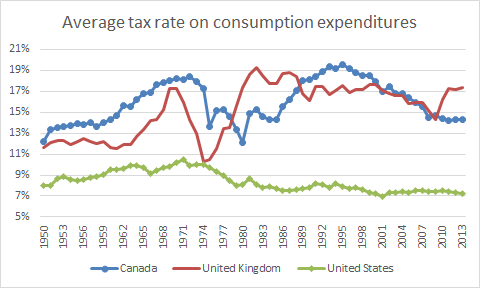
Taxes on consumption expenditure were very different stories across the Atlantic. There has been a tapering down in the average tax rate on American consumption expenditure since 1970 after modest increases before that. Canadian taxes on consumption expenditure rose steadily until the 1970s, then drop steadily in the 1970s and than rose in the 1980s and dropped again after 1992. British taxes on consumption expenditure rose sharply in the late 1960s, dropped sharply and then rose again in the 1970s and was pretty steady after that.
The sleeper tax in all three countries was payroll taxes to fund social security and the welfare state. These rose steadily in the USA, UK and Canada up until the 1990s.
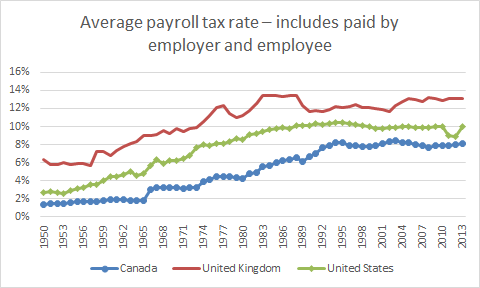
Source: Cara McDaniel.
Despite all that nonsense about neoliberalism from the Left over Left, the average rate of tax on capital income did not appear to change much at all over the last 50 years. There was a modest taper in US capital income taxation from the mid-30s to the mid-20s over the entire post-war period. The average Canadian tax rate on income from capital rose steadily in the 60s, fell steadily in the 70s before rising again in the mid-1980s and fell again after 2000. The average British tax rate on capital income rose steadily in the 60s and 70s, coinciding with the emergence of Britain as a sick man of Europe, and then stabilised in the the 1980s onwards but with a dip in the late 80s before a rise in the early 1990s.. Despite the large cuts in the statutory corporate tax rate in the UK, there was only a mild taper in the average tax rate on capital income in the UK.
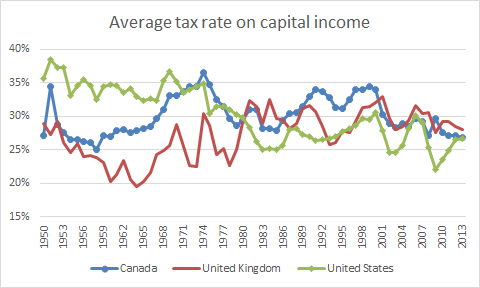
Source: Cara McDaniel.
The average tax rate on investment expenditures is pretty stable in the USA for the entire post-war period. The only significant increase in the average tax rate on investment expenditures in the UK coincided with the emergence of the sick man in Europe after a drop in the early 70s. The average tax rate on investment expenditures do not change at all in the UK after the 1970s. The Canadian average tax rate on investment expenditures is higher than elsewhere. It rose steadily in the 50s and 60s, dropped in the 70s and rose again in the 80s before tapering from 1992 onwards.
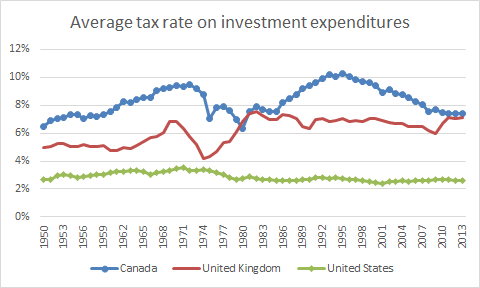
Source: Cara McDaniel.
These higher on rising taxes and the UK and Canada did nothing for either country in catching up with the USA. The figure 1 below shows real GDP per working age per American, Canadian and British.
Figure 1: Real GDP per Canadian, British and American aged 15-64, converted to 2013 price level, updated 2005 EKS purchasing power parities, 1950-2013
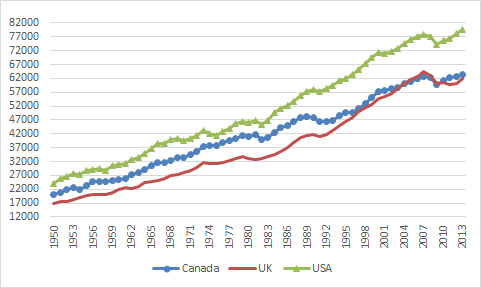
Source: Computed from OECD StatExtract and The Conference Board, Total Database, January 2014, http://www.conference-board.org/economics
The USA is pulling away from Canada and the UK in GDP per working age person. The exception is British economy from about 1990 onwards which caught up with Canada.
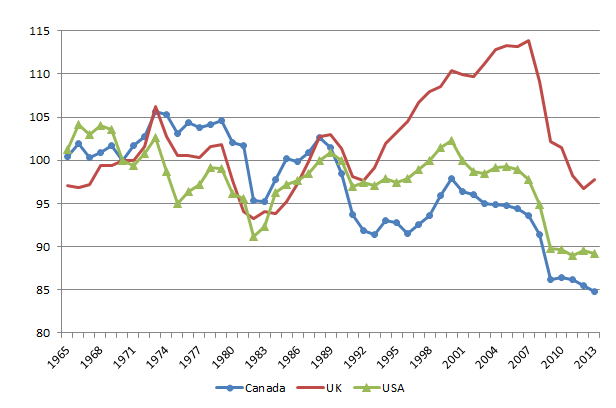
Figure 2, which is detrended GDP data, illustrates the British economic boom in the 1990s. Each country’s annual economic growth rate is detrended by 1.9%, the detrending value currently used by Ed Prescott. A flat line is growth at 1.9%, a rising line is above trend growth, a falling line is below trend growth.
Figure 2: Real GDP per Canadian, British and American aged 15-64, converted to 2013 price level, updated 2005 EKS purchasing power parities, detrended 1.9%, 1950-2013
Source: Computed from OECD Stat Extract and The Conference Board, Total Database, January 2014, http://www.conference-board.org/economics
Figure 2 shows that Canada has been in a long-term decline since the mid-1980s with much of this decline coinciding with periods of rising taxes on income from labour.
The British economy boomed in the 1990s, after the tax hikes of the 1970s and early 80s were reversed. This growth dividend was squandered by the Blair government in the 2000.
Figure 2 also shows that US growth was rather stable with some ups and downs up until 2007, expect during the productivity slowdown in the 1970s. The first major departure from trend growth of 1.9% was with the onset of the great recession.
Who Pays Taxes in America in 2015?
16 Apr 2015 Leave a comment
in politics - USA, public economics Tags: tax incidence
/cdn0.vox-cdn.com/uploads/chorus_asset/file/3601626/ctj_taxrate.0.png)
State and local taxes are rather regressive.
/cdn0.vox-cdn.com/uploads/chorus_asset/file/3601618/ctj_taxshares.0.png)


via Think the poor don’t pay taxes? This chart proves you very wrong. – Vox and How Much Do the Top 1 Percent Pay of All Taxes?
Who pays income tax in the USA?
14 Apr 2015 Leave a comment
in politics - USA, public economics Tags: tax incidence, top 1%
The top 1% of income earners in the U.S. pay nearly half of all income tax on.wsj.com/1IRkAr1 http://t.co/n6L8QhArtq—
Nick Timiraos (@NickTimiraos) April 12, 2015
A great chart that may be misleading because so many taxpayers pay no net income tax
15 Jan 2015 Leave a comment
in Public Choice, taxation Tags: expressive voting, rational ignorance, tax incidence
Very useful #DataViz! UK now gives a breakdown of what your taxes were spent on.
Example via bit.ly/1BAz9vh http://t.co/Ero8h6kHCM—
Max Roser (@MaxCRoser) January 05, 2015
Net and average tax in NZ | Kiwiblog
17 Nov 2014 Leave a comment


Tax Burdens: Some Facts (For a Change) | Pundit 2011
16 Nov 2014 Leave a comment
in income redistribution, liberalism, politics - New Zealand, Public Choice, public economics Tags: tax burdens, tax incidence


The 47% is bigger than you think
16 Nov 2014 2 Comments
in politics - USA, public economics, Rawls and Nozick Tags: 47%, tax incidence, who pays taxes

 Utopia, you are standing in it!
Recent Comments