
Co-op founder expains impact of net neutrality on a small ISP
17 Dec 2017 Leave a comment
in applied price theory, economics of media and culture, economics of regulation, industrial organisation, politics - New Zealand, politics - USA, survivor principle Tags: net neutrality, The fatal conceit, The pretence to knowledge, unintended consequences
Russian offsetting behaviour
16 Oct 2017 Leave a comment
in applied price theory, sports economics Tags: offsetting behaviour, unintended consequences

Financial regulation and financial crisis | Sam Peltzman
11 Oct 2017 Leave a comment
in applied price theory, economics of regulation, financial economics, global financial crisis (GFC), macroeconomics, monetary economics, Sam Peltzman Tags: offsetting behaviour, unintended consequences
What Does Research Tell Us About Minimum Wage?
16 Sep 2017 Leave a comment
in applied price theory, applied welfare economics, economics of regulation, labour economics, minimum wage Tags: unintended consequences
Monty Python on the economics of begging and do-gooders
24 Jun 2017 Leave a comment
in applied price theory, labour economics, movies, occupational choice, poverty and inequality Tags: begging, do gooders, Monty Python, offsetting behaviour, unintended consequences
Early temperance movements were a public health setback
10 Jun 2017 Leave a comment
in applied price theory, economic history, economics of regulation, health economics Tags: economics of prohibition, offsetting behaviour, The fatal conceit, unintended consequences
Watching a history of prohibition. Started in 1850s, at least half a century before safe drinking water was freely available such as through tap water.
Beer was much safer than drinking water until a good way into the 20th century. Initial temperance movement was against hard liquor but quickly was about abstinence.

Humanitarians redeemed Sudanese slaves by buying them out of slavery. Did it work out?
02 Jun 2017 Leave a comment
in applied price theory, development economics, economics of crime, growth disasters, law and economics Tags: economics of slavery, offsetting behaviour, unintended consequences
Why is the Swedish gender wage gap so stubbornly stable (and high)?
06 May 2017 Leave a comment
in discrimination, gender, human capital, labour economics, labour supply, occupational choice Tags: economics of fertility, female labour force participation, gender wage gap, maternity leave, preference formation, statistical discrimination, Sweden, unintended consequences
The Swedes are supposed to be in a left-wing utopia. Welfare state, ample childcare and long maternity leave but their gender wage gap is almost as bad as in 1980. They must be a misogynist throwback.

Maybe Megan McArdle can explain:
There are countries where more women work than they do here, because of all the mandated leave policies and subsidized childcare — but the U.S. puts more women into management than a place like Sweden, where women work mostly for the government, while the private sector is majority-male.
A Scandinavian acquaintance describes the Nordic policy as paying women to leave the home so they can take care of other peoples’ aged parents and children. This description is not entirely fair, but it’s not entirely unfair, either; a lot of the government jobs involve coordinating social services that women used to provide as homemakers.
The Swedes pay women not to pursue careers. The subsidies from government from mixing motherhood and work are high. Albrecht et al., (2003) hypothesized that the generous parental leave a major in the glass ceiling in Sweden based on statistical discrimination:
Employers understand that the Swedish parental leave system gives women a strong incentive to participate in the labour force but also encourages them to take long periods of parental leave and to be less flexible with respect to hours once they return to work. Extended absence and lack of flexibility are particularly costly for employers when employees hold top jobs. Employers therefore place relatively few women in fast-track career positions.
Women, even those who would otherwise be strongly career-oriented, understand that their promotion possibilities are limited by employer beliefs and respond rationally by opting for more family-friendly career paths and by fully utilizing their parental leave benefits. The equilibrium is thus one of self-confirming beliefs.
Women may “choose” family-friendly jobs, but choice reflects both preferences and constraints. Our argument is that what is different about Sweden (and the other Scandinavian countries) is the constraints that women face and that these constraints – in the form of employer expectations – are driven in part by the generosity of the parental leave system
Most countries have less generous family subsidies so Claudia Goldin’s usual explanation applies to their falling gender wage gaps
Quite simply the gap exists because hours of work in many occupations are worth more when given at particular moments and when the hours are more continuous. That is, in many occupations earnings have a nonlinear relationship with respect to hours. A flexible schedule comes at a high price, particularly in the corporate, finance and legal worlds.
Offsetting behaviour alert: boxing headguards @EricCrampton
04 May 2017 Leave a comment
in health and safety, labour economics, occupational choice, sports economics Tags: health and safety, offsetting behaviour, unintended consequences
When people complain about the black market or organised crime
02 May 2017 Leave a comment
in applied price theory, economic history, economics of crime, economics of regulation, health economics, law and economics Tags: black markets, offsetting behaviour, organised crime, unintended consequences
#GarethMorgan wants sitting tenant laws
28 Apr 2017 Leave a comment
in applied price theory, applied welfare economics, economics of regulation, income redistribution, politics - New Zealand, Public Choice, rentseeking Tags: 2017 New Zealand election, offsetting behaviour, rent control, unintended consequences
Morgan wants to restrict the ability to evict tenants for reasons other than damage to the property and non-payment of rent. This includes not been able to evict a tenant on sale of the property.
We intend to change the regulations around residential tenancy law so leases make it far easier for a tenant to remain in the premises long term…
This will be achieved by restricting the conditions under which a landlord can evict a tenant to those of non-payment of rent or property damage. Sale of a property is not necessarily a legitimate reason for eviction. Tenants will be able to give 90 days notice.
That policy will make winding up of estates difficult. Houses will be have to be left vacant rather than rented while affairs are put in order. That is to name one of many flaws in a policy announced by a party that prioritises being different over been useful and right.
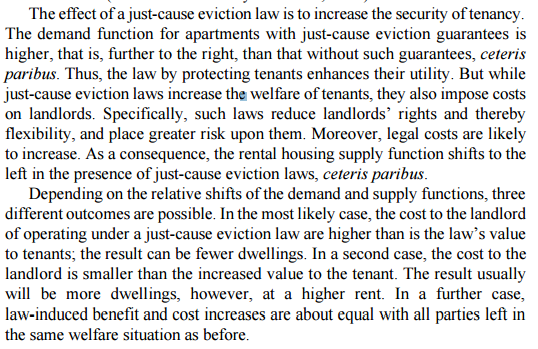
Source: RENTING Werner Z. Hirsch at encyclopedia of law and economics.
What’s the Right Minimum Wage?
25 Feb 2017 Leave a comment
in applied price theory, applied welfare economics, economics, labour economics, minimum wage Tags: offsetting behaviour, The fatal conceit, unintended consequences

 Utopia, you are standing in it!
Recent Comments