
Eugene Fama and the simulative effects of fiscal policy
31 Jul 2014 6 Comments
in budget deficits, fiscal policy, great depression, great recession, macroeconomics Tags: crowding out, Eugene Fama, fiscal policy, Treasury view of fiscal policy

Eugene Fama argues that government bailouts and stimulus plans seem attractive when there are idle resources – when there is unemployment such as in a recession or depression including in the 1930s.
Fama counters that:
1. Bailouts and stimulus plans must be financed.
2. If the financing takes the form of additional government debt, the added debt displaces other uses of the funds.
3. Thus, stimulus plans only enhance incomes when they move resources from less productive to more productive uses.
In the end, despite the existence of idle resources, bailouts and stimulus plans do not add to current resources in use. They just move resources from one use to another.

Fama noted that there was just one valid negative comment in response to this argument that appears to be valid which was made by Brad DeLong.
Fama thinks Delong’s point about involuntary inventory accumulation is consistent with Fama’s initial arguments about the need for the stimulus to work through moving resources to higher value uses.
For me, the notion that a fiscal stimulus is a negative productivity shock is a good starting point for analysis. The method of financing the stimulus is important too.
Economic agents know that a temporary expenditure program has no lasting effect on employment but has lasting effect on disposable income and taxes. Indeed, massive public interventions to maintain employment and investment during a financial crisis can, if they distort incentives enough, lead to a depression.
In Australia, there was a massive fiscal contraction from late 1930 onwards called the Premiers’ Plan. In 1931, unemployment rates was 25% or more.
- The Premiers’ Plan required the federal and state governments to cut spending by 20%, including cuts to wages and pensions and was to be accompanied by tax increases, reductions in interest on bank deposits and a 22.5% reduction in the interest the government paid on internal loans.
- The Premiers’ Plan was complementary to the Arbitration Court’s 10 per cent nominal wage cut in January 1931 and the devaluation of the Australian pound. Most countries had abandoned the gold standard by 1931 and 1932 and devalued by about 10% including the UK. These competitive devaluations were called currency wars. Most countries below started to recovery before they left the gold standard, a year or two before they left the cross of gold.
Maclaren (1936) dated the Australian economic recovery from the last months of 1932. It was to take another three years before unemployment rates fell below 10 per cent — the rate it had been during most of the 1920s.
The June 1931 Premiers’ Plan of fiscal consolidation had time by late 1932 to become credible and take hold given the usual leads and lag on fiscal policy. Unemployment data for the time show a rapid fall in the high twenties unemployment rate in 1932 to be below 10 per cent by 1937.
“Inflation is always and everywhere a monetary phenomenon”
31 Jul 2014 Leave a comment
in budget deficits, fiscal policy, macroeconomics, monetarism, monetary economics Tags: Joan Robinson
Joan Robinson thought German hyperinflation was not caused by monetary policy!!

Almost, but not quite.
Back in the days when dinosaurs roamed the earth, and Cambridge economists kept guard at the Temple of Keynes, Milton Friedman’s focus on inflation as a monetary phenomenon was a revelation—and an excellent one. Next to Joan Robinson’s surreal claims that printing money was not responsible for the German hyperinflation, Friedman’s version of monetary economics provided a very healthy dose of sanity. And as central banks across the world learned from the mistakes of the 70s and brought inflation under control, it became clear that the monetary authority indeed had the power to contain the price level via control of the money supply.
But it’s important to know what this account leaves out: how, exactly, do prices adjust? And over what length of time does this happen?
The modern view, backed up by impressive (though not entirely conclusive) empirical evidence, is that most prices are…
View original post 301 more words

Pass the Bucks: Investment Incentives as Political Credit-Claiming Devices: Evidence from a Survey Experiment
31 Jul 2014 Leave a comment
in economics

From Nathan Jensen, Edmund Malesky, Mariana Medina, Ugur Ozdemir:
Both countries and subnational governments commonly engage in competition for mobile capital, offering generous incentives to attract investment. Existing research has suggested that these tax incentives have a limited ability to affect investment patterns and are often excessively costly, when measured against the amount of investment and jobs created. If tax incentives have such uncertain benefits, why offer them? In this paper, we build off work on electoral pandering to argue that incentives allow politicians to take credit for firms’ investment decisions. We test the empirical implications of this theory using a nationwide internet survey, which employs a randomized experiment to test how voters evaluate the performance of incumbent U.S. governors. Our findings illustrate a critical political benefit of offering such incentives. Politicians can use these incentives to take credit for investment flowing into their districts and to minimize the political fallout…
View original post 6 more words
Hayek on Keynes and the microeconomic foundations of macroeconomics
31 Jul 2014 9 Comments
in applied price theory, F.A. Hayek, macroeconomics Tags: FA Hayek, Keynes, the microeconomic foundations of macroeconomic

HT: Cafe Hayek

Justice Thomas, a colour-blind Constitution and Brown v. Board of Education (1954)
31 Jul 2014 Leave a comment

I have a dream – Martin Luther King Jr.
31 Jul 2014 1 Comment
in liberalism Tags: equality before the law, racism, The Age of Enlightenment

Managerial Econ: Fee-for-service vs. capitation: 10 fewer amputations per capita
31 Jul 2014 Leave a comment
in health economics Tags: agent principal problems, asymmetric information, moral hazard

- Single-year mortality rates fell from 6.8 per cent in the traditional fee-for-service sample to 1.8 per cent
- Patients in the Medicare Advantage plans had shorter average stays in the hospital (about 19 per cent shorter.)
- Patients in the managed plans were more likely to receive preventive care …For example, diabetic patients in the fee-for-service sample had an average of 11.5 amputations per 1,000 patients; those in HMO plans with global capitation had only 0.3.

via Managerial Econ: Fee-for-service vs. capitation: 10 fewer amputations per capita.
Managerial Econ: Physician Induced Demand
31 Jul 2014 Leave a comment
in applied welfare economics, health economics Tags: agent principal problems, asymmetric information, moral hazard, Physician Induced Demand

Rehavi and Johnson compare obstetricians’ choice of C-section during childbirth when the expectant mother is herself a medical doctor to when she is not. From their abstract:
… Consistent with PID [Physician Induced Demand], physicians are almost 10 per cent less likely to receive a C-section, with only a quarter of this effect attributable to differential sorting of patients to hospitals or obstetricians.
Forty Years Ago, Scientists Blamed The Polar Vortex On Global Cooling
31 Jul 2014 Leave a comment
in economics

Depending on which scam they are currently being funded by, scientists blame the polar vortex alternatively on global warming and global cooling.
Scientists have found other indications of global cooling. For one thing there has been a noticeable expansion of the great belt of dry, high-altitude polar winds —the so-called circumpolar vortex—that sweep from west to east around the top and bottom of the world. Indeed it is the widening of this cap of cold air that is the immediate cause of Africa’s drought.
TIME Magazine Archive Article — Another Ice Age? — Jun. 24, 1974

Calmfor’s Iron Law of Active Labour Market Policy.
31 Jul 2014 Leave a comment
in applied price theory, fiscal policy, job search and matching, labour economics, labour supply, macroeconomics, welfare reform Tags: Active labour market programs, Lars Calmfors, welfare reform, work for the dole, workfare

Lars Calmfors is a Swedish economist whose main interest is labour makets.
His iron law of Active Labour Market Policy (ALMP) refers to a characteristic of make work schemes, like the WPA that operated in the United States in the 1930s.
The characteristic or problem with these schemes is that if people are attracted to these schemes by generous pay or conditions, their motive to search for regular work is necessarily reduced.
Assuming unemployment is anywhere near NAIRU, the effect of this reduced aggregate labour supply will be inflationary, which means that demand will have to be reduced, which in turn means that the jobs created by the make work scheme will be, at least to some extent, at the expense of regular jobs.
Alternatively, if people are coerced into joining make work schemes because of what might be called a “workfare” sanction, their job search efforts are not reduced, thus the jobs created by the make work scheme have a better chance of not being at the expense of normal jobs.
via RALPHONOMICS: Calmfor’s Iron Law of Active Labour Market Policy..
How flexible is the New Zealand labour market
31 Jul 2014 1 Comment
in economics of regulation, labour economics, politics - New Zealand, unemployment, welfare reform Tags: 90 day trials, employment law, employment probation periods, employment protection, labour market regulation
The first chart below shows that NZ is the 4th most deregulated labour market for individual dismissals.

Source: OECD employment protection index
The next figure below shows that NZ is top of the world for deregulation of lay-offs and redundancies.
![clip_image002[7]](https://utopiayouarestandinginit.com/wp-content/uploads/2014/07/clip_image0027.jpg "clip_image002[7]")
Source: OECD employment protection index
The chart below shows that New Zealand is far more flexible than in Western Europe and is pretty near the USA in terms of people moving in and out of the unemployment pool every month with great ease.
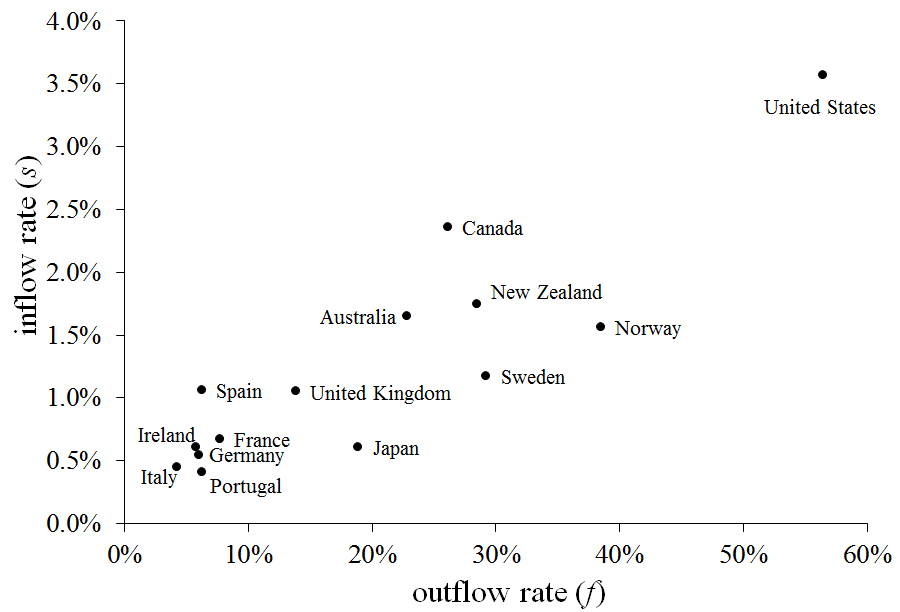
Source: Elsby, Hobijn and Şahin (2013).
There are very high outflow rates from unemployment among the Anglo-Saxon and Nordic economies. The economies of Continental Europe stand in stark contrast. Unemployment outflow rates in these economies lie below 10% at a monthly frequency.
A major labour market reform in recent years in New Zealand was introduction of the option of a 90 day trial for new employees, initially in small businesses and then in all businesses.
The UK recently extended its trial period from one-year to two-years. Trial periods are common in OECD member countries.
There is plenty of evidence to back-up the notion that increased job security leads to less employee effort and more absenteeism. Some examples are:
· Sick leave spiking straight after probation periods ended;
· Teacher absenteeism increasing after getting tenure after 5-years; and
· Academic productivity declining after winning tenure.
The MBIE research into the actual operation of 90-day trials was highly favourable in terms of increased employment, the hiring of riskier applicants and lower costs of ending bad job matches (about 15-20% of trials did not work out). These outcomes are the usual importance of a test drive argument for employment trial periods.
Interestingly, the MBIE research also found that some employers hired new employees on 90-day trials for positions about which these employers were uncertain might be profitable. But for the option of the trial period, these jobs never would have existed.
This suggests that in some firms, 90-day trials are a decisively cheaper alternative to hiring an employee and perhaps making them redundant later if the new position does not pay for itself. No one’s fault: the market just did not sustain the expansion in staff as expected.
The MBIE research shows that winners from 90-day trials are new labour force entrants, the unemployed and beneficiaries, migrants and labour force re-entrants such as mothers.
I kept note of an interesting press report adding to this where Hospitality New Zealand Wellington president Jeremy Smith said he had hired dozens of staff he would not otherwise have considered. Because of the transient nature of the hospitality industry, it was often difficult to check references so a trial period “levelled the playing field”.

 Utopia, you are standing in it!
Recent Comments