In the modern world, many of the topics about which people have opinions are some distance away from any actual experience or expertise that these same people have. In this situation, people are unlikely to form their opinions with a deep dive into relevant history, data, and academic research. Instead, they are more likely to…
What are Folk Economic Beliefs?
What are Folk Economic Beliefs?
25 Feb 2026 Leave a comment
in applied price theory, behavioural economics, economics of education
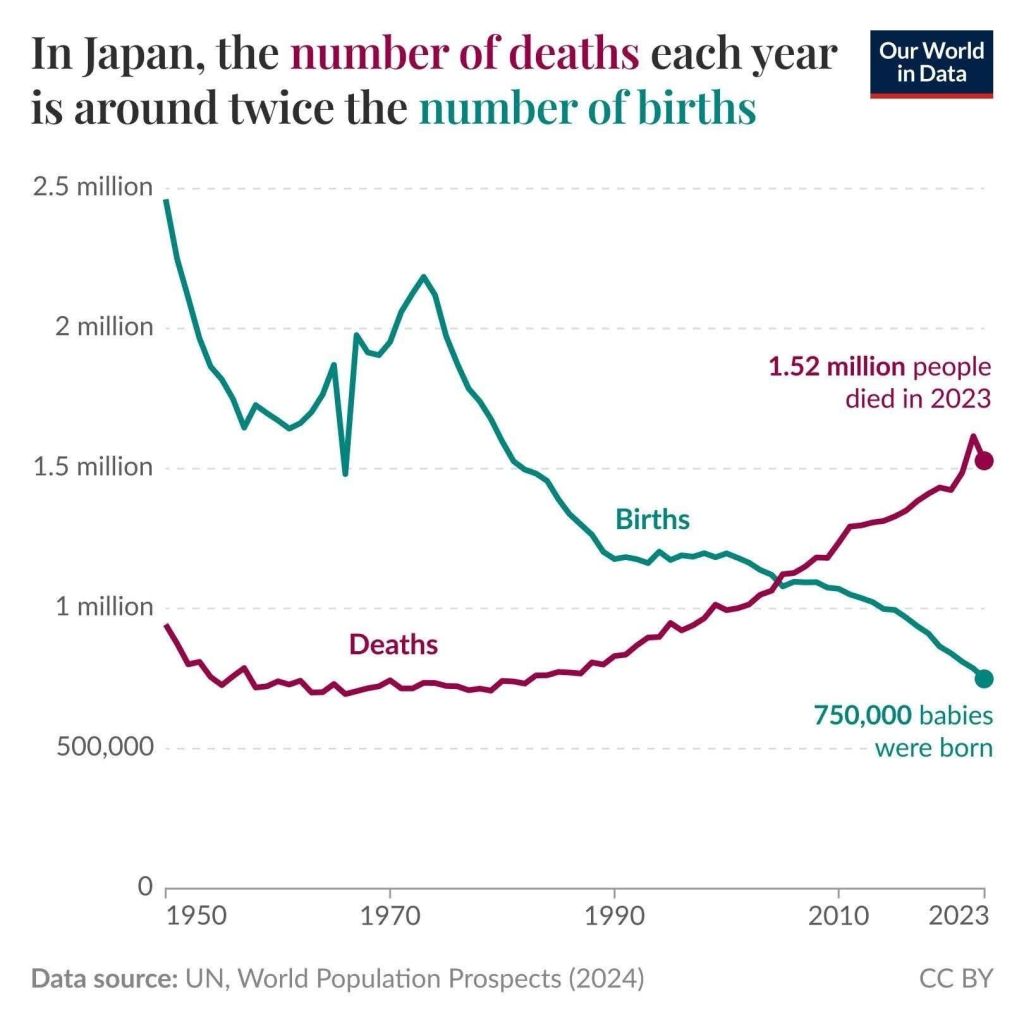
So much for the population bomb
25 Feb 2026 Leave a comment
in labour economics, labour supply, population economics Tags: ageing society, Japan, population bust
From Discount to Discrimination: The Strange Economics of Anti-Competitive Antitrust
24 Feb 2026 Leave a comment
in applied price theory, economics of regulation, entrepreneurship, history of economic thought, industrial organisation, law and economics Tags: competition law, creative destruction

Antitrust has always been a strange regulatory enterprise. Businesses are largely free to engage in various commercial practices involving price, output, product design, distribution, research, and innovation—until they’re not. Outside the paradigmatic examples of explicit agreements among competitors to fix price and output, many business practices live in a gray zone. Whether a particular pricing…
From Discount to Discrimination: The Strange Economics of Anti-Competitive Antitrust
Is There a Political Downside to Tax Migration?
24 Feb 2026 Leave a comment
in applied price theory, economic growth, economic history, fiscal policy, labour economics, labour supply, macroeconomics, politics - USA, Public Choice, public economics Tags: taxation and labour supply, taxation and entrepreneurship, taxation and investment

I’m a big fan of tax migration. I cheer when productive people escape high-tax states or high-tax nations. And when the geese with the golden eggs fly away, it thwarts the plans of greedy politicians. The latest example of this is the exodus of billionaires – worried about a wealth tax – from California (the […]
Is There a Political Downside to Tax Migration?
Lawfare Begins Against Repealing Endangerment Finding–Legalities Outlook
24 Feb 2026 Leave a comment
in economics of climate change, economics of regulation, energy economics, environmental economics, environmentalism, global warming, law and economics, politics - USA, Public Choice, transport economics, urban economics Tags: constitutional law

The expected blowback from invested climatists is underway, as reported by legacy media whose bias is with the alarmists. Examples: EPA faces lawsuit over scrapping the ‘endangerment finding,’ a pillar of climate regulation, Scientific American E.P.A. Faces First Lawsuit Over Its Killing of Major Climate Rule, NY Times Lawsuit: EPA revoking greenhouse gas finding risks […]
Lawfare Begins Against Repealing Endangerment Finding–Legalities Outlook
The Moral Failure of Pacifism
24 Feb 2026 1 Comment
in defence economics, laws of war, liberalism, libertarianism, Marxist economics, war and peace Tags: World War II
Pacifism presents itself as the highest moral ground: a principled refusal to engage in violence, an insistence that all killing is always wrong, and a hope that moral purity can disarm brutality. In practice, however, pacifism is not merely naïve but morally evasive. It refuses responsibility for consequences, confuses intentions with outcomes, and ultimately relies […]
The Moral Failure of Pacifism
Bill Maher’s new rule: The King’s speech
23 Feb 2026 Leave a comment
in politics - USA, television, TV shows
Bill Maher’s latest “Real Time” clip argues that we should get rid of the State of the Union Address (coming up Tuesday), at least under Trump. That’s because to Maher it’s ludicrous that Trump keeps appropriating the powers of Congress for himself, violating our Constitutional separation of powers. The speech has become, says Maher, not…
Bill Maher’s new rule: The King’s speech
New Zealand First’s Economics
23 Feb 2026 Leave a comment
in applied price theory, politics - New Zealand
Shane Jones is committed to state-led economic development. New Zealand First and ACT sit further apart on the economics spectrum than do Labour and National. On other parts of the policy spectrum the two are more aligned, but this column’s focus is primarily on economics and, particularly, the economics of NZF. I leave Christopher Luxon’s […]
New Zealand First’s Economics
Aussie Senator: US Social Media Reluctance to Censor Climate Skeptics – “This is the Problem”
23 Feb 2026 Leave a comment
in economics of climate change, energy economics, environmental economics, environmentalism, global warming, politics - Australia Tags: climate activists, climate alarmism, free speech

Apparently free speech is OK, as long as the Australian Government thinks what you are saying is true.
Aussie Senator: US Social Media Reluctance to Censor Climate Skeptics – “This is the Problem”
The Economic Burden of Protectionism, Part III
23 Feb 2026 Leave a comment
in applied price theory, econometerics, economic history, history of economic thought, industrial organisation, international economics, politics - USA, survivor principle

In Part I and Part II of this series, we looked at research showing that Americans are bearing the burden of Trump’s trade taxes. Those findings are a useful antidote to Trump’s silly and illiterate claim that foreign companies are swallowing the added cost. In both of those columns, however, I pointed out that I’m […]
The Economic Burden of Protectionism, Part III
Can fertility return to replacement levels?
23 Feb 2026 Leave a comment
in labour economics, labour supply, population economics
Many countries, including almost all developed countries and many developing countries, are now experiencing below-replacement fertility, with fertility rates having declined substantially over the past decade or more. That means that each generation will be progressively smaller than the last, and almost inevitably that leads to a declining population (in the absence of offsetting migration…
Can fertility return to replacement levels?

“It’s Not Going to End Well for Them”: Susan Rice Joins Call for a Revenge Purge After Democrats Re-Take Power
22 Feb 2026 Leave a comment
in economics of crime, law and economics, politics - USA

As Democrats plan for the possible takeover in the midterms and 2028 election, they are already openly discussing their push…
“It’s Not Going to End Well for Them”: Susan Rice Joins Call for a Revenge Purge After Democrats Re-Take Power
Clearing up some misconceptions about the DoE report
22 Feb 2026 1 Comment
in economics of bureaucracy, economics of climate change, economics of regulation, energy economics, environmental economics, environmentalism, global warming, politics - USA, Public Choice
by Ross McKitrick Last year I had the privilege of working with a small team (me, Judy Curry, John Christy, Steve Koonin and Roy Spencer) on a draft report for U.S. Energy Secretary Chris Wright on the topic of climate … Continue reading → The post Clearing up some misconceptions about the DoE report appeared…
Clearing up some misconceptions about the DoE report
The Case Against Net Zero
22 Feb 2026 1 Comment
in economics of climate change, economics of regulation, energy economics, environmental economics, environmentalism, global warming Tags: British politics

By Paul Homewood Robin Guenier has updated his Case Against Net Zero: In October 2008, Parliament passed the Climate Change Act requiring the Government to ensure that by 2050 ‘the net UK carbon account’ was reduced to a level at least 80% lower than that of 1990; this refers to CO2 and […]
The Case Against Net Zero
 Utopia, you are standing in it!
Recent Comments