Macron’s government consistently spent more as a share of total output than any other OECD member, with the public sector accounting for over 57% of GDP in 2024. The telling trend is France’s divergence from its neighbors. When Macron took office, France’s debt-to-GDP ratio was 11 percentage points above the Eurozone average; by 2024, that gap […]
French facts of the day
French facts of the day
14 Oct 2025 1 Comment
in applied price theory, economics of bureaucracy, economics of regulation, energy economics, environmental economics, fiscal policy, law and economics, macroeconomics, property rights, Public Choice, rentseeking, urban economics Tags: France
Sorry, But Pope Leo Is Mistaken
13 Oct 2025 Leave a comment
in applied price theory, development economics, economics of religion, growth disasters, growth miracles Tags: The Great Enrichment
TweetHere’s a letter to a new correspondent. Mr. __: Thanks for sharing Sohrab Ahmari’s tweet, which I’d not otherwise have noticed. It is, frankly, pathetically inept. In order to criticize the pro-free-market Acton Institute, Ahmari favorably quotes Pope Leo’s assertion that “pseudo-scientific data are invoked to support the claim that a free market economy will…
Sorry, But Pope Leo Is Mistaken
The supply side of media bias
12 Oct 2025 Leave a comment
in applied price theory, econometerics, industrial organisation, politics - USA, survivor principle Tags: media bias
In my ECONS102 class, we cover economic explanations for media bias. Drawing on past research from Matthew Gentzkow and others, we demonstrate that there are demand-side explanations (media bias arises because of a bias in the preferences of the news-consuming public) and supply-side explanations (media bias arises because media firms segment the market, and focus…
The supply side of media bias
Is the earned income tax overrated?
09 Oct 2025 Leave a comment
in applied price theory, economics of education, human capital, income redistribution, labour economics, labour supply, occupational choice, Public Choice, public economics, welfare reform Tags: taxation and labour supply
This policy has been so popular with economists on a bipartisan basis, yet a recent piece in ReStud raises some doubts, as the wage subsidies induce many to drop out of school: As a complement to the federal earned income tax credit (EITC), some states offer their own EITC, typically calculated as a percentage of […]
Is the earned income tax overrated?
We do actually have a transformational government
09 Oct 2025 Leave a comment
in applied price theory, economic growth, economics of regulation, law and economics, macroeconomics, politics - New Zealand, property rights
Governments of the left like to claim they are transformational, when they’re not. The Ardern Government achieved so little it was the opposite. They used wellbeing as a slogan, and did a couple of disastrous mergers. They spent a lot of money. To be fair the Clark Government did actually achieve some major stuff such […]
We do actually have a transformational government
Part II: Yes, Taxes Change Behavior
08 Oct 2025 Leave a comment
in applied price theory, labour economics, labour supply, public economics Tags: taxation and entrepreneurship, taxation and investment, taxation and labour supply

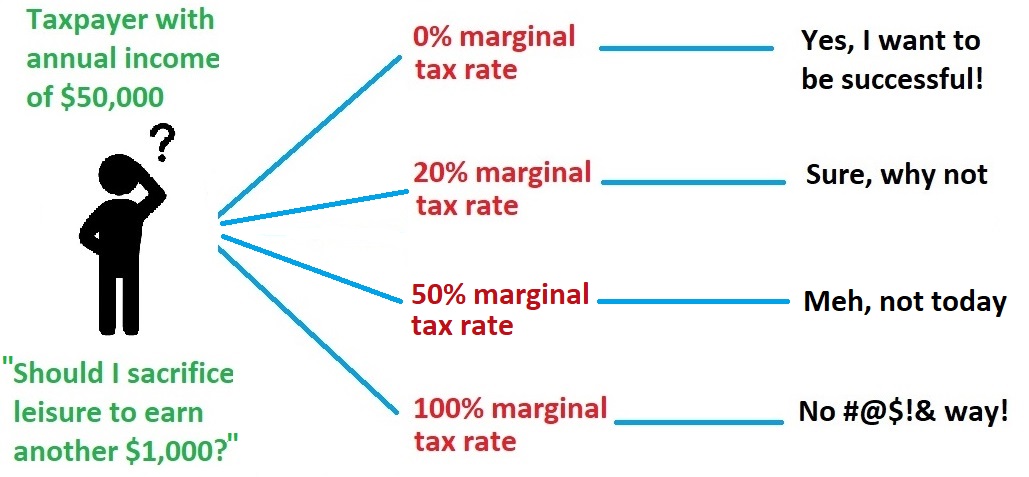
There are several visual ways of helping people understand how fiscal policy (and especially marginal tax rates) can change behavior. The philoso-raptor meme. The questioning worker. Supply-and-demand curves. The Wizard-of-Id parody. To augment these examples, I’ve started a series that is based on real-world examples. Part I of the series highlighted how the capital gains […]
Part II: Yes, Taxes Change Behavior
The impact of taxes and transfers on inequality in New Zealand
08 Oct 2025 Leave a comment
in applied price theory, economics of education, human capital, labour economics, labour supply, politics - New Zealand, poverty and inequality

This week, my ECONS102 class covered inequality, and social security. Which is timely, because I have been meaning to blog about this Treasury Analytical Note from 2024, by Tod Wright and Hien Nguyen, for some time. Wright and Nguyen look at the distributional impact of taxes, transfers, and government spending (on healthcare and education).Importantly, they distinguish…
The impact of taxes and transfers on inequality in New Zealand
Getting rid of subidies creates wealth
06 Oct 2025 Leave a comment
in applied price theory, comparative institutional analysis, energy economics, industrial organisation, Public Choice, public economics Tags: electric cars, Internet, subsidies
REASON: Starting Today, Electric Vehicle Buyers No Longer Get a Federal Tax Credit. It’s bad news for upper-income motorists wanting a deal, but good news for taxpayers. In 2022, then-President Joe Biden signed the Inflation Reduction Act (IRA) into law…,[awarding] up to $7,500 for purchasing an electric vehicle. …Donald Trump [terminated the subsidy] on September…
Getting rid of subidies creates wealth
Quotation of the Day…
05 Oct 2025 Leave a comment
in applied price theory, history of economic thought, international economics

Tweet… is from page 196 of Arnold Kling‘s excellent 2004 book, Learning Economics: [O]utsourcing is symmetric. For every job that we outsource to India, India outsources a job to us. That giant sucking sound you hear is jobs being created in the U.S. to meet the needs of Indian consumers. That is guaranteed to happen.…
Quotation of the Day…
Unbeatable: The Brutally Honest Case for Free Markets | Bryan Caplan
04 Oct 2025 Leave a comment
in applied price theory, comparative institutional analysis, economic growth, economic history, income redistribution, industrial organisation, labour economics, law and economics, liberalism, libertarianism, macroeconomics, Public Choice Tags: The Great Enrichment
Is it dangerous to say that entrepreneurs are heroes?
30 Sep 2025 Leave a comment
in applied price theory, Austrian economics, entrepreneurship, history of economic thought, industrial organisation
Back in the early 1990s, I wrote a paper called “The Creative-Destroyers: Are Entrepreneurs Mythological Heroes?” A reviewer at a journal said “The conclusion that entrepreneurs are heroes seems to be very dangerous!” That was in 1993.There is a picture of this review below. After that is a link to where I posted this paper here…
Is it dangerous to say that entrepreneurs are heroes?
H1-B visa fees and the academic job market
28 Sep 2025 1 Comment
in applied price theory, economics of education, international economic law, international economics, politics - USA, Public Choice, rentseeking Tags: free trade, tariffs
Assume the courts do not strike this down (perhaps they will?). Will foreigners still be hired at the entry level with an extra 100k surcharge? I would think not,as university budgets are tight these days. I presume there is some way to turn them down legally, without courting discrimination lawsuits? What if you ask them […]
H1-B visa fees and the academic job market
Not-so-killer acquisitions
27 Sep 2025 Leave a comment
in applied price theory, economic history, economics of regulation, industrial organisation, law and economics, politics - USA, theory of the firm Tags: competition law
Eric Crampton writes – A lot of changes are coming in competition policy. Last week, the government announced a package of reforms that, overall, set the Commerce Commission on a more activist tack. One proposed reform will align New Zealand more closely with Australia’s regime, guarding against so-called ‘killer acquisitions’.
Not-so-killer acquisitions
Part I: Yes, Taxes Change Behavior
26 Sep 2025 Leave a comment
in applied price theory, economic growth, entrepreneurship, fiscal policy, human capital, labour economics, labour supply, macroeconomics, Public Choice, public economics Tags: taxation and entrepreneurship, taxation and investment, taxation and labour supply
From a big-picture economic perspective, I worry most about the damage of high tax burdens on innovation, entrepreneurship, and investment. Those are things that generate enormous benefits for society, yet also things that are very sensitive to bad tax policy (specifically high marginal tax rates and the tax code’s bias against saving and investment). Sadly, […]
Part I: Yes, Taxes Change Behavior
What Do Managers Do?
26 Sep 2025 1 Comment
in applied price theory, managerial economics, organisational economics, personnel economics
Economists have been thinking for a long time about the operation of buying and selling in markets. However, they have traditionally spent less time studying what happens inside a firm–a setting in which forces of supply and demand are replaced by managerial decision-making. Anyone who has had both a good boss and bad boss knows…
What Do Managers Do?
 Utopia, you are standing in it!
Recent Comments