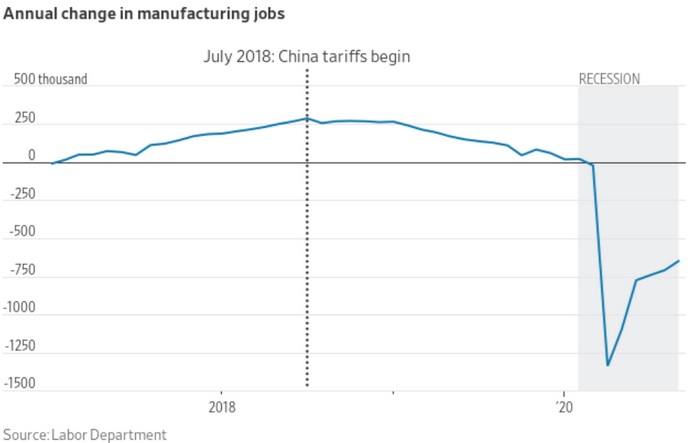
To augment my four-part video series about trade (dealing with the WTO, creative destruction, deficits, and economics), here’s part of my recent lecture about Trump’s trade policy to the Universidad de Libertad in Mexico City For those who (mistakenly) want to skip the video, my speech focused on these five themes. Trade deficits don’t matter. […]
TweetNational Review‘s Charles Cooke explains that Trump’s trade war is needless. Two slices: How do I hate President Trump’s capricious levying of tariffs? Let me count the ways. They are constitutionally suspect, statutorily usurpative, diplomatically toxic, and culturally chaotic; they represent a profound political risk for the new administration — the potential upsides of which…
Over the past half-century, the share of men enrolled in college has steadily declined relative to women. Today, 1.6 million more women than men attend four-year colleges in the U.S. This trend has not lowered marriage rates for college women, a substantial share of whom have historically married economically stable men without college degrees. Both […]
In arguments over industrial policy, there’s often a moment where someone makes an assertion like: “Every nation has industrial policy. Even not having an industrial policy is a type of industrial policy. The only relevant question is what kind of industrial policy we should choose.” In my experience, the people who make this argument then…
Bryce Wilkinson writes – If you believe some of its critics, the pending Regulatory Standards Bill is a demonic measure to end New Zealand society as we know it. This is beyond false; it is ridiculous. In fact, it is a modest transparency measure. It will better inform the public about laws and regulations likely […]
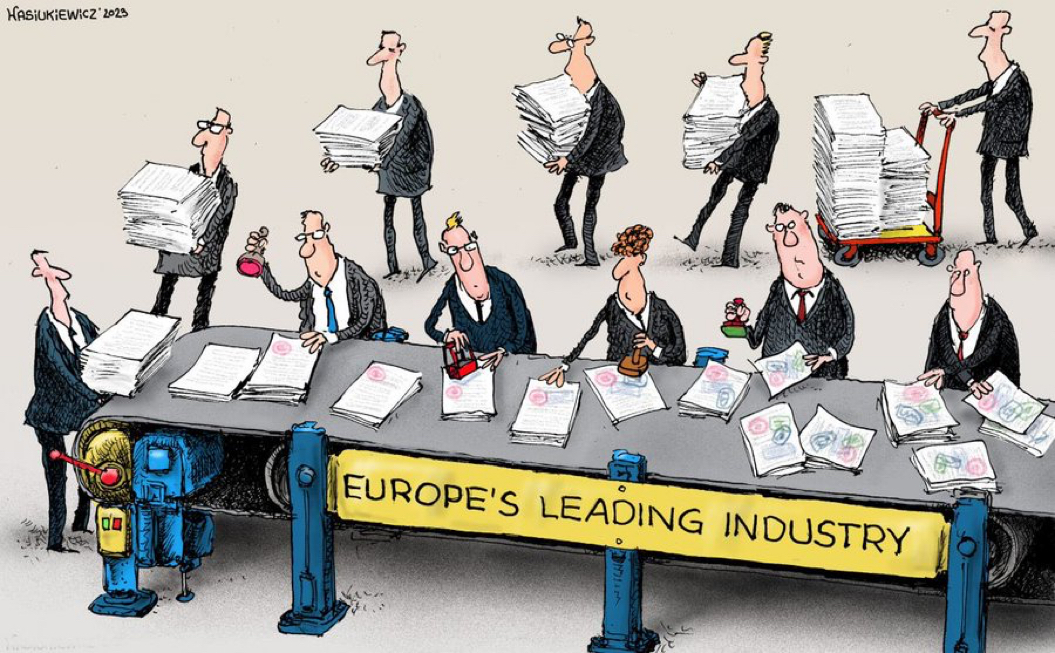
I have a special page for humor involving Europe, but I have not added to it since sharing some Brexit humor in 2016. Let’s being the process of catching up with some amusing cartoons and memes mocking our government-loving cousins on the other side of the Atlantic Ocean. I’ve made the serious point that bureaucrats […]
The Prime Minister’s speech 10 days or so ago kicked off a flurry of commentary. No one much anywhere near the mainstream (ie excluding Greens supporters) questioned the rhetoric. New Zealand has done woefully poorly on productivity for a long time and we really need better outcomes, and the sorts of policy frameworks that would […]
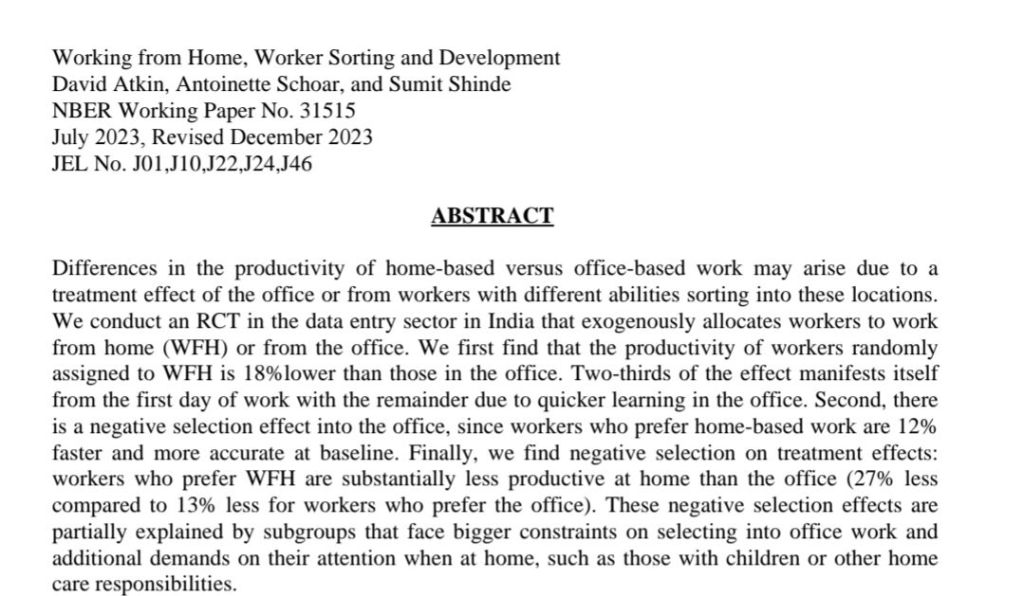
The picture below is of a few paragraphs from the book The Economics of Public Issues, which I often used as a supplemental textbook when I was teaching. Now for modern day Mexico. See How Mexican Cartels Test Fentanyl on Vulnerable People and Animals: A global crackdown on fentanyl has led cartels to innovate production methods…
It’s well-known that when a couple has a child, the average woman experiences a “child penalty” in labor market outcomes, while outcomes for the man are largely unchanged. For a discussion of this pattern using US data, here’s an article by Jane Waldfogel from back in 1998 in the Journal of Economic Perspectives. As that…
By Claudia Goldin. From NPR’s Planet Money.”Countries around the world have seen a jaw-dropping decline in fertility rates. In this paper, Claudia Goldin, the 2023 winner of the Nobel Prize in economic sciences, offers a new theory to help explain why (listen to The Indicator’s conversation with her back in 2021). Goldin starts by providing…
Trump’s first few weeks have been a mix of good and bad for this libertarian, all against a backdrop of horror at how Imperial the presidency has become. But as of today, perhaps the most destructive and stupid initiative has begun: Because we are all tired of those fentanyl-toting Canadians crossing the border illegally. I…
Michael Reddell writes – I’ve spent the last week writing a fairly substantial review of a recent book (“Australia’s Pandemic Exceptionalism: How we crushed the curve but lost the race”) by a couple of Australian academic economists on Australia’s pandemic policies and experiences. For all its limitations, there isn’t anything similar in New Zealand. What […]
Targeting big existing businesses may be tempting to politicians, but ensuring market openness will do more good Eric Crampton writes – It’s fair to say that economists like competition. It’s also fair to say that when politicians start talking about competition, economists ought to get a little bit nervous.
The subtitle is New Estimates of Productivity Growth in England from 1250 to 1870, and the authors are Paul Bouscasse, Emi Nakamura, and Jón Steinsson. Abstract: We estimate productivity growth in England from 1250 to 1870. Real wages over this period were heavily influenced by plague-induced swings in the population. Our estimates account for these […]
Why Evolution is True is a blog written by Jerry Coyne, centered on evolution and biology but also dealing with diverse topics like politics, culture, and cats.
In Hume’s spirit, I will attempt to serve as an ambassador from my world of economics, and help in “finding topics of conversation fit for the entertainment of rational creatures.”
“We do not believe any group of men adequate enough or wise enough to operate without scrutiny or without criticism. We know that the only way to avoid error is to detect it, that the only way to detect it is to be free to inquire. We know that in secrecy error undetected will flourish and subvert”. - J Robert Oppenheimer.


Recent Comments