The Free Press: Bates, “a new tough-on-crime prosecutor, … replaced a scandal-plagued `progressive.’” ” Incapacitation (selection): sometimes referred to as “specific deterrence.” Bates said that his office has identified about about 6,000 frequent, violent offenders and put between 3,000 and 3,500 of them in prison. The cooperation of federal law enforcement has helped take a…
Did incapacitation, deterrence, or rehabilitation reduce crime in Baltimore?
Did incapacitation, deterrence, or rehabilitation reduce crime in Baltimore?
31 May 2026 Leave a comment
in applied price theory, economics of crime, law and economics, politics - USA
Supply is elastic, installment #1637
31 May 2026 Leave a comment
in applied price theory, economics of crime, economics of regulation, health economics, law and economics, transport economics
With deadly precision, the Trump administration has launched dozens of attacks on small boats in the waters off South America, killing nearly 200 people in a campaign U.S. officials say is meant to curb the flow of illicit drugs to the United States. But almost nine months into the operation, epidemiologists, addiction scientists and public…
Supply is elastic, installment #1637
Absurd Cost Overruns Are a Bipartisan Problem
30 May 2026 Leave a comment
in applied price theory, economic history, industrial organisation, managerial economics, organisational economics, survivor principle, theory of the firm

Regarding the pervasive problem of cost overruns (defined as government programs and projects that wind up costing far more than initial estimates), I’ve always appreciated this image sent by a reader. It nicely captures a key reason for cost overruns, which is that there is no bottom-line incentive for bureaucrats and politicians to monitor costs. […]
Absurd Cost Overruns Are a Bipartisan Problem
SEZs as policy trial areas
29 May 2026 1 Comment
in applied price theory, comparative institutional analysis, constitutional political economy, economic growth, economics of regulation, industrial organisation, law and economics, macroeconomics, property rights
A decade ago, I coauthored a report looking at how greater localism and subsidiarity could be achieved in a very centralised country where local councils have variable capabilities. We settled on policy trial areas. The basic gist was as follows. First, a community would pitch a policy trial area – a special economic zone – with different policy…
SEZs as policy trial areas
Europe’s War on Wealth
29 May 2026 Leave a comment
in applied price theory, economic growth, economic history, fiscal policy, income redistribution, industrial organisation, labour economics, labour supply, macroeconomics, occupational choice, P.T. Bauer, poverty and inequality, Public Choice, public economics Tags: European Union

Given the relative economic weakness that plagues most European nations (documented here, here, here, here, and here), a top priority for policy makers should be to improve incentives for wealth creation. But that assumes politicians care about the prosperity of citizens. Based on a new report from the European Commission, the answer is no. Instead of […]
Europe’s War on Wealth
On Private Money
28 May 2026 Leave a comment
in applied price theory, economic history, financial economics, history of economic thought, macroeconomics, monetary economics
TweetHere’s a letter to the Wall Street Journal. Editor: Greg Ip’s argument that cryptocurrencies, being privately issued, will fail as money relies heavily on his historical claim that privately issued bank notes in the 19th-century United States failed as money (“Stablecoins Are Private Money. That’s Why They’re a Risk to the Economy.” May 25). Mr.…
On Private Money
Trade Deficit Illiteracy, Part III
28 May 2026 Leave a comment
in applied price theory, budget deficits, economic growth, fiscal policy, history of economic thought, international economics, macroeconomics, politics - USA
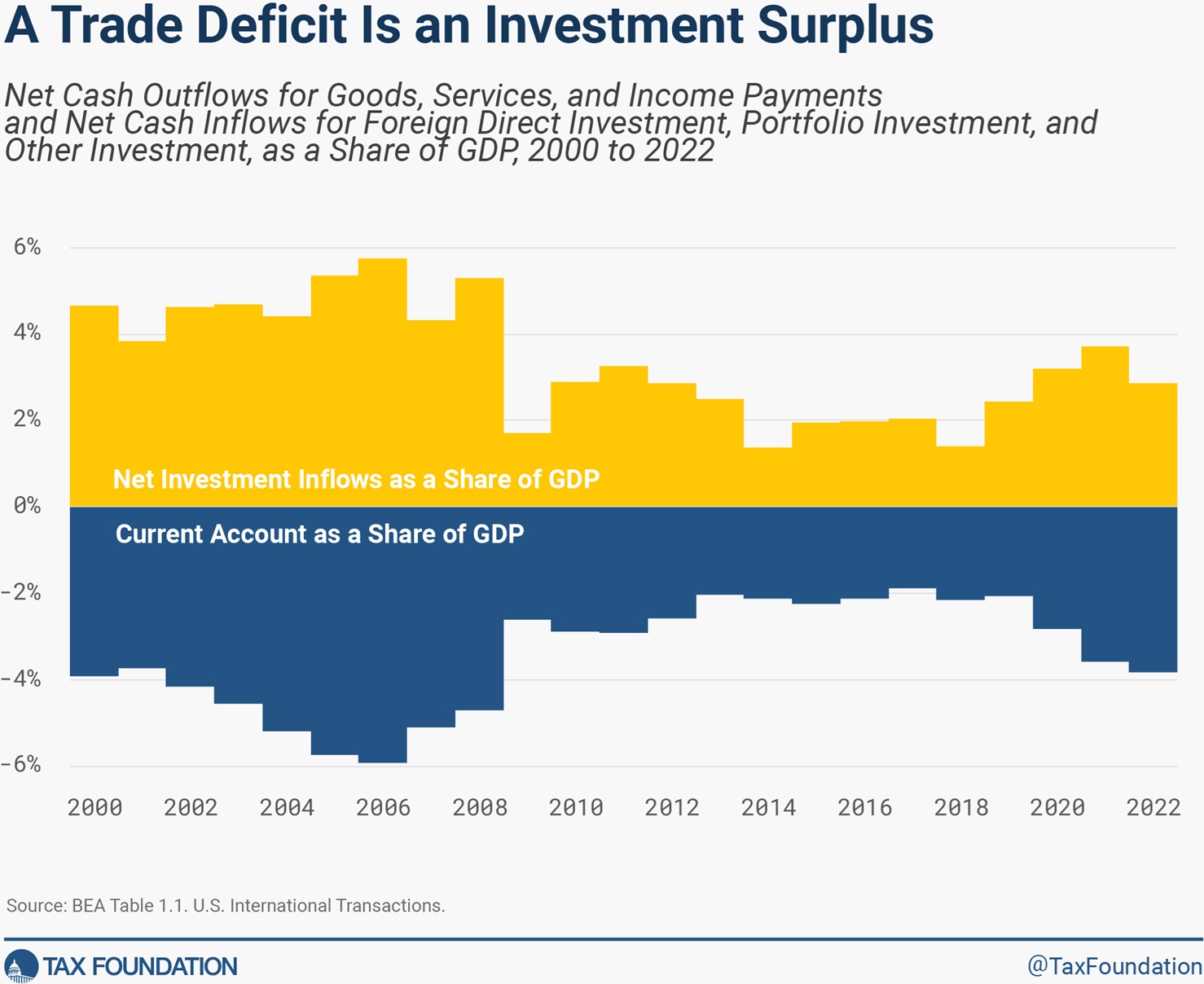
Looking at Part I and Part II, and considering the focus of today’s column, this series should actually be entitled “Trade Deficit Literacy.” That’s because the material I cite explains that a trade deficit is merely the flip side of an investment surplus. And it is good that the United States is a magnet for […]
Trade Deficit Illiteracy, Part III
The corporate tax rate really matters
26 May 2026 Leave a comment
in applied price theory, econometerics, economic growth, economic history, entrepreneurship, fiscal policy, macroeconomics Tags: taxation and entrepreneurship, taxation and investment
Three findings emerge. First, improvements in aggregate tax competitiveness are positively and significantly associated with real GDP per capita growth, robust to a wide range of controls. Second, this aggregate effect is driven entirely by the corporate tax pillar; no other component displays a significant growth effect. Third, the corporate tax effect materializes contemporaneously and…
The corporate tax rate really matters
Quotation of the Day…
26 May 2026 Leave a comment
in applied price theory, history of economic thought, international economics

Tweet… is from pages 171-172 of Menzie Chinn’s and Douglas Irwin’s excellent 2025 textbook, International Economics: The Lerner Equivalence Theorem – that an import tariff is equivalent to an export tax – carries a powerful message: a country that tries to protect import competing industries from foreign competition may be able to help those industries…
Quotation of the Day…
Are Living Standards Higher in France or Mississippi?
25 May 2026 Leave a comment
in applied price theory, economic growth, economic history, income redistribution, labour economics, macroeconomics, poverty and inequality, Public Choice Tags: France

Earlier this month, in Part V of my series on the U.S. vs. Europe (previous versions available here, here, here, and here), I shared a chart showing the OECD calculations of “Actual Individual Consumption.” The AIC numbers are designed to give people an apples-to-apples comparison of living standards. I’m re-sharing the chart today, and I’ve […]
Are Living Standards Higher in France or Mississippi?
Liberal Economists Score an Own Goal Against Bezos
25 May 2026 Leave a comment
in applied price theory, fiscal policy, James Buchanan, labour economics, labour supply, macroeconomics, Public Choice, public economics
Jeff Bezos tweeted: Yes, the United States has the most progressive tax system in the world. The top 1% pay 40% of taxes, the bottom 50% pay 3% of taxes. We can make it even more progressive by zeroing out taxes on the bottom half. It’s a small amount of the total tax revenue but…
Liberal Economists Score an Own Goal Against Bezos
Repugnant Economics
24 May 2026 Leave a comment
in applied price theory, history of economic thought
I spoke on a panel at AEI with Nobelist Al Roth about his new book, Moral Economics, which covers “repugnant markets,” from prostitution to surrogacy to kidney exchange. A fun book! My case study was acting. Acting was considered repugnant for over 2,000 years. In Rome, actors could not vote, hold office, or be trusted…
Repugnant Economics
The (Amusingly) Destructive Economics of Wealth Taxation
24 May 2026 Leave a comment
in applied price theory, economic growth, entrepreneurship, fiscal policy, human capital, income redistribution, labour economics, labour supply, macroeconomics, poverty and inequality, Public Choice, public economics Tags: taxation and entrepreneurship, taxation and investment, taxation and labour supply
I’ve shared several columns (here, here, here, here, and here) reviewing scholarly research on the harmful economic impact of wealth taxation. From now on, however, I think I’ll simply share this clever video from the folks at Reason. The video uses humor to make very important points about how a wealth tax would diminish incentives […]
The (Amusingly) Destructive Economics of Wealth Taxation
Bet On It Book Club: For a New Liberty, Chapter 13
24 May 2026 Leave a comment
in applied price theory, Austrian economics, comparative institutional analysis, economics of regulation, environmental economics, environmentalism, history of economic thought, law and economics, Murray Rothbard, property rights, Public Choice

SummaryThis chapter, on “Conservation, Ecology, and Growth,” is an early statement of free-market environmentalism. It begins by ridiculing leftists’ decades of contradictory complaints about capitalism: “Stagnation; deficient growth; overaffluence; overpoverty; the intellectual fashions changed like ladies’ hemlines,” and quoting one of Schumpeter’s best lines:Capitalism stands its trial before judges who have the sentence of death…
Bet On It Book Club: For a New Liberty, Chapter 13
The Case Against Socialism, Part V
24 May 2026 Leave a comment
in applied price theory, comparative institutional analysis, constitutional political economy, development economics, economic growth, economic history, growth disasters, growth miracles, macroeconomics, Marxist economics Tags: North Korea, South Korea

As far as I know, Matt Mitchell and I are not related, but we both have a low opinion of socialism. He covers a lot of ground (defining socialism, the role of prices, socialism’s death toll, and the myth of Nordic socialism) in this 15-minute interview. Matt does such a good job that I didn’t […]
The Case Against Socialism, Part V
 Utopia, you are standing in it!
Recent Comments