HL Mencken on the Harmful Digital Communication Bill
26 Jun 2015 Leave a comment
in applied price theory, applied welfare economics, comparative institutional analysis, constitutional political economy, economics of crime, economics of media and culture, economics of regulation, law and economics, liberalism, politics - New Zealand, Public Choice Tags: chilling effect, disorderly conduct, free speech, infotopia, Internet trolls, meddlesome preferences, nanny state, offsetting behaviour, The fatal conceit, The pretence to knowledge, unintended consequences
More heat than light in the recent inequality debate
26 Jun 2015 1 Comment
The rise in articles about inequality in NZ sure doesn't match the data on inequality.
youtube.com/watch?v=uCT7aE… http://t.co/z2eWKgXJiL—
Eric Crampton (@EricCrampton) June 26, 2015
Banning Bottled Water: the Unintended Consequences.
26 Jun 2015 Leave a comment
in applied price theory, economics of regulation, health economics, politics - USA Tags: meddlesome preferences, nanny state, offsetting behaviour, The fatal conceit, The pretence to knowledge, unintended consequences
Starting in 2012, the University of Vermont began a process of requiring that all campus locations selling beverages provided 30% “healthy” beverages, and then that all locations phases out all sales of bottled water.
There were two hope: 1) reduced use of bottles, when bottled water was no longer available, and 2) that healthier beverages would be consumed.
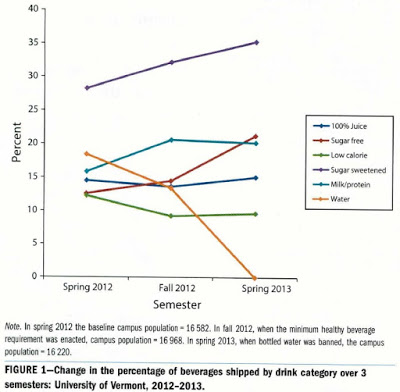
The orange line that drops to zero shows bottled water being phased out. The rising line at the top shows the rise in sugar-sweetened beverages. The red line in the middle that rises sharply shows the rise in sugar-free beverages.
via CONVERSABLE ECONOMIST: Banning Bottled Water: Unintended Consequences.
"You didn’t build that" – which of sport superstars, celebrities and top CEOs earn their pay more?
25 Jun 2015 Leave a comment
in applied price theory, applied welfare economics, entrepreneurship, financial economics, industrial organisation, Marxist economics, politics - New Zealand, politics - USA, rentseeking, sports economics, survivor principle Tags: CEO pay, Leftover Left, obama, superstar wages, superstars, top 1%
Defenders have also pointed to the pay of pro ballplayers or Hollywood stars, but they do not determine their own pay (as CEOs do) and are paid based on performance. Once they begin to fail, they are dumped. By contrast, CEO pay isn’t tied to performance in any meaningful way.
It’s a big concession to say that athletes and celebrities earn their pay but top CEOs don’t. Most of all, that concession changes the case against the top 1% from inequality to just desert – a big shift in theories of distributive justice. It’s also a big risk to base the argument for greater equality and a 80% top tax rate not only on the excesses of CEOs but on the very specific and testable hypothesis that these CEOs determine their own pay.
if we are to look at CEOs, top athletes and Hollywood celebrities, it is the athletes and celebrities who benefited the most from the windfall of been able to service huge markets through the global media market.
Figure 1: CEO pay and share market performance
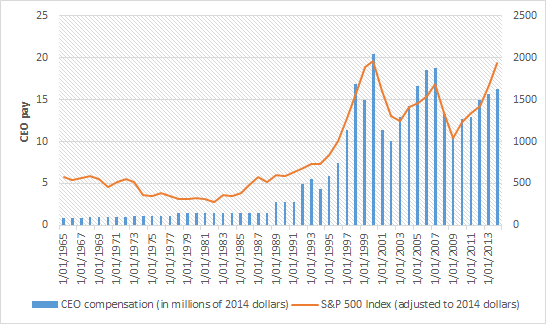
Source: Economic Policy Institute.
CEOs actually have to run large complex companies to earn their pay, which is why their compensation tracks the share market relatively closely. Athletes and celebrities don’t do that what they do any better than in the past. They simply do it in front of a global media market. Since the late 1970s, the ratio of average pay of CEOs of large public companies to the average market value of those companies has stayed relatively constant: CEO pay grew hand in hand with corporations.
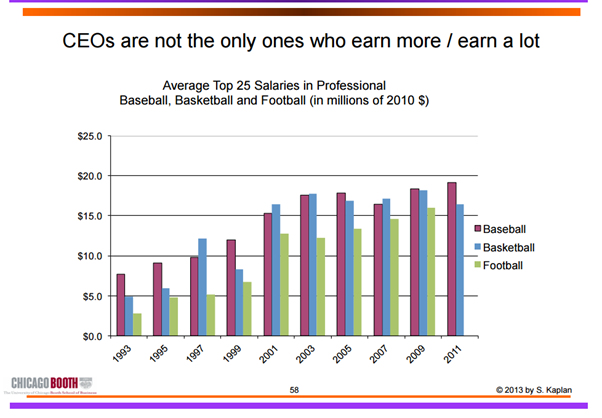
Steven Kaplan and Joshua Rauh make a number of basic points backed up by detailed evidence about CEO pay:
- While top CEO pay has increased, so has the pay of private company executives and hedge fund and private equity investors;
- ICT advances increase the pay of many – of professional athletes (technology increases their marginal product by allowing them to reach more consumers), Wall Street investors (technology allows them to acquire information and trade large amounts more easily), CEOs and technology entrepreneurs in the Forbes 400; and
- Technology allows top executives and financiers to manage larger organizations and asset pools – a loosening of social norms and a lack of independent control of CEO pacesetting does not explain similar increases in pay for private companies– technology explains it;
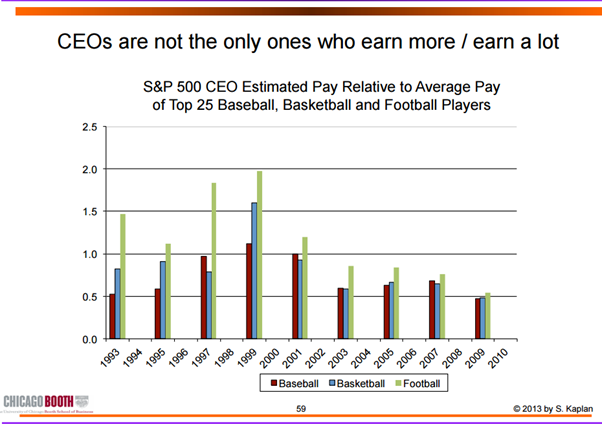
To put it simply:
If the reason for growth of incomes at the very top is, say, managerial power in publicly owned companies, then one would expect the increases in income at the top levels to be much larger for that group.
But the breadth of the occupations that have seen a rise in top income levels is much more consistent with the argument that the increase in “superstar” pay (or pay at the top) has been driven by the growth of information and communications technology, and the ways this technology allows individuals with particular skills that are in high demand to expand the scale of their performance.
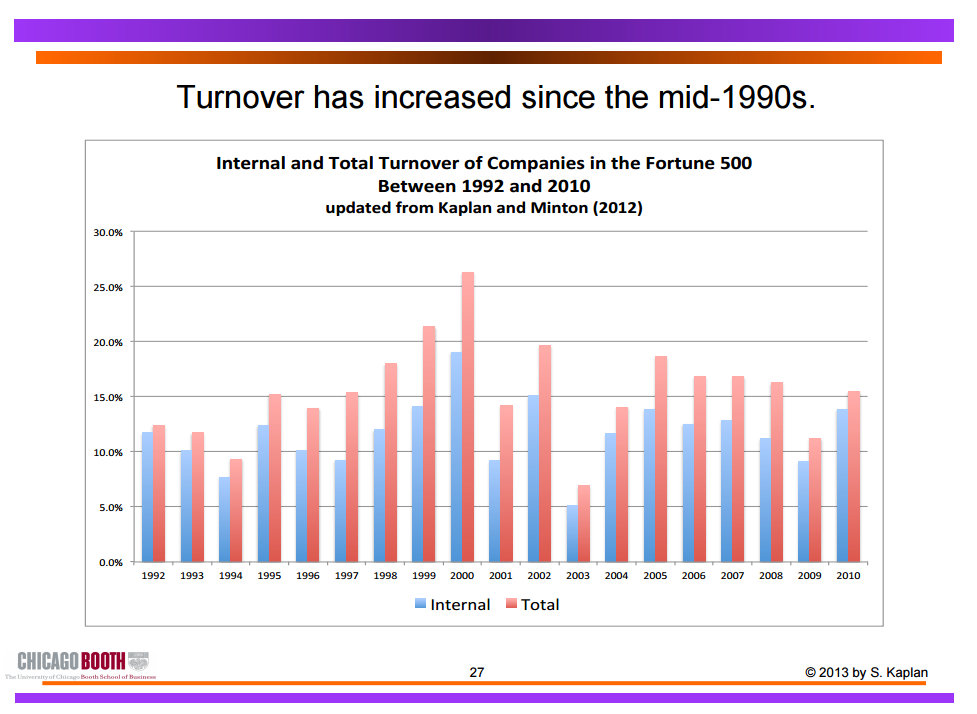
As for the turnover argument, that underperforming athletes and celebrities are dropped, prior to the GFC, CEO turnover was already on the rise:
Turnover is 14.9% from 1992 to 2005, implying an average tenure as CEO of less than seven years. In the more recent period since 1998, total CEO turnover increases to 16.5%, implying an average tenure of just over six years.
Internal turnover is significantly related to three components of firm performance – performance relative to industry, industry performance relative to the overall market, and the performance of the overall stock market.
Only 21.3% of CEOs in 1992 remained in that role in 1999; only 16.35% of CEOS on the job in 2000 were there in 2007. In any given year, one out of six Fortune 500 CEOs loses their jobs, compared to one out of 10 in the 1970s.
Dirk Jenter and Fadi Kanaan in a study of of 3,365 CEO turnovers from 1993 to 2009 found that:
CEOs are significantly more likely to be dismissed from their jobs after bad industry and, to a lesser extent, after bad market performance. A decline in industry performance from the 90th to the 10thpercentile doubles the probability of a forced CEO turnover.
In another study, Kaplan found that average CEO pay increased substantially during the 1990s, but declined by more than 30% from peak levels reached around 2000.
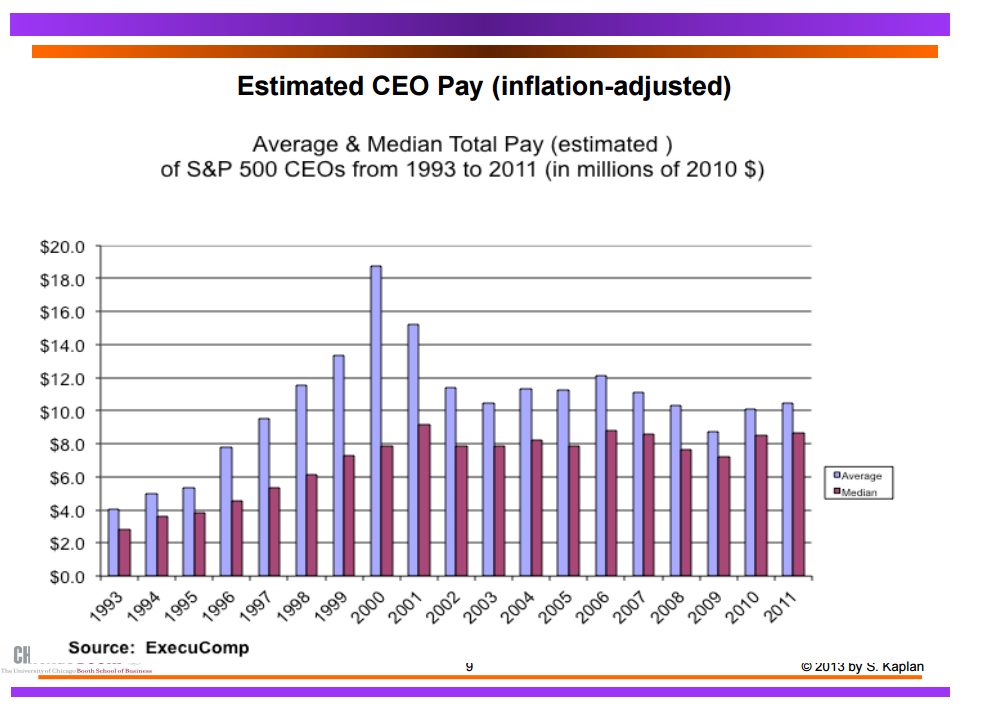
In addition, private company executives have seen their pay increase by at least as much as public companies. Private company executives with fewer agency problems have increased by more than public company executives. To close with another quote from Kaplan:
The point of these comparisons is to confirm that while public company CEOs earn a great deal, they are not unique. Other groups with similar backgrounds–private company executives, corporate lawyers, hedge fund investors, private equity investors and others—have seen significant pay increases where there is a competitive market for talent and managerial power problems are absent.
Again, if one uses evidence of higher CEO pay as evidence of managerial power or capture, one must also explain why these professional groups have had a similar or even higher growth in pay. It seems more likely that a meaningful portion of the increase in CEO pay has been driven by market forces as well.
@MaxRashbrooke The top 1% in New Zealand are lazy and incompetent as a ruling class
24 Jun 2015 1 Comment
in applied price theory, applied welfare economics, economic history, entrepreneurship, health and safety, human capital, industrial organisation, liberalism, Marxist economics, poverty and inequality, Rawls and Nozick, unions Tags: capitalism and freedom, Class war, Joan Robinson, Joseph Schumpeter, social insurance, The Great Enrichment, top 1%, welfare state, withering away in the proletariat
New work by Chris Ball and John Creedy shows substantial *declines* in NZ inequality.
initiativeblog.com/2015/06/24/ine… http://t.co/f94fw4Bhae—
Eric Crampton (@EricCrampton) June 24, 2015
The top 1% in New Zealand really have been dropping the class war ball for at least a generation.
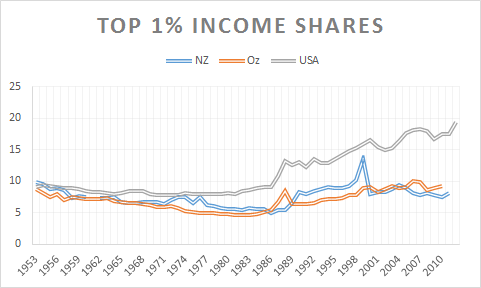
Source: The World Top Incomes Database.
Not only have the New Zealand top 1% been pretty miserable at increasing their share of incomes, hardly any change since 1990 and not much before that, the top 1% allowed inequality in both consumption and disposable income to actually fall since 1990 as shown by Treasury analysis published today.
Joan Robinson was on to this in the 1940s when she said the battle cry of Marxists would have to change from the 1848 version “rise up ye workers, rise up for you have nothing to lose but your chains” to “rise up ye workers, rise up for you have nothing to lose but the prospect of a suburban home and a motorcar”.

Today that battle cry of the Marxist revolution would have to be “rise up ye workers rise up for you have nothing to lose but your iPhone and your air points”. As Joan Robinson observed in the 1940s, that’s not much of a basis for a revolutionary movement.
The opportunity cost of renewable energy subsidies
22 Jun 2015 Leave a comment
in applied price theory, applied welfare economics, development economics, environmental economics, global warming, health economics, Public Choice, rentseeking Tags: climate alarmism, evidence-based policy, global warming, green rent seeking
Millennials’ Political Views Don’t Make Any Sense
22 Jun 2015 Leave a comment
in applied price theory, comparative institutional analysis, constitutional political economy, economics of information, economics of media and culture, income redistribution, politics - USA, Public Choice, rentseeking Tags: antiforeign bias, antimarket bias, expressive voting, make-work bias, rational ignorance, rational irrationality, voter demographics
Millennial politics is simple, really. Young people support big government, unless it costs any more money. They’re for smaller government, unless budget cuts scratch a program they’ve heard of. They’d like Washington to fix everything, just so long as it doesn’t run anything.

Young people lean way left on issues like gay marriage, pot, and immigration. On abortion and gun control, they swim closer to the rest of the electorate.
But on economics, they’re all over the map. You get the sense, reading the Reason Foundation and Pew studies, that a savvy pollster could trick a young person into supporting basically any economic policy in the world with the right combination of triggers. Conservative and liberal partisans can cherry-pick this survey to paint Millennials as whatever ideology they want.

On spending:
Conservatives can say: 65 percent of Millennials would like to cut spending.
Liberals can say: 62 percent would like to spend more on infrastructure and jobs.On taxes:
Conservatives can say: 58 percent of Millennials want to cut taxes overall.
Liberals can say: 66 percent want to raise taxes on the wealthy.On government’s role in our lives:
Conservatives can say: 66 percent of Millennials say that “when something is funded by the government, it is usually inefficient and wasteful.”
Liberals can say: More than two-thirds think the government should guarantee food, shelter, and a living wage.On government size:
Conservatives can say: 57 percent want smaller government with fewer services (if you mention the magic word “taxes”).
Liberals can say: 54 percent want larger government with more services (if you don’t mention “taxes”).

via Millennials’ Political Views Don’t Make Any Sense – The Atlantic and This poll proves that millennials have totally incoherent political views – Vox.
Gun-free zones an easy target for killers | John Lott
19 Jun 2015 1 Comment
in applied price theory, economics of crime, economics of regulation, law and economics, politics - USA Tags: game theory, gun control, John Lott, mass public shootings, offsetting behaviour, read killers, The fatal conceit, The pretence to knowledge, unintended consequences

The difference between tariffs and quotas
18 Jun 2015 Leave a comment
in applied price theory, applied welfare economics, industrial organisation, international economics Tags: antimarket bias, import competition, international trade, protectionism, quotas, tariffs
What’s the difference between #tariffs and #quotas? Let’s find out buff.ly/1FS7QkZ http://t.co/hsx2VVG5e6—
MRUniversity (@MRevUniversity) May 30, 2015
The opportunity cost of expressive politics: fossil fuels disinvestment versus actually doing something that might help
17 Jun 2015 Leave a comment
in applied price theory, applied welfare economics, comparative institutional analysis, environmental economics, global warming, politics - Australia, politics - New Zealand, politics - USA, Public Choice, rentseeking Tags: cap and trade, carbon tax, carbon trading, climate alarmism, expressive voting, fossil fuel disinvestment, global warming, rational irrationality, Robert Stavins

Mises on the dangers of specialisation and economic analysis
17 Jun 2015 Leave a comment
in applied price theory, applied welfare economics, comparative institutional analysis, constitutional political economy, Ludwig von Mises Tags: division of labour, methodology of economics, philosophy of economics, The fatal conceit, The pretence to knowledge
Mises on why economics analysis is so unpopular
14 Jun 2015 Leave a comment
in applied price theory, applied welfare economics, comparative institutional analysis, constitutional political economy, economics of bureaucracy, income redistribution, Ludwig von Mises, Public Choice, rentseeking Tags: antiforeign bias, antimarket bias, expressive voting, green rent seeking, makework bias, NIMBYs, rational ignorance, rational irrationality
Milton Friedman on the essence of the Age of the Worker
13 Jun 2015 Leave a comment
in applied price theory, applied welfare economics, economic growth, economic history, health and safety, income redistribution, industrial organisation, labour economics, labour supply, macroeconomics, Milton Friedman, occupational choice, politics - Australia, politics - New Zealand, politics - USA, Public Choice, rentseeking, unions Tags: competition and monopoly, The Great Enrichment, union power, union wage premium
Supplements to wages and salaries have grown dramatically, but labour compensation inequality has not
12 Jun 2015 Leave a comment
in applied price theory, applied welfare economics, politics - Australia, politics - New Zealand, politics - USA Tags: Leftover Left, Piketty, top 1%
Gross Domestic Income (GDI) is a complete measure of all income earned in the United States. About half is wages, salaries, and benefits. A quarter goes to business-level taxes and the replacement of worn out machinery. Another quarter of gross domestic income is returned to owners of capital, including business owners and private homeowners.
The shares of income returned to workers and owners of capital remain constant over time once benefits, taxes, and depreciation are accounted for – two-thirds of net income goes to labour and one-third goes to capital.
Rather than focus on shares of GDP, a recent preoccupation of the Left over Left, we should focus on shares of labour compensation, that is, wages, salaries and fringe benefits. Both Piketty and his critics agree on that.

via A Walkthrough of Gross Domestic Income | Tax Foundation.
The Nordics use optimal tax theory to fund their welfare states
12 Jun 2015 Leave a comment
in applied price theory, economic history, politics - USA, Public Choice, public economics Tags: Denmark, growth of government, Norway, optimal tax theory, Scandinavia, size of government, Sweden, welfare state
Efficient taxes gather more revenue and therefore are capable of funding a larger public sector with less political resistance from groups who are net taxpayers. The so-called neoliberal reforms of the 1980s and 1990s actually saved the welfare state by putting it on a revenue raising structure that provoked less political resistance.
A switch to more efficient taxes through tax reforms allows governments to raise the same amount or larger amount of revenue for the same level of political resistance from taxpayers. This is because less revenue and output is wasted by discouraging labour supply, investment, savings and investment in capital with high marginal rates of tax on narrower tax basis. Everyone gains from converging on more efficient modes redistribution.
The Nordic countries have been on to this application of optimal tax theory to expanding the size of government and the welfare state for a long time. The Nordics have high but flat taxes on labour income, low taxes on business income and a high, broad-based consumption tax be it called a VAT or GST as illustrated by a just published Tax Foundation report.
To begin with, the USA has a smaller government because it relies more income taxes than on consumption taxes.

Governments in Europe switched towards consumption taxes such as the VAT or GST because this allowed them to raise a large amount of revenue with broad-based taxes at low rates. A VAT or GST exempts exports and business to business transactions from taxes so that reduced taxpayer resistance.
Scandinavian income taxes raise much more revenue than in the USA because they are rather flat. That is, they tax most people at these high rates, not just high-income taxpayers. The top tax rate in the Scandinavian countries cuts in at about one and a half times average income or less rather than eight times average income as in the USA.
Flat high tax "How do Scandinavian countries pay for their govt spending?" bit.ly/1KZ7jOs @JimPethokoukis http://t.co/33oRg8Ozqh—
Old Whig (@aClassicLiberal) June 11, 2015
The marginal income tax rates including this top income tax rate cuts in a low level of income is also rather high in the Nordic countries relative to the USA’s top income tax rate with the exception of Norway.

Nonetheless the Nordic countries are alert to not killing the goose that laid the golden egg. Company taxes are relatively low in Scandinavian countries as compared to the USA so that businesses do not flee to other jurisdictions.

Top marginal tax rates on dividends and capital gains are not above-average in the Nordic states but their taxes on less mobile tax bases such as from labour and consumption are much higher.

A large welfare state such as those in the Nordic countries require a significant amount of revenue, so the tax base in these countries must be broad. This also means higher taxes on consumption through the VAT or GST and higher taxes on middle-income taxpayers.
Business taxes are a less reliable source of revenue because of capital flight and disincentives to invest. Thus, the Nordics do not place above-average tax burdens on capital income and focus taxation on labour and consumption.
via Sources of Government Revenue across the OECD, 2015 | Tax Foundation and How Scandinavian Countries Pay for Their Government Spending | Tax Foundation.


Recent Comments