Shocker! EPA chief admits nature can ‘restore’ itself (but only if the EPA caused the problem)
15 Aug 2015 Leave a comment
in comparative institutional analysis, economics of bureaucracy, economics of media and culture, economics of regulation, environmental economics, industrial organisation, Public Choice, public economics Tags: constitutional law, sovereign immunity
Pope Francis Needs a Better Role Model for Economic Policy
15 Aug 2015 Leave a comment
in applied price theory, applied welfare economics, comparative institutional analysis, constitutional political economy, economics of bureaucracy, Public Choice Tags: Catholic Church, The fatal conceit, The pretense to knowledge

What’s the greatest economic tragedy in modern history?
The obvious answer is communism, which produced tens of millions of needless deaths and untold misery for ordinary people.  Just compare living standards in North Korea and South Korea, or Chile and Cuba.
But if there was a second-place prize for the world’s biggest economic failure, Argentina would be a strong contender.
Here’s one fact that tells you everything you need to know. In 1946, when Juan Perón came to power, Argentina was one of the 10-richest nations in the world. Economic policy certainly wasn’t perfect, but government wasn’t overly large are markets generally were allowed to function. Combined with an abundance of natural resources, that enabled considerable prosperity.
But Perón decided to conduct an experiment in statism.
Here’s how Wikipedia describes his economic policy.
Campaigning among workers with promises of land, higher wages, and social security, he won…
View original post 630 more words
Does fair trade help the poor?
11 Aug 2015 Leave a comment
in applied price theory, applied welfare economics, comparative institutional analysis, development economics, growth disasters, growth miracles, health and safety, human capital, industrial organisation, international economics, labour economics, survivor principle Tags: agricultural economics, expressive voting, fair trade, rational irrationality
How @equitablegrowth showed inequality helps growth when arguing inequality harms growth
10 Aug 2015 1 Comment
in applied price theory, applied welfare economics, comparative institutional analysis, currency unions, economic growth, economic history, economics of regulation, entrepreneurship, Euro crisis, fiscal policy, global financial crisis (GFC), income redistribution, labour economics, labour supply, macroeconomics, Marxist economics, poverty and inequality, Public Choice, public economics, rentseeking Tags: British disease, entrepreneurial alertness, Eurosclerosis, France, German unification, Germany, growth of government, sick man of Europe, social insurance, Sweden, taxation and entrepreneurship, taxation and investment, taxation and labour supply, welfare state
The Washington Centre for Equitable Growth recently tweeted that inequality harms growth in the USA as compared to Sweden, France, Germany and the UK. It was relying on some dodgy OECD research.
.@OECD sees continued rise in growth-harming inequality, reports @PaulHannon29 on.wsj.com/1EZpq1S http://t.co/xt4heZysXT—
Equitable Growth (@equitablegrowth) May 21, 2015
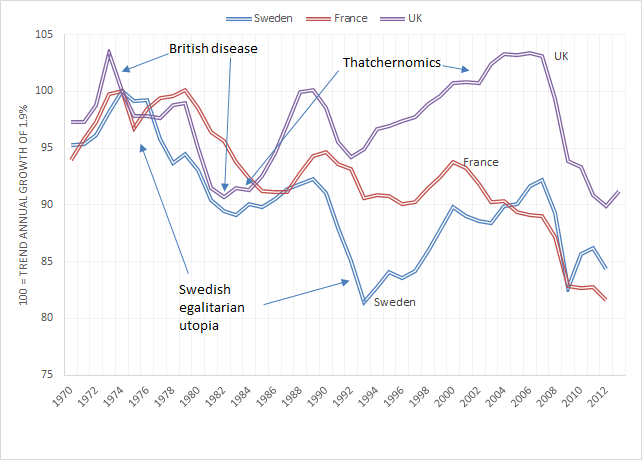
The Washington Centre for Equitable Growth did not check their inequality ratios they tweeted against trends in economic growth and economic policy since 1970, which I have reproduced in figure 1. Germany is not included in figure 1 because German data on growth is thrown askew by German unification.
Figure 1: Real GDP per British, French and Swede aged 15-64, 2014 US$ (converted to 2014 price level with updated 2011 PPPs), 1.9 per cent detrended, 1970-2013
Source: Computed from OECD Stat Extract and The Conference Board. 2015. The Conference Board Total Economy Database™, May 2015, http://www.conference-board.org/data/economydatabase/
Figure 1 shows that France has been in a long-term decline since the late 1970s despite the blessings of a more equal society than the USA as championed by the Washington Centre for Equitable Growth. In figure 1, a flat line is growth in real GDP per working age person, PPP, at the same rate as the USA for the 20th century, which was 1.9% per year. A falling line in figure 1 indicates growth of less than 1.9% while a rising line indicates growth in real GDP per working age person, PPP, in excess of 1.9%. In figure 1, France hardly ever grew at the trend rate of growth for the USA of 1.9% per year and was frequently well below that rate.

Sweden tells a slightly different story in figure 1 because of regime change in the early 1990s when Sweden adopted more liberal economic policies where taxes and government spending were reduced:
The rapid growth of the state in the late 1960s and 1970s led to a large decline in Sweden’s relative economic performance. In 1975, Sweden was the 4th richest industrialised country in terms of GDP per head. By 1993, it had fallen to 14th.
@alexvoronov använda smygfinansiering av Generell Välfärd är alltid av ondo. @NimaSanandaji: bit.ly/1Nar2eV http://t.co/wD0YEgncIE—
Old Whig (@aClassicLiberal) August 05, 2015
That regime change reversed a long economic decline since 1970 under the egalitarian policies of the Swedish Social Democratic Party. Under the Swedish Social Democratic Party, Sweden was almost always growing at less than the trend rate of growth of the USA, which was 1.9%. That position reversed only when there was a turn away from big government and high taxes.

Figure 1 tells a similar story for the British economy: a long economic decline in the 1970s when Britain was the sick man of Europe. Under Thatchernomics, Europe had a long economic boom for 20 years or more – see figure 1.
In the 1970s, under the high taxes of the Heath, Callaghan and Wilson administrations, as figure 1 shows, Britain was the sick man of Europe. With the election of the Thatcher Government, Britain soon grew at better than the US trend growth rate for nearly 20 years through few exceptions.
Graph of the Day: The UK has among the lowest total tax rates on businesses in the G7 http://t.co/l6mMhN9yLD—
CPS Think Tank (@CPSThinkTank) August 04, 2015
Swedosclerosis and Eurosclerosis compared
10 Aug 2015 Leave a comment
in applied welfare economics, comparative institutional analysis, economic growth, economic history, economics of regulation, industrial organisation, labour economics, labour supply, macroeconomics, survivor principle Tags: Eurosclerosis, Sweden, taxation and entrepreneurship, taxation and investment, taxation and labour supply, welfare state
Adam Smith on entrepreneurial alertness
08 Aug 2015 Leave a comment
in Adam Smith, applied price theory, comparative institutional analysis, economic history, economics of regulation, entrepreneurship, industrial organisation Tags: creative destruction, entrepreneurial alertness, offsetting behaviour, The meaning of competition
There is an economic literature on feuds and duelling
07 Aug 2015 Leave a comment
in applied price theory, comparative institutional analysis, economic history, economics of media and culture Tags: adverse selection, asymmetric information, competition as a discovery procedure, duals, feuds, game theory, moral hazard, screening, signalling
How they resolved spats before Twitter existed
thepoke.co.uk/2015/07/26/res… http://t.co/a04CTYT2aX—
The Poke (@ThePoke) July 27, 2015
The Left opposed airline deregulation
05 Aug 2015 Leave a comment
in applied price theory, applied welfare economics, comparative institutional analysis, economic history, economics of regulation, entrepreneurship, income redistribution, industrial organisation, politics - Australia, politics - New Zealand, politics - USA, Public Choice, rentseeking, survivor principle Tags: airline deregulation, antimarket bias, bootleggers and baptists, expressive voting, Leftover Left, rational ignorance, rational irrationality
CHART: US average airfares 1979 to 2014 measured in number of hours work at the average wage. @chartoftheday http://t.co/q7Phz3VkU0—
Mark J. Perry (@Mark_J_Perry) August 02, 2015
An internal inconsistency in certain leading conspiracy theories
05 Aug 2015 Leave a comment
in applied price theory, comparative institutional analysis, economics of bureaucracy, economics of media and culture, health economics, Public Choice, rentseeking Tags: antiscience left, climate alarmism, conspiracy theories, conspiracy theorists, GMOs, political psychology
Must we always tread on eggshells?
03 Aug 2015 Leave a comment
in applied welfare economics, comparative institutional analysis, economics of media and culture, liberalism Tags: free speech, meddlesome preferences, moral panic, nanny state, political correctness, trigger warnings
Trigger Warning: Those easily offended could be offended by this message. http://t.co/69NRjjeK7y—
Mark J. Perry (@Mark_J_Perry) July 28, 2015
North and South Korea in the 20th century
03 Aug 2015 Leave a comment
in applied price theory, applied welfare economics, comparative institutional analysis, constitutional political economy, development economics, economic history, economics of bureaucracy, growth disasters, growth miracles, income redistribution, Marxist economics, Public Choice, rentseeking Tags: central planning, North Korea, South Korea
Deirdre McCloskey’s speech on ‘Bourgeois Dignity’
03 Aug 2015 Leave a comment
in applied price theory, applied welfare economics, comparative institutional analysis, constitutional political economy, economic history, entrepreneurship, industrial organisation, law and economics, property rights, survivor principle Tags: Deirdre McCloskey, entrepreneurial alertness, industrial revolution, The Great Enrichment, The Great Fact
The fates of two islands under constant threat from a neighbouring military colossus
01 Aug 2015 Leave a comment
in applied price theory, applied welfare economics, Austrian economics, comparative institutional analysis, constitutional political economy, development economics, economics of media and culture, economics of regulation, growth disasters, growth miracles, income redistribution, industrial organisation, law and economics, liberalism, Marxist economics, property rights, Public Choice, rentseeking, survivor principle Tags: anticapitalist mentality, antimarket bias, capitalism and freedom, China, Cuba, expressive voting, Hong Kong, Leftover Left, public intellectuals, rational ignorance, rational irrationality, Twitter left
What is the Great Fact?
31 Jul 2015 Leave a comment
in comparative institutional analysis, development economics, economic history Tags: Deirdre McCloskey, The Great Fact
Developing countries’ share of economic activity increased from 20% of global GDP in 2000 to 40% in 2013—@JimKim_WBG http://t.co/QxqPkGjzvQ—
World Bank (@WorldBank) June 09, 2015
"Starvation worldwide is at an all-time low & falling…" —@DeirdreMcClosk. Data to explore: buff.ly/1G78cDt http://t.co/598P4mYdzH—
HumanProgress.org (@humanprogress) June 09, 2015


Recent Comments