Drug Price Controls End Up Costing Patients Their Lives
24 Sep 2015 Leave a comment
in applied price theory, applied welfare economics, comparative institutional analysis, economics of regulation, entrepreneurship, health economics, industrial organisation, law and economics, politics - USA, property rights, survivor principle Tags: creative destruction, endogenous growth theory, innovation, intellectual property rights, patents and copyrights, pharmaceutical innovation, price controls
Our research shows that when prices fall, innovation falls even more. Patients would see their lives cut short by delayed or absent drugs.
Source: Drug Price Controls End Up Costing Patients Their Health – NYTimes.com
…cutting prices by 40 to 50 percent in the United States will lead to between 30 and 60 percent fewer R and D projects being undertaken in the early stage of developing a new drug. Relatively modest price changes, such as 5 or 10 percent, are estimated to have relatively little impact on the incentives for product development – perhaps a negative 5 percent.
Source: The Effect of Price Controls on Pharmaceutical Research


Stigler on economics as a big tent @RusselNorman @NZGreens @GreenpeaceNZ @Mark_J_Perry
21 Sep 2015 1 Comment

The Twitter Left believes in obedience to authority as long as they are in charge
21 Sep 2015 Leave a comment
in comparative institutional analysis, liberalism, Marxist economics, Music, Public Choice Tags: political psychology, The Who
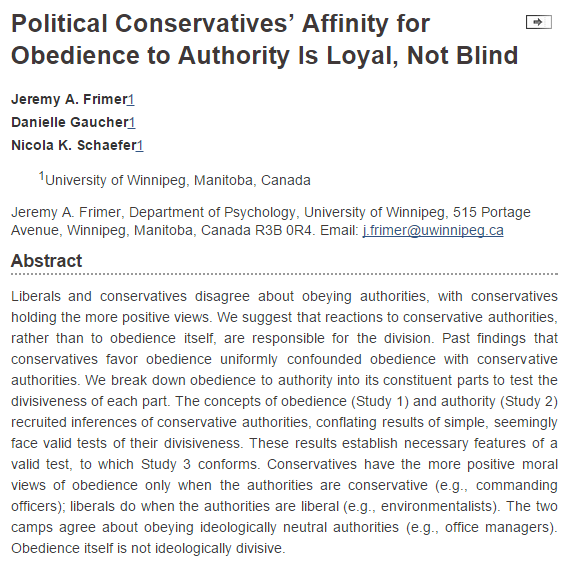
Yesterday’s hippies, today’s grumpy old man, believed they were sticking it to the man. The only real problem of the left wing of politics with authority was they and those like them were not in charge. Jeremy Frimer explains:
Together with my collaborators Dr. Danielle Gaucher and Nicola Schaefer, we asked both red and blue Americans to share their views about obeying liberal authorities (e.g., “obey an environmentalist”). In an article that we recent published in Personality and Social Psychology Bulletin, we found that liberals were now the ones calling for obedience.
And when the authorities were viewed as ideologically neutral (e.g., office manager), liberals and conservatives agreed. Only when people perceived the authority to be conservative (e.g., religious authority) did conservatives show a positive bias…
Liberal versus conservative is like Yankee fans versus Red Socks fans. Each has its own flag to which it pledges allegiance. And each side has its own authorities to which it demands obedience.
Hayek explains the inexplicable value of capitalism and traditions
13 Sep 2015 Leave a comment
in applied price theory, applied welfare economics, comparative institutional analysis, constitutional political economy, F.A. Hayek, liberalism Tags: capitalism and freedom, market selection, spontaneous order, The meaning of competition
@NZGreens are so polite on Twitter @MaramaDavidson @RusselNorman @greencatherine
12 Sep 2015 1 Comment
in comparative institutional analysis, constitutional political economy, economics of media and culture, liberalism, managerial economics, organisational economics Tags: Cass Sunstein, Daily Me, information cocoons, infotopia, John Stuart Mill, Karl Popper, New Zealand Greens, Twitter, Twitter left
One of the first things I noticed when feuding on Twitter with Green MPs was how polite they were. Twitter is not normally known for that characteristic and that is before considering the limitations of 144 characters. People who are good friends and work together will go to war over email without any space limitations for the making an email polite and friendly. Imagine how easy it is to misconstrue the meaning and motivations of tweets that can only be 144 characters.

The New Zealand Green MPs in their replies on Twitter make good points and ask penetrating questions that explain their position well and makes you think more deeply about your own. Knowledge grows through critical discussion, not by consensus and agreement.

Cass Sunstein made some astute observations in Republic.com 2.0 about how the blogosphere forms into information cocoons and echo chambers. People can avoid the news and opinions they don’t want to hear.
Sunstein has argued that there are limitless news and information options and, more significantly, there are limitless options for avoiding what you do not want to hear:
- Those in search of affirmation will find it in abundance on the Internet in those newspapers, blogs, podcasts and other media that reinforce their views.
- People can filter out opposing or alternative viewpoints to create a “Daily Me.”
- The sense of personal empowerment that consumers gain from filtering out news to create their Daily Me creates an echo chamber effect and accelerates political polarisation.
A common risk of debate is group polarisation. Members of the deliberating group move toward a more extreme position relative to their initial tendencies! How many blogs are populated by those that denounce those who disagree? This is the role of the mind guard in group-think.

Sunstein in Infotopia wrote about how people use the Internet to spend too much time talking to those that agree with them and not enough time looking to be challenged:
In an age of information overload, it is easy to fall back on our own prejudices and insulate ourselves with comforting opinions that reaffirm our core beliefs. Crowds quickly become mobs.
The justification for the Iraq war, the collapse of Enron, the explosion of the space shuttle Columbia–all of these resulted from decisions made by leaders and groups trapped in “information cocoons,” shielded from information at odds with their preconceptions. How can leaders and ordinary people challenge insular decision making and gain access to the sum of human knowledge?
Conspiracy theories had enough momentum of their own before the information cocoons and echo chambers of the blogosphere gained ground.

J.S. Mill pointed out that critics who are totally wrong still add value because they keep you on your toes and sharpened both your argument and the communication of your message. If the righteous majority silences or ignores its opponents, it will never have to defend its belief and over time will forget the arguments for it.
As well as losing its grasp of the arguments for its belief, J.S. Mill adds that the majority will in due course even lose a sense of the real meaning and substance of its belief. What earlier may have been a vital belief will be reduced in time to a series of phrases retained by rote. The belief will be held as a dead dogma rather than as a living truth.
Beliefs held like this are extremely vulnerable to serious opposition when it is eventually encountered. They are more likely to collapse because their supporters do not know how to defend them or even what they really mean.

J.S. Mill’s scenarios involves both parties of opinion, majority and minority, having a portion of the truth but not the whole of it. He regards this as the most common of the three scenarios, and his argument here is very simple. To enlarge its grasp of the truth, the majority must encourage the minority to express its partially truthful view. Three scenarios – the majority is wrong, partly wrong, or totally right – exhaust for Mill the possible permutations on the distribution of truth, and he holds that in each case the search for truth is best served by allowing free discussion.

Mill thinks history repeatedly demonstrates this process at work and offered Christianity as an illustrative example. By suppressing opposition to it over the centuries Christians ironically weakened rather than strengthened Christian belief. Mill thinks this explains the decline of Christianity in the modern world. They forgot why they were Christians.
An opportunity lost – to expel #WesternAustralia from the rest of Australia and seal the border
11 Sep 2015 Leave a comment
in comparative institutional analysis, constitutional political economy, economic history, politics - USA, Public Choice, rentseeking Tags: Australia, economics of borders, economics of succession, Scotland, self-determination, succession movements, Western Australia
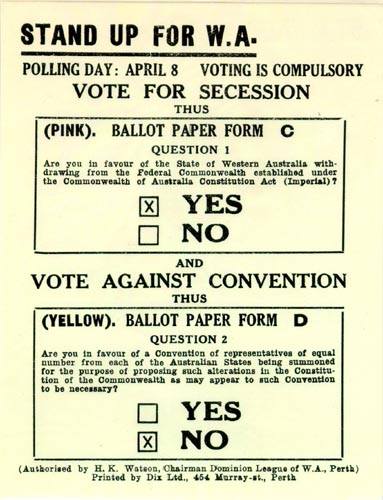
Western Australian secessionists, in common with Scottish nationalists, really do like to dictate the terms of their succession which always includes an open border and a generous financial settlement regarding division of federal government debts.
How arrogant. Why should parting be sweet? If you do not want us, why should we want you. If you want to find your own destiny, you can find it good and hard.
Applied welfare economics was never value free, but applied price theory is @TimothyTTaylor
11 Sep 2015 Leave a comment
in applied welfare economics, comparative institutional analysis, constitutional political economy, history of economic thought, liberalism, Murray Rothbard Tags: David Colander, Henry Hazlitt, Joan Robinson, methodology of economics
The first words uttered in my first lecture in applied welfare economics by Bob Rutherford were ‘this course starts with an explicit political position – that of liberalism’. I never forgot that.

Source: CONVERSABLE ECONOMIST: Crossing the Ravine from Economic Theory to Policy Advice.
This leads us to Robert and Zeckhauser’s taxonomy of disagreement:
Positive disagreements can be over questions of:
1. Scope: what elements of the world one is trying to understand?
2. Model: what mechanisms explain the behaviour of the world?
3. Estimate: what estimates of the model’s parameters are thought to obtain in particular contexts?
Values disagreements can be over questions of:
1. Standing: who counts?
2. Criteria: what counts?
3. Weights: how much different individuals and criteria count?
Any positive analysis tends to include elements of scope, model, and estimation, though often these elements intertwine; they frequently feature in debates in an implicit or undifferentiated manner. Likewise, normative analysis will also include elements of standing, criteria, and weights, whether or not these distinctions are recognised.
The origin of political disagreement is a broad church indeed in a liberal democracy. Those you disagree with are not evil, they just disagree with you. As Karl Popper observed:
There are many difficulties impeding the rapid spread of reasonableness. One of the main difficulties is that it always takes two to make a discussion reasonable. Each of the parties must be ready to learn from the other.


#JFK on @jeremycorbyn #toriesforcorbyn
10 Sep 2015 Leave a comment
in comparative institutional analysis, constitutional political economy, Marxist economics, Public Choice Tags: British politics, JFK, Leftover Left


Is sociology really irrelevant in policy debates?
03 Sep 2015 Leave a comment
in applied price theory, applied welfare economics, comparative institutional analysis, constitutional political economy, economics of bureaucracy, economics of media and culture, income redistribution, labour economics, occupational choice, Public Choice, rentseeking Tags: compensating differentials, evidence-based policy, media bias, offsetting behaviour, public intellectuals, sociology, The fatal conceit, The pretence to knowledge, unintended consequences
Is sociology really irrelevant in policy debates? @familyunequal does a better job with the #s blog.contexts.org/2015/01/25/soc… http://t.co/c4E25DTCmm—
(@SocImages) February 04, 2015
Where is it easiest to start a business?
20 Aug 2015 Leave a comment
in applied welfare economics, comparative institutional analysis, economics of regulation, industrial organisation, labour economics, occupational choice, occupational regulation Tags: cost of doing business, creative destruction, entrepreneurial alertness, freedom of entry
Where is it easiest to start a business? Explore the fully interactive map. buff.ly/1GPl5DM #progress http://t.co/YlN3vtfKpt—
HumanProgress.org (@humanprogress) June 18, 2015
Henry Hazlett on why economics is so difficult
20 Aug 2015 Leave a comment
in applied price theory, applied welfare economics, comparative institutional analysis, constitutional political economy, economics of bureaucracy, income redistribution, Public Choice, rentseeking Tags: antiforeign bias, antimarket bias, bootleggers and baptists, green rent seeking, Henry Hazlett, makework bias, methodology of economics, philosophy of economics


Recent Comments