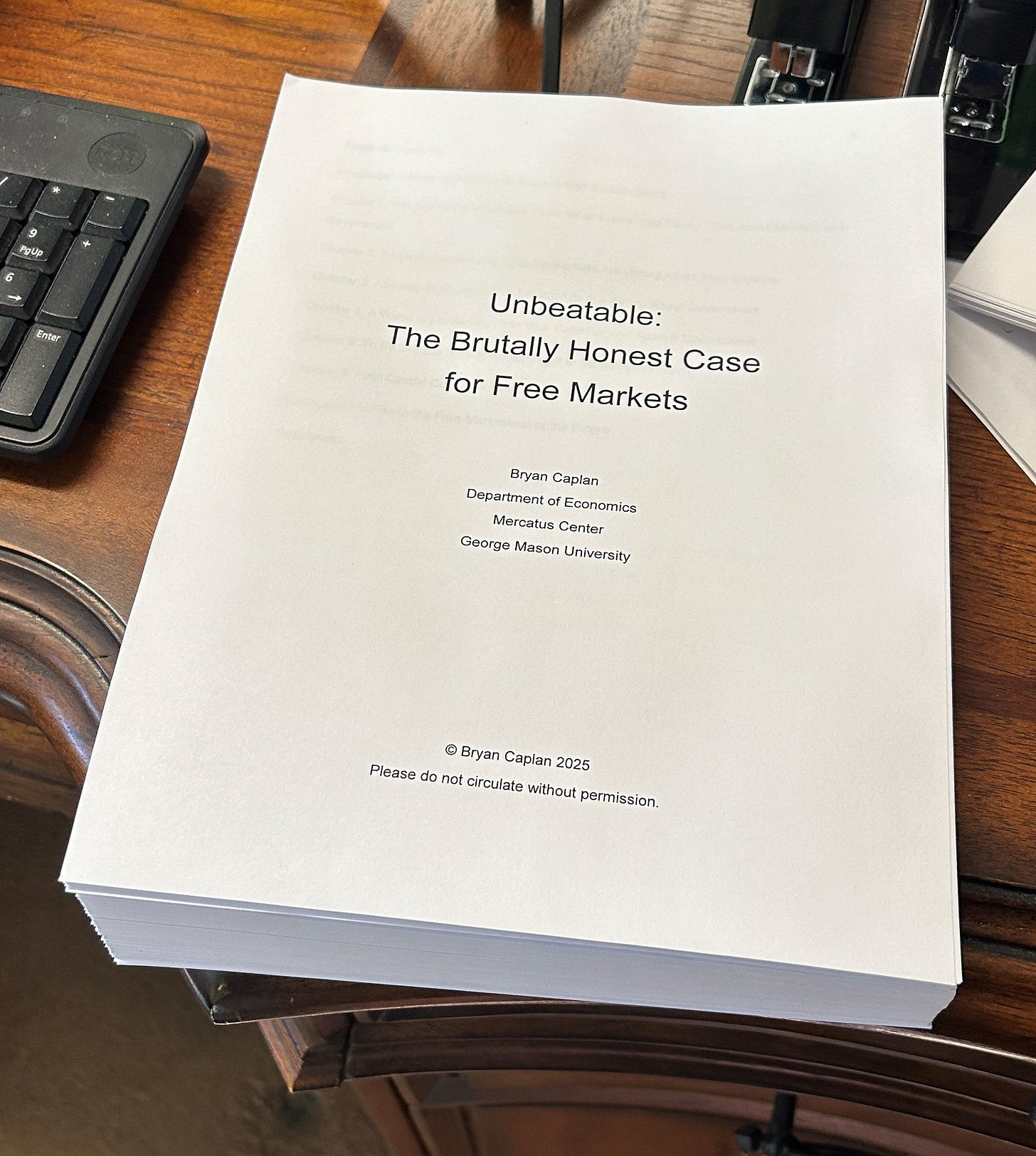
An excerpt from Chapter 3 of *Unbeatable*
Excusing the Government
Celebrating humanity's flourishing through the spread of capitalism and the rule of law
22 May 2025 Leave a comment
in applied price theory, applied welfare economics, comparative institutional analysis, constitutional political economy, economics of bureaucracy, economics of regulation, history of economic thought, income redistribution, international economics, labour economics, law and economics, property rights, Public Choice, public economics, rentseeking, urban economics

An excerpt from Chapter 3 of *Unbeatable*
Excusing the Government
19 May 2025 Leave a comment
in applied price theory, comparative institutional analysis, constitutional political economy, David Friedman, defence economics, economics of crime, economics of regulation, environmental economics, history of economic thought, industrial organisation, law and economics, property rights
10 May 2025 Leave a comment
in applied price theory, applied welfare economics, Austrian economics, comparative institutional analysis, constitutional political economy, economic history, economics of education, economics of regulation, history of economic thought, human capital, labour economics, occupational choice

An excerpt from Chapter 1 of *Unbeatable*
The Mainstream World Is Not Free-Market
06 May 2025 Leave a comment
in constitutional political economy, Public Choice Tags: British constitutional law, British politics

Ahead of major pieces of legislation designed to reform the composition of the House of Lords, and our recent event ‘Reforming the House of Lords’ discussing the history of this tricky issue, Dr Emma Peplow, Head of Contemporary History, draws upon our Oral History Project to revisit the last time significant reforms were introduced. The […]
‘A negative achievement’: Behind the scenes of the House of Lords Act 1999
01 May 2025 Leave a comment
in constitutional political economy, politics, Public Choice Tags: Canada

Election of 2025 On 28 April 2025, we returned yet another minority parliament in the 45th federal general election. Elections Canada’s preliminary results show that this general election brought out the highest voterturnout since 1993, at 68.7% compared to 69.6% thirty-two years ago. The fervent proponents of proportional representation should take heart that the Bloc […]
More Arthur Meighen Than Brian Mulroney? Pierre Poilievre Might Soon Confront The Reform Act
03 Apr 2025 Leave a comment
in comparative institutional analysis, constitutional political economy, economics of bureaucracy, economics of education, economics of information, economics of media and culture, international economics, law and economics, liberalism, Marxist economics, politics, property rights, Public Choice Tags: Brexit, British politics, political psychology
Political battles historically have been framed as contests between left-wing and right-wing ideologies, with clear distinctions based on policy preferences and socio-economic class interests. However, contemporary political dynamics reveal a new axis of conflict: the division between the educated and the uneducated. This emerging distinction marks a significant departure from traditional political alignments, reshaping electoral […]
Uneducated vs educated
03 Apr 2025 Leave a comment
in comparative institutional analysis, constitutional political economy, economic growth, economic history, law and economics, macroeconomics, politics - New Zealand, Public Choice Tags: constitutional law
In an excellent article in the Herald, Richard Prebble (or “Prebs” as we call him) argues the proposals presented by National-ACT for a…
Prebs is Right – a 4 Year Parliamentary Term is no panacea to NZ’s stagnation. The problem is neither the Nats nor Labour have had a plan since 1993.
02 Apr 2025 Leave a comment
in constitutional political economy, economic history, liberalism, Public Choice Tags: British constitutional law

In this guest post, originally published on the Victorian Commons website, Professor Simon Morgan of Leeds Beckett University, the principal investigator on the Letters of Richard Cobden Online resource, shows how Cobden’s letters can shed light on his role as a constituency MP. The publication in 2023 of the Letters of Richard Cobden Online, an open access database […]
Richard Cobden and his constituencies
31 Mar 2025 Leave a comment
in constitutional political economy, discrimination, politics - New Zealand Tags: Age of Enlightenment, constitutional law, free speech, political correctness, regressive left
Tauranga MP Sam Uffindell has a simple proposed members’ bill to amend the Bill of Rights Act to have equal suffrage extend to local government. Equal suffrage is a fundamental human right. The Universal Declaration of Human Rights says: The will of the people shall be the basis of the authority of government; this will […]
Equality of suffrage seen as bad by Radio NZ
14 Mar 2025 Leave a comment
in applied price theory, comparative institutional analysis, constitutional political economy, economic history, entrepreneurship, history of economic thought, income redistribution, industrial organisation, labour economics, law and economics, liberalism, Marxist economics, politics - USA, property rights, Public Choice, rentseeking Tags: The Great Enrichment
Long ago, I co-blogged for EconLog with Arnold Kling. Now he’s running a book club for Liberty Fund. Last month, Arnold invited me and philosopher Rachel Ferguson to discuss Mike Huemer’s new Progressive Myths. Enjoy!
*Progressive Myths*: The Kling Club Convo
14 Mar 2025 Leave a comment
in applied price theory, Austrian economics, comparative institutional analysis, constitutional political economy, economics of information, entrepreneurship, history of economic thought, industrial organisation, law and economics, property rights Tags: economics of planning
An excellent EconTalk episode with Pete Boettke on the socialist calculation debate. I like Boettke on the three Ps. The three Ps–property, prices, and profits and loss. Property incentivizes us. Prices guide us. Profits lure us to new changes and losses discipline us. Today, “incentives matter” is often considered the first lesson of economics. But […]
Boettke on the Socialist Calculation Debate
09 Mar 2025 Leave a comment
in applied price theory, comparative institutional analysis, constitutional political economy, economic history, economics of bureaucracy, entrepreneurship, health economics, history of economic thought, Public Choice, public economics, rentseeking
I have a new working paper out. It proposes a price theory-based explanation of why states nationalize the production of “public goods” (i.e., non-excludable and non-rivalrous). This is different than existing explanations as the theory ignores whether private provision is efficient or superior to public provision. I call it the “redistributive engine” theory whereby the […]
Working paper: Why nationalize the production of public goods?
06 Mar 2025 Leave a comment
in constitutional political economy, discrimination, economic history, economics of bureaucracy, law and economics, politics - New Zealand, property rights, Public Choice, rentseeking Tags: Age of Enlightenment, constitutional law, free speech, political correctness, racial discrimination, regressive left
Hon Tama Potaka Minister of Maori Development 28 February 2025 Dear Minister, After careful consideration I must resign as a Member of the Waitangi Tribunal. The treaty is not just our founding document, it makes New Zealand unique. Two peoples peacefully agreeing to form a nation. Over the summer I have been reading Tribunal reports […]
RICHARD PREBBLE: Letter of resignation from the Waitangi Tribunal
08 Feb 2025 Leave a comment
in applied price theory, applied welfare economics, Austrian economics, comparative institutional analysis, constitutional political economy, development economics, entrepreneurship, industrial organisation, international economics, politics - USA Tags: 2024 presidential election

To augment my four-part video series about trade (dealing with the WTO, creative destruction, deficits, and economics), here’s part of my recent lecture about Trump’s trade policy to the Universidad de Libertad in Mexico City For those who (mistakenly) want to skip the video, my speech focused on these five themes. Trade deficits don’t matter. […]
Trade 101 for Trumpies
16 Jan 2025 Leave a comment
in applied price theory, applied welfare economics, Austrian economics, comparative institutional analysis, constitutional political economy, economic growth, economic history, economics of regulation, energy economics, environmental economics, financial economics, fiscal policy, human capital, income redistribution, international economics, labour economics, labour supply, law and economics, liberalism, libertarianism, macroeconomics, Marxist economics, politics - USA, poverty and inequality, property rights, Public Choice, public economics, regulation, rentseeking
In this 12-second video, Margaret Thatcher is talking about the Labour Party in the United Kingdom, but her warning has universal application. And when I say her warning has universal application, I’m not joking. Politicians generally can’t resist the temptation to buy votes. And I fear that this can and will happen at all levels […]
Margaret Thatcher, Michael Curley, and the 19th Theorem of Government
Celebrating humanity's flourishing through the spread of capitalism and the rule of law
A History of the Alt-Right
Econ Prof at George Mason University, Economic Historian, Québécois
Celebrating humanity's flourishing through the spread of capitalism and the rule of law
Scholarly commentary on law, economics, and more
Beatrice Cherrier's blog
Celebrating humanity's flourishing through the spread of capitalism and the rule of law
Why Evolution is True is a blog written by Jerry Coyne, centered on evolution and biology but also dealing with diverse topics like politics, culture, and cats.
Celebrating humanity's flourishing through the spread of capitalism and the rule of law
A rural perspective with a blue tint by Ele Ludemann
DPF's Kiwiblog - Fomenting Happy Mischief since 2003
Celebrating humanity's flourishing through the spread of capitalism and the rule of law
The world's most viewed site on global warming and climate change
Tim Harding's writings on rationality, informal logic and skepticism
A window into Doc Freiberger's library
Let's examine hard decisions!
Commentary on monetary policy in the spirit of R. G. Hawtrey
Thoughts on public policy and the media
Celebrating humanity's flourishing through the spread of capitalism and the rule of law
Politics and the economy
A blog (primarily) on Canadian and Commonwealth political history and institutions
Reading between the lines, and underneath the hype.
Economics, and such stuff as dreams are made on
"The British constitution has always been puzzling, and always will be." --Queen Elizabeth II
Celebrating humanity's flourishing through the spread of capitalism and the rule of law
WORLD WAR II, MUSIC, HISTORY, HOLOCAUST
Undisciplined scholar, recovering academic
Celebrating humanity's flourishing through the spread of capitalism and the rule of law
Res ipsa loquitur - The thing itself speaks
In Hume’s spirit, I will attempt to serve as an ambassador from my world of economics, and help in “finding topics of conversation fit for the entertainment of rational creatures.”
Researching the House of Commons, 1832-1868
Articles and research from the History of Parliament Trust
Reflections on books and art
Posts on the History of Law, Crime, and Justice
Celebrating humanity's flourishing through the spread of capitalism and the rule of law
Exploring the Monarchs of Europe
Cutting edge science you can dice with
Small Steps Toward A Much Better World
“We do not believe any group of men adequate enough or wise enough to operate without scrutiny or without criticism. We know that the only way to avoid error is to detect it, that the only way to detect it is to be free to inquire. We know that in secrecy error undetected will flourish and subvert”. - J Robert Oppenheimer.
The truth about the great wind power fraud - we're not here to debate the wind industry, we're here to destroy it.
Celebrating humanity's flourishing through the spread of capitalism and the rule of law
Recent Comments