The millennium development goals were supposed to be utopian rather than under-promising to over-deliver
25 May 2015 Leave a comment
in development economics, growth disasters, growth miracles Tags: capitalism and freedom, millennium development goals, The Great Escape, The Great Fact

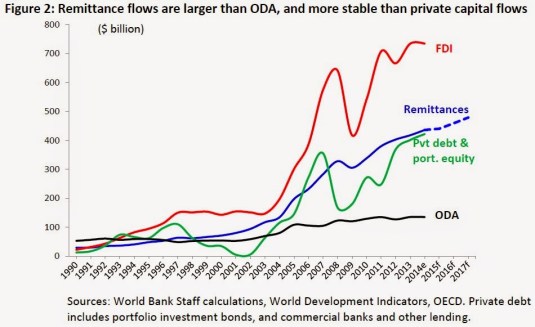
The Rise of Remittances
20 May 2015 Leave a comment
in development economics, economics of love and marriage, growth disasters, growth miracles Tags: economics of the family, remittances

Some countries simply skipped having a landline
18 May 2015 Leave a comment
in development economics, economics of media and culture, growth disasters, growth miracles Tags: cellphones, creative destruction, technology diffusion

What does Google auto complete say about Africa?
18 May 2015 Leave a comment
in development economics, growth disasters, growth miracles Tags: Africa, Google
Google Autocomplete results by African country when you type in “Why is [name of country] so…?” http://t.co/MwCZLJEa8M—
Dr.iDaywa (@iDaywa) February 06, 2014
The Great Fact, past and future, in one chart
18 May 2015 Leave a comment
in development economics, growth miracles Tags: capitalism and freedom, The Great Escape, The Great Fact
Some good news for development economists econ.st/1A7xuSu http://t.co/UcDhD1SCXz—
The Economist (@TheEconomist) May 18, 2015
The economic basis of the Anti-science Left
18 May 2015 Leave a comment
in development economics, health economics Tags: antiscience left, charlatan, conjecture and refutation, pseudoscience, quackery, Quacks, richer is safer, The Great Escape, The Great Fact, wealthier is healthier
When did Down Under overtake the Mother Country? Real GDP Britain, Australia and New Zealand 1820–2010
17 May 2015 Leave a comment
in development economics, economic growth, economic history, growth disasters, growth miracles, macroeconomics Tags: Australia, British economy, convergence, lost decades, Maddison database, New Zealand
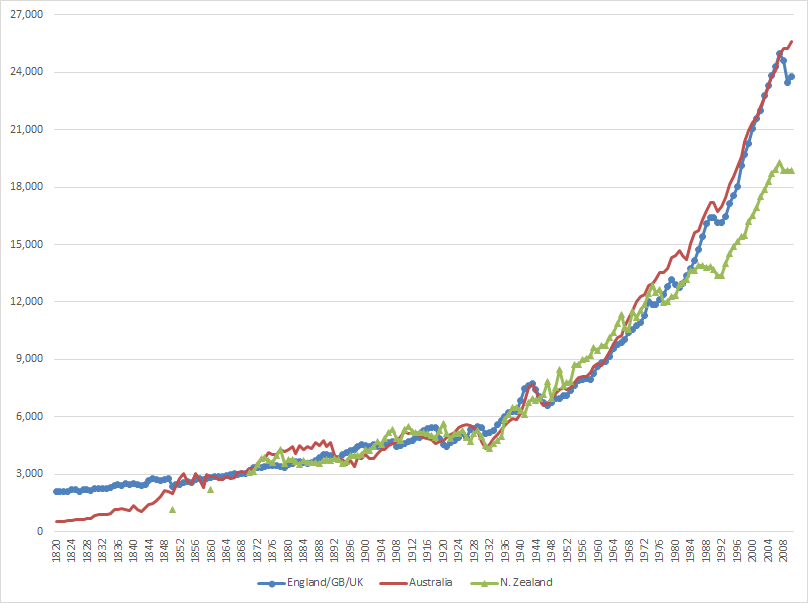
Pretty quickly according to figure 1. Britain, Australia and New Zealand quickly had similar standards of living in the middle of the 19th century until about 1880. Australia was richer for about 20 years until the great Federation drought took the wind out of its sails.
Figure 1: British, Australian and New Zealand GDP per capita (1990 Int. GK$PPP), 1820 – 2010
Source: The Maddison-Project, http://www.ggdc.net/maddison/maddison-project/home.htm 2013 version.
New Zealand then broke away at the end of the Second World War from both Australia and UK. In the mid-1960s circumstances changed with Australia drifting ahead of the UK and New Zealand drifting away to a lower standard of living.
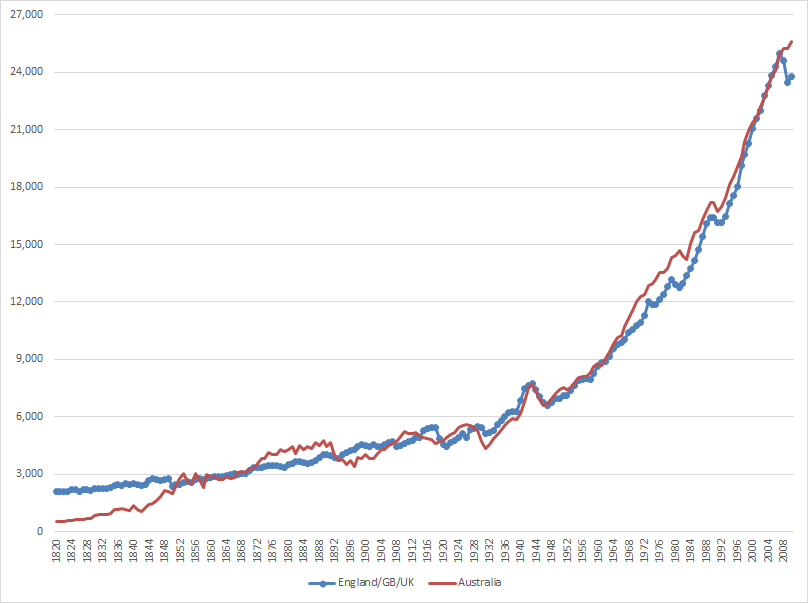
Figure 2: British and Australian GDP per capita (1990 Int. GK$PPP), 1820 – 2010
Source: The Maddison-Project, http://www.ggdc.net/maddison/maddison-project/home.htm 2013 version.
Figure 2 shows that from about 1960 until 1990 Australia was richer than the UK. After that, the growth dividend of Thatchernomics allowed the British to catch up again to the Australians.
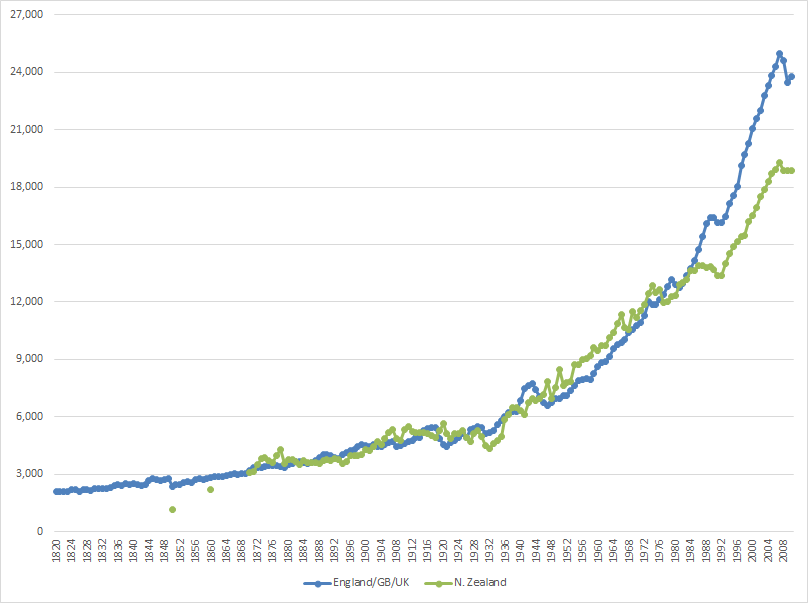
Figure 3: British and New Zealand GDP per capita (1990 Int. GK$PPP), 1820 – 2010
Source: The Maddison-Project, http://www.ggdc.net/maddison/maddison-project/home.htm 2013 version.
Figure 3 shows that New Zealand was richer than the UK in the mid-20th century. The lost decades in New Zealand from 1974 to 1992 let the sick man of Europe overtake New Zealand before Thatchernomics caused a growth spurt in the UK to take the British well ahead.
Figure 4: Australian and New Zealand GDP per capita (1990 Int. GK$PPP), 1820 – 2010
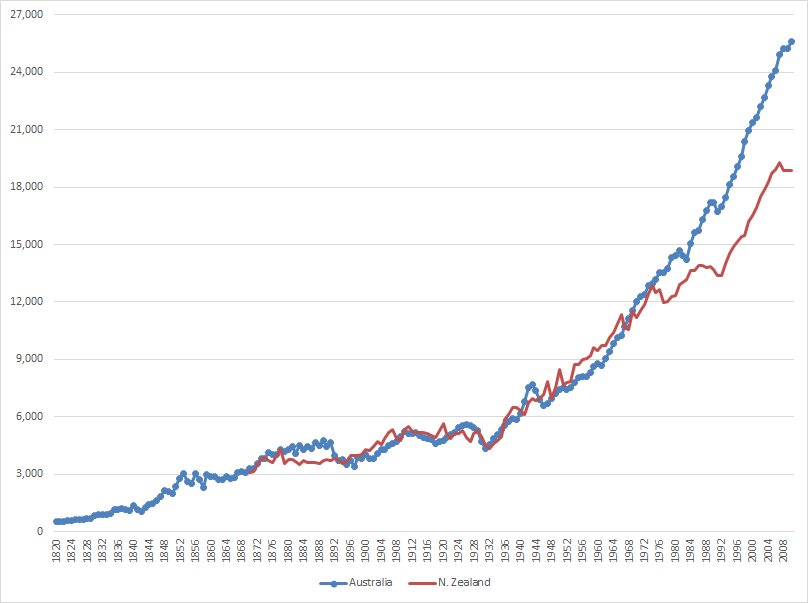
Source: The Maddison-Project, http://www.ggdc.net/maddison/maddison-project/home.htm 2013 version.
Figure 4 shows that New Zealand was richer than Australian in the first part of the post-war period. The divergence started with the onset of the lost decades in New Zealand in the early 1970s.
The International diffusion of the Internet
17 May 2015 Leave a comment
in development economics, economic history, entrepreneurship, growth disasters, growth miracles, industrial organisation, survivor principle Tags: China, creative destruction, international technology diffusion, technology diffusion
Leading causes of death in Africa
17 May 2015 Leave a comment
in development economics, growth disasters, growth miracles, health economics Tags: The Great Escape
Urban planners are confident souls
15 May 2015 Leave a comment
in development economics, economics of regulation, environmental economics, growth miracles, politics - Australia, politics - New Zealand, politics - USA, urban economics Tags: green rent seeking, housing affordability The fatal conceit, land use regulation, offsetting behaviour, RMA, The pretence to knowledge, unintended consequences, urban planning, zoning

The Great Escape – child mortality since 1950
14 May 2015 Leave a comment
in development economics, growth disasters, growth miracles, health economics Tags: child mortality, infant mortality, The Great Escape
Child mortality rate down across the globe via @UNICEF
statista.com/chart/3410/glo… http://t.co/SAYPhFMIC0—
Statista (@StatistaCharts) April 17, 2015
The Great Escape = a big increase in life expectancy inequality
13 May 2015 Leave a comment
In 1800 the global average life expectancy was 32.
Global health inequality was low – no country had over 40 years! http://t.co/BRpzvw9XJA—
Max Roser (@MaxCRoser) May 11, 2015
@MaxCRoser Now over the last decades many caught up – and inequality is declining. While average is now much higher. http://t.co/NDmWzivrhs—
Max Roser (@MaxCRoser) May 11, 2015
The fiscal consequences of oil at $50 a barrel
12 May 2015 Leave a comment
in development economics, energy economics, growth disasters, growth miracles Tags: Oil prices
#Dailychart: Oil at $50 econ.st/14nUWvA http://t.co/eg1PpoipWZ—
The Economist (@ECONdailycharts) January 07, 2015


Recent Comments