https://twitter.com/humanprogress/status/594875847552675841/photo/1
As China grew freer economically, its poverty rate fell. buff.ly/1DiVIow http://t.co/8upmR6NUvV—
HumanProgress.org (@humanprogress) April 26, 2015
Celebrating humanity's flourishing through the spread of capitalism and the rule of law
05 May 2015 Leave a comment
in development economics, economic history, growth disasters, growth miracles Tags: The Great Escape, The Great Fact
https://twitter.com/humanprogress/status/594875847552675841/photo/1
As China grew freer economically, its poverty rate fell. buff.ly/1DiVIow http://t.co/8upmR6NUvV—
HumanProgress.org (@humanprogress) April 26, 2015
05 May 2015 Leave a comment
in development economics, health economics Tags: anti-vaccination movement, India, The Great Escape, vaccinations, vaccines
04 May 2015 Leave a comment
in development economics, economics of natural disasters, growth disasters, growth miracles Tags: capitalism and freedom, earthquakes, Nepal, richer is safer, The Great Escape, The Great Fact, wealthier is healthier
Prosperity strengthens resilience against disasters. buff.ly/1JORl8y #Nepal #EarthQuakeResponse http://t.co/yx4E98QJn6—
HumanProgress.org (@humanprogress) April 28, 2015
04 May 2015 Leave a comment
in development economics, growth disasters, growth miracles, Music Tags: Bono, ODA, overseas aid, U2
04 May 2015 Leave a comment
in development economics, growth disasters, growth miracles, health economics Tags: Anti-Science left, extreme poverty, global poverty, world under
03 May 2015 Leave a comment
in applied welfare economics, development economics, economic history, growth disasters, growth miracles Tags: capitalism and freedom, The Great Enrichment, The Great Escape, The Great Fact
Behold: The most important economic chart in Western civilization. ow.ly/Moa2h @JimPethokoukis http://t.co/s1lzl1HLb9—
(@AEI) May 01, 2015
02 May 2015 Leave a comment
in development economics, growth disasters, growth miracles Tags: cell phones, Digital poverty, extreme poverty, global poverty, Internet access, mobile phones, technology diffusion
How the Internet is changing the lives of the poor — if they can get on on.wsj.com/1IGuFqL http://t.co/LuBE72AQPW—
Wall Street Journal (@WSJ) April 22, 2015
02 May 2015 Leave a comment
in development economics, health economics Tags: life expectancy, The Great Escape
#Dailychart: In almost every country, mortality rates fell during the four decades to 2010 econ.st/XUYuSn http://t.co/kTg4oyQPRY—
The Economist (@ECONdailycharts) September 23, 2014
02 May 2015 Leave a comment
in development economics, environmental economics, global warming, growth disasters, growth miracles Tags: climate alarmism, do gooders, global warming, World Bank
5 ways to reduce the drivers of climate change: 1) Put a price on carbon: wrld.bg/LBatf http://t.co/JZRHZliCSm—
World Bank (@WorldBank) April 17, 2015
30 Apr 2015 Leave a comment
in development economics, growth miracles Tags: China
30 Apr 2015 Leave a comment
in development economics, economics of education, growth disasters, growth miracles Tags: College premium, education premium, educational attainment
29 Apr 2015 Leave a comment
in development economics, growth disasters, growth miracles Tags: Pacific Islands
29 Apr 2015 Leave a comment
in development economics, growth disasters, Marxist economics, politics - New Zealand
The Greens in Parliament yesterday were making great play of the fact that New Zealand is willing to conclude a trade agreement with Saudi Arabia, but not with ISIS, despite the fact that both behead people.
Watermelons have short memories, which is why they are so prone to political and moral hypocrisy as they manifested yesterday. The Greens have forgotten how keen they were last year about the improvements in trade and diplomatic ties of the USA with another totalitarian relic: Cuba.
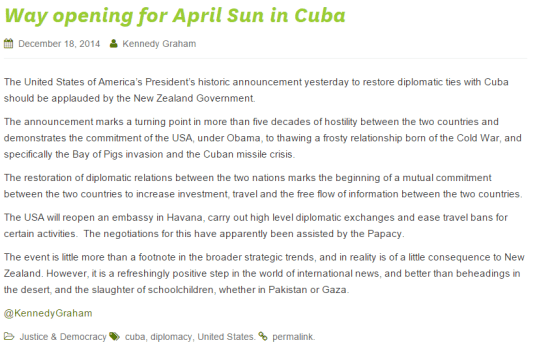
A 2009 report by Human Rights Watch concluded that
Raúl Castro has kept Cuba’s repressive machinery firmly in place…since being handed power by his brother Fidel Castro …[s]cores of political prisoners arrested under Fidel continue to languish in prison, and Raúl has used draconian laws and sham trials to incarcerate scores more who have dared to exercise their fundamental rights.
Freedom House classifies Cuba as being “Not Free” and notes that
Cuba is the only country in the Americas that consistently makes Freedom House’s list of the Worst of the Worst: the World’s Most Repressive Societies for widespread abuses of political rights and civil liberties.
Noam Chomsky once said the former Soviet Union was a dungeon with social services. Saudi Arabia is a dungeon with better social services than the Cuban dungeon. Saudi per capita income exceeds $50,000; Cuban per capita income is 1/5 of that.
In common with ISIS, a gang of thugs took over Cuba by military force in 1958 in the name of their god. Castro and his cronies murdered tens of thousands of political opponents both straight away and through the years to establish and retain their authority.
Cuba President Raul #Castro ratified its support to Venezuela against U.S. sanctions Fri at May Day parade in #Havana http://t.co/yqyF4XvcIA—
People's Daily,China (@PDChina) May 02, 2015
In common with Saudi Arabia after its foundation as a unified kingdom after the First World War, Cuba has become a hereditary monarchy that rules with an iron fist. In common with Saudi Arabia, Cuba is a haven for terrorists and a sponsor of terrorism abroad to this day.
The Green foreign affairs spokesman even went so far as to defend Westphalian sovereignty and the right of national self-determination and not to have ideologies imposed on a country.
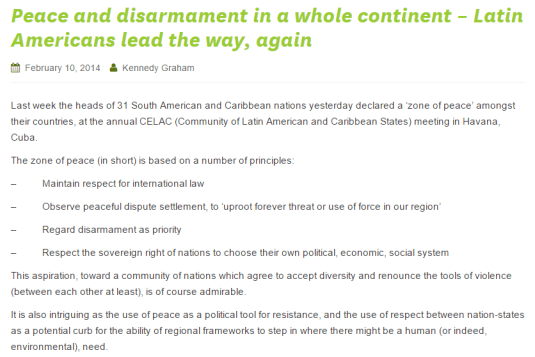
and

The Saudi and Cuban dictatorships could not have put it better. The Russian communist dictatorship did go on about democracies not interfering in their internal affairs too.
The Green foreign affairs spokesman was so dewy eyed about the Cuban healthcare system after going to Cuba as a guest of their so-called parliament that it would make Michael Moore blush.
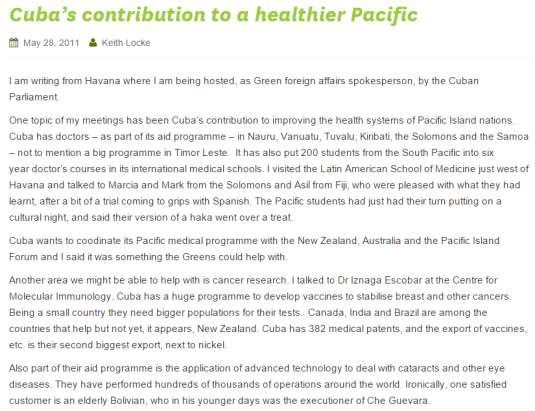
I wonder if the Greens would be so welcoming of Saudi foreign aid to the Pacific island health systems? Whatever else you can say about Saudi Arabia, they do have an excellent healthcare systems and plenty of petrodollars.
Saudi Arabia and Cuba are dungeons with Saudi Arabia having much better social services. New Zealand trades with both.
An unnamed co-conspirator in this fawning at the jackboots of a dictator even went so far as to say Cuba had its problems rather than speak truth to power and call it for what it is: a totalitarian dictatorship.
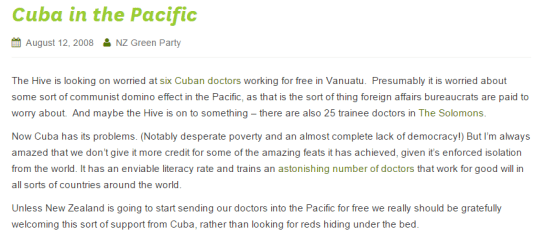
As the Greens said repeatedly regarding UN trade sanctions on Iraq after the first Gulf war, the only people that lose by limiting that trade were the ordinary people of that country were already on the end of a pretty bad deal.
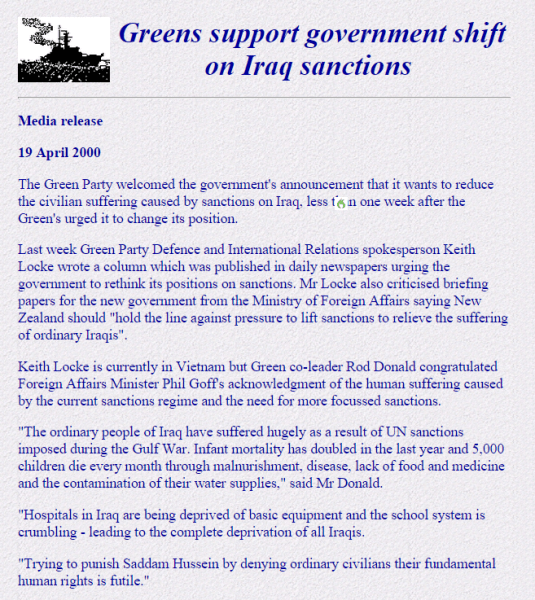
That principle set out by the Greens regarding the harm of trade sanctions on ordinary people applies to trade with Cuba and Saudi Arabia as well. A country with trade links is more to lose than a country that does not have them. The ruling elite rarely suffers from trade sanctions as Daniel Griswold observed:
Even if sanctions inflict some pain on the target country, they typically fail because of the nature of regimes most likely to become targets of sanctions. Human rights abuses tend to vary inversely with economic development. Governments that systematically deprive citizens of basic human rights typically intervene in daily economic life, resulting in underdeveloped and relatively closed economies. Such nations are the least sensitive to economic pressure. The autocratic nature of their governments also means that they are relatively insulated from any domestic discontent caused by sanctions. If anything, sanctions tend to concentrate economic power in the hands of the target government and reduce that of citizens.
The Greens cannot welcome trade and diplomatic links with one totalitarian country but not another. The Greens cannot oppose trade sanctions on Iraq because of the harm to ordinary people then call for limits on trade ties with Saudi Arabia without regard to the harm to ordinary Saudis. Trade sanctions do not work in any case as Rogoff noted:
As Hufbauer and Schott, among others, have illustrated, the effects of sanctions are often fairly disappointing – so much so that many scholars have concluded that such measures often are imposed so that governments can appear to domestic audiences to be “doing something.” Certainly, severe US sanctions on Cuba failed to bring the Castro regime to heel; indeed, President Barack Obama’s move to reestablish full diplomatic relations may have more effect.
What makes each of these dungeons horrible is their totalitarian dictatorships, not the particular God that motivates their tyranny.

29 Apr 2015 1 Comment
in development economics, growth disasters, growth miracles Tags: extreme poverty, global poverty, Leftover Left, Oxfam, The Great Fact
https://twitter.com/FraserNelson/status/557288908216864768/photo/1
@stranglershands em, i respectfully disagree (attached) http://t.co/vmqoj1AV28—
Fraser Nelson (@FraserNelson) January 19, 2015
27 Apr 2015 Leave a comment
in applied welfare economics, development economics, economic history, growth disasters, growth miracles Tags: extreme poverty, global poverty, India, Leftover Left, poverty and inequality
In #India poverty is falling very, very rapidly – while inequality is rising.
More at: bit.ly/1KLT8Lh http://t.co/t5d1LQR4l0—
Max Roser (@MaxCRoser) April 27, 2015
Celebrating humanity's flourishing through the spread of capitalism and the rule of law
Celebrating humanity's flourishing through the spread of capitalism and the rule of law
Celebrating humanity's flourishing through the spread of capitalism and the rule of law
Celebrating humanity's flourishing through the spread of capitalism and the rule of law
Celebrating humanity's flourishing through the spread of capitalism and the rule of law
Celebrating humanity's flourishing through the spread of capitalism and the rule of law
Celebrating humanity's flourishing through the spread of capitalism and the rule of law
Celebrating humanity's flourishing through the spread of capitalism and the rule of law
A History of the Alt-Right
Econ Prof at George Mason University, Economic Historian, Québécois
Celebrating humanity's flourishing through the spread of capitalism and the rule of law
Scholarly commentary on law, economics, and more
Beatrice Cherrier's blog
Celebrating humanity's flourishing through the spread of capitalism and the rule of law
Celebrating humanity's flourishing through the spread of capitalism and the rule of law
Celebrating humanity's flourishing through the spread of capitalism and the rule of law
Why Evolution is True is a blog written by Jerry Coyne, centered on evolution and biology but also dealing with diverse topics like politics, culture, and cats.
Celebrating humanity's flourishing through the spread of capitalism and the rule of law
A rural perspective with a blue tint by Ele Ludemann
DPF's Kiwiblog - Fomenting Happy Mischief since 2003
Celebrating humanity's flourishing through the spread of capitalism and the rule of law
The world's most viewed site on global warming and climate change
Tim Harding's writings on rationality, informal logic and skepticism
A window into Doc Freiberger's library
Let's examine hard decisions!
Commentary on monetary policy in the spirit of R. G. Hawtrey
Thoughts on public policy and the media
Celebrating humanity's flourishing through the spread of capitalism and the rule of law
Politics and the economy
A blog (primarily) on Canadian and Commonwealth political history and institutions
Reading between the lines, and underneath the hype.
Economics, and such stuff as dreams are made on
"The British constitution has always been puzzling, and always will be." --Queen Elizabeth II
Celebrating humanity's flourishing through the spread of capitalism and the rule of law
Celebrating humanity's flourishing through the spread of capitalism and the rule of law
WORLD WAR II, MUSIC, HISTORY, HOLOCAUST
Undisciplined scholar, recovering academic
Celebrating humanity's flourishing through the spread of capitalism and the rule of law
Res ipsa loquitur - The thing itself speaks
In Hume’s spirit, I will attempt to serve as an ambassador from my world of economics, and help in “finding topics of conversation fit for the entertainment of rational creatures.”
Researching the House of Commons, 1832-1868
Articles and research from the History of Parliament Trust
Reflections on books and art
Posts on the History of Law, Crime, and Justice
Celebrating humanity's flourishing through the spread of capitalism and the rule of law
Exploring the Monarchs of Europe


Recent Comments