When people try to think about the long-term future, by which I mean here looking a half-century or a century ahead, they often suffer a lack of imagination. As a common example, they take today’s problems and just multiply them by a factor of ten. Or they assume that improved central planning, in one form…
Nordhaus on the Perils of Long-Term Forecasting
Nordhaus on the Perils of Long-Term Forecasting
01 Jan 2025 Leave a comment
in applied price theory, econometerics, economic history Tags: The Great Enrichment
The end of oil?
05 Dec 2024 Leave a comment
in applied price theory, econometerics, economics of climate change, energy economics, environmental economics, environmentalism, global warming, law and economics, politics - USA, property rights, Public Choice, rentseeking, resource economics Tags: peak oil
It is now plausible to envision scenarios in which global demand for crude oil falls to essentially zero by the end of this century, driven by improvements in clean energy technologies, adoption of stringent climate policies, or both. This paper asks what such a demand decline, when anticipated, might mean for global oil supply. One […]
The end of oil?
The Consequences of Limiting the Tax Deductibility of R&D
03 Dec 2024 Leave a comment
in applied price theory, econometerics, entrepreneurship, fiscal policy, macroeconomics, Public Choice, public economics Tags: taxation and entrepreneurship, taxation and investment
We study the tax payment and innovation consequences of limiting the tax deductibility of research and development (“R&D”) expenditures. Beginning in 2022, U.S. companies are required to capitalize and amortize R&D rather than immediately deduct these expenditures. We utilize variation in U.S. firms’ fiscal year ends to test the effects of the R&D tax change […]
The Consequences of Limiting the Tax Deductibility of R&D
Unauthorized Immigration and Local Government Finances
30 Nov 2024 Leave a comment
in applied price theory, econometerics, human capital, income redistribution, labour economics, labour supply, politics - USA, poverty and inequality, Public Choice, public economics Tags: economics of immigration
This paper examines how unauthorized immigration affects the fiscal health of local governments in the United States. Using detailed data on unauthorized immigrants’ countries of origin and arrival dates from the Syracuse TRAC database, we isolate immigration flows driven by social, economic, and political conditions in source countries. We predict local immigration patterns using a […]
Unauthorized Immigration and Local Government Finances
Local Labor Market Effects of Amazon
18 Nov 2024 Leave a comment
in applied price theory, econometerics, labour economics, labour supply, urban economics
Does the entry of a large employer to a local labor market increase welfare for residents? To answer this question, I analyze the local effects of the dramatic expansion of Amazon’s fulfillment center (FC) network from 2010 onward. I exploit the staggered roll-out of FCs across large U.S. metros in a difference-in-difference framework. I find […]
Local Labor Market Effects of Amazon
Who Matters More in a Move: You or Your Spouse?
04 Nov 2024 Leave a comment
in applied price theory, discrimination, econometerics, economics of love and marriage, gender, human capital, labour economics, labour supply, law and economics, occupational choice, poverty and inequality Tags: gender wage gap, marriage and divorce, sex discrimination
New research finds couples are more likely to move for a job when it benefits the man, even when the woman’s career stands to benefit more by movingBy Dalvin Brown of The WSJ. Excerpts:”Couples are moving again for better job opportunities. They are more likely to make those moves when the husband’s earnings stand to…
Who Matters More in a Move: You or Your Spouse?
The National Childcare Program During World War II
02 Nov 2024 Leave a comment
in applied price theory, defence economics, discrimination, econometerics, economic history, gender, human capital, labour economics, labour supply, war and peace Tags: World War II
The United States has has a nationwide childcare program at one time in its history: a temporary program during World War II. Tim Sablik of the Federal Reserve Bank of Richmond tells the story and summarizes some economic research on the topic in “When Uncle Sam Watched Rosie’s Kids: To support women working on the…
The National Childcare Program During World War II
Biden-Harris policies and their consequences were no surprise to those paying attention
30 Oct 2024 Leave a comment
in applied price theory, applied welfare economics, budget deficits, business cycles, econometerics, economic growth, economic history, economics of bureaucracy, economics of regulation, energy economics, entrepreneurship, environmental economics, financial economics, fiscal policy, global warming, health economics, income redistribution, industrial organisation, law and economics, macroeconomics, monetary economics, politics - USA, property rights, Public Choice, public economics, rentseeking Tags: 2024 presidential election, drug lags, taxation and entrepreneurship, taxation and investment
Milton Friedman used to advise researchers to focus on large policy changes rather than attempting to separate a small change’s signal from the noise. In this sense, the “ambitious” policy agenda of the Biden-Harris administration was expected to be a gift to the research community. Accepting this gift, since 2020 I have been making forecasts…
Biden-Harris policies and their consequences were no surprise to those paying attention
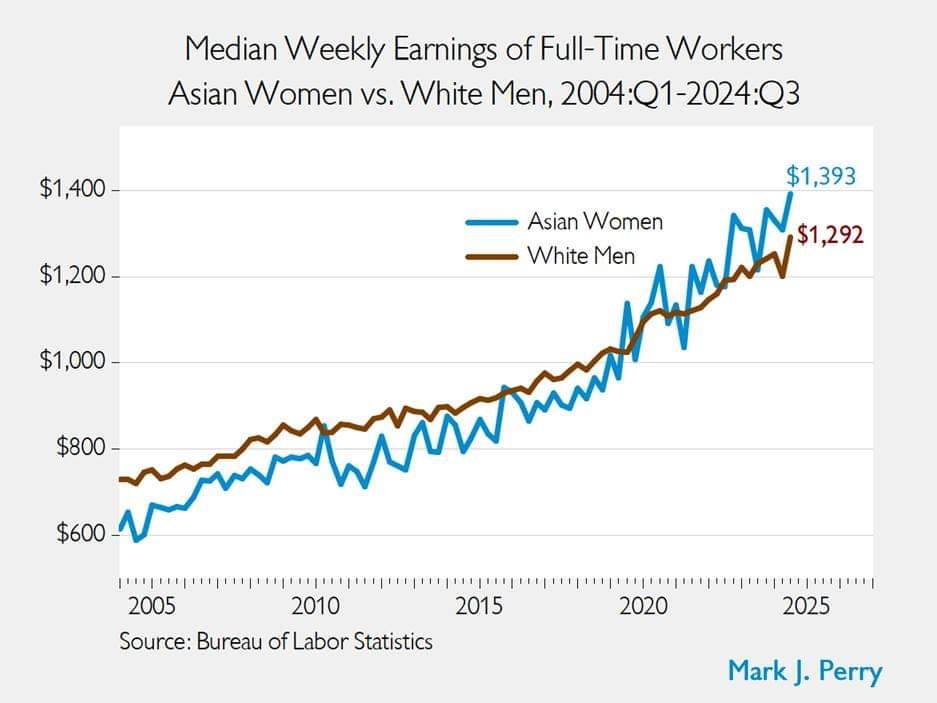
The gender gap that dare not speak its name
18 Oct 2024 Leave a comment
in discrimination, econometerics, economic history, economics of education, gender, human capital, labour economics, labour supply, occupational choice, poverty and inequality Tags: gender wage gap, racial discrimination
Fatal Flaw Discredits IPCC Science
08 Oct 2024 Leave a comment
in econometerics, energy economics, environmental economics, global warming

By way of John Ray comes this Spectator Australia article A basic flaw in IPCC science. Excerpts in italics with my bolds and added images. Detailed research is underway that threatens to undermine the foundations of the climate science promoted by the IPCC since its First Assessment Report in 1992. The research is re-examining the […]
Fatal Flaw Discredits IPCC Science
US Productivity Growth: Downside, Upside
08 Oct 2024 Leave a comment
in applied price theory, econometerics, economic growth, economic history, entrepreneurship, history of economic thought, industrial organisation, labour economics, labour supply, macroeconomics Tags: The Great Enrichment
Over time, a rising US standard of living is driven by productivity growth. Michael Peters succinctly describes the problem in “America Must Rediscover Its Dynamism” (Finance & Development, September 2024). He writes: The US economy has a multitrillion-dollar problem. It’s the dramatic slowdown in productivity growth over the past couple of decades. Between 1947 and…
US Productivity Growth: Downside, Upside
The Economic Consequences of the French Wealth Tax
17 Sep 2024 Leave a comment
in applied price theory, econometerics, economic history, entrepreneurship, fiscal policy, human capital, income redistribution, labour economics, labour supply, macroeconomics, occupational choice, poverty and inequality, Public Choice, public economics Tags: taxation and entrepreneurship, taxation and investment, taxation and labour supply
By Eric Pichet, here is the abstract: Despite attempts to ‘unwind’ the Impôt de Solidarité sur la Fortune (‘Solidarity Wealth Tax,’ the French wealth tax) during the last legislature (2002-2007), ISF yields had soared by 2006, jumping from €2.5 billion in 2002 to €3.6 billion. Analysis of the economic consequences of this ISF wealth tax […]
The Economic Consequences of the French Wealth Tax
Interview with Greg Mankiw: New Keynesian Macro, Growth, and Economic Policy
04 Sep 2024 Leave a comment
in applied price theory, budget deficits, business cycles, development economics, econometerics, economic growth, economic history, Edward Prescott, fiscal policy, great depression, history of economic thought, labour economics, law and economics, macroeconomics, Milton Friedman, monetarism, monetary economics, politics - USA, Public Choice, Robert E. Lucas, unemployment
Jon Hartley interviews Greg Mankiw on topics including New Keynesian macroeconomics, growth, and economic policy more broadly at his Capitalism and Freedom website (August 20, 2024, video and transcript available). Here are a few of the comments that caught my eye. On big models and small models in studying the macroeconomy: [O]n the issue of…
Interview with Greg Mankiw: New Keynesian Macro, Growth, and Economic Policy
It is wonderful to put inefficient firms out of business
31 Aug 2024 1 Comment
in applied price theory, econometerics, economic history, entrepreneurship, history of economic thought, industrial organisation, survivor principle Tags: creative destruction
The differences between the most and least productive companies can be startlingly high. By one estimate, in the US alone the most productive firms in a sector can be more than two to four times more cost-effective than the least productive ones. Given the size of those discrepancies, any expansion of trade or innovation that makes […]
It is wonderful to put inefficient firms out of business
 Utopia, you are standing in it!
Recent Comments