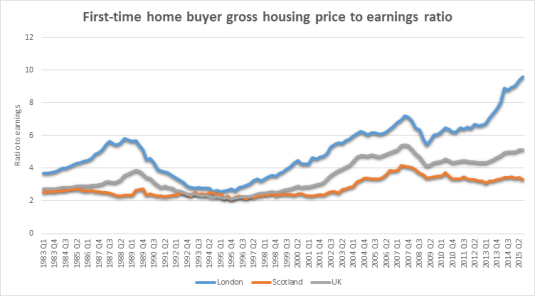
@jeremycorbyn @johnmcdonnellMP People’s QE & 1st home buyer affordability in London, Scotland and the UK since 1983
26 Oct 2015 Leave a comment
in economic history, macroeconomics, monetary economics
Many of the Twitter Left who voted in Jeremy Corbyn to lead the British Labour Party into what will be a self-inflicted electoral oblivion have no adult memory of paying high mortgage payments when there was high inflation.

Source: House Prices Data Download | Nationwide.
Those who have escaped the overweening conceit of youth still have raw memories of high inflation and high mortgage payments and that was when housing was much, much cheaper.
Source: House Prices Data Download | Nationwide.
An excellent wedge issue for the Tories on the 2020 general election will be even under rock bottom interest rates housing affordability is in crisis.
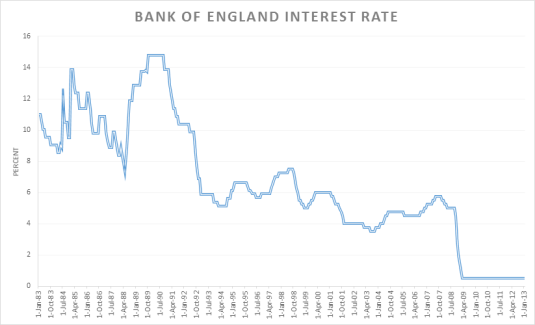
Imagine what will happen if even moderate inflation were to return. There is no buffer left in the budgets of middle class homebuyers to pay much more if there were to be a People’s quantitative easing.
Some very British creative destruction in telecommunications
26 Oct 2015 Leave a comment
in economic history, economics of media and culture Tags: British economy, creative destruction, mobile phones, technology diffusion
https://twitter.com/amberleybooks/status/653168927996948480/photo/1
The UK telephone network became fully automatic #OTD 14 Oct 1976 with the closure of Portree manual exchange, Skye http://t.co/V5x08iyQdg—
BT Archives (@BTArchives) October 14, 2015
Operator Agnes Dewar connects the last call on the last UK manual telephone exchange, Portree, Isle of Skye #OTD 1976 http://t.co/SddN0vUq1d—
BT Archives (@BTArchives) October 14, 2015
A rising majority of university students around the world are women
26 Oct 2015 Leave a comment
in development economics, discrimination, economic history, economics of education, gender, growth disasters, growth miracles, human capital, labour economics Tags: College premium, compensating differentials, education premium, graduate premium, marriage and divorce, reversing gender gap
A rising majority of university students around the world are women (HT @cblatts) http://t.co/6loTmSgrk9—
William Easterly (@bill_easterly) June 15, 2015
The Great Escape and #vegetarianism
25 Oct 2015 Leave a comment
in development economics, economic history, environmental economics, growth miracles, health economics, Public Choice, rentseeking Tags: expressive politics, The Great Enrichment, The Great Escape, The Great Fact, vegetarianism
@NaomiAKlein agrees with #MiltonFriedman on Mancur Olson’s theory of how nations escape institutional sclerosis
25 Oct 2015 Leave a comment
in comparative institutional analysis, constitutional political economy, development economics, economic history, economics of bureaucracy, income redistribution, Marxist economics, Milton Friedman, Public Choice, rentseeking, technological progress Tags: expressive voting, interest groups, Leftover Left, logic of collective action, Mancur Olson, Naomi Klein, pressure groups, rational ignorance, rational irrationality, rise and decline of nations, Twitter left

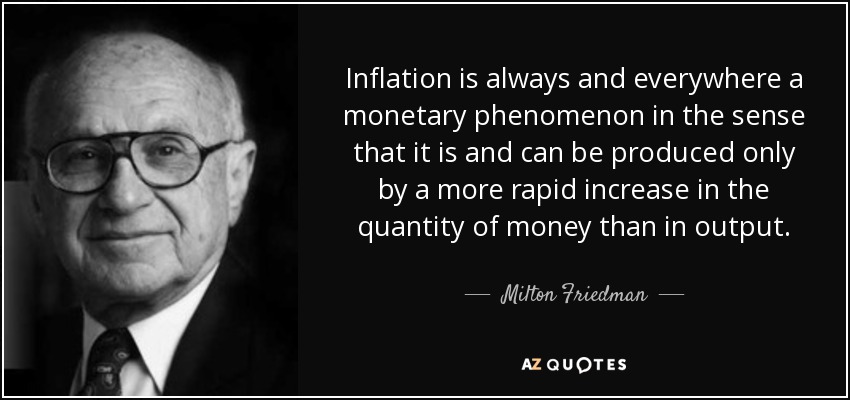
Source: quoted by Naomi Klein in “The Shock Doctrine”.
LA premiere tonight @NaomiAKlein @avilewis @mrdannyglover in person Q&A 7.30pm sundancecinemas.com http://t.co/wRkPFbnUHu—
Changes Everything (@thischanges) October 16, 2015
1. There will be no countries that attain symmetrical organization of all groups with a common interest and thereby attain optimal outcomes through comprehensive bargaining.
2. Stable societies with unchanged boundaries tend to accumulate more collusions and organizations for collective action over time.
3. Members of “small” groups have disproportionate organizational power for collective action, and this disproportion diminishes but does not disappear over time in stable societies.
4. On balance, special-interest organizations and collusions reduce efficiency and aggregate income in the societies in which they operate and make political life more divisive.
5. Encompassing organizations have some incentive to make the society in which they operate more prosperous, and an incentive to redistribute income to their members with as little excess burden as possible, and to cease such redistribution unless the amount redistributed is substantial in relation to the social cost of the redistribution.
6. Distributional coalitions make decisions more slowly than the individuals and firms of which they are comprised, tend to have crowded agendas and bargaining tables, and more often fix prices than quantities.
7. Distributional coalitions slow down a society’s capacity to adopt new technologies and to reallocate resources in response to changing conditions, and thereby to reduce the rate of economic growth.
8. Distributional coalitions, once big enough to succeed, are exclusive, and seek to limit the diversity of incomes and values of their membership.
9. The accumulation of distributional coalitions increases the complexity of regulation, the role of government, and the complexity of understandings, and changes the direction of social evolution.
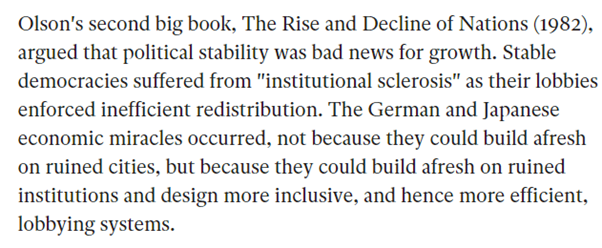
Source: Obituary: Professor Mancur Olson | Obituaries | News | The Independent
@MaxCRoser the impact of the top 1% on Swedish economic growth
25 Oct 2015 Leave a comment
in applied welfare economics, economic growth, economic history, macroeconomics, Marxist economics Tags: endogenous growth theory, envy, Leftover Left, politics of envy, Sweden, top 1%
#Sweden: Inequality decreased hugely in the 20th century – but is now rising.
bit.ly/1DEBY1P https://t.co/MHPgp29AWZ—
Max Roser (@MaxCRoser) October 24, 2015
A fall in the share of the top 1% of total Swedish total incomes was in tune with the emergence of a new word in the English language which was Swedosclerosis. That was the long stagnation in the Swedish economy in the 1970s and the 1980s with Swedish economic growth well below that in the trend rate of growth in the USA. Only after an increase in the top 1% share in Sweden did economic growth start recovering to trend.
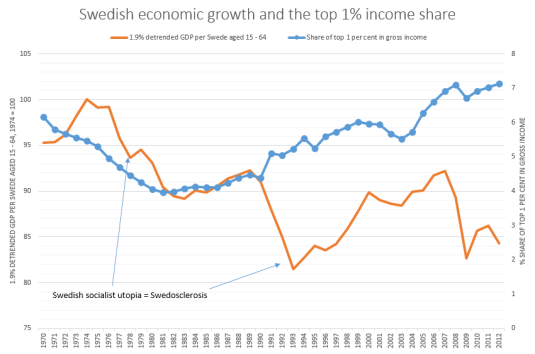
Source: Computed from OECD StatExtract and The Conference Board. 2015. The Conference Board Total Economy Database™, May 2015, http://www.conference-board.org/data/economydatabase/
In the chart above, a flat-line in real GDP per working age Swede is growth at the trend rate of the US economy for the 20th century which was 1.9% per year. A falling line is Swedish growth below trend, a rising line is growth above that trend rate of 1.9% in Sweden. A trend rate of 1.9% is the trend rate of growth currently used by Edward Prescott for the USA in the 20th century.
@JamilAnderlini @ft @PickardJE British & Chinese real GDP PPP @urmyes1
25 Oct 2015 Leave a comment
in development economics, economic history, growth miracles
Stunning statistic from @JamilAnderlini @ft https://t.co/Uotf5kzwlQ—
Jim Pickard (@PickardJE) October 24, 2015
Looks like it’s been another big day for breathless journalism at the Financial Times.
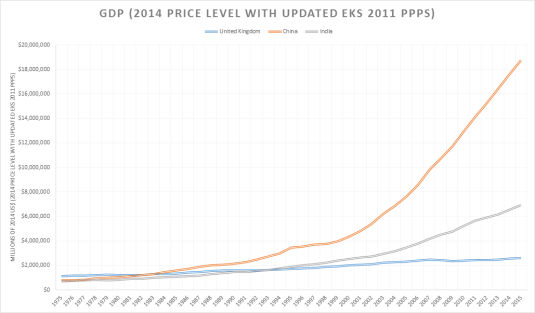
Source: The Conference Board. 2015. The Conference Board Total Economy Database™, May 2015, http://www.conference-board.org/data/economydatabase/
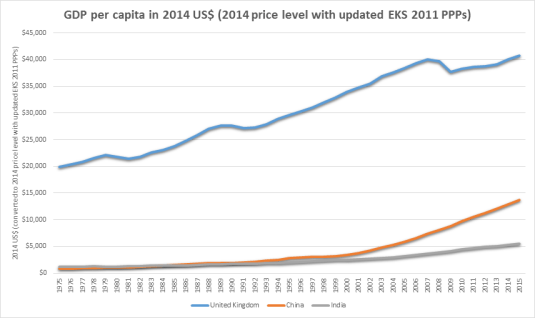
Source: The Conference Board. 2015. The Conference Board Total Economy Database™, May 2015, http://www.conference-board.org/data/economydatabase/
Creative destruction in telegraph messages
25 Oct 2015 Leave a comment
in economic history, economics of media and culture Tags: Australia, creative destruction
#OTD 21 Oct 1872 a UK – Australia telegraph service opened from London to Darwin, 20 hours to transmit a message! https://t.co/cgnbhLzAuw—
BT Archives (@BTArchives) October 21, 2015
RT @NaomiAKlein what’s changed since you left high school?
24 Oct 2015 Leave a comment
in development economics, economic history, growth miracles, Marxist economics Tags: Bill Easterly, Leftover Left, Naomi Klein, The Great Enrichment, The Great Escape, The Great Fact
.@worldbankdata allows us to see how our world has changed since 1985 #BackToTheFuture https://t.co/8t5DZDMFfz—
DFID Stats (@DFID_Stats) October 21, 2015
No matter how you measure it, the news on global poverty is great. From @EconBizFin http://t.co/qKM6suo4YO—
William Easterly (@bill_easterly) October 15, 2015
Special 5pm premiere screening in Los Angeles tonight Q&A with @avilewis & @NaomiAKlein sundancecinemas.com http://t.co/Oi4oeKoQHB—
Changes Everything (@thischanges) October 16, 2015
South Korean gender pay gap for the 10th, 50th and 90th percentile since 1985
24 Oct 2015 Leave a comment
in development economics, discrimination, economic history, economics of education, gender, growth miracles, human capital, labour economics, labour supply, occupational choice Tags: asymmetric marriage premium, compensating differentials, gender wage gap, marital division of labour, South Korea
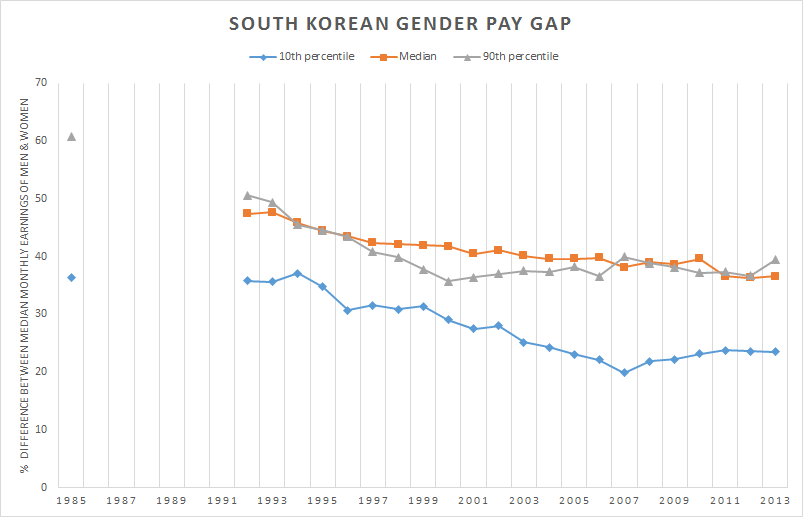
The Japanese gender pay gap at the 10th, 50th and 90th percentile since 1975
23 Oct 2015 Leave a comment
in discrimination, economic history, gender, human capital, labour economics, labour supply, occupational choice Tags: compensating differentials, gender wage gap, Japan
The unadjusted gender pay gap is still large in Japan but is declining slowly.

@zoesqwilliams has great timing on capitalism not doing enough on poverty @worstall
23 Oct 2015 Leave a comment
in development economics, economic history, growth disasters, growth miracles, Marxist economics, poverty and inequality Tags: extreme poverty, global poverty, Leftover Left, life expectancies, The Great Escape, The Great Fact, Twitter left
When Zoe Williams was born in 1973, 60% of humanity lived in extreme poverty. That has dropped to 1 in 10.
When my father was born, 7 in 10 people lived in absolute poverty.
Today, it's 1 in 10! https://t.co/1Caqku3AY1—
Tim Fernholz (@TimFernholz) October 21, 2015
Just the other day, the World Bank estimated that extreme poverty has dropped below 10% of the world’s population for the first time in human history but some are still grumbling.
What will it take to finish the “Last Mile” in ending extreme #poverty? brook.gs/1LiFT8E http://t.co/YxSZ36VCSW—
Brookings (@BrookingsInst) October 07, 2015
Zoe Williams is not grumbling about the failed states and predatory government responsible for the last pockets of extreme poverty, but about the inequality from economic progress under capitalism.
The extreme poor live in conflict & rural areas: wrld.bg/Nynge #endpoverty http://t.co/43HDDI11JR—
World Bank (@WorldBank) May 31, 2015
Zoe Williams honestly believes that extreme poverty could have been reduced faster if we had taken on the socialist road.
These 4 nations are 50% of mankind. That's 3.5 billion people who are living longer. buff.ly/1Kle6mU #health http://t.co/949oqisMsL—
HumanProgress.org (@humanprogress) June 30, 2015
China and India escaped from extreme poverty by rejecting socialism.
Just released: new global poverty estimates from 1990-2015 using updated extreme poverty line http://t.co/LxD5q2n6Mg—
Laurence Chandy (@laurencechandy) October 04, 2015
China and India received next to no overseas development assistance in their Great Escape from extreme poverty.
Embrace the free market and overtake your socialist competitors. buff.ly/1PZ3yuN http://t.co/xfpF4vtqlv—
HumanProgress.org (@humanprogress) October 05, 2015
There’s been some clear-cut natural experiments such as between Chile and Venezuela and Japan, Hong Kong, Singapore and just about any other developing country in terms of capitalism as the only path to prosperity.
Results of past EU referenda
23 Oct 2015 Leave a comment
in currency unions, economic history, Euro crisis Tags: British economy, British politics, EU
Britain will vote to decide on its EU membership. But referendum results are unpredictable
econ.st/1G7Up3b http://t.co/HsXhe8HoDZ—
The Economist (@TheEconomist) October 18, 2015
@oxfamnz 80% of the world lived in extreme poverty when my father was born
23 Oct 2015 Leave a comment
When my father was born, 7 in 10 people lived in absolute poverty.
Today, it's 1 in 10! https://t.co/1Caqku3AY1—
Tim Fernholz (@TimFernholz) October 21, 2015
Number living <$1.90/day in the 10 countries w/ largest extreme poor populations. using new @WorldBank #data @oxfam http://t.co/YQm8XSVpfK—
Nick Galasso (@vngalasso) October 19, 2015
The Global Middle Class Is Kind of Poor. Amazing graphic. buff.ly/1I5FDbz http://t.co/QB6maF7X2n—
Nick Galasso (@vngalasso) July 16, 2015
And people say I'm pessimistic! Is this the most important graph on the economic history of the world? HT @MaxCRoser http://t.co/pawcLOSadv—
Nick Galasso (@vngalasso) June 22, 2015
.@TheEconomist Great graph! Global #inequality to fall; what about within country #inequality? buff.ly/1c74E95 http://t.co/QTufMdR4om—
Nick Galasso (@vngalasso) May 21, 2015
Inequality has actually been falling in a lot of the world … but not in the U.S. washingtonpost.com/news/wonkblog/… https://t.co/VjnO8D6RQQ—
Matt O'Brien (@ObsoleteDogma) October 22, 2015


Recent Comments