'The world is getting better all the time, in 11 maps and charts' – bit.ly/1M7W4Xr http://t.co/slB6oStjFq—
Max Roser (@MaxCRoser) July 14, 2015
The Great Escape by continent
14 Sep 2015 Leave a comment
in development economics, economic history, growth disasters, growth miracles, health economics Tags: Africa, child mortality, China, India, infant mortality, life expectancies, South America, The Great Escape
@jeremycorbyn incomes of the poorest increased most under Blairism @UKLabour
13 Sep 2015 2 Comments
in economic history, labour economics, Marxist economics, poverty and inequality Tags: British economy, Leftover Left, Tony Blair, Trish Labor Party, welfare state
Under Tony Blair the incomes of the UK's poorest families increased by more than under any other Prime Minister. http://t.co/8Uh8GBqbRB—
Tom Forth (@thomasforth) September 12, 2015
100 Years Of #Beauty
13 Sep 2015 Leave a comment
in economic history Tags: economics of beauty
100 Years Of Beauty in 11 Pics bit.ly/1F0mXL5 http://t.co/zuym4DxnyE—
Lost In History (@SadHappyAmazing) September 11, 2015
US and UK Real Housing Price Index, 1975 – 2015
13 Sep 2015 Leave a comment
in economic history, economics of regulation, politics - USA, urban economics Tags: British economy, British politics, housing affordability, housing prices, land supply, land use planning, NIMBYs, zoning

Source: International House Price Database – Dallas Fed
Note: The house price index series is an index constructed with nominal house price data. The real house price index is an index calculated by deflating the nominal house price series with a country’s personal consumption expenditure deflator.
Much higher house prices and the political sustainability of a return of inflation
13 Sep 2015 1 Comment
in business cycles, economic history, global financial crisis (GFC), inflation targeting, macroeconomics, monetary economics, politics - New Zealand, urban economics Tags: expressive voting, housing affordability, inflation rates, median voter theorem, mortgage belt, mortgage rates, rational ignorance, rational rationality
Mortgage interest rates were last in the double digits in the late 1980s and early 1990s. Since then, housing prices have exploded in New Zealand and barely paused for the recession in the wake of the Global Financial Crisis.
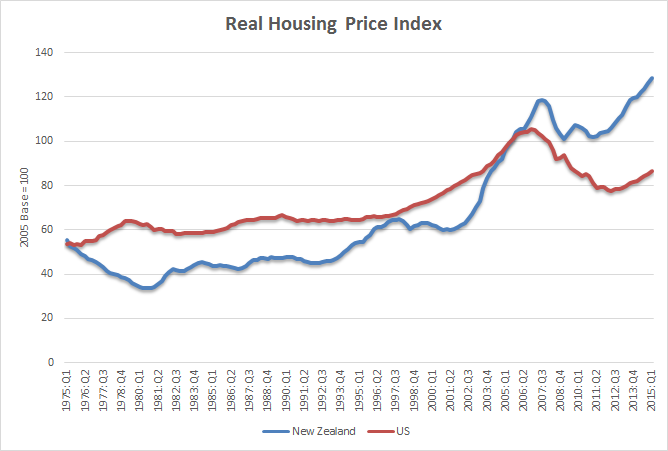
Source: International House Price Database – Dallas Fed; Housing prices deflated by personal consumption expenditure deflator.
With house prices and mortgages several times what they used to be, the ability for any household income to absorb the sudden return of high mortgage interest rates because of a return of even moderate CPI inflation and double-digit mortgage rates is well-nigh impossible, politically.
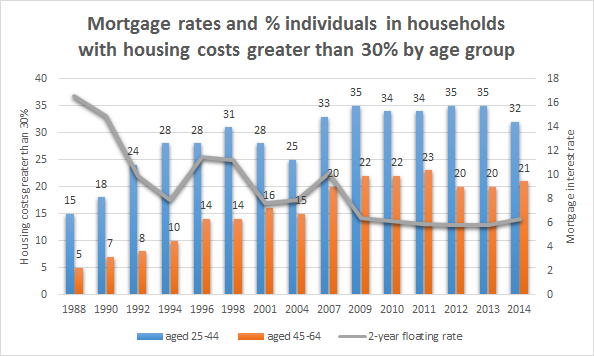
Source: Reserve Bank of New Zealand Mortgage rates and Bryan Perry, Household Incomes in New Zealand: trends in indicators of inequality and hardship 1982 to 2014 – Ministry of Social Development, Wellington (August 2015) Table C.5.
The chart above shows that the number of 25 to 44-year-olds in New Zealand who have more than 30% of their income going to housing expenses has doubled since 1988 to nearly a third of all households. The number of 45 to 64-year-olds who pay more than 30% of their income in housing expenses has quadrupled to 20%. That is a lot of voters who would be offended by mismanagement of monetary policy.
None of these households would have much left over to absorb an increasing mortgage interest rates. That is very different political arithmetic too the last time both mortgage rates and CPI inflation were in double digits, which was more than 20 years ago. Not many New Zealanders under the age of 40 or 45 have an adult memory of high inflation and high mortgage rates.
Creative destruction in laptops
13 Sep 2015 Leave a comment
in economic history, economics of media and culture, entrepreneurship Tags: creative destruction, laptops
The difference that 25 years makes. http://t.co/amfutCoLT0—
Lost In History (@SadHappyAmazing) September 11, 2015
Watch your back in Rap & Hip-Hop, look after yourself in Heavy Metal and Punk
13 Sep 2015 Leave a comment
in economic history, economics of crime, economics of media and culture, health and safety, health economics, labour economics, law and economics, Music, occupational choice Tags: crime and punishment, homicide rates, law and order, suicide
What kills popular musicians? Depends on the genre http://t.co/BTDvdWOS4F—
paulkirby (@paul1kirby) September 11, 2015
@jeremycorbyn @UKLabour has a long history of picking losers as leaders
13 Sep 2015 Leave a comment
in economic history, Public Choice Tags: British Labour Party, British politics, Leftover Left, Twitter left
Great chart. Labour not keen on choosing on leaders who can win elections, 1906-2015. Contrast the Tories http://t.co/VBlT7k5ONB—
paulkirby (@paul1kirby) September 12, 2015
Creative destruction in pizzas
12 Sep 2015 Leave a comment
in economic history, economics of media and culture, entrepreneurship Tags: creative destruction
Pizza night? Enjoy this first. A @nytimes 1944 explanation of pizza to an unsuspecting America http://t.co/Q5vhCLaQT6—
paulkirby (@paul1kirby) September 11, 2015
An opportunity lost – to expel #WesternAustralia from the rest of Australia and seal the border
11 Sep 2015 Leave a comment
in comparative institutional analysis, constitutional political economy, economic history, politics - USA, Public Choice, rentseeking Tags: Australia, economics of borders, economics of succession, Scotland, self-determination, succession movements, Western Australia
Western Australian secessionists, in common with Scottish nationalists, really do like to dictate the terms of their succession which always includes an open border and a generous financial settlement regarding division of federal government debts.
How arrogant. Why should parting be sweet? If you do not want us, why should we want you. If you want to find your own destiny, you can find it good and hard.

How Senator Bilyk’s Dad found paradise in Australia @Catbilyk
11 Sep 2015 Leave a comment
in economic history, politics - Australia, war and peace Tags: Australia, economics of migration, Poland, Russia, Ukraine, World War II
An old Uni mate’s dad was rounded up by the Nazis in the Polish Ukraine in 1941 and carted off as a slave in factories in Germany. He survived the war. He ended up in a refugee camp. He met and married a Dutch lass.
He did not want to go back to the Ukraine because that part of the Ukraine was now Russian under Stalin. That part of the Ukraine was Polish before the war.
Soviet post-war expansion resulted in border changes, the creation of a Communist Bloc & the start of the Cold War. http://t.co/0Os3EPp6Th—
History Facts 247 (@historyfacts247) August 17, 2015
Australia was the first country to accept them as refugees. He raised a family in Tasmania, working in a factory to support them.
I knew one of his two sons who became economists both at the University of Tasmania and in Canberra. One of his daughter’s was elected to the Australian Senate in the 2007 general election.
After such a rough start in life, my old mate’s dad must regard Australia as paradise for him, his wife and their family.
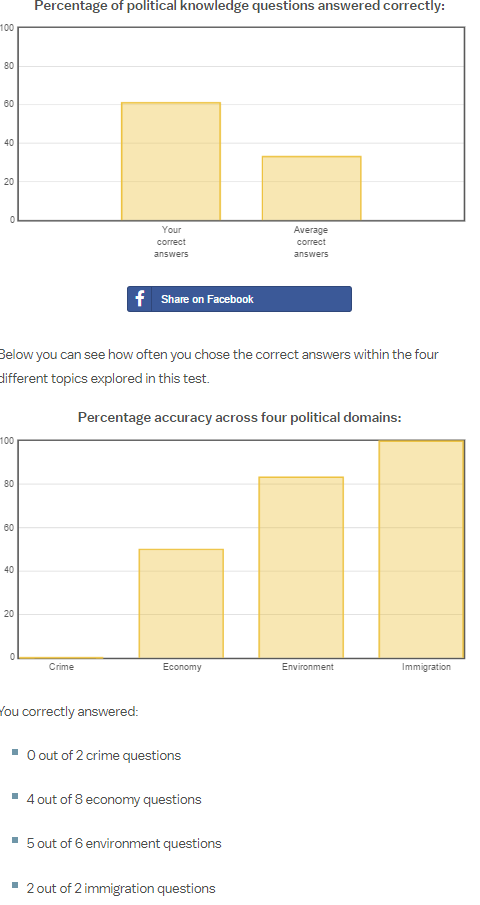
This #Vox political bias test is biased despite my good result
11 Sep 2015 Leave a comment
in economic growth, economic history, economics of climate change, economics of crime, environmental economics, health economics, macroeconomics

The Great Escape in Chinese infant mortality was stunning
11 Sep 2015 Leave a comment
in development economics, economic history, growth disasters, growth miracles, health economics, Marxist economics Tags: child mortality, China, global poverty, infant mortality, stream poverty, The Great Escape
China's infant mortality rate fell 85% since 1970, nearing the U.S. rate. buff.ly/1g7eLNk #health http://t.co/b9eno1jk6X—
HumanProgress.org (@humanprogress) September 08, 2015


Recent Comments