Stratfor Graphic: The Ottoman Empire, 1798-1923 info.stratfor.com/twlg/ http://t.co/Grq8LCHHRG—
(@Stratfor) July 30, 2015
The Ottoman Empire at the start of World War I
07 Aug 2015 Leave a comment
in economic history Tags: Ottoman Empire, World War I
There is an economic literature on feuds and duelling
07 Aug 2015 Leave a comment
in applied price theory, comparative institutional analysis, economic history, economics of media and culture Tags: adverse selection, asymmetric information, competition as a discovery procedure, duals, feuds, game theory, moral hazard, screening, signalling
How they resolved spats before Twitter existed
thepoke.co.uk/2015/07/26/res… http://t.co/a04CTYT2aX—
The Poke (@ThePoke) July 27, 2015
Two charts on Trump and a more important one on Herman Cain
06 Aug 2015 3 Comments
in economic history, politics - USA, Public Choice Tags: 2012 presidential election, 2016 presidential election


via Why is Trump surging? Blame the media. – The Washington Post.
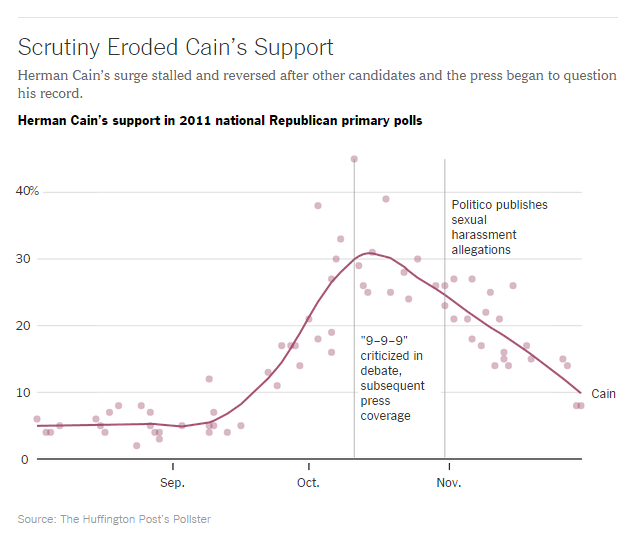
via Donald Trump and the Press: Why Coverage Matters – The New York Times.
Creative destruction in oldest businesses
06 Aug 2015 Leave a comment
in economic history, entrepreneurship, industrial organisation, survivor principle Tags: business history, creative destruction, Japan, market selection
Japan houses more than half of the world's 1,000 oldest businesses:
priceonomics.com/why-are-so-man… http://t.co/LVzPPKOeJw—
Zachary Crockett (@zzcrockett) July 15, 2015
The Great Escape in infant mortality
06 Aug 2015 Leave a comment
in applied welfare economics, economic history, health economics, population economics Tags: infant mortality, life expectancies, The Great Escape, The Great Fact
Child mortality declined dramatically – and #India and #Ghana are catching up fast.
From: OurWorldInData.org http://t.co/uReMfGyoPd—
Max Roser (@MaxCRoser) November 11, 2014
The education explosion in the 20th century
06 Aug 2015 Leave a comment
in economic history, economics of education, human capital, labour economics, occupational choice Tags: age of human capital, educational attainment
Dramatic increase in education across all demographic groups over the past 100 years bit.ly/16XYZun http://t.co/0Ew0OxDzlx—
Catherine Mulbrandon (@VisualEcon) August 27, 2013
Modern European borders superimposed over Europe in 1914
06 Aug 2015 Leave a comment
in defence economics, economic history, war and peace Tags: France, Germany, Russia, UK politics, World War I
Modern European borders superimposed over Europe in 1914 immediately before World War ! – bit.ly/1BCI17c http://t.co/0vADDCvp2l—
Brilliant Maps (@BrilliantMaps) December 12, 2014
French unemployment incidence by duration since 1983
05 Aug 2015 Leave a comment
in economic history, Euro crisis, job search and matching, labour economics, labour supply, macroeconomics, unemployment Tags: employment law, equilibrium unemployment rate, France, labour market regulation, natural unemployment rate, unemployment duration
Nothing really changes in France recently unemployment duration. Italian labour market is notorious for having very low inflows and outflows from employment and unemployment.
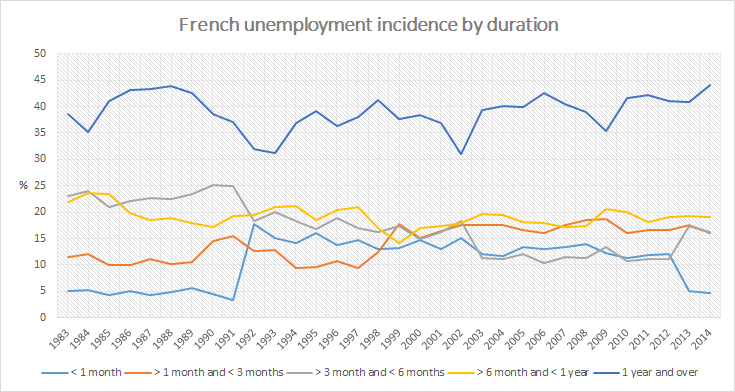
Source: OECD StatExtract.
Any progress ever on the gender wage gap in France, Germany, Sweden and Norway since 1980?
05 Aug 2015 Leave a comment
in discrimination, economic history, gender, labour economics, law and economics Tags: France, gender wage gap, Germany, Leftover Left, Norway, Sweden, Twitter left
Our friends on the Left go on about how wonderful place Sweden is despite its gender gap being stuck for 35 years. Not much better in Norway and in Germany and France for that matter.
Figure 1: gender wage, % of median male wage, full-time employees, France, Germany, Sweden and Norway, 1980 – 2012

Source: Earnings and wages – Gender wage gap – OECD Data.
The gender wage gap in figure 1 is unadjusted and defined as the difference between median earnings of men and women relative to median earnings of men. Data refer to full-time employees.
Swedosclerosis, Eurosclerosis and the British disease compared
05 Aug 2015 2 Comments
in currency unions, economic growth, economic history, economics of regulation, Euro crisis, fiscal policy Tags: British disease, British economy, Eurosclerosis, France, Germany, Italy, sick man of Europe, Sweden, Swedosclerosis
Figure 1 shows stark differences between Sweden, France, Italy and the UK since 1970 in departures from trend growth rates of 1.9% in real GDP per working age person, PPP. Italy did quite OK until 2000 growing at about the trend growth rate of 1.9% after which it fell into a hole so deep that it barely notice the onset of the global financial crisis. Sweden really had been the sick man of Europe until it turned its back on high taxing, welfare state socialism in the early 1990s. France has been in a long decline so much so that the global financial crisis is hard to pick up in the acceleration in its long decline in the mid-1990s. Figure 1 also shows Britain did very well, both under the neoliberal horrors of Thatcherism and the betrayals by Tony Blair of a true Labour Party platform. The UK grew at above the trend annual growth to 1.9% for most of the period from the early 1980s to 2007. The UK has done not so well since the onset of the global financial crisis.
Figure 1: Real GDP per Swede, French, British and Italian aged 15-64, 2014 US$ (converted to 2014 price level with updated 2011 PPPs), 1.9 per cent detrended, 1970-2013
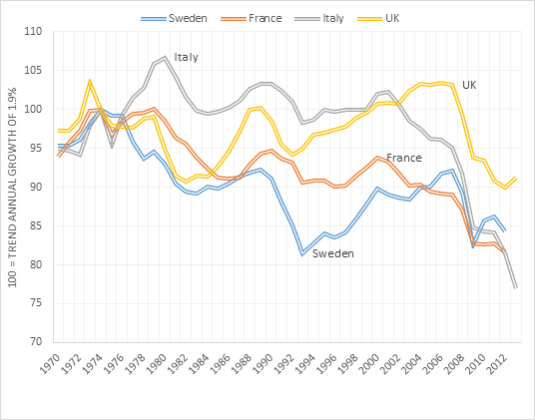
Source: Computed from OECD StatExtract and The Conference Board. 2015. The Conference Board Total Economy Database™, May 2015, http://www.conference-board.org/data/economydatabase/
Note: When the line is flat, the economy is growing at its trend annual growth rate. A falling line means below trend annual growth; a rising line means of above trend annual growth. Detrended with values used by Edward Prescott.
German data was not in figure 1 because German unification threw all of its data into disarray for long-term comparison purposes.
Climate change that is worth worrying about
05 Aug 2015 Leave a comment
in economic history, environmental economics, global warming Tags: global cooling, global warming, ice ages, Little ice age
Europe during Weichselian- & Würm-Glaciation period (which ended 11,700 years ago). http://t.co/Sx58qdIEAA—
Amazing Maps™ (@amazingmap) August 03, 2015
The Left opposed airline deregulation
05 Aug 2015 Leave a comment
in applied price theory, applied welfare economics, comparative institutional analysis, economic history, economics of regulation, entrepreneurship, income redistribution, industrial organisation, politics - Australia, politics - New Zealand, politics - USA, Public Choice, rentseeking, survivor principle Tags: airline deregulation, antimarket bias, bootleggers and baptists, expressive voting, Leftover Left, rational ignorance, rational irrationality
CHART: US average airfares 1979 to 2014 measured in number of hours work at the average wage. @chartoftheday http://t.co/q7Phz3VkU0—
Mark J. Perry (@Mark_J_Perry) August 02, 2015
Do vaccines work?
04 Aug 2015 Leave a comment
in applied welfare economics, economic history, environmental economics, health economics Tags: anti-vaccination movement, antiscience left, conjecture and refutation, vaccinations, vaccines
Beautiful charts by WSJ on history of vaccines and diseases:
graphics.wsj.com/infectious-dis… http://t.co/MWXr8nPWie—
Neil Halloran (@neilhalloran) February 24, 2015


Recent Comments