
The views of politicians and the media on oil prices
08 Feb 2015 Leave a comment
in economics of media and culture, energy economics Tags: Oil prices
 HT:
HT:
Grand Canyon, 1914
08 Feb 2015 Leave a comment
Political ideologies mapped by profession
08 Feb 2015 Leave a comment
in economics of media and culture, human capital, occupational choice Tags: academic bias, media bias

Vaccines work, get over it
07 Feb 2015 Leave a comment
in economics of media and culture, health economics Tags: anti-vaccination movement, conjecture and refutation, Quacks, vaccines
Vaccines Work. Here Are the Facts – and a Comic.
(Medium bit.ly/1x3fapV) http://t.co/Ed6FufQLY9—
Max Roser (@MaxCRoser) January 06, 2015
Name recognition and your chances of winning the presidential nomination
06 Feb 2015 Leave a comment
in economics of information, economics of media and culture, politics - USA Tags: 2016 presidential election, name recognition
Does global warming denial and the anti-vaccination movement march to the same anti-science step?
03 Feb 2015 Leave a comment
in climate change, economics of information, economics of media and culture, environmental economics, global warming, health economics, politics - Australia, politics - New Zealand, politics - USA, Public Choice Tags: anti-vaccination movement, climate alarmists, expressive politics, expressive voting, psychology of persuasion

In the last post, I presented evidence, collected as part of the CCP Vaccine Risk Perception study, that showed that the trope has no meaningful connection to fact.
Those who accept and reject human evolution, those who believe in and those who are skeptical about climate change, all overwhelmingly agree that vaccine risks are low and vaccine benefits high.
The idea that either climate change skepticism or disbelief in evolution denotes hostility to science or lack of comprehension of science is false, too. That’s something that a large number of social science studies show. The CCP Vaccine Risk study doesn’t add anything to that body of evidence.
Vaccination rates are a serious issue. Do those that are trying to lift vaccination rates think they going to get anywhere by calling people stupid, corrupt and in the pay of a multinational.
Of course not. This matter is serious. It’s a real public health risk.
People are persuaded to vaccinate through gentle messages providing facts in a way they can understand that also respects their knowledge, their intellect, and their concerns for the safety of the children. You don’t win people over by insulting them.
The climate alarmists are so insulting because they have no interest in persuading the people that are actually talking to. They are reaching out to members on the audience were are on the margin, and appealing to their political base, including the fundraising base by showing how staunch they are in slaying the Dragon.
Evidence of mass kidnappings of Occupy protesters
03 Feb 2015 Leave a comment
in economics of media and culture, politics - Australia, politics - New Zealand, politics - USA Tags: activists, do gooders, expressive voting, Left-wing hypocrisy, occupy movement, superstar effect

Because the most-popular songs now stay on the charts for months, the relative value of a hit has exploded.
The top 1 percent of bands and solo artists now earn 77 percent of all revenue from recorded music, media researchers report. And even though the amount of digital music sold has surged, the 10 best-selling tracks command 82 percent more of the market than they did a decade ago.
The advent of do-it-yourself artists in the digital age may have grown music’s long tail, but its fat head keeps getting fatter.
The only explanation for the failure of the Twitter Left to protest against this concentration or of wealth and massive rise in ticket prices to the downtrodden young public that go to concerts is a mass kidnapping of the protesters in the Occupy Wall Street movement.

30 Years Of Cell Phones
03 Feb 2015 Leave a comment
Yes Prime Minister – The Department of Education and Science
03 Feb 2015 Leave a comment
in comparative institutional analysis, constitutional political economy, economics of education, economics of media and culture, TV shows Tags: Yes Prime Minister
What was the most watched regular TV show in American history?
03 Feb 2015 Leave a comment
in economics of media and culture, televison, TV shows Tags: MASH
Why is NZ so hostile to foreign investment, 32nd in the Index of Economic Freedom 2015? USA is 66th!
02 Feb 2015 Leave a comment
in applied price theory, applied welfare economics, economics of media and culture, economics of regulation, international economics, politics - New Zealand Tags: bootleggers and baptists, foreign direct investment, foreign investment, free trade, Index of Economic Freedom
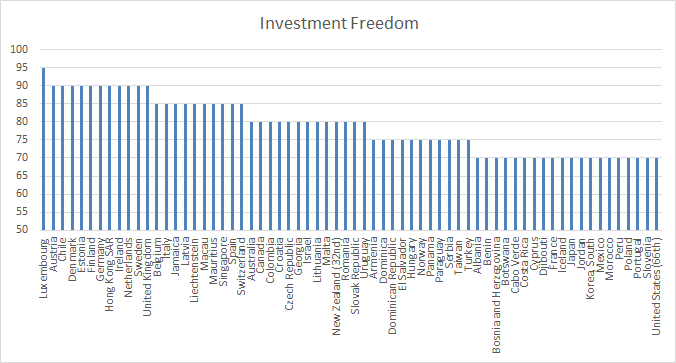
Source: 2015 Index of Economic Freedom
According to the Index of Economic Freedom 2015, in New Zealand
Foreign investment is welcomed, but the government may screen some large investments.
There was a major review of New Zealand foreign investment regulations about 10 years ago. The purpose of that review commissioned by the Labour government’s Minister of Finance, Dr Michael Cullen, was to deregulate the regulation of foreign investment in New Zealand.
At the time,under the Overseas Investment Act, the Minister of Finance could refuse permission to any investment. Australia’s current overseas investment regulations are the same. The federal treasurer may reject foreign investment proposals on the basis of an open-ended definition of national interest.
The last time that foreign investors had been refused permission to invest in New Zealand was in the early 1980s under then National Party Government Prime Minister Robert Muldoon. In a fit of pique, he refused permission to an Australian investor.
The revised foreign investment regulations limits the ability of government to reject foreign investors to narrow criteria such as the acquisition of sensitive land and large New Zealand companies. As part of this theme that foreign acquisitions of land was the main policy concern regarding foreign investment, the administration of the foreign investment regulations was moved out of a Overseas Investment Commission housed at the Reserve Bank of New Zealand to the very low key Land Information Office:
The Overseas Investment Office (OIO) assesses applications from overseas investors seeking to invest in sensitive New Zealand assets – being ‘sensitive’ land, high value businesses (worth more than $100 million) and fishing quota.
Naturally, subsequent to this genuine attempt by the Labour government of 10 years ago to deregulate foreign investment regulation, a number of investments have been refused since then often on the pretext that some part of the investment acquired sensitive coastal land door or rural land. The criteria for regulating foreign investment is as follows:
As regards the criteria relating to the relevant “overseas person”, the OIO needs to be satisfied that:
- the “overseas person” has demonstrated financial commitment to the investment; and
- the “overseas person” or (if that person is not an individual) the individuals with ownership and control of the overseas person (such as the shareholders and directors of the overseas purchaser):
- have the business experience and acumen relevant to that investment;
- are of good character; and
- are not prohibited from entering New Zealand by reason of sections 15 or 16 of the Immigration Act 2009 (e.g. persons who have been imprisoned for certain periods of time).
As regards the criteria relating to the particular investment, the OIO needs to be satisfied that the overseas investment will, or is likely to, benefit New Zealand (or any part of it or group of New Zealanders). When considering this, the OIO has a range of factors that it must consider (including, for example, whether the investment will create new job opportunities, introduce new technology or business skills, advance a significant Government policy or strategy, or bring other consequential benefits to New Zealand).
The New Zealand Initiative recently reviewed this criteria for regulating overseas investment into New Zealand and found that:
the report finds that the criteria for approval do not test the economic benefit to New Zealanders, where sensitive land is sold to an overseas person not intending to live in New Zealand indefinitely.
Indeed, the criteria are unambiguously hostile, even excluding the gain to a New Zealand vendor. This opens the way for the imposition of approval conditions that could impose net costs on New Zealanders given the regime’s potentially adverse effects on land values
The regulation of foreign investment in other countries is much more specific about what it is trying to achieve,as New Zealand Initiative also noted in its recent review:
New Zealand’s comprehensive screening regime accounts for our poor international ranking in the OECD’s FDI Regulatory Restrictiveness Index.
Most other countries focus their regimes more narrowly on national security considerations, often relating to particularly sensitive industries or sectors.
The main reason the public supports foreign investment regulation is because the public doesn’t like foreigners, and politicians pander to that xenophobia. If foreign investment is reduced, more of total investment spending has to be funded from domestic saving.

Access to foreign savings – trade in savings – allows investment to be made sooner, consumption to be smoothed over hiatuses such as recessions, and consumption to be bought forward in the light of better times such higher output and higher future incomes as because of foreign investment.The

The large national gains from foreign capital inflows is not part of that debate. A recent review of the gains from foreign capital inflows to New Zealanders found access to foreign saving led to national income per head, net of the servicing cost of foreign capital:
- average income gains of $2,600 per worker arising on a cumulative basis from capital inflow over the period 1996 – 2006; and
- growth in the value of New Zealand’s assets has greatly exceeded the rise in external liabilities to the extent that national wealth per head has risen by $14,000 in 2007 prices between 1996 and 2006.
You can’t let facts bugger a good story.
The foreign investment is in response to the high returns in the local market and the inflow of foreign capital will continue until local rates of return match those in other countries. Equalisation of risk-adjusted rate of returns is central to the operation of capital markets.
Stopping this process of equalisation of returns on capital through regulation only benefits the capitalists inside the country because the curbing of foreign investment stops rates of return falling to those overseas. Foreign investment regulation reduces the wages of New Zealand workers because they have less capital and fewer modern technologies to work with.
Fortunately, local capitalists can work in league with economic populists on the left and the right and the anti-foreign bias of the voting public to make it more difficult for foreign investors to come to New Zealand and drive down the profits of New Zealand capitalists. Who gains from that? As Paul Krugman said:
The conflict among nations that so many policy intellectuals imagine prevails is an illusion; but it is an illusion that can destroy the reality of mutual gains from trade.


Recent Comments