
Source: The Hilarious Censor Negotiation Letter From Monty Python…
Celebrating humanity's flourishing through the spread of capitalism and the rule of law
09 Feb 2016 Leave a comment
in economic history, economics of media and culture, economics of regulation, liberalism, movies
09 Feb 2016 1 Comment
in applied price theory, economics of bureaucracy, economics of regulation, entrepreneurship, managerial economics, minimum wage, organisational economics, personnel economics, politics - New Zealand, Ronald Coase, theory of the firm
Research publicised by a Living Wage UK highlighted the Achilles heel of any living wage proposal. This Achilles heel applies to the voluntary adoption of the living wage and a living wage mandated through minimum wage laws.
The critique to follow accepts pretty much everything claimed by the living wage movement about the benefits of the living wage but simply traces out the consequence of this one promised benefit.

Source: New evidence of business case for adopting Living Wage Living Wage Foundation.
The living wage is substantially above the minimum wage. Offering the living wage will change the composition of the recruitment pool of low-wage employers. This is the Achilles heel of the living wage which Living Wage UK documents in its study it tweeted about and from which I have taken the above snapshot.
Jobseekers would not have considered vacancies by these employers will now apply because of the living wage increase. These better calibre applicants will win those jobs ahead of the jobseekers whose current productivity levels are less than that to justify the cost of the living wage.
Central to the living wage rhetoric is that somehow employees will be more productive because of the adoption of the living wage.
The simplest way of doing that for an employer is to hire more qualified, more productive employers are no longer a hire the type of people you currently hire. They will be unemployed or pushed into the non-living wage sector of the low-wage market.
Best 2 Minimum Wage Cartoons Ever, from Henry Payne, Updated for Seattle's $15 "Economic Death Wish" @HenryEPayne http://t.co/vatUzkHMss—
Mark J. Perry (@Mark_J_Perry) August 18, 2015
A living wage is an exclusionary policy where ordinary workers, often with families who are not productive enough to produce $19.25 per hour living wage plus overheads will never be interviewed.
The workers with the type of skills that currently win those jobs covered by a living wage increase will not be shortlisted because the quality of the recruitment pool will increase because of the living wage.
There will be an influx of more skilled workers attracted by the higher wages for living wage jobs. They will go to the head of the queue and displaced workers who currently apply for and win these jobs before the adoption of the living wage.
Any extra labour productivity from paying a living wage increase is in doubt because low skilled service sectors are notorious for their low potential for productivity gains. They are the bread-and-butter of Baumol’s disease.
The modern theories of the firm focus, in part or in full on reducing opportunistic behaviour, cheating and fraud in employment relationships. The cost of discovering prices and making and enforcing contracts and getting what you pay for are central to Coase’s theory of the firm put forward in 1937.
The profits of entrepreneurs for running a firm is directly linked from their successful policing of the efforts of employees and sub-contractors to ensure the team and each member perform as promised and individual rewards matched individual contributions (Alchian and Demsetz 1972; Barzel 1987). Alchian and Demsetz’s (1972) theory of the firm focused on moral hazard in team production. As they explain:
Two key demands are placed on an economic organization-metering input productivity and metering rewards.
The main rationale in personnel economics from everything ranging from employer funding of retirement pensions to the structure of promotions and executive pay including stock options is around better rewarding self-motivating employees who strive harder and reducing the costs of monitoring employee effort.
At bottom, the efficiency wage hypothesis is entrepreneurs are unaware of the higher quality and greater self-motivation of better paid recruits for vacancies but wise bureaucrats and farsighted politicians notice these gaps in the market. Bureaucrats and politicians notice these gaps in the market before those who gain from superior entrepreneur alertness to hitherto untapped opportunities for profit do so and instead leave that money on the table.
It’s kicking the living wage movement when it is down to mention that low paid workers with families will lose a considerable part of the living wage increase because of reductions in family tax credits and in-kind assistance from the government that are linked to their pay.
Their jobs are put at risk because of a large increase in the cost of employing them to their employers. Their take-home pay after taxes, family tax credits and other government assistance increases by much less. This is a pointless gamble with job security because of the much small increase in the take-home pay of many breadwinners on the living wage.
08 Feb 2016 Leave a comment
in defence economics, economics of bureaucracy, economics of education, economics of information, economics of media and culture, economics of regulation, energy economics, entrepreneurship, environmental economics, income redistribution, politics - USA, Public Choice, rentseeking Tags: 2016 presidential election Republican Party, Democratic Party, votor demographics
07 Feb 2016 Leave a comment
in development economics, economics of regulation, growth disasters, law and economics, property rights Tags: bribery and corruption, capitalism and freedom, doing business, economics of corruption, Index of Economic Freedom, India, rule of law
For a country riddled with corruption, Indians report the surprising amount of confidence in their courts despite the corruption in those courts as well.
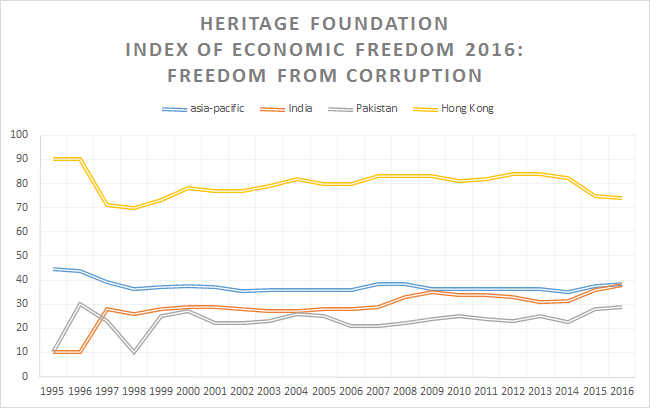
Source: Index of Economic Freedom.

06 Feb 2016 Leave a comment
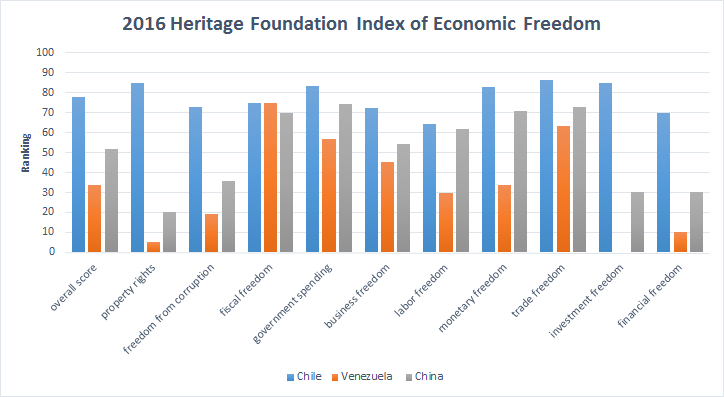
in development economics, economics of regulation, entrepreneurship, fiscal policy, growth disasters, growth miracles, industrial organisation, labour economics, law and economics, macroeconomics, monetary economics, property rights, public economics Tags: capitalism and freedom, Chile, China, The Great Escape, Venezuela
06 Feb 2016 Leave a comment
in applied price theory, economics of regulation, financial economics, politics - USA
05 Feb 2016 Leave a comment
in development economics, economics of regulation, growth disasters, growth miracles, law and economics, property rights Tags: doing business, Venezuela
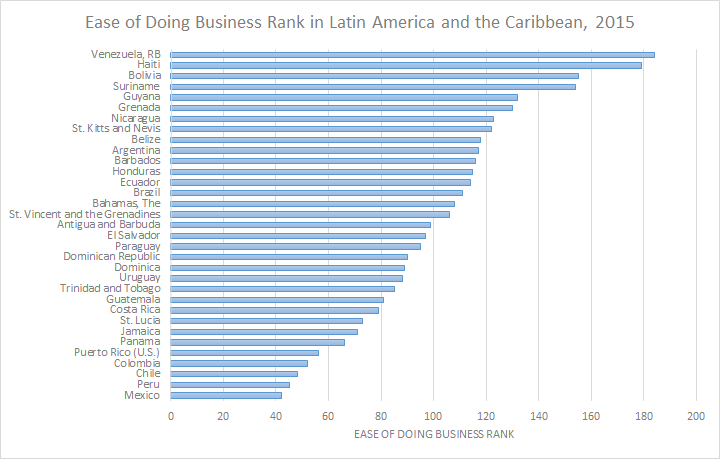
Source: World Bank Doing Business Database 2015.
04 Feb 2016 Leave a comment
in constitutional political economy, economics of regulation, international economic law, international economics, International law, labour economics, law and economics, politics - New Zealand, unions Tags: employment law, employment protection, employment regulation, ILO, labour market regulation, social clauses, TPPA
New Zealand has signed and ratified dozens of International Labour Organisation Conventions dating back to 1921. They all fetter the sovereignty of New Zealand. As a member of the ILO, New Zealand is required to report on its application of ILO Conventions.
That limitation on the sovereignty of New Zealand is no more and no less than in an international trade agreement. New Zealand can renounce an international trade agreement and has renounced nine International Labour Organisation conventions.
Jane Kelsey makes the following points about the legal implications of the Trans-Pacific Partnership agreement:
The 30 chapter Trans-Pacific Partnership Agreement (TPPA) constrains domestic law and policy at central government level, and in places by local government and SOEs, in diverse areas beyond traditional aspects of international trade.
…The TPP provides cumulative opportunities for foreign states and corporations to influence domestic decisions which may be burdensome and intrusive.
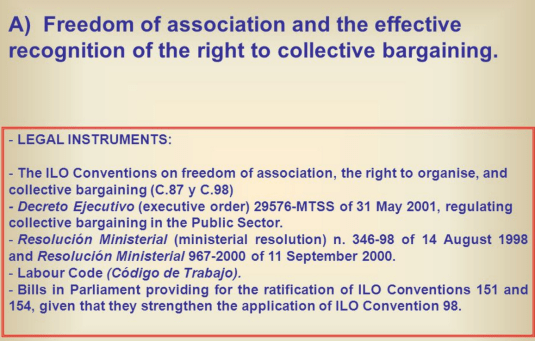
The exact same objections apply to the ILO conventions. The union movement does not hesitate to argue that the democratic process in New Zealand should be overridden because the proposal at hand purportedly conflicts with an ILO convention.
For example, when the government was choosing to deregulate collective bargaining, the sovereignty of Parliament was questioned because of an ILO convention. Helen Kelly, CTU President said:
in Parliament on 4 June, the Minister was asked if he agreed with advice from officials that the ability for employers to opt out of multi-employer bargaining may breach our obligations under ILO Convention 98 on the right to organise and collective bargaining.
…There is no point attending such an important UN ILO conference at the time your Government is being advised it is breaching its undertakings to that very organisation…
The CTU President also referred to the regulatory impact statement prepared for that collective bargaining legislation:
The paper also points out that these changes open NZ up to international examination by the International Labour Organisation (ILO) for non-compliance with Convention 98 – on the Right to Organise and Collectively Bargain, which New Zealand has signed up to.
Helen Kelly says “at least four of the proposals are deemed to be inconsistent with our international obligations, and two of them are classified as uncertain. Why the Government wants law changes that damage our international obligations is unclear.”
Council of Trade Unions submissions to minimum wage reviews have at least a dozen references to ILO conventions and the requirement to honour their provisions.
Posner and Goldsmith rightly argue that international law is a product of states pursuing their interests on the international stage. It does not induce states to comply contrary to their interests. The possibilities for what it can achieve are limited.
Government sign-up to various international agreements depending on their political priorities. You cannot complain that governments that you did not vote do what government you voted for also did, which was sign up to international agreements that suited their political agendas. The solution is to work harder to win the next general election.
As for opposing trade agreements on sovereignty grounds, it is rank hypocrisy for the union movement to do so given the number of times it cites international labour agreements when it suits them and seeks their inclusion in trade agreements to raise labour costs in developing countries.
03 Feb 2016 Leave a comment
in applied welfare economics, economics of regulation, international economic law, international economics, politics - New Zealand
The op-ed by Tim Hazledine today made a poor case against the Trans-Pacific Partnership agreement (TPPA). A much better case could be made but for his still fighting the 1990 election in New Zealand, which was about the future of economic reform.
He starts off strong by saying that the agreement is a mixed bag. I am of the same view. The TPPA is a so-so deal with small net gains.
Economic stuff the PM DIDNT mention #TPPANoWay @ItsOurFutureNZ @etangata @Mihi_Forbes @FoxMarama @grantrobertson1 https://t.co/L9rtd1dXvp—
Moana Maniapoto (@moanatribe) January 26, 2016
The TPPA and other trade agreements have dubious chapters such as the trade and environmental clauses, the intellectual property chapter and investor-state dispute settlement. Good arguments can be mounted against all of them, especially the inclusion of trade and environmental clauses into trade agreements.
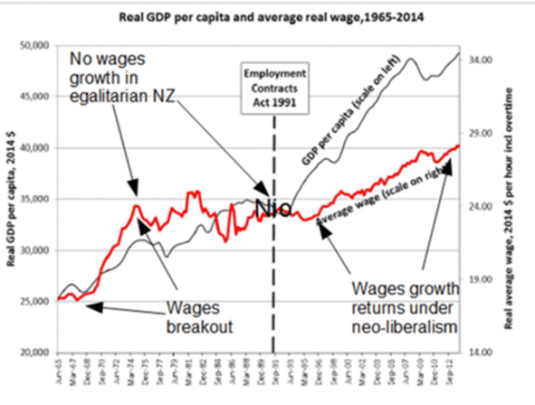
Hazledine makes few of these points of mine, preferring instead to start with a rant against economic reform in New Zealand:
One of the more gormless of the 1980s “Rogernomics” economic policy experiments was to slash tariffs on imports without seeking equivalent concessions from our trading partners.
That didn’t do us much good then, but means now that matching reductions under the TPP is relatively painless for New Zealand, because our tariffs are already so low.
He wants to put tariffs back up again so that the poor pay well over the odds to import goods that are often not made in New Zealand and when they were they were very expensive.
Henry Simons argued that economics and in particular applied price theory is most useful both to the student and the political leader as a prophylactic against popular fallacies. Paul Krugman explained the twisted logic of trade negotiations well in this tradition when he said:
Anyone who has tried to make sense of international trade negotiations eventually realizes that they can only be understood by realizing that they are a game scored according to mercantilist rules, in which an increase in exports – no matter how expensive to produce in terms of other opportunities foregone – is a victory, and an increase in imports – no matter how many resources it releases for other uses – is a defeat.
The implicit mercantilist theory that underlies trade negotiations does not make sense on any level, indeed is inconsistent with simple adding-up constraints; but it nonetheless governs actual policy.
The economist who wants to influence that policy, as opposed to merely jeering at its foolishness, must not forget that the economic theory underlying trade negotiations is nonsense – but he must also be willing to think as the negotiators think, accepting for the sake of argument their view of the world.
The logic of trade negotiations is they are about cutting tariffs we should have cut long ago in return to others cutting their tariffs which they too should have cut long ago if they had any concern for the welfare of their own country rather than special interests.
Tim Hazledine swallows the logic of trade negotiations hook, line and sinker with all the enthusiasm of a non-economist but he is a professional economist. Professional economists laugh at the mercantilist logic of trade negotiations.
Paul Krugman summarised the TPPA well recently from a standpoint of a professional economist, which occasional he still is:
I’ve described myself as a lukewarm opponent of the Trans-Pacific Partnership; although I don’t share the intense dislike of many progressives, I’ve seen it as an agreement not really so much about trade as about strengthening intellectual property monopolies and corporate clout in dispute settlement — both arguably bad things, not good, even from an efficiency standpoint….
What I know so far: pharma is mad because the extension of property rights in biologics is much shorter than it wanted, tobacco is mad because it has been carved out of the dispute settlement deal, and Republicans in general are mad because the labour protection stuff is stronger than expected. All of these are good things from my point of view. I’ll need to do much more homework once the details are clearer.
Krugman then reminded that a trade agreement is most politically viable when it is most socially harmful. This is the point that the opponents of the TPPA miss. They will not want to discuss how some trade agreements are good deals but others are bad. That would admit that trade agreements can be welfare enhancing, and sometimes they are but sometimes not.
Hazledine’s op-ed improves noticeably when he talks about sovereignty but this will backfire on him as I will show shortly:
what perhaps most concerns TPP doubters is possible loss of sovereignty – control by legitimate New Zealand governments over New Zealand policies and institutions: Pharmac, mining, greenhouse gases, fracking, biomedical patents, the Treaty of Waitangi and others have been raised as being at risk. TPP supporters have attempted to soothe such concerns, but I’d say they should come clean. Of course the TPP will weaken New Zealand’s sovereignty. That is what these things are supposed to do!
The fundamental idea or ideology behind the TPP is that national governments cannot be trusted to act independently on many issues, because they will inevitably succumb to local vested interests. Only the cleansing discipline of untrammelled global free-market forces will deliver efficient outcomes.
I fully understand the economic logic of this position, and could easily myself compile a long list of harmful effects of local vested interests, at the top of which would actually be those Canadian etc dairy and other agricultural policies.
But the basic premise is flawed. Most of the sovereignty we are giving up is not ceded to the invisible hand of free, competitive markets. It is not even handed over to larger sovereign states, such as the United States. It is largely to be conceded in the cause of making the world a safer place for huge, stateless multinational corporations to roam. Are we sure this is what we want?
I agree that treaties reduce sovereignty. That is what they are about. I am particularly concerned about treaties that reduce New Zealand’s sovereignty over its greenhouse gas emissions. These sovereignty arguments against trade agreements apply equally to climate treaties.
Likewise, trade agreements should not include trade and environmental standards as they limit the right of New Zealand to deregulate its labour market.
What's in the #TPP? Robust enforceable environmental protections. Get the facts ustr.gov/tpp #LeadOnTrade http://t.co/hzapJwGaCa—
USTR (@USTradeRep) October 05, 2015
What's in the #TPP? Protections for American workers. Get the facts: ustr.gov/tpp #MadeInAmerica http://t.co/VPeV70zaPT—
USTR (@USTradeRep) October 05, 2015
All too often unions point out that this or that International Labor Organisation convention signed decades ago conflicts with labour market deregulation. That undermines the sovereignty of New Zealand regarding the regulation of the economy just as much is the TPPA.
03 Feb 2016 Leave a comment
in defence economics, economic history, economics of regulation, energy economics, entrepreneurship, environmental economics, financial economics, global warming Tags: active investing, disinvestment, entrepreneurial alertness, ethical investing, Fossil Fuels, green rentseeking, hedge funds, passive investing, renewable energy, solar power, Vice Fund, wind power

Just as the Vice Fund specialises in investing in tobacco, alcohol, gaming and defence shares, Cool Futures Funds Management is starting-up to specialise in betting against global warming by shorting green stocks:
…instead of renewables being our energy future, they’re betting on the subsidies drying up and the whole industry collapsing; instead of fossil fuels being left in the ground as “stranded assets”.
An example of the nice little earners this hedge fund can come across is anticipating when particular investors will want to disinvest from fossil fuels.
When institutional investors ranging from universities to sovereign investment funds such as the New Zealand Superannuation Fund seek to disinvest from fossil fuels, that will be a good time to buy cheap shares.The
02 Feb 2016 Leave a comment
in constitutional political economy, development economics, economics of regulation, growth miracles, international economics, politics - New Zealand, Public Choice, rentseeking
The key reason why China joined the World Trade Organisation and other trade agreements is to bring some semblance of law to an authoritarian country. 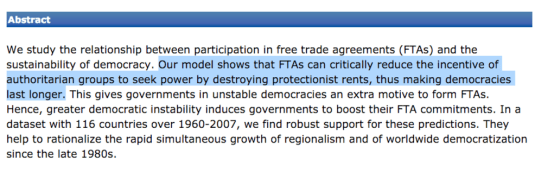
Source: AEAweb: AEJ: Macro (6,2) p. 29 – Free Trade Agreements and the Consolidation of Democracy via Max Roser.
Both the elites and ordinary people are prospering tremendously from the rise of capitalism in China, Vietnam and other places. A move away from this liberalisation to a more authoritarian setting would cost too many people too much money.
In the course of these economic liberalisations, China and Vietnam, for example, changed from totalitarian dictatorships to tin-pot dictatorships. As long as you keep out of politics in these countries, there is a fair degree of freedom and much more freedom compared to the days of communism.
Percentage employed in agriculture in the world's major economies over the last 50 years. https://t.co/UbaDnaE8Lr—
Robert Wilson (@CountCarbon) January 08, 2016
01 Feb 2016 1 Comment
in applied welfare economics, constitutional political economy, economics of regulation, income redistribution, politics - New Zealand, public economics
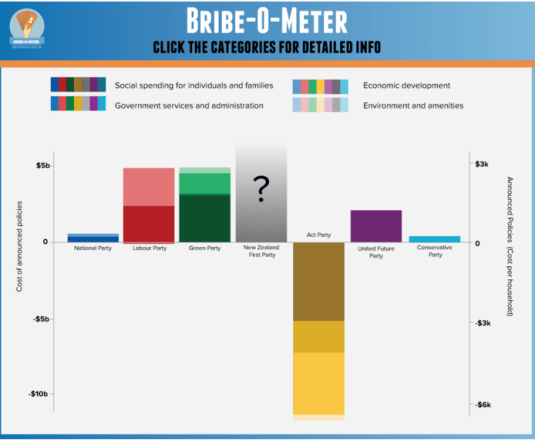
I am sure there will be lots of squabbling over parameters and assumptions of any tax, spending or regulation proposal submitted to the independent costings unit proposed recently by the New Zealand Greens.
The bigger problem is static and dynamic scoring. There is some history of doing this for taxes but little for spending and that is before you consider externalities. Imagine the squabbling over roading proposals and their externalities. The practical hurdles to dynamic scoring are:
Against that is dynamic scoring removes the bias against pro-growth policies in current budgetary scoring:
[A] theoretical advantage of accurate dynamic scoring is that it is not biased against pro-growth policies compared to the current conventional scoring method. By ignoring macroeconomic effects, the conventional method overstates the true budgetary cost of pro-growth policies, such as infrastructure investments, and understates the cost of anti-growth policies.
The bigger problem is something I learnt when costing a tax proposal for an election campaign. There was an error because I did the costing on a spreadsheet while I had a bad head cold.
The advantage of the error was the policy, as a result of this minor error in the tabulations attracted considerable attention from the major parties.
I was advised by a very wise head that this tabulation error in the dynamic scoring was not so bad a problem. This was because the tabulation error gave our side a chance to have a go at them again in the media. The policy announcement stayed in the new cycles for longer than otherwise and attracted attention from the big parties.
If a policy is too good, too perfect, the other parties will kill it with silence. You get only one bite in the news cycle and that is it.
If your policy announcement is killed by silence, at least you are guaranteed a chance to go at it again when the proposed independent costings unit a week or so later in the election campaign. You might disagree of those costings just to attract attention in the next new cycle.
Given the size, ambition and nebulous externality content of Green party proposals, they will benefit considerably from getting another go by questioning the Parliamentary budget office costings. That guarantees at least two new cycles to every one of their budgetary and regulatory announcements. No wonder they have proposed this independent costings unit.
If the New Zealand Greens do not like the costing from their proposed independent costings unit, they can just rage against neoliberalism and the conservative bias of economists. They cannot lose in terms of another bite of the 24-hour news cycle.
As a starter to feigning disagreement with any independent costings of their tax, spending and regulation proposals, Milton Friedman argued that people agree on most social objectives, but they differ often on the predicted outcomes of different policies and institutions. This leads us to Robert and Zeckhauser’s taxonomy of disagreement:
Positive disagreements can be over questions of:
1. Scope: what elements of the world one is trying to understand?
2. Model: what mechanisms explain the behaviour of the world?
3. Estimate: what estimates of the model’s parameters are thought to obtain in particular contexts?
Values disagreements can be over questions of:
1. Standing: who counts?
2. Criteria: what counts?
3. Weights: how much different individuals and criteria count?
Any positive analysis tends to include elements of scope, model, and estimation, though often these elements intertwine; they frequently feature in debates in an implicit or undifferentiated manner. Likewise, normative analysis will also include elements of standing, criteria, and weights, whether or not these distinctions are recognised. There is a rich harvest for nit-picking to keep the story going.
01 Feb 2016 Leave a comment
in economic history, economics of regulation, urban economics
29 Jan 2016 Leave a comment
in economics of regulation, health economics, politics - New Zealand
Celebrating humanity's flourishing through the spread of capitalism and the rule of law
Celebrating humanity's flourishing through the spread of capitalism and the rule of law
Celebrating humanity's flourishing through the spread of capitalism and the rule of law
Celebrating humanity's flourishing through the spread of capitalism and the rule of law
Celebrating humanity's flourishing through the spread of capitalism and the rule of law
A History of the Alt-Right
Econ Prof at George Mason University, Economic Historian, Québécois
Celebrating humanity's flourishing through the spread of capitalism and the rule of law
Scholarly commentary on law, economics, and more
Beatrice Cherrier's blog
Celebrating humanity's flourishing through the spread of capitalism and the rule of law
Celebrating humanity's flourishing through the spread of capitalism and the rule of law
Celebrating humanity's flourishing through the spread of capitalism and the rule of law
Why Evolution is True is a blog written by Jerry Coyne, centered on evolution and biology but also dealing with diverse topics like politics, culture, and cats.
Celebrating humanity's flourishing through the spread of capitalism and the rule of law
A rural perspective with a blue tint by Ele Ludemann
DPF's Kiwiblog - Fomenting Happy Mischief since 2003
Celebrating humanity's flourishing through the spread of capitalism and the rule of law
The world's most viewed site on global warming and climate change
Tim Harding's writings on rationality, informal logic and skepticism
A window into Doc Freiberger's library
Let's examine hard decisions!
Commentary on monetary policy in the spirit of R. G. Hawtrey
Thoughts on public policy and the media
Celebrating humanity's flourishing through the spread of capitalism and the rule of law
Politics and the economy
A blog (primarily) on Canadian and Commonwealth political history and institutions
Reading between the lines, and underneath the hype.
Economics, and such stuff as dreams are made on
"The British constitution has always been puzzling, and always will be." --Queen Elizabeth II
Celebrating humanity's flourishing through the spread of capitalism and the rule of law
Celebrating humanity's flourishing through the spread of capitalism and the rule of law
WORLD WAR II, MUSIC, HISTORY, HOLOCAUST
Undisciplined scholar, recovering academic
Celebrating humanity's flourishing through the spread of capitalism and the rule of law
Res ipsa loquitur - The thing itself speaks
In Hume’s spirit, I will attempt to serve as an ambassador from my world of economics, and help in “finding topics of conversation fit for the entertainment of rational creatures.”
Researching the House of Commons, 1832-1868
Articles and research from the History of Parliament Trust
Reflections on books and art
Posts on the History of Law, Crime, and Justice
Celebrating humanity's flourishing through the spread of capitalism and the rule of law
Exploring the Monarchs of Europe
Cutting edge science you can dice with
Small Steps Toward A Much Better World
“We do not believe any group of men adequate enough or wise enough to operate without scrutiny or without criticism. We know that the only way to avoid error is to detect it, that the only way to detect it is to be free to inquire. We know that in secrecy error undetected will flourish and subvert”. - J Robert Oppenheimer.
 Utopia, you are standing in it!
Recent Comments