Are Electric Cars Really Green?
24 Mar 2016 Leave a comment
in economics, energy economics, environmental economics, transport economics Tags: electric cars
Can We Rely on Wind and Solar Energy?
23 Mar 2016 Leave a comment
in economics, energy economics, environmental economics, global warming Tags: solar power, wind power
Did Earth Hour save any power? @GreenpeaceNZ
21 Mar 2016 Leave a comment
in energy economics, environmental economics, environmentalism, global warming Tags: Earth Hour, expressive politics, expressive voting, Greenpeace, Human Achievement Hour, New Zealand Greens, pessimism bias, rational irrationality
Regression time! Using Saturdays only, control for temp and time, earth hour had zero effect. @bcshaffer #ableg https://t.co/krTy8DFvrE—
Trevor Tombe (@trevortombe) March 20, 2016
Solution aversion and the anti-science Left
11 Mar 2016 1 Comment
in applied price theory, applied welfare economics, comparative institutional analysis, constitutional political economy, economics of regulation, energy economics, environmental economics, global warming, health economics, law and economics, politics - Australia, politics - New Zealand, politics - USA, property rights, Public Choice Tags: antiscience left, climate alarmism, geo-engineering, GMOs, growth of knowledge, gun control, motivated reasoning, nuclear power, political persuasion, solar power, solution aversion, wind power
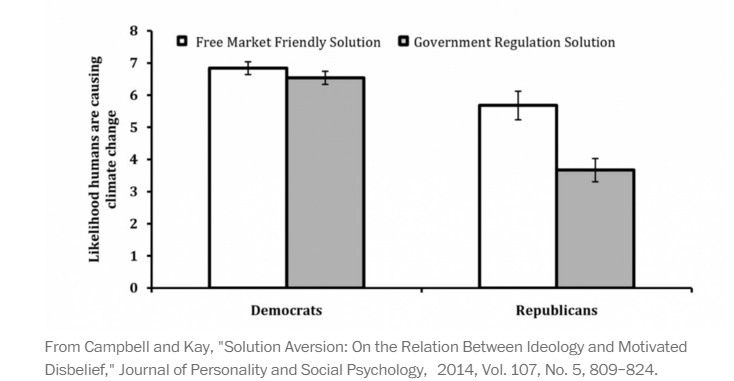
Climate science is the latest manifestation of solution aversion: denying a problem because it has a costly solution. The Right does this on climate science, the Left does it on gun control, GMOs, and plenty more. Cass Sunstein explains:
It is often said that people who don’t want to solve the problem of climate change reject the underlying science, and hence don’t think there’s any problem to solve.
But consider a different possibility: Because they reject the proposed solution, they dismiss the science. If this is right, our whole picture of the politics of climate change is off.
Some psychologists wasted grant money on lab experiments to show that people that think the solution to a problem is costly tend to rubbish every aspect of the argument. Any politician will tell you you do not concede anything. Sunstein again:
Campbell and Kay asked the participants whether they agreed with the IPCC. And in both, about 80 percent of Democrats did agree; the policy solutions made no difference.
Republicans, in contrast, were far more likely to agree with the IPCC when the proposed solution didn’t involve regulatory restrictions…
Here, then, is powerful evidence that many people (of course not all) who purport to be skeptical about climate science are motivated by their hostility to costly regulation.
The Left is equally prone to motivated readings. For example, it was found that those on the left are much more concerned about home invasions when gun control can reduce them rather than increase them.

The Left picks and chooses which scientific consensus as it accepts. The overwhelming consensus among researchers is biotech crops are safe for humans and the environment. This is a conclusion that is rejected by the very environmentalist organisations that loudly insist on the policy relevance of the scientific consensus on global warming.
Previously the precautionary principle was used to introduce doubt when there was no doubt. But when climate science turned in their favour, environmentalists wanted public policy to be based on the latest science.
The Right is welcoming of the science of nuclear energy or geo-engineering. The Left rejects it point-blank. Their refusal to consider nuclear energy as a solution to global warming is a classic example of solution aversion. Let he who is without sin cast the first stone.
A life without oil is not so easy @GreenpeaceNZ @RusselNorman @GarethMP
08 Mar 2016 Leave a comment
in energy economics, environmental economics, global warming Tags: Oil prices, rational irrationality
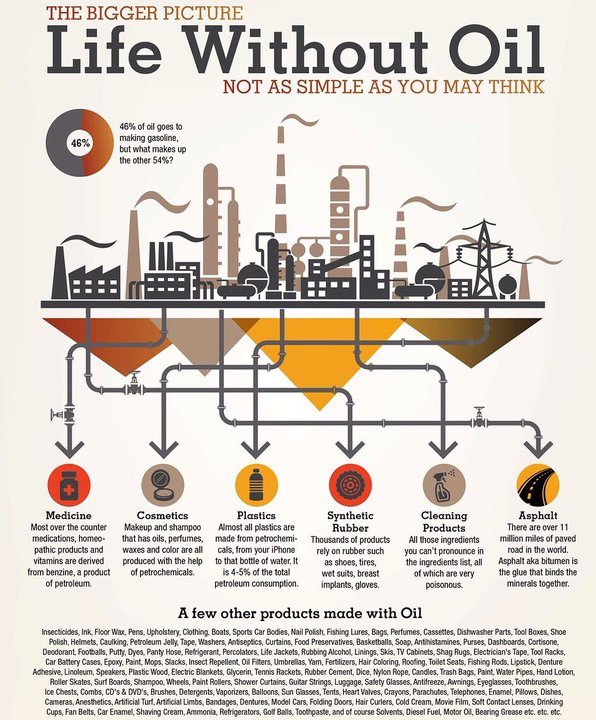
HT: Mark Perry.
Is Climate Change Our Biggest Problem?
06 Mar 2016 Leave a comment
in economics, energy economics, environmental economics, global warming Tags: climate alarmism, global warming
Oil prices were really low in the 90s
04 Mar 2016 Leave a comment
in economic history, energy economics, industrial organisation, survivor principle Tags: cartel theory, Oil prices, OPEC

How to deal with science denialists
03 Mar 2016 Leave a comment
in economics of education, economics of information, economics of media and culture, energy economics, environmental economics, global warming, health economics Tags: antiscience left, climate alarmism, growth of knowledge, philosophy of science, quackery, Quacks
Most climate alarmists do not separate the policy issues, the economic issues, from the science of global warming as suggested in this flowchart. Specifically, they do not ask what is the economic and social cost of global warming.
Europe at night
26 Feb 2016 Leave a comment
Peak coal was long ago
25 Feb 2016 Leave a comment
in economic history, energy economics Tags: coal prices, Oil prices, peak oil
Are we there yet on solar power? @GarethMP @GreenpeaceNZ @NZGreens
24 Feb 2016 Leave a comment
in economic history, energy economics, environmental economics, Public Choice, rentseeking Tags: Big Solar, green rent seeking, rational irrationality, solar energy, solar power

Source: History of Solar Power – IER.
Think Again: The Green Economy @janlogie @GarethMP
23 Feb 2016 Leave a comment
in applied welfare economics, energy economics, environmental economics, politics - New Zealand, politics - USA, Public Choice, resource economics Tags: climate alarmism, green economy, green rent seeking
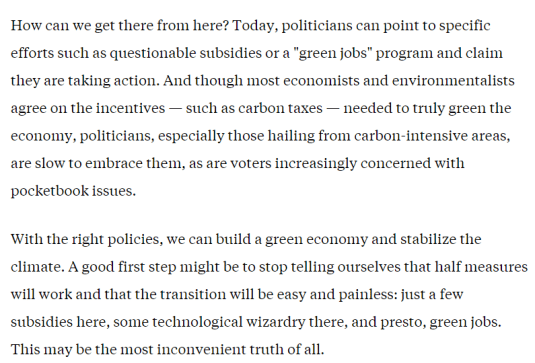
Source: Matthew Kahn (2009) Think Again: The Green Economy | Foreign Policy


Recent Comments