
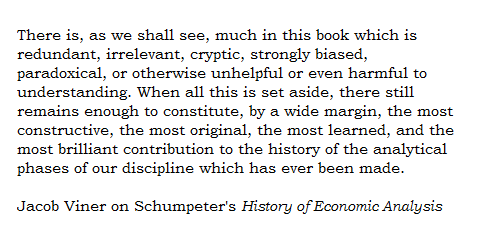
Has any brave souls actually read Schumpeter’s “History of Economic Analysis?
25 Feb 2015 Leave a comment
in history of economic thought Tags: Joseph Schumpeter
The Fabian economics of the minimum wage
25 Feb 2015 Leave a comment
in history of economic thought, labour economics, minimum wage Tags: eugenics, Fabian Society, Sydney Webb

HT: fee.org

Milton Friedman on how New Keynesian Macroeconomics is mostly monetarism
06 Feb 2015 Leave a comment


The competing visions of stabilisation policy have been defined by Franco Modigliani and Milton Friedman
26 Jan 2015 Leave a comment
in business cycles, economics of information, history of economic thought, macroeconomics, Milton Friedman, monetarism, monetary economics Tags: Franco Modigliani, Keynes in macroeconomics, monetary policy, stabilisation policy, The fatal conceit, The pretence to knowledge


Paul Samuelson and Robert Lucas both agree that economists have solved the problem of economic depressions
24 Jan 2015 Leave a comment
in business cycles, fiscal policy, great depression, great recession, history of economic thought, macroeconomics, monetary economics, Robert E. Lucas Tags: Paul Samuelson, prosperity and depression, The fatal conceit, The pretence to knowledge


Sorry, Conservatives—Basic Economics Has a Liberal Bias By Matthew Yglesias
22 Jan 2015 Leave a comment
in history of economic thought, occupational regulation Tags: academic bias, political bias
…here are some ideas that I’ve seen in most of the introductory economics textbooks I’ve looked at:
- Governments (typically through central banks) need to manage the demand level of national economies to prevent catastrophic recessions and mass unemployment.
- Absent carbon pricing, a market economy will massively overproduce greenhouse gases.
- Many industries, such as broadband Internet, are “natural monopolies” where an unregulated market will lead to higher prices and less investment than is socially optimal.
- Due to asymmetrical information, consumers in a market economy will be unable to bargain effectively with doctors and other providers of health care services.
- Due to adverse selection, consumers in a market economy will be unable to effectively insure themselves against health risks.
- Due to the declining marginal utility of money, taking $100 from a rich person and giving it to a poor one will increase human welfare.
- Increasing the number of immigrants, raising taxes on the rich, and making Social Security benefits more generous will make almost everyone better off.
I could go on like this. But suffice it to say that one of the main reasons that so many economists are Democrats is that on a whole lot of issues the basic econ 101 view supports the liberal position.
via Economics is liberal: Chris House on conservative economics..

Noah Smith wouldn’t have his fantasies about the right-wing politics of economists if he had been job-hunting in the mid-1980s and the 1990s
10 Jan 2015 1 Comment
in history of economic thought
Noah Smith somehow persuaded himself that the economics profession is moving to the left after a period on the right. There is ample evidence to show that the economists who make up the economics profession were never right-wingers. To be specific, Smith says in his recent op-ed that:
A lot of people see economics as a “conservative science” that makes up unrealistic theories in order to push a free-market agenda. I don’t know if that was ever true — maybe in the 1970s? — but if so, those days are long gone.
And that
Back in the 1970s, the public face of economics was Milton Friedman. A consummate public intellectual, Friedman would travel around the country giving lectures about the power of free markets and the virtues of capitalism. Just search YouTube and you can easily see highlight reels of Friedman smacking down socialists and idealistic leftist youths. He inspired a generation of bright young conservatives to go into economics. And before Friedman, there was Friedrich Hayek, whose tirade against Keynesian government intervention is still revered by many on the right.
Noah Smith received his PhD in economics from the University of Michigan, graduating in 2012. He is a blogger, professor and writer for Bloomberg view.
It is well known, and easy to locate on the web, a large number of papers showing that the average economist is a moderate Democrat and has been so for the several decades since these surveys and other research has been undertaken. The cleverest of these cross-tab voter registrations with faculty homepages.
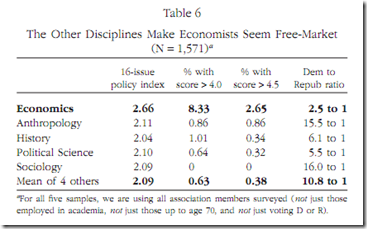
For example, Dan Klein showed that for Stanford, an overall Democrat: Republican ratio was 7.6:1. Indeed, registered Democrats easily outnumber registered Republicans in most economics departments in the USA. The registered Democrat to Republican ratio in sociology departments is 44:1! For the humanities overall, only 10 to 1. As people register for vote in the USA and political donations are a public record, it’s relatively easy to find out their political bias.

Little wonder that Dan Klein titled one of his papers “Is there a free-market economist in the house” in which he said:
We find that about 8 percent of AEA members can be considered supporters of free-market principles, and that less than 3 percent may be called strong supporters. The data are broken down by voting behaviour (Democratic or Republican). Even the average Republican AEA member is “middle-of-the-road,” not free-market.
The Bush administration was populated by new Keynesian macroeconomists. Indeed, there are so few leading economists who are Republicans, especially in the macroeconomics field, that it was difficult for President Bush to recruit a chairman of his Council of Economic Advisers that was of high standing in the profession as a macroeconomist.
As for Milton Friedman been the spokesman for the economics profession in the 1970s, I wish he had been. It would have made my job hunting a lot easier in the 1980s and 1990s in Canberra.
Mentioning Milton Friedman’s name in the mid-1980s at job interviews in Canberra would have been extremely career limiting. Not much better in the early 1990s.
Back in the 1980s, Milton Friedman was just graduating from being ‘a wild man in the wings’ to just a suspicious character in policy circles.
If you name dropped Hayek in the 1980s and 1990s, any sign of name recognition would have indicated that you were been interviewed by educated people.
I know from first-hand experience working in the economic division of the Prime Minister’s Department that Friedman certainly had no influence on macroeconomic policy in Australia in the late 1980s. The economists in the monetary policy section have great difficulty even describing what Friedman stood for in terms of monetary policy.
I wrote two papers in 1995 for the then Industry Commission in Canberra on merger and price control policy. I was required by the deputy chairman (and the champion of my paper) to delete all of my references to Richard Posner and Robert Bork because they were too contentious. They were merely Chicago school of anti-trust economics.
As I mentioned at the start, Noah Smith completed his Ph.D. in 2012. I put his ignorance of the left-wing bias of the economics profession down to his youth and inexperience.


Recent Comments