The fates of two islands under constant threat from a neighbouring military colossus
01 Aug 2015 Leave a comment
in applied price theory, applied welfare economics, Austrian economics, comparative institutional analysis, constitutional political economy, development economics, economics of media and culture, economics of regulation, growth disasters, growth miracles, income redistribution, industrial organisation, law and economics, liberalism, Marxist economics, property rights, Public Choice, rentseeking, survivor principle Tags: anticapitalist mentality, antimarket bias, capitalism and freedom, China, Cuba, expressive voting, Hong Kong, Leftover Left, public intellectuals, rational ignorance, rational irrationality, Twitter left
The American stock market is highly regulated
01 Aug 2015 Leave a comment
in economic history, economics of regulation, financial economics, industrial organisation, politics - USA Tags: financial regulation, rational ignorance, rational irrationality
Check out this awesome chart of U.S. Market Complexity
bloomberg.com/news/articles/… http://t.co/gRQNnhwjZo—
Barry Ritholtz (@ritholtz) July 09, 2015
The first-ever video played on MTV TD 1981 was?
01 Aug 2015 Leave a comment
in economic history, economics of media and culture, entrepreneurship, industrial organisation, Music, survivor principle Tags: competition as a discovery procedure, creative destruction, entrepreneurial alertness, legacy media, The meaning of competition
It’s Time to Name a Price on KiwiRail – how much more in losses before committing to shutting it down?
30 Jul 2015 Leave a comment
in industrial organisation, international economics, politics - New Zealand Tags: bailouts, corporate welfare, KiwRail, New Zealand Greens, TPPA
If a TPPA means no more bailouts for KiwiRail, that is a major benefit from the agreement not previously brought to public attention.
New Zealand shouldn’t be signing an agreement that ties future governments’ hands. #TPPANoWay http://t.co/dawreBzLia—
Green Party NZ (@NZGreens) July 30, 2015The KiwiRail bailouts add 1 to 2 percentage points to the company tax of every New Zealand business. Cutting the company tax by 1-2% by not bailing out KiwiRail would be a major public benefit. I now have one more reason to favour the TPPA.
For all the TPP's flaws, the biggest trade deal in years is good news for the world econ.st/1SjmwS3 http://t.co/UokBxoOXgf—
The Economist (@EconBizFin) July 30, 2015A trade agreement tying the hands of future governments preventing them from bailing out failing state-owned enterprises would be a major gain that could more than offset and indeed pay for the higher drug prices that may result from longer patent lives for new drugs.

In the finest public service traditions of free and frank advice, the New Zealand Treasury in its budget advice this year advised ministers to contemplate shutting down KiwiRail.
Treasury recommended the Government fund KiwiRail for one more year and undertake a comprehensive public study to look into closing the company. The study is public so that people were informed of the costs of running the rail network compared with any benefits it provided. The Government rejected the idea.
Figure 1: State-owned enterprise welfare, Vote Transport and Vote Finance (KiwiRail), Budgets 08/09 to 15/16
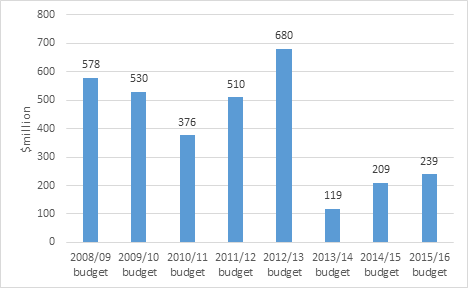
KiwiRail has been a constant thorn in the taxpayers’ side. Since this rail business was acquired in 2008 for $665 million as a commercial investment, Crown investments have totalled $3.4 billion – see Figure 1.
Fortunately in the 2015 budget, the Minister of Finance signalled that the government’s patience with the KiwiRail deficits is not unlimited. KiwiRail…
View original post 204 more words
Amazon.com as a gale of creative destruction
30 Jul 2015 Leave a comment
in economic history, economics of media and culture, entrepreneurship, industrial organisation, survivor principle Tags: Amazon.com, business history, creative destruction, e-commerce, entrepreneurial alertness, Walmart
Amazon is now bigger than Walmart read.bi/1Lyy93u http://t.co/XBsLW2HG8o—
Business Insider (@businessinsider) July 24, 2015
If bureaucrats were any good at picking winners, they would be hedge funds managers
30 Jul 2015 Leave a comment
in applied price theory, comparative institutional analysis, economics of bureaucracy, entrepreneurship, financial economics, human capital, industrial organisation, labour economics, managerial economics, occupational choice, organisational economics, rentseeking, survivor principle Tags: active investing, corporate welfare, efficient markets hypothesis, entrepreneurial alertness, hedge funds, industry policy, passive investing, picking winners, The fatal conceit, The pretence to knowledge
Page 32 of "An Illustrated Guide to Income" more economic #dataviz at: bit.ly/12SEI9p http://t.co/HYm0II2UNI—
Catherine Mulbrandon (@VisualEcon) May 08, 2013
Page 33 of "An Illustrated Guide to Income" more economic #dataviz at: bit.ly/10M7lqR http://t.co/FcmaqZWB32—
Catherine Mulbrandon (@VisualEcon) May 09, 2013
The hedge fund industry held $2.9 trillion of assets in June. Exchange-traded funds did better econ.st/1DdXgWS http://t.co/CK2foqMOpw—
The Economist (@EconEconomics) August 01, 2015
Creative destruction in advertising revenue around the globe
30 Jul 2015 Leave a comment
in development economics, economic history, economics of media and culture, growth miracles, industrial organisation, survivor principle Tags: competition as a discovery procedure, creative destruction, digital media, legacy media, technology diffusion, The meaning of competition
Why I'm optimistic about digital media, in 2 charts vox.com/2015/7/28/9050… http://t.co/FrVpJC2e2F—
Vox (@voxdotcom) July 28, 2015
Deirdre McCloskey on the Samaritan’s dilemma
30 Jul 2015 Leave a comment
in applied price theory, applied welfare economics, comparative institutional analysis, constitutional political economy, development economics, economic history, economics of regulation, entrepreneurship, growth disasters, growth miracles, history of economic thought, income redistribution, industrial organisation, liberalism, Public Choice, rentseeking, survivor principle Tags: Age of Innovation, bourgeoisie deal, capitalism and freedom, Deirdre McCloskey, The Great Enrichment, The Great Escape, The Great Fact

Jane Kelsey opposes handcuffs on the democratic choices of future governments! Does she oppose labour and environmental standards in trade agreements too?
30 Jul 2015 6 Comments
in applied price theory, applied welfare economics, comparative institutional analysis, constitutional political economy, economics of regulation, environmental economics, health economics, industrial organisation, international economic law, international economics, International law, law and economics, property rights, Public Choice Tags: climate treaties, copyrights, customs unions, environmental standards, free trade agreements, free trade zones, intellectual property law, ISDS, Jane Kelsey, Labour standards, Left-wing hypocrisy, neocolonialism, patents, preferential trading agreeents, regional trade agreements, regulatory harmonisation, TPA, TPPA, WTO
Jane Kelsey in a television interview said she opposes the reductions in sovereignty in trade agreements that result from investor-state dispute settlement (ISDS) provisions because they limit the democratic choices of future governments.
If so, she must oppose environmental and labour standards in trade agreements and, more importantly, binding the hands of future governments with climate treaties. All international treaties are about restrictions on sovereignty.
Environmental and labour clauses in trade agreements and climate treaties all limit the powers of governments to legislate on environmental and employment law in accordance with the will of the people as expressed in the most recent election and change of government. Power to the people.
https://twitter.com/rorymccourt/status/625540621457960960
Jane Kelsey would do better focusing on those parts of the TPPA deal that lowers the net value of the deal such as those extending the term of patents over the drugs. All international treaties are about trade-offs.

The most important reason for focusing on intellectual property law in trade agreements is Kelsey is likely to actually win people over that are not on the far left, including many on the right of politics over to her cause. Kelsey is too busy rounding up the usual suspects.

Ranting about big corporate conspiracies and the investor state dispute settlement clauses puts people off.
As copyright duration's at play in #TPPA, a reminder of the costs when copyright's too long.
offsettingbehaviour.blogspot.co.nz/2014/03/orphan… http://t.co/tOtihpDmSU—
Eric Crampton (@EricCrampton) July 29, 2015
These gusts of paranoia lose support on issues where there is common ground to be suspicious about the growing scope of trade agreements and their reach behind borders.

Regulatory harmonisation is advisable only when there are compelling reasons such as the prevention of hazards or technical compatibility of products – do the plugs fit into each other? As Sykes argues:
as a normative matter, harmonization is inferior to a legal system that tolerates regulatory differences subject to legal constraints, and that relies on mutual recognition where appropriate (the exception to this claim being matters of technical compatibility between products).
Related, as a positive manner, harmonization will often lack any political constituency and thus instances of true harmonization will be rare.
#TPPA The first Paul Krugman on trade agreements that level the playing field behind the border
29 Jul 2015 2 Comments

EU/OECD averages on R&D spending
27 Jul 2015 Leave a comment
in economic growth, industrial organisation, macroeconomics, survivor principle Tags: creative destruction, endogenous growth theory, entrepreneurial alertness, innovation, R&D
UK below EU/OECD averages on R&D spending: contributes to big productivity problem wef.ch/1dNOgv1 #budget15 http://t.co/OiN0706Tyi—
William Bain (@William_Bain) July 09, 2015

I thought America’s poor never had health insurance cover!? I’ve watched too much American TV?
26 Jul 2015 1 Comment
in applied welfare economics, economic history, economics of media and culture, health economics, industrial organisation, politics - USA, Public Choice, rentseeking, survivor principle Tags: adverse selection, expressive voting, health insurance, Leftover Left, media bias, medicaid, Medicare, moral hazard, Obamacare, rational ignorance, rational irrationality
#Medicaid expands access to health coverage and supports work: bit.ly/1RKHQ2x #Medicaidat50 http://t.co/mydZMggcXg—
Center on Budget (@CenterOnBudget) July 20, 2015
6.4 million seniors get the vital support & care they need thanks to Medicaid: bit.ly/1HqYvNG #Medicaidat50 http://t.co/onWMiYj301—
Center on Budget (@CenterOnBudget) July 23, 2015
Reminder: #Medicaid helps millions of babies: bit.ly/1RS7ME5 #Medicaidat50 http://t.co/SeJ7MFPGWE—
Center on Budget (@CenterOnBudget) July 20, 2015
#Medicaid help millions of children across the country live healthier lives. #Medicaidat50: bit.ly/1RS7ME5 http://t.co/LT6rXhNzUg—
Center on Budget (@CenterOnBudget) July 16, 2015
50 years of coverage that every American deserves. #Medicare http://t.co/uRtERV2k9K—
American Progress (@amprog) July 30, 2015
Mann: Celebrating historic gains in coverage for kids CCF#2015 http://t.co/g7CYQ7DuwN—
Georgetown CCF (@GeorgetownCCF) July 22, 2015
#Medicare has been keeping seniors insured and healthy for 50 years. http://t.co/mXW4x12Rhi—
American Progress (@amprog) July 30, 2015
The majority of Americans of all ages don't recognize that gov subsidizes their health care: vox.com/2015/3/1/81257… http://t.co/ivq5eLThsi—
(@SocImages) April 22, 2015
 Utopia, you are standing in it!

Recent Comments