In Part I and Part II of this series, we looked at research showing that Americans are bearing the burden of Trump’s trade taxes. Those findings are a useful antidote to Trump’s silly and illiterate claim that foreign companies are swallowing the added cost. In both of those columns, however, I pointed out that I’m […]
In Part I of this series, we reviewed some new research from the New York Federal Reserve. That study showed that Americans bear about 90 percent of the burden of Trump’s Liberation Day trade taxes. Though I added my own two cents because I don’t actually care that much about who bears the burden of […]
The good news is that Europe has a lot of economic freedom by world standards. Especially Western Europe. The bad news is that economic freedom has been declining in Western Europe. To make matters worse, Europe has a big demographic problem, with a growing number of older people over time who have been promised benefits […]
How many times have I heard versions of that claim? Erik Brynjolfsson picks up the telephone in the FT: While initial reports suggested a year of steady labour expansion in the US, the new figures reveal that total payroll growth was revised downward by approximately 403,000 jobs. Crucially, this downward revision occurred while real GDP…
Does this mean we will have fewer stories from the Post about how human hair clothing can save the Earth?! What will happen to the team of Washington Post ‘climate solution’ reporters?! The world of journalism has dramatically improved today!
Based on a video from the Center for Freedom and Prosperity back in 2010, as well a video from Johan Norberg I shared in 2016, there’s a lot to learn by looking at Swedish economic history. Here’s a more recent video that also looks at that nation’s economic track record. You’ll notice a similar message […]
New Zealand was the first Western developed country to sign a free trade agreement with China, and it came into force in 2008. At the time, the New Zealand government estimated an increase in exports to China of between NZ$225 million and NZ$350 million (between US$180 million and US$280 million), and Ministry of Foreign Affairs…
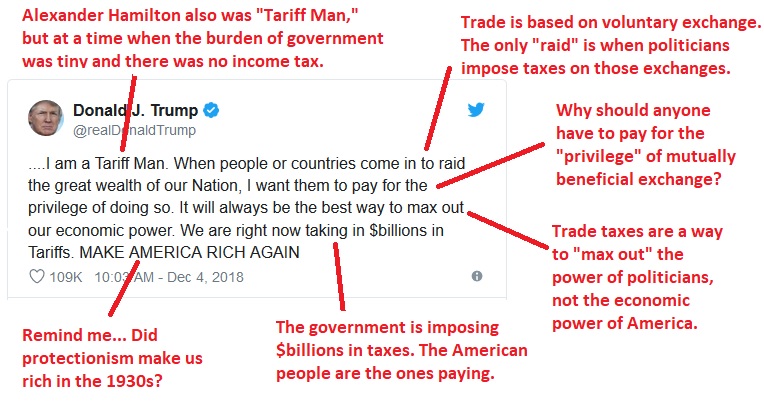
Donald Trump, who describes himself as “Tariff Man,” recently wrote a column in defense of his protectionist trade policy for the Wall Street Journal. After reading the column, my first thought was that Trump was trying to show he is more economically illiterate than Joe Biden (a big challenge, as seen here and here). And […]
The proposed acquisition of Warner Bros. Discovery (WBD) assets by Netflix is already being cast as a landmark antitrust “test case.” If past deals are any guide, the critiques will follow a familiar script: narrow market definitions, selective data points, and headline-friendly market-share claims designed to trigger alarm. Yet in a video ecosystem defined by…
When a truly great new invention appears, people rarely greet it with the reverence that hindsight later bestows. Instead, they squint at it through the lens of the familiar. They ask: What is this like? And because it is not like anything they already know, they underestimate it. History is littered with inventions that, at […]
It is all the more remarkable, then, that within six years Britain’s agricultural output had transformed, more profoundly and at a faster pace than any time since the start of the Industrial Revolution. The most urgent need was to provide a substitute for all that previously imported foreign wheat. In 1939, Britain only had 11.8…
Sara Frueh interviews David Autor on the subject: “How Is AI Shaping the Future of Work?” (Issues in Science and Technology, January 6, 2026). Here are some snippets that caught my eye, but it’s worth reading the essay and even clicking on some of the suggested additional readings: How broadly are AI tools already being…
Let us hope: Britain is seeing early signs of a long-awaited turnaround of its productivity woes, according to an alternative measure that suggests output per hour worked has risen at a pace not seen since before the financial crisis. The Resolution Foundation said a “blistering” productivity surge has been masked by problems with official statistics and pointed…
HBR: SUMMARY:THE CHALLENGE: Major companies competing in many industries struggle to stay abreast of rapidly changing technologies. ONE MAJOR CAUSE: They are typically organized into business units, each with its own set of functions. Thus the key decision makers—the unit leaders—lack a deep understanding of all the domains that answer to them.THE APPLE MODEL: The company is organized…
Why Evolution is True is a blog written by Jerry Coyne, centered on evolution and biology but also dealing with diverse topics like politics, culture, and cats.
“We do not believe any group of men adequate enough or wise enough to operate without scrutiny or without criticism. We know that the only way to avoid error is to detect it, that the only way to detect it is to be free to inquire. We know that in secrecy error undetected will flourish and subvert”. - J Robert Oppenheimer.





 Utopia, you are standing in it!
Recent Comments