TweetIdeally, every government would implement a policy of unilateral free trade. But governments, of course, by their nature testify that reality is very far from ideal. Here’s a letter to a long-time correspondent. Mr. B__: Thanks for your email in response to this blog post of mine in which I express support for the World…
Harnessing Mercantilist Idiocy for the Public Good
Harnessing Mercantilist Idiocy for the Public Good
17 Apr 2026 Leave a comment
in applied price theory, history of economic thought, industrial organisation, international economics
The Paramount Question Isn’t Paramount
17 Apr 2026 Leave a comment
in applied price theory, economics of media and culture, economics of regulation, entrepreneurship, industrial organisation, law and economics, managerial economics, market efficiency, movies, organisational economics, politics - USA, television Tags: competition law, creative destruction, merger law enforcement

Big mergers make headlines. They don’t always make antitrust problems. In a previous commentary, I explored the antitrust implications of a potential acquisition of Warner Bros. Discovery (WBD). That uncertainty is now resolved. On Feb. 27, Paramount Skydance Corp. agreed to acquire WBD for roughly $110 billion in enterprise value—$31 per share, all cash. The…
The Paramount Question Isn’t Paramount
La Marxista: Mamdani Pledges to Open First City-Run Store with Projected $30 Million Initial Cost
15 Apr 2026 Leave a comment
in economics of bureaucracy, economics of regulation, history of economic thought, industrial organisation, law and economics, Marxist economics, politics - USA, property rights, Public Choice, survivor principle, urban economics Tags: New York City, state ownership

Mayor Zohran Mamdani used his “First 100 Days” speech this week to announce that he has kept his promise to…
La Marxista: Mamdani Pledges to Open First City-Run Store with Projected $30 Million Initial Cost
Why “Gini Coefficients” Are Meaningless
09 Apr 2026 Leave a comment
in economics of education, entrepreneurship, financial economics, history of economic thought, human capital, industrial organisation, labour economics, labour supply, occupational choice, poverty and inequality
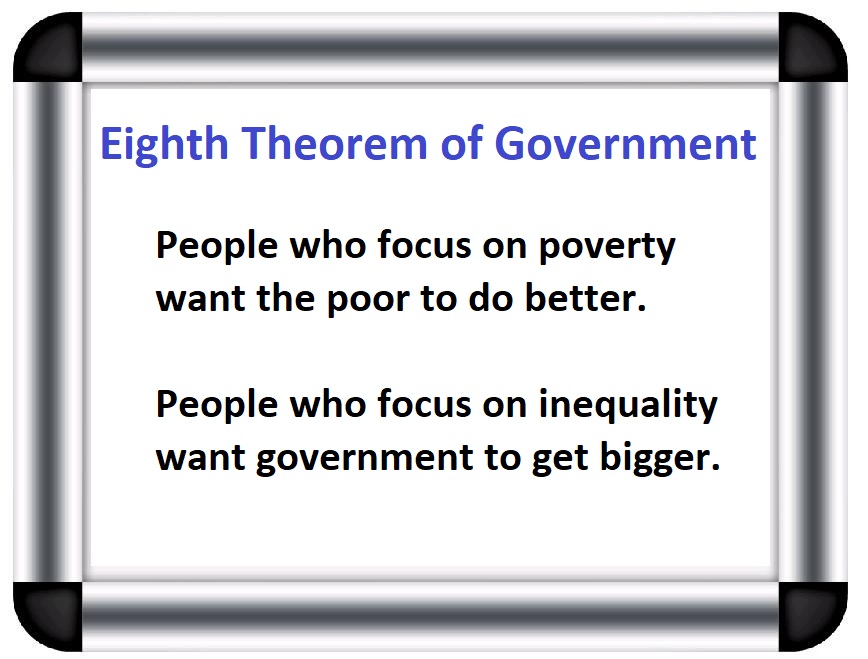
I created the 8th Theorem of Government because it’s important to distinguish between people who want to help the poor and people who want to punish the rich. The former group has good motives while the latter group has ignoble motivations. Envy (common among the leftist intelligentsia) Public choice (common among leftist politicians) Zero-sum illiteracy […]
Why “Gini Coefficients” Are Meaningless
Is there something about manufacturing that requires special policies to help it that other industries don’t get?
07 Apr 2026 Leave a comment
in applied price theory, entrepreneurship, industrial organisation, politics - USA, survivor principle
I have excerpts from posts or articles by three different economists. The answer seems to be no. Two are older and one is very recent by Harvard prof Jason Furman, who was once the chair of the Council of Economic Advisors under Obama. Then two older sources. One is from Tyler Cowen (2023), professor at…
Is there something about manufacturing that requires special policies to help it that other industries don’t get?
Abolish the BSA
04 Apr 2026 Leave a comment
in economics of media and culture, economics of regulation, industrial organisation, politics - New Zealand
The Broadcasting Standards Authority announced: The Broadcasting Standards Authority has confirmed it has jurisdiction to consider a complaint about content transmitted by an online broadcaster. In a decision published today, the Authority determined it can accept, and is required to consider under the Broadcasting Act, complaints about The Platform’s Live Talkback programme, because the programme meets…
Abolish the BSA
Javier Milei Week, Part IV: Argentina’s Pre-2023 Descent into Protectionism
26 Mar 2026 Leave a comment
in applied price theory, Austrian economics, development economics, economic history, growth disasters, industrial organisation, international economics, survivor principle Tags: Argentina

Last year, as part of a series on the additional reforms Milei needs to enact in Argentina, I shared this video on reducing protectionism. Since the video was only one-minute long, there was no chance to provide details. But at the conference in Buenos Aires this week, Professor Jorge Streb shared some fascinating details on […]
Javier Milei Week, Part IV: Argentina’s Pre-2023 Descent into Protectionism
Quotation of the Day…
17 Mar 2026 Leave a comment
in applied price theory, development economics, economic history, entrepreneurship, growth disasters, growth miracles, industrial organisation, labour economics, labour supply Tags: creative destruction, The Great Enrichment
Tweet… is from page 103 of Historical Impromptus, a 2020 collection of some of Deirdre McCloskey’s work on economic history; this quotation, specifically, is from McCloskey’s 2000 review, in the Minnesota Journal of Global Trade, of Thomas Friedman’s The Lexus and the Olive Tree and John Gray’s False Dawn [original emphasis]: Globalization encourages the capitalist…
Quotation of the Day…
COMESA, WhatsApp Business, and Antitrust in Search of a Theory
17 Mar 2026 Leave a comment
in applied price theory, economics of regulation, industrial organisation, law and economics, property rights Tags: competition law

Meta’s decision to limit third-party AI access to WhatsApp Business has quickly drawn antitrust scrutiny across multiple jurisdictions. The Common Market for Eastern and Southern Africa (COMESA) Competition and Consumer Commission (CCCC) is the latest authority to open an investigation. But before the case can answer whether Meta’s conduct harms competition, a more basic question…
COMESA, WhatsApp Business, and Antitrust in Search of a Theory
If Iran stopped exporting oil
16 Mar 2026 Leave a comment
in business cycles, defence economics, economic growth, energy economics, industrial organisation, international economics, International law, macroeconomics, resource economics, war and peace Tags: Iran
By ChatGPT-5.2 If Iran’s oil exports alone stopped, the world would feel it, but it would probably be a serious price shock rather than an immediate global supply collapse. Iran has recently been exporting roughly 1.1–1.5 million barrels a day, close to its 2025 average of about 1.69 million barrels a day, with China buying more than 80% of those shipped […]
If Iran stopped exporting oil
Cost Overruns Are Bad for Taxpayers, Good for Insiders
14 Mar 2026 Leave a comment
in applied price theory, comparative institutional analysis, economics of bureaucracy, entrepreneurship, industrial organisation, managerial economics, market efficiency, organisational economics, Public Choice

My First Theorem of Government is the simple observation that insiders are the biggest beneficiaries of government. I was motivated to release that theorem because bad news for taxpayers is good news for bureaucrats, consultants, contractors, lobbyists, and politicians. A classic example is the Department of Education in Washington, which has squandered more than $2.6 […]
Cost Overruns Are Bad for Taxpayers, Good for Insiders
Tech Has Never Caused a Job Apocalypse. Don’t Bet on It Now.
12 Mar 2026 1 Comment
in applied price theory, entrepreneurship, history of economic thought, industrial organisation, labour economics, labour supply, survivor principle Tags: creative destruction
Neither theory, history nor the latest data suggests a recession driven by AI job dislocation is likely By Greg Ip. Excerpts:”Technological advancements always cost some people their jobs—those whose skills can be easily substituted by tech. But their loss is more than offset through three other channels. The new technology enhances the skills of some survivors,…
Tech Has Never Caused a Job Apocalypse. Don’t Bet on It Now.
Dismantling the competition myth
06 Mar 2026 Leave a comment
in Austrian economics, comparative institutional analysis, economic history, economics of regulation, entrepreneurship, history of economic thought, industrial organisation, law and economics, organisational economics, politics - Australia, technological progress, theory of the firm Tags: competition law, creative destruction
Ask anyone in Australia’s competition law community what transformed the economy, and you will hear a familiar story. Australia was once a cartelised, complacent place where businesses divided up markets and consumers paid the price. Then came the Trade Practices Act in 1974, and competition law forced firms to compete. This is not a fringe […]
Dismantling the competition myth
Bet On It Book Club: For a New Liberty, Chapter 4
02 Mar 2026 Leave a comment
in applied price theory, Austrian economics, comparative institutional analysis, economics of bureaucracy, industrial organisation, law and economics, liberalism, Murray Rothbard, privatisation, Public Choice
Update: I’m doing a Substack Live today on You Have No Right to Your Culture with the Boyd Institute’s Peter Banks. 4 PM ET.SummaryThis is the shortest chapter of the book, just six pages long. Rothbard makes a laundry list of what he calls “the major problem areas of our society” and argues that government…
Bet On It Book Club: For a New Liberty, Chapter 4
Laying Off Workers: Cheap vs. Expensive
01 Mar 2026 Leave a comment
in applied price theory, economics of regulation, entrepreneurship, industrial organisation, labour economics, labour supply, survivor principle Tags: creative destruction

When thinking about what makes an economy flourish, many of us tend to focus on the success stories of innovation and growth. After all, success stories involve an element of risk, which means a chance of failure. When it’s more expensive to fail, then avoiding the risk of failure–by avoiding innovative but risky business choices–starts…
Laying Off Workers: Cheap vs. Expensive


Recent Comments