https://twitter.com/paul1kirby/status/642813666249822208/photo/1

Hollywood movies write women out of the script & create a make-believe world where men do all jobs.Ace chart http://t.co/0eM17kRJKW—
paulkirby (@paul1kirby) September 10, 2015
Celebrating humanity's flourishing through the spread of capitalism and the rule of law
15 Sep 2015 Leave a comment
in discrimination, gender, labour economics, labour supply, occupational choice Tags: gender gap, gender wage gap, Hollywood economics
https://twitter.com/paul1kirby/status/642813666249822208/photo/1
Hollywood movies write women out of the script & create a make-believe world where men do all jobs.Ace chart http://t.co/0eM17kRJKW—
paulkirby (@paul1kirby) September 10, 2015
12 Sep 2015 Leave a comment
in constitutional political economy, discrimination, economics of education, gender, labour economics, labour supply, liberalism, occupational choice, Public Choice, rentseeking Tags: economics of fertility, economics of the family, engines of liberation, female labour force participation, feminism, women's liberation
10 Sep 2015 Leave a comment
in discrimination, economic history, economics of education, gender, human capital, labour economics, labour supply Tags: British economy, gender wage gap
09 Sep 2015 Leave a comment
in discrimination, economic history, gender, human capital, labour economics, labour supply, occupational choice Tags: asymmetric marriage premium, gender wage gap


31 Aug 2015 Leave a comment
in discrimination, economics of love and marriage, gender, labour economics, labour supply, politics - USA, poverty and inequality, welfare reform Tags: asymmetric marriage premium, child poverty, economics and fertility, engines of liberation, family poverty, marriage and divorce, marriage premium, single mothers, single parents
43.1% of single mothers are living in poverty this #MothersDay statusofwomendata.org http://t.co/OgWcmvLnDZ—
IWPR (@IWPResearch) May 10, 2015
28 Aug 2015 Leave a comment
in discrimination, economics of crime, economics of love and marriage, labour economics, law and economics, politics - New Zealand, population economics, poverty and inequality, unemployment, urban economics, welfare reform Tags: crime and punishment, criminal deterrence, economics of the family, racial discrimination, single mothers, single parents, teen pregnancies
Did Mass Incarceration Destroy the Black Family? Not exactly. bit.ly/1f8jgXm http://t.co/1q2nKJnU9W—
City Journal (@CityJournal) August 13, 2015
14 Aug 2015 Leave a comment
in discrimination, economics of education, gender, labour economics Tags: fainting couch feminism, male privilege, meddlesome preferences, micro-aggressions, nanny state, safe spaces, trigger warnings
13 Aug 2015 Leave a comment
in applied welfare economics, discrimination, economic history, labour economics, politics - New Zealand, poverty and inequality Tags: Maori economic development
From a longer-term perspective, all groups showed a strong rise from the low point in the mid 1990s through to 2010. In real terms, overall median household income rose 47% from 1994 to 2010: for Maori, the rise was even stronger at 68%, and for Pacific, 77%.
These findings for longer- term trends are robust, even though some year on year changes may be less certain. For 2004 to 2010, the respective growth figures were 21%, 31% and 14%.

Source: Bryan Perry, Household Incomes in New Zealand: trends in indicators of inequality and hardship 1982 to 2014 – Ministry of Social Development, Wellington (August 2015), Table D6.
13 Aug 2015 Leave a comment
in business cycles, discrimination, gender, human capital, job search and matching, labour economics, labour supply, macroeconomics, occupational choice Tags: female labour force participation, male labour force participation, recessions and recoveries
CHART: The Great Recession Had a Disproportionately Negative Effect on Men That Continues Today @CHSommers @AsheSchow http://t.co/wnfdUOUn0a—
Mark J. Perry (@Mark_J_Perry) August 08, 2015
05 Aug 2015 Leave a comment
in discrimination, economic history, gender, labour economics, law and economics Tags: France, gender wage gap, Germany, Leftover Left, Norway, Sweden, Twitter left
Our friends on the Left go on about how wonderful place Sweden is despite its gender gap being stuck for 35 years. Not much better in Norway and in Germany and France for that matter.
Figure 1: gender wage, % of median male wage, full-time employees, France, Germany, Sweden and Norway, 1980 – 2012

Source: Earnings and wages – Gender wage gap – OECD Data.
The gender wage gap in figure 1 is unadjusted and defined as the difference between median earnings of men and women relative to median earnings of men. Data refer to full-time employees.
04 Aug 2015 1 Comment
in discrimination, gender, labour economics, politics - Australia, politics - New Zealand, politics - USA Tags: Australia, British economy, gender wage gap
New Zealand does much better than most on the gender wage gap for full-time workers.
Figure 1: gender wage, % of median male wage, full-time employees, USA, UK, Australia and New Zealand, 1970 – 2012
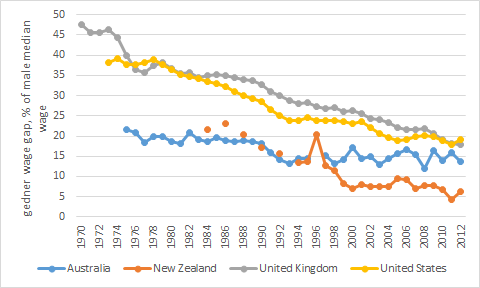
Source: Earnings and wages – Gender wage gap – OECD Data.
The gender wage gap in figure 1 is unadjusted and defined as the difference between median earnings of men and women relative to median earnings of men. Data refer to full-time employees.
I never found it terribly helpful to include part-time workers, such as in an hourly measure of the gender wage gap because of a larger trade-off between cash wages and work life balance in part-time jobs.
02 Aug 2015 2 Comments
in discrimination, gender, health and safety, labour economics, occupational choice, transport economics Tags: aviation, gender fatalities gaps, occupational deaths and injuries, reverse gender gap
Dear "lumbersexuals": real loggers are 30x more likely to die on the job than the avg worker priceonomics.com/how-the-lumber… http://t.co/1BLTBI37da—
Zachary Crockett (@zzcrockett) June 12, 2015
Celebrating humanity's flourishing through the spread of capitalism and the rule of law
Celebrating humanity's flourishing through the spread of capitalism and the rule of law
Celebrating humanity's flourishing through the spread of capitalism and the rule of law
Celebrating humanity's flourishing through the spread of capitalism and the rule of law
Celebrating humanity's flourishing through the spread of capitalism and the rule of law
Celebrating humanity's flourishing through the spread of capitalism and the rule of law
Celebrating humanity's flourishing through the spread of capitalism and the rule of law
Celebrating humanity's flourishing through the spread of capitalism and the rule of law
A History of the Alt-Right
Econ Prof at George Mason University, Economic Historian, Québécois
Celebrating humanity's flourishing through the spread of capitalism and the rule of law
Scholarly commentary on law, economics, and more
Beatrice Cherrier's blog
Celebrating humanity's flourishing through the spread of capitalism and the rule of law
Celebrating humanity's flourishing through the spread of capitalism and the rule of law
Celebrating humanity's flourishing through the spread of capitalism and the rule of law
Why Evolution is True is a blog written by Jerry Coyne, centered on evolution and biology but also dealing with diverse topics like politics, culture, and cats.
Celebrating humanity's flourishing through the spread of capitalism and the rule of law
A rural perspective with a blue tint by Ele Ludemann
DPF's Kiwiblog - Fomenting Happy Mischief since 2003
Celebrating humanity's flourishing through the spread of capitalism and the rule of law
The world's most viewed site on global warming and climate change
Tim Harding's writings on rationality, informal logic and skepticism
A window into Doc Freiberger's library
Let's examine hard decisions!
Commentary on monetary policy in the spirit of R. G. Hawtrey
Thoughts on public policy and the media
Celebrating humanity's flourishing through the spread of capitalism and the rule of law
Politics and the economy
A blog (primarily) on Canadian and Commonwealth political history and institutions
Reading between the lines, and underneath the hype.
Economics, and such stuff as dreams are made on
"The British constitution has always been puzzling, and always will be." --Queen Elizabeth II
Celebrating humanity's flourishing through the spread of capitalism and the rule of law
Celebrating humanity's flourishing through the spread of capitalism and the rule of law
WORLD WAR II, MUSIC, HISTORY, HOLOCAUST
Undisciplined scholar, recovering academic
Celebrating humanity's flourishing through the spread of capitalism and the rule of law
Res ipsa loquitur - The thing itself speaks
In Hume’s spirit, I will attempt to serve as an ambassador from my world of economics, and help in “finding topics of conversation fit for the entertainment of rational creatures.”
Researching the House of Commons, 1832-1868
Articles and research from the History of Parliament Trust
Reflections on books and art
Posts on the History of Law, Crime, and Justice
Celebrating humanity's flourishing through the spread of capitalism and the rule of law
Exploring the Monarchs of Europe


Recent Comments