Avg hrs worked / wk
Turkey: 49
Mexico: 45
Greece: 39
USA: 39
France: 36
Germany: 35https://t.co/MD1lZBegQw pic.twitter.com/62lEcJnFC8— Max Galka (@galka_max) January 18, 2016
Average hours worked in main job
13 Feb 2016 Leave a comment
in labour economics, labour supply Tags: hours worked
GDP per hour worked across the OECD
13 Feb 2016 Leave a comment
in economic growth, labour economics, labour supply, macroeconomics Tags: labour productivity
The 1996 US federal welfare reforms at 20
12 Feb 2016 Leave a comment
in applied welfare economics, economic history, labour economics, labour supply, politics - USA, welfare reform
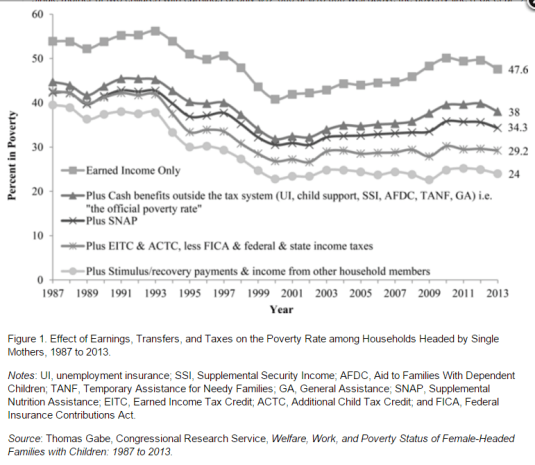
Despite the dire predictions, there has been a permanent reduction in child poverty of 25%, a 35% increase in the employment rates of never married mothers and a 16% increase in the employment rates of single mothers.
Minorities benefited the most from the 1996 US federal welfare reforms in terms of higher employment rates and lower child poverty rates.
As part of the 1996 reforms, Medicaid eligibility was not lost when going off welfare and single parents by getting a job qualified for the Earned Income Tax Credit.
Harvard business School survey discovers that workers want more
12 Feb 2016 Leave a comment
in human capital, labour economics, labour supply, occupational choice, personnel economics, poverty and inequality, unions Tags: compensating differentials, union wage premium, unions

F A Hayek – Unemployment And The Free Market
12 Feb 2016 Leave a comment
in applied price theory, Austrian economics, business cycles, economic growth, F.A. Hayek, fiscal policy, job search and matching, labour economics, labour supply, macroeconomics, unemployment, unions Tags: job search, mismatch unemployment, search unemployment, union power, union wage premium, waiting unemployment
Mandatory severance pay by length of job tenure in the G7, Australia, New Zealand, Ireland, Scandinavia, Greece and Spain
11 Feb 2016 Leave a comment
in human capital, job search and matching, labour economics, labour supply, law and economics, managerial economics, organisational economics, personnel economics, property rights, unemployment Tags: employment law, employment protection laws, employment regulation, firm-specific human capital, job search, labour market regulation, severance pay
There are a wide differences across the OECD in mandatory severance pay in the event of a layoff.
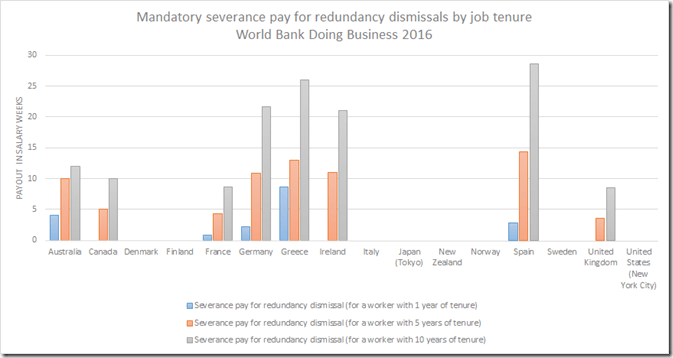
Source: Labor Market Regulation – Doing Business – World Bank Group.
Severance pay makes it more expensive to fire and therefore more expensive to hire. This means fewer job vacancies will be created but they will last longer.
The presence of mandatory severance pay could increase or reduce the unemployment rate but unemployment durations will increase because it takes longer to find a suitable job match among the fewer available vacancies.
Mandating severance pay does not make the job match inherently more profitable. It just redistributes some of the surplus from the job match to the end when it is terminated.
Employers and jobseekers may agree to severance pay where investments in firm specific and job specific human capital for the job is profitable.
Severance pay in these circumstances gives the employer and more reasons to invest in specific human capital. The promise to pay severance pay will make the employer hesitate to lay them off. The employer will instead retain them over a slack period or redeploy them within the company rather than pay them out. This pre-commitment encourages investment in firm specific and job specific human capital by both sides more secure, which makes the job match more profitable overall for both sides.
Of course, if it was possible to negotiate completely around severance pay mandated by law, there would be no effects on hiring, firing and unemployment durations. All it would mean is take-home pay would be less but in the event of a layoff, these employees would get that this wage reduction back as a lump sum.
New Zealand male labour force participation, ages 50 to 74, 5 year age bands, 1986 – 2014
08 Feb 2016 Leave a comment
in labour economics, labour supply, politics - New Zealand, public economics Tags: old-age pension, older workers, social insurance
Older workers in the past was defined by a drop-off in labour force participation at the age of 55 such as there was in the 1990s. Not only that is no more, New Zealand workers aged 60 to 64 participate in the labour force to the same extent as workers in their 50s, more or less.
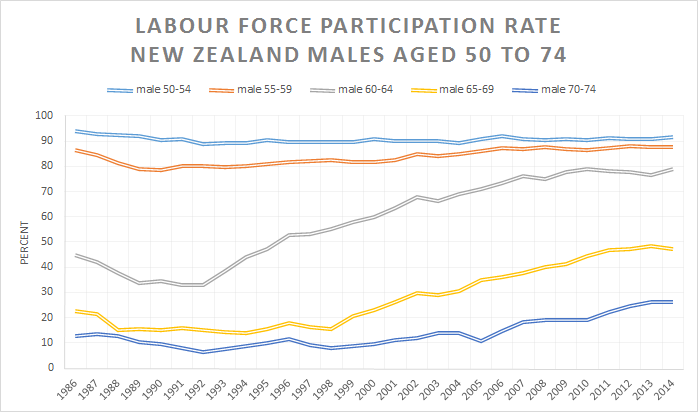
Source: OECD Stat.
Workers aged 65 to 69 and aged 70 to 74 also rapidly increased their labour force participation. Nonetheless, in New Zealand they still get an old age pension in these age brackets without an income test or an asset test.
Female labour force participation rate, workers aged 65 to 69, US, UK, Australia and New Zealand since 1960
06 Feb 2016 Leave a comment
in gender, labour economics, labour supply, politics - New Zealand, public economics Tags: ageing society, labour demographics, old age pensions, older workers, social insurance
The phased increase in the eligibility age for the New Zealand old pension from 60 to 65 from the mid-1990s obviously carried through to the labour force participation of women over 65 as well.
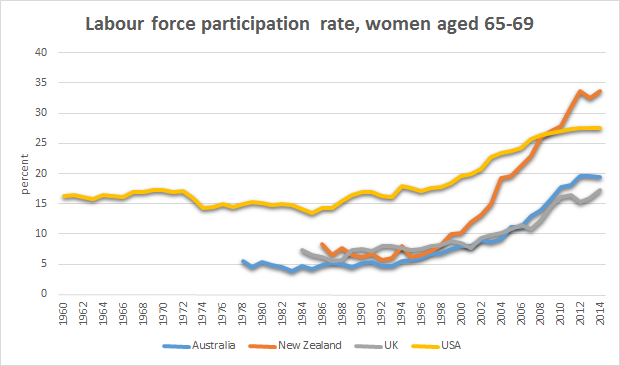
Data extracted on 05 Feb 2016 05:13 UTC (GMT) from OECD.Stat.
Gender wage gap myths and realities
06 Feb 2016 Leave a comment
in discrimination, gender, human capital, labour economics, labour supply, occupational choice, politics - New Zealand, politics - USA
A bizarre Finnish amateur racing car practice for redistributing winning
06 Feb 2016 Leave a comment
in economics of media and culture, fiscal policy, income redistribution, labour economics, labour supply, law and economics, poverty and inequality, property rights, public economics, rentseeking Tags: basic income, car racing, Finland, guaranteed minimum income, negative income tax
Female labour force participation rate, workers aged 60 to 64, USA, UK, Australia and New Zealand since 1960
06 Feb 2016 Leave a comment
in economic history, labour economics, labour supply, politics - New Zealand, public economics Tags: ageing society, labour demographics, old-age pension, older workers, social insurance, welfare state
The increase in the eligibility age from the age of 60 to the age of 65 for the old age pension in New Zealand clearly sparked an explosion in female labour force participation between these ages.
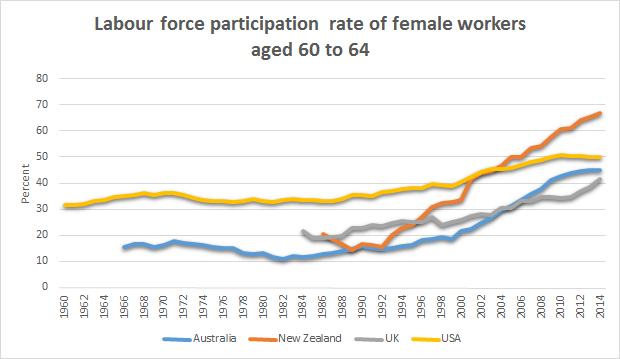
Data extracted on 05 Feb 2016 04:49 UTC (GMT) from OECD.Stat.
US, Danish, British, Canadian, Australian and New Zealand tax and social security burden net of cash benefits as a % of labour costs, one-earner married couple with two children since 2000
05 Feb 2016 Leave a comment
in labour economics, labour supply, politics - Australia, politics - New Zealand, politics - USA, public economics Tags: 2016 presidential election, British election, Canada, Denmark, family tax credit, in work tax credit, taxation and labour supply
For some reason the Labour government in New Zealand in the mid-2000s could not bring itself to admit it was introducing a huge tax cut for families. To avoid admitting it ever gave a tax cut, that Labour government called the huge family tax credit introduced in 2004 and 2005 Working for Families.
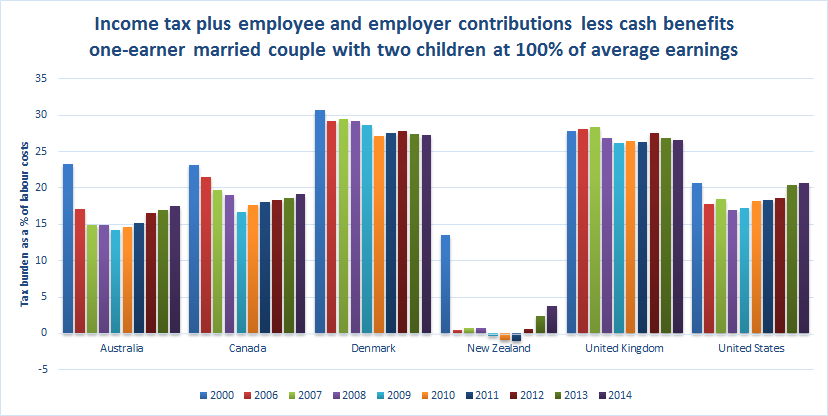
Source: Taxing Wages 2015 – OECD 2015
The above data does not include the effects of GST and VAT.
Labour force participation rates of US, UK, Australian and New Zealand male workers aged 65 to 69 since 1960
05 Feb 2016 Leave a comment
in economic history, labour economics, labour supply, politics - New Zealand, public economics
Up until the early 1990s, New Zealand had a universal old age pension that was paid from the age of 60. There was no means test or assets test. The eligibility age for this old age pension was increased to age 65 over the course of the 1990s and early 2000s. It obviously showed up in the labour supply of workers aged 66 and over in New Zealand after the change in the eligibility age.
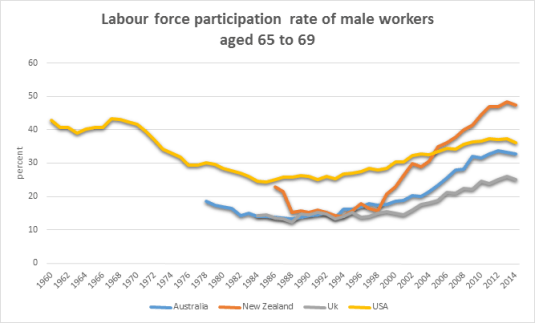
Data extracted on 05 Feb 2016 04:49 UTC (GMT) from OECD.Stat.
Labour force participation rates of US, UK, Australian and New Zealand workers aged 60 to 64 since 1960
05 Feb 2016 Leave a comment
in applied price theory, economic history, labour economics, labour supply, politics - New Zealand, public economics
Up until the early 1990s, New Zealand had a universal old age pension that was paid from the age of 60. There was no means test or assets test. The eligibility age for this old age pension was increased to age 65 over the course of the 1990s and early 2000s. It obviously showed up in the labour supply of workers aged 60 to 64 in New Zealand both before and after the change in the eligibility age.

Data extracted on 05 Feb 2016 04:49 UTC (GMT) from OECD.Stat.
 Utopia, you are standing in it!
Recent Comments