NEWS FLASH: The Labor Force Participation Rate for Men Has Been Steadily Trending Downward for the last 67 Years! http://t.co/N66WJJnHsF—
Mark J. Perry (@Mark_J_Perry) May 08, 2015
Male labour force participation has been in a long-term decline
24 May 2015 Leave a comment
in gender, labour economics, labour supply, occupational choice, unemployment Tags: labour demographics, labour force participation, male labour force participation, reversing gender gap
Why do middle-aged German men become sensitive new age guys?
24 May 2015 Leave a comment
in economics of love and marriage, labour economics, labour supply, occupational choice, population economics Tags: economics of family, Germany, household production, marital division of labour, marriage and divorce
The gender gap in housework narrows as men in Germany approach and enter retirement family-studies.org/how-mens-retir… http://t.co/5Q8IaHkSC4—
Inst. Family Studies (@FamStudies) May 04, 2015
The employment rates of sole parents with school age children, OECD, 2011
23 May 2015 Leave a comment
in gender, labour economics, labour supply, welfare reform Tags: child poverty, economics of families, female labour force participation, paternal labour force participation, single parents
Figure 1: percentage of sole parents working with youngest child aged 6-14, 2011

Source: OECD family database
Figure 2: percentage of sole parents working part0time with youngest child aged 6-14, 2011
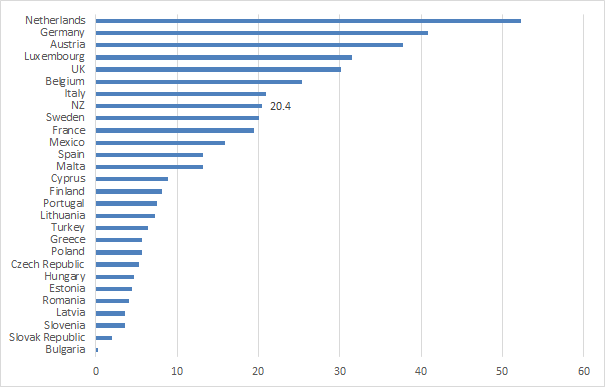
Source: OECD family database
The employment rates of sole parents with toddlers, OECD, 2011
22 May 2015 Leave a comment
in gender, labour economics, labour supply, welfare reform Tags: child poverty, economics of families, female labour force participation, paternal labour force participation, single parents
Figure 1: percentage of sole parents with youngest child aged under two not working, 2011

Source: OECD family database
Figure 2: percentage of sole parents with youngest child aged under two working part-time, 2011
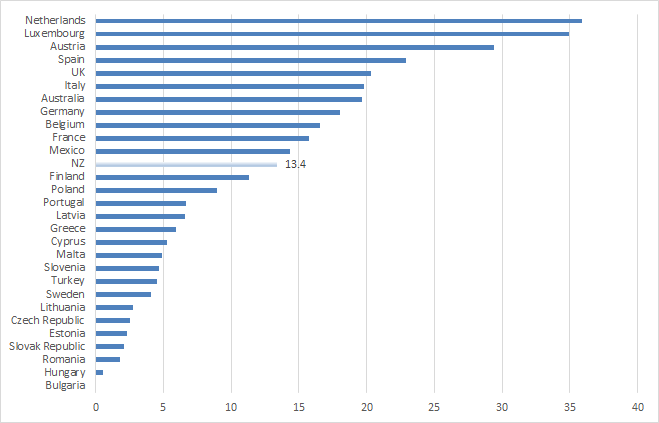
Source: OECD family database
The education premium illustrated
22 May 2015 1 Comment
in economics of education, human capital, labour economics, labour supply, occupational choice Tags: education premium
Youth unemployment in America by sex and education
21 May 2015 Leave a comment
in economics of education, human capital, labour economics, labour supply, unemployment Tags: great recession, labour demographics
America’ s mums
20 May 2015 Leave a comment
in discrimination, economics of love and marriage, gender, labour economics, labour supply, law and economics, occupational choice Tags: economics of marriage, female labour falls participation, marriage and divorce, single mothers
America's moms: pewrsr.ch/1uJD07V by @pewresearch #MothersDay http://t.co/o8TIH9xWSH—
Neil Shah (@NeilShahWSJ) May 10, 2015
Hours worked per worker varies greatly across industrialised countries
20 May 2015 Leave a comment
Monday morning blues? Compare the avg number of #working hours in yr country per year. More: bit.ly/1JPVYQu http://t.co/r5MsELJr1n—
(@OECD) April 19, 2015
Families with single mothers face the greatest risk of falling into deep poverty
20 May 2015 1 Comment
American families with single mothers face the greatest risk of falling into deep poverty: brook.gs/1IVXiTo http://t.co/dwLcQzvHkh—
Brookings (@BrookingsInst) May 13, 2015
The geography of the global talent pool, now and 2030
19 May 2015 1 Comment
in economics of education, human capital, labour economics, labour supply, occupational choice Tags: College premium, economics of migration, graduate premium, tertiary education, university premium
The global talent pool has never been larger, will grow to 2030, read bit.ly/1Dg7heM (pdf) #education #stats http://t.co/aiIiTDbZt9—
(@OECD) April 24, 2015
The age composition of the US labour force
19 May 2015 Leave a comment
in labour economics, labour supply Tags: ageing society, labour demographics, labour force participation, older workers
It happened: Millennials are now the biggest generation in the U.S. workforce on.wsj.com/1IugHMe http://t.co/lUDjT1Rjwk—
Becky Bowers (@beckybowers) May 11, 2015
The three S’s in family policy
18 May 2015 Leave a comment
in economics of education, gender, human capital, labour economics, labour supply, occupational choice, poverty and inequality, welfare reform Tags: child poverty, economics of marriage, family poverty, female labour force participation, labour force participation, male labour force participation, marriage and divorce, single parents, welfare reform
Helpful distinctions for family thinking: structure, stability & strength (&.. how related) @inclusionist @mboteach http://t.co/zMi92WYUhi—
Richard V. Reeves (@RichardvReeves) January 13, 2015
Working age populations of Australia, New Zealand and Japan
18 May 2015 Leave a comment
in labour economics, labour supply, politics - New Zealand, politics - USA Tags: ageing society, Australia, Japan, labour demographics, New Zealand
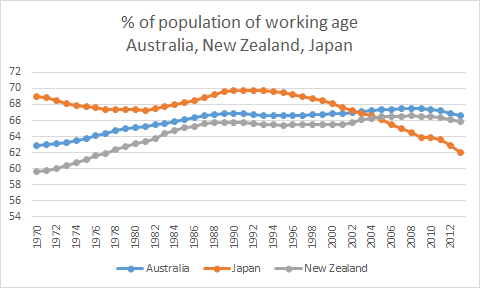
HT: OECD
Paid sick day entitlements across the OECD membership
17 May 2015 Leave a comment
in economics of regulation, labour economics, labour supply, occupational choice Tags: employment law, employment protection laws, employment regulation
The War on Poverty at 50
16 May 2015 Leave a comment
in economic history, labour economics, labour supply, poverty and inequality, welfare reform Tags: 1996 US welfare reforms, child poverty, family poverty, war on poverty

The big drop .in both child poverty and poverty in general was after the 1996 welfare reforms.


via Chart Book: The War on Poverty at 50, Section 1 | Center on Budget and Policy Priorities.
 Utopia, you are standing in it!

Recent Comments