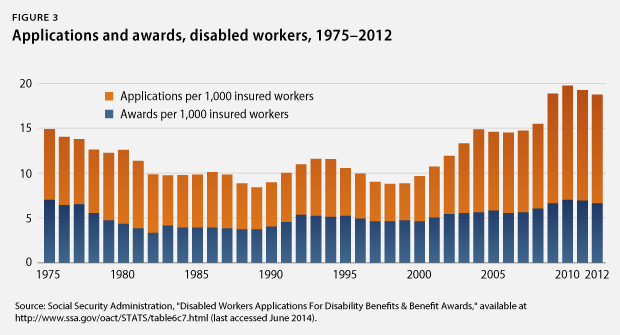
via Social Security Disability Insurance | Center for American Progress.
Celebrating humanity's flourishing through the spread of capitalism and the rule of law
29 Apr 2015 Leave a comment
in health and safety, health economics, labour economics, labour supply, welfare reform Tags: disability benefits
29 Apr 2015 Leave a comment
in human capital, labour economics, labour supply, politics - Australia, politics - New Zealand, politics - USA Tags: economics of immigration
Migrants (esp. new ones) to UK more likely to have tertiary education than migrants to Australia [OECD[ http://t.co/xfOSQmiCxd—
Jonathan Portes (@jdportes) March 05, 2015
29 Apr 2015 Leave a comment
in labour economics, labour supply Tags: ageing society, labour demographics
28 Apr 2015 Leave a comment
in labour economics, labour supply, occupational choice, poverty and inequality, welfare reform Tags: 1996 US welfare reforms, female labour supply, labour demographics, welfare state
The share of single mothers without a high school degree with earnings rose from 49 percent to 64 percent between 1995 and 2000 but has since fallen or remained constant almost every year since then. At 55 percent, it’s now just slightly above its level in 1997, the first full year of welfare reform (see first graph).

TANF now serves only 25 of every 100 families with children that live below the poverty line, down from AFDC’s 68 of every 100 such families before the welfare law
Over the last 18 years, the national TANF average monthly caseload has fallen by almost two-thirds — from 4.7 million families in 1996 to 1.7 million families in 2013 — even as poverty and deep poverty have worsened.
The number of families with children in poverty hit a low of 5.2 million in 2000, but has since increased to more than 7 million. Similarly, the number of families with children in deep poverty (with incomes below half of the poverty line) hit a low of about 2 million in 2000, but is now above 3 million.

The employment situation for never-married mothers with a high school or less education — the group of mothers most affected by welfare reform — has changed dramatically over the last several decades.
In the early 1990’s, when states first made major changes to their cash welfare programs, only about half of these mothers worked.
Importantly, there was a very large employment gap between the share of these never-married mothers and single women without children with similar levels of education, suggesting that there was substantial room for these never-married mothers to increase their participation in the labour force.
By 2000, the employment gap between these two groups of women closed, and it has remained so. But in the years since, the employment rate for both groups has fallen considerably.
The employment rate for never-married mothers is now about the same as when welfare reform was enacted 18 years ago. This suggests that the economy and low education levels are now the causes of limited employment among never-married mothers — not the availability of public benefits or anything particular to never-married mothers.

The Centre on Budget and Policy Priorities, who hail clearly from the Left of American politics, scrupulously documented the following:
Welfare dependency down by two thirds, employment of never married mothers up to levels no one thought possible, family poverty down, and economic independence is much more widespread and all because of the 1996 US Federal welfare reforms. That sounds like success to me – a great success.
via Chart Book: TANF at 18 | Center on Budget and Policy Priorities.
27 Apr 2015 1 Comment
in discrimination, gender, human capital, labour economics, labour supply, occupational choice, politics - New Zealand Tags: activists, do gooders, gender wage gap, Left-wing hypocrisy, Leftover Left
With the rapid closure in the raw female male wage gap in New Zealand over the last 15 or so years, the lack of celebration of this achievement among equal pay activists is puzzling.
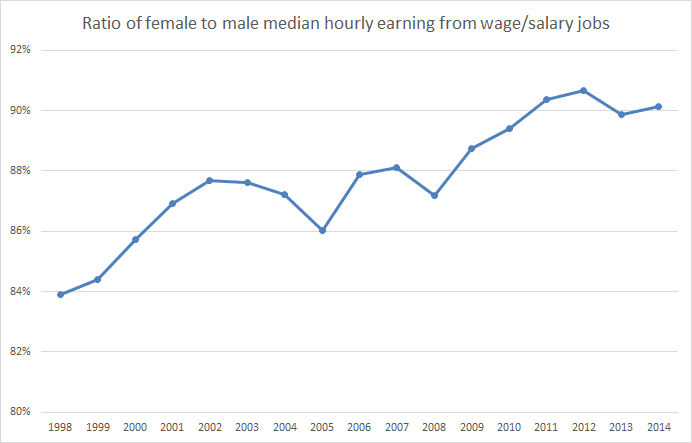
Source: Statistics New Zealand, New Zealand Social indicators, Median hourly earnings.
27 Apr 2015 Leave a comment
in labour economics, labour supply, population economics Tags: ageing society, economics of fertility, Japan, labour demographics
Japan's projected population through 2050. #dataviz
Source: washingtonpost.com/blogs/worldvie… http://t.co/79DKF0mQTs—
Randy Olson (@randal_olson) January 06, 2015
24 Apr 2015 3 Comments
in economics of love and marriage, gender, labour economics, labour supply, poverty and inequality, welfare reform Tags: family demographics, single parents


via Was Moynihan Right? What happens to the children of unmarried mothers : Education Next
24 Apr 2015 Leave a comment
in economic growth, fiscal policy, great recession, labour economics, labour supply, macroeconomics, politics - USA Tags: great recession, obama, Obamacare, taxation and entrepreneurship, taxation and investment, taxation and labour supply


.
23 Apr 2015 Leave a comment
in economic history, labour economics, labour supply, poverty and inequality, welfare reform
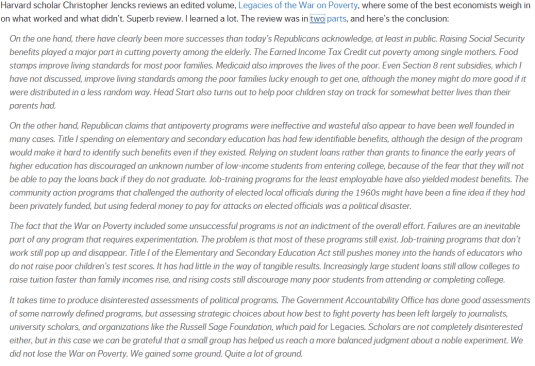
Via The war on poverty at age 50: What US social programs worked and which failed? – Chris Blattman.
23 Apr 2015 Leave a comment
in discrimination, economics of education, gender, human capital, labour economics, labour supply, occupational choice Tags: gender wage gap reversed gender gap
CHART: The Huge College Degree Gender Gap: Since 1982, Women Have Earned ~10M MORE US College Degrees Than Men! http://t.co/83JhRfwCLE—
Mark J. Perry (@Mark_J_Perry) March 11, 2015
22 Apr 2015 Leave a comment
in human capital, labour economics, labour supply, poverty and inequality Tags: labour demographics
How people with different incomes spend money trib.al/PMtRkSy via @TheAtlantic http://t.co/JeemS9s7oJ—
(@CityLab) April 08, 2015
22 Apr 2015 Leave a comment
in economics of education, human capital, labour economics, labour supply, occupational choice Tags: College premium, economics of personality traits, education premium, IQ
20 Apr 2015 1 Comment
in business cycles, fiscal policy, great depression, labour economics, labour supply, macroeconomics, politics - USA, unemployment, unions Tags: capital taxation, FDR, Herbert Hoover, Leftover Left, Leo Ohanian, New Deal, union power, union wage premium, unionisation
Our friends on the left at the Economic Policy Institute were good enough to remind us of the link between rapid unionisation of the US labour market in the early and mid-1930s and the petering out of the recovery from the great depression. That recession within a depression is the Roosevelt recession.
New blog on Mind The Gap: on labour #unions and income #inequality
oxfamblogs.org/mindthegap/201… http://t.co/FyrOboCaRk—
Ricardo FuentesNieva (@rivefuentes) April 17, 2015
Harold Cole and Lee Ohanian analysed in depth this double-dip depression in the USA in a paper in the Journal of Political Economy titled “New Deal Policies and the Persistence of the Great Depression: A General Equilibrium Analysis” about 10 years ago:
The recovery from the Great Depression was weak… Real gross domestic product per adult, which was 39 percent below trend at the trough of the Depression in 1933, remained 27 percent below trend in 1939. Similarly, private hours worked were 27 percent below trend in 1933 and remained 21 percent below trend in 1939.
The weak recovery is puzzling because the large negative shocks that some economists believe caused the 1929–33 downturn—including monetary shocks, productivity shocks, and banking shocks—become positive after 1933. These positive shocks should have fostered a rapid recovery, with output and employment returning to trend by the late 1930s.
The focus of the paper by Cole and Ohanian in explaining the weak recovery – the double-dip depression in the 1930s – are the New Deal cartelisation policies designed to limit competition and increase labour bargaining power through extensive unionisation of workforce.

The recovery from the depths of the Great Depression was weak but real wages in several sectors rose significantly above trend despite mass unemployment.

The view that limiting competition in product markets and the labour market was essential for economic prosperity was influential in the 1920s and 1930s. Both FDR and Hoover believed high wages were the key to prosperity.
FDR’s recipe for economic recovery from the great depression when he came to office in 1933 was raising prices and wages and the promotion of unions:
Union membership rose from about 13 percent of employment in 1935 to about 29 percent of employment in 1939, and strike activity doubled from 14 million strike days in 1936 to about 28 million in 1937.
The result of this suppression of market competition and the encouragement of unions was real wages increase despite the weak recovery:
The coincidence of high wages, low consumption, and low hours worked indicates that some factor prevented labour market clearing during the New Deal.
The combination of government interference with competition and strong unions stifled the recovery from the great depression rather than speed it up as was the plan of FDR:
New Deal labour and industrial policies did not lift the economy out of the Depression as President Roosevelt had hoped.
Instead, the joint policies of increasing labour’s bargaining power and linking collusion with paying high wages prevented a normal recovery by creating rents and an inefficient insider-outsider friction that raised wages significantly and restricted employment.
Not only did the adoption of these industrial and trade policies coincide with the persistence of depression through the late 1930s, but the subsequent abandonment of these policies coincided with the strong economic recovery of the 1940s.
U.S. unemployment fell from 22.9% in 1932 to 9.1% in 1937, a reduction of 13.8%, but was back up to 13% by 1938. The Social Security payroll tax debuted in 1937 on top of tax increases in the Revenue Act of 1935. In 1937, the economy fell into recession again. Cooley and Ohanian argue that:
The economy did not tank in 1937 because government spending declined. Increases in tax rates, particularly capital income tax rates, and the expansion of unions, were most likely responsible.
The Great Depression in the USA was unique in the fact that it was so long and the recovery, so weak:
Total hours worked per adult in 1939 remained about 21% below their 1929 level, compared to a decline of 27% in 1933… Per capita consumption did not recover at all, remaining 25% below its trend level throughout the New Deal, and per-capita non-residential investment averaged about 60% below trend.
After 1933, productivity growth was rapid, the banking system was stabilized, deflation was eliminated and there was plenty of demand stimulus as the Fed more than doubled the monetary base between 1933 and 1939. As Lee Ohanian noted:
Depressions are periods of low employment and low living standards. The normal forces of supply and demand should have reduced wages, which would have lowered business costs and increased employment and output. What prevented the normal forces of supply and demand from working?
Central to the faltering of this recovery by 1937 was the regime change when the Supreme Court finally upheld revised laws promoting unionisation:
The downturn of 1937-38 was preceded by large wage hikes that pushed wages well above their NIRA levels, following the Supreme Court’s 1937 decision that upheld the constitutionality of the National Labor Relations Act. These wage hikes led to further job loss, particularly in manufacturing.
The "recession in a depression" thus was not the result of a reversal of New Deal policies, as argued by some, but rather a deepening of New Deal polices that raised wages even further above their competitive levels, and which further prevented the normal forces of supply and demand from restoring full employment.
Lee Ohanian argues that the defining characteristic of the Great Depression was this failure of real wages to fall in the face of mass unemployment:
The defining characteristic of the Great Depression is a substantial and chronic excess supply of labour, with employment well below normal, and real wages in key industrial sectors well above normal.
Policies of Hoover and of FDR of propping up wages and encouraging unions and work sharing were the most important factors in precipitating and prolonging the Great Depression. The Great Depression was the first time U.S. wages did not fall in that you were administered a period of significant deflation.
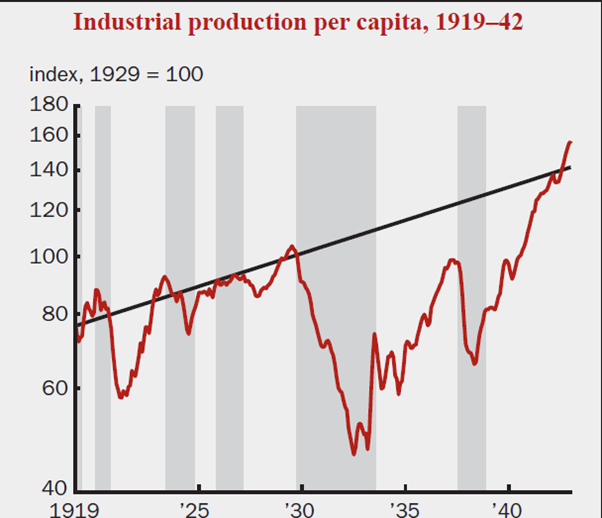
The manufacturing sector, where unions and the threat of unionisation was much stronger which was much harder hit initially than the agricultural sector both in terms of loss of jobs and wages not falling. The Great Depression did not start as an ordinary garden variety recession, as argued by Milton Friedman. It was immediately severe and sector specific with industrial production declining by about 35% between late 1929 and the end of 1930.
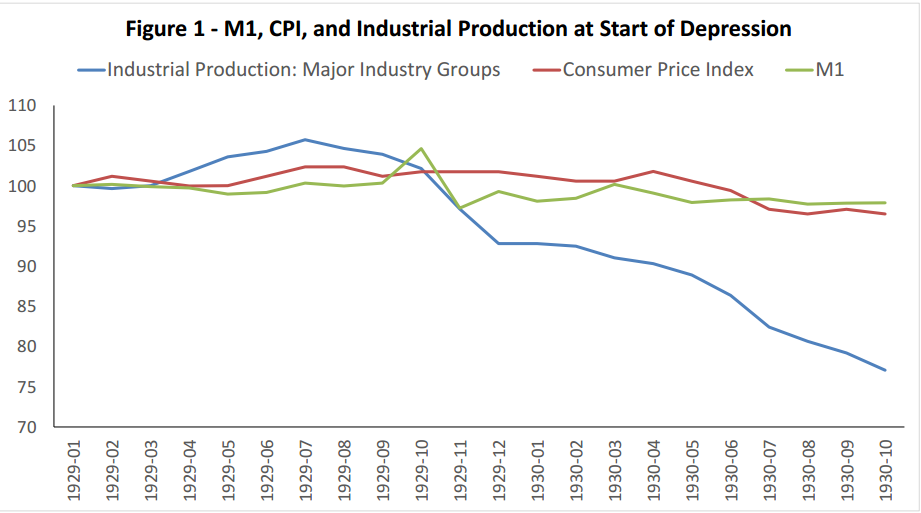
This decline in industrial production occurs before any banking crises. Despite this sector specific nature of the onset that Great Depression, monetary policy might have some role in explaining the start of the Great Depression but not in its prolongation:
any monetary explanation of the Depression requires a theory of very large and very protracted monetary non-neutrality. Such a theory has been elusive because the Depression is so much larger than any other downturn, and because explaining the persistence of such a large non-neutrality requires in turn a theory for why the normal economic forces that ultimately undo monetary non-neutrality were grossly absent in this episode.

Source: A different view of the Great Depression’s cause | VOX, CEPR’s Policy Portal.
Celebrating humanity's flourishing through the spread of capitalism and the rule of law
Scholarly commentary on law, economics, and more
Beatrice Cherrier's blog
Celebrating humanity's flourishing through the spread of capitalism and the rule of law
Celebrating humanity's flourishing through the spread of capitalism and the rule of law
Celebrating humanity's flourishing through the spread of capitalism and the rule of law
Why Evolution is True is a blog written by Jerry Coyne, centered on evolution and biology but also dealing with diverse topics like politics, culture, and cats.
Celebrating humanity's flourishing through the spread of capitalism and the rule of law
Celebrating humanity's flourishing through the spread of capitalism and the rule of law
A rural perspective with a blue tint by Ele Ludemann
DPF's Kiwiblog - Fomenting Happy Mischief since 2003
Celebrating humanity's flourishing through the spread of capitalism and the rule of law
The world's most viewed site on global warming and climate change
Tim Harding's writings on rationality, informal logic and skepticism
A window into Doc Freiberger's library
Let's examine hard decisions!
Commentary on monetary policy in the spirit of R. G. Hawtrey
Thoughts on public policy and the media
Celebrating humanity's flourishing through the spread of capitalism and the rule of law
Politics and the economy
A blog (primarily) on Canadian and Commonwealth political history and institutions
Reading between the lines, and underneath the hype.
Economics, and such stuff as dreams are made on
"The British constitution has always been puzzling, and always will be." --Queen Elizabeth II
Celebrating humanity's flourishing through the spread of capitalism and the rule of law
Celebrating humanity's flourishing through the spread of capitalism and the rule of law
WORLD WAR II, MUSIC, HISTORY, HOLOCAUST
Undisciplined scholar, recovering academic
Celebrating humanity's flourishing through the spread of capitalism and the rule of law
Res ipsa loquitur - The thing itself speaks
Celebrating humanity's flourishing through the spread of capitalism and the rule of law
Researching the House of Commons, 1832-1868
Articles and research from the History of Parliament Trust
Reflections on books and art
Posts on the History of Law, Crime, and Justice
Celebrating humanity's flourishing through the spread of capitalism and the rule of law
Exploring the Monarchs of Europe
Cutting edge science you can dice with
Small Steps Toward A Much Better World
“We do not believe any group of men adequate enough or wise enough to operate without scrutiny or without criticism. We know that the only way to avoid error is to detect it, that the only way to detect it is to be free to inquire. We know that in secrecy error undetected will flourish and subvert”. - J Robert Oppenheimer.
The truth about the great wind power fraud - we're not here to debate the wind industry, we're here to destroy it.
Celebrating humanity's flourishing through the spread of capitalism and the rule of law
Celebrating humanity's flourishing through the spread of capitalism and the rule of law
Economics, public policy, monetary policy, financial regulation, with a New Zealand perspective
Celebrating humanity's flourishing through the spread of capitalism and the rule of law
Restraining Government in America and Around the World
 Utopia, you are standing in it!
Recent Comments