New #FactualFeminist on gender gap in criminal sentencing has >4,000 views — and only 1 thumb down–so far. https://t.co/gVr9KIKagg
— Christina Hoff Sommers (@CHSommers) March 17, 2015
What are the biggest workplace time wasters?
16 Mar 2015 Leave a comment
in industrial organisation, labour economics, labour supply, managerial economics, occupational choice, organisational economics, personnel economics, survivor principle Tags: cyber loafing

An International Look at the Single-Parent Family–where is New Zealand?
16 Mar 2015 1 Comment
in discrimination, economics of love and marriage, gender, labour economics, labour supply, law and economics, occupational choice, welfare reform Tags: economics of fertility, family demographics, labour demographics, single parents

How Much Did the Musicians of Woodstock Get Paid?
13 Mar 2015 Leave a comment
in labour economics, labour supply, Music Tags: superstar effect

There are surprisingly large differences in female part-time employment rates
11 Mar 2015 Leave a comment
Unemployment by education
11 Mar 2015 Leave a comment
in business cycles, great recession, human capital, job search and matching, labour economics, labour supply, occupational choice, politics - USA, unemployment Tags: labour demographics
The new gender gap in education
09 Mar 2015 Leave a comment
in discrimination, economic history, gender, labour economics, labour supply, politics - USA
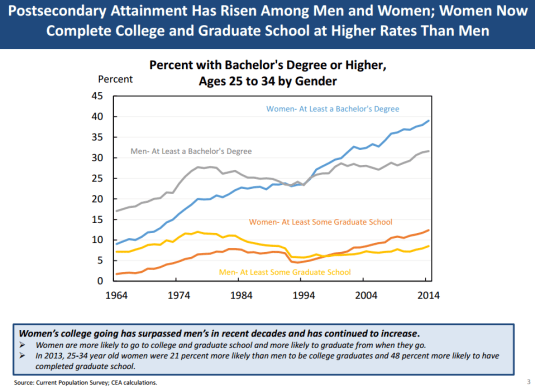
Source: whitehouse.gov


The explosion in women’s professional education just after the pill became widely available
07 Mar 2015 Leave a comment
in discrimination, economic history, economics of education, gender, labour economics, labour supply, occupational choice, politics - USA Tags: economics of fertility, engines of liberation, female labour supply, gender wage gap, reversing gender gap, The Pill
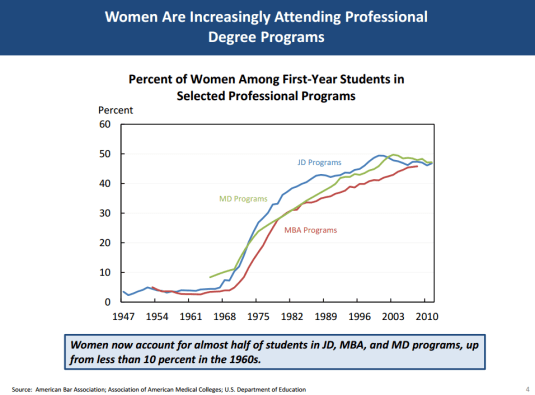
Source: whitehouse.gov
Who is on zero hours contracts in the UK?
06 Mar 2015 Leave a comment
in job search and matching, labour economics, labour supply, politics - New Zealand Tags: zero hours contracts
Firstly, those on zero hours contracts are overwhelmingly younger people and more often women. Both groups value flexible working hours more than others. That’s why they make up the majority of workers on zero hours contracts.
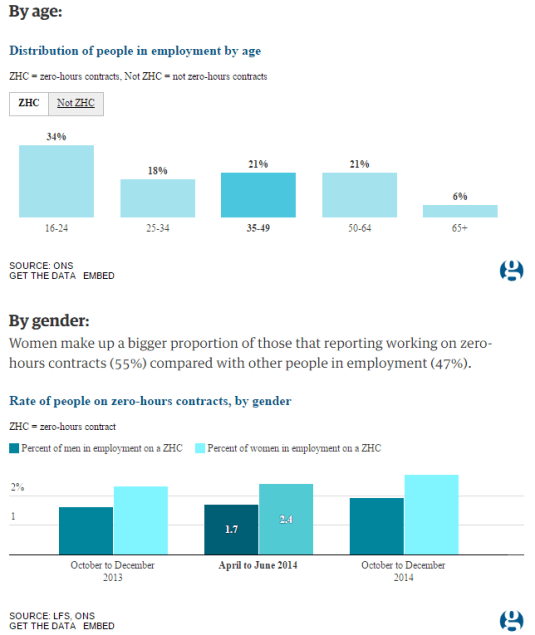
Also not surprisingly, people on zero hours contracts also tend to be more often in full-time education. Another group that values flexibility in hours. Furthermore, many of those on zero hours contracts have only been in the current job for less than 12 months. Again, suggesting they come from groups that change jobs frequently, which means they can easily quit and find another job if they don’t like a zero-hours contract.
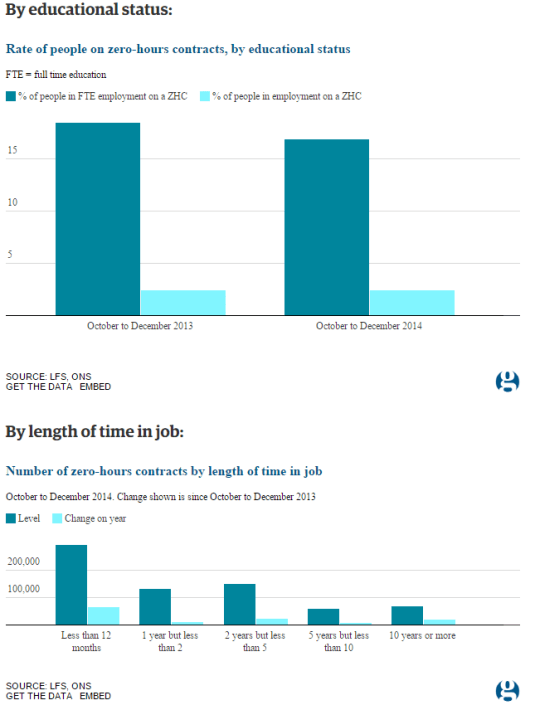
Via Zero-hours contracts in four charts | News | The Guardian
Another boy’s own analysis by the IMF of the decline of unions and inequality in recent decades
06 Mar 2015 Leave a comment
in discrimination, gender, human capital, labour economics, labour supply Tags: decline of unions, female labour force participation, gender analysis, gender wage gap, IMF, reversing gender wage gap, union power
we find strong evidence that lower unionization is associated with an increase in top income shares in advanced economies during the period 1980–2010

Gender analysis! Gender analysis! Where is the gender analysis, which is central to any analysis of inequality in and outside of the labour market!
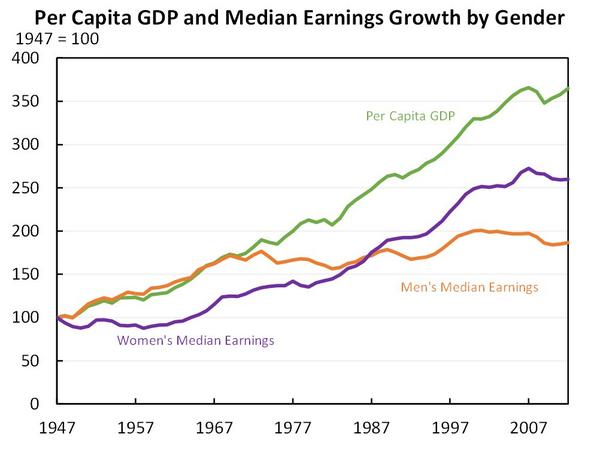
Women have done swimmingly over the last few decades in terms of closing the gender wage gap, increasing labour force participation and overtaking men in investment in higher education.
Who's the weaker sex? Women now make up the majority of university students around the world econ.st/1x1cUli http://t.co/6YWv6SuQc4—
The Economist (@TheEconomist) March 13, 2015
As for unions and women, their record of discrimination against women as threat to the union wage premium was so appalling that even Hollywood was willing to take a swipe at unions and the hostility with which mining unions, for example, greeted the first female miners.
In spite of women’s early involvement in labour struggles, deeply ingrained prejudices against women taking a full role in the workplace were often reinforced by labour unions themselves. Women were seen as mere auxiliaries to the movement, or worse, as threats to men’s jobs.
HT: whitehouse.gov


 Utopia, you are standing in it!
Recent Comments