New Zealand national labour force projections – the invasion of the 65+ worker

Figure 1: National labour force projections by age group, 2006-2041

image

Source: Statistics New Zealand, cyclical migration scenario

Not that many years time, about 2035, there will be almost as many workers as there are young workers – those between 15 and 24. About 400,000 workers in each age bracket.

Not that long ago all, in the early 1990s, there were about 25,000 workers in New Zealand were over 65 – they could fit in a football stadium. Soon, they will equal the population of the national capital: Wellington.

Workers aged 65+ moved from accounting for 1.5 per cent of workers in 1991 to 5 per cent in 2011 and 9 per cent in 2021!

Some economics of zero-hours contracts – part 3: the fixed costs of working

The Unite Union, which represents about 7000 workers across New Zealand, has announced a campaign against zero-hours contracts. Zero-hours contracts have no specified hours or times of work so a worker could end up working 40 hours one week and none the next.

Unite national director Mike Treen did not know of the specific numbers of such contracts, but said these contracts were particularly common in the fast food industry, although they also appeared in some other industries.

Unite Union’s national director said that zero hours contracts made workers vulnerable to abuse as they became too nervous to speak out, for fear of having their hours reduced.

There’s no security and it puts enormous power in the hands of managers. People are extremely reluctant to assert their rights for simple things like breaks…

Treen admitted that zero-hours contracts gave employers flexibility, but pretended to know that the amount of flexibility employers actually needed was often exaggerated.


It’s not like they have huge swings or anything. They know how much they are going to sell on any particular day of the week during the year… We don’t expect everybody to have guaranteed hours but 80 per cent of the crew should be able to have it.

Treen said the union was not planning to push for a law change at this stage and would focus on addressing the issue during negotiations with fast food companies early next year.

The new leader of the opposition has promised to outlaw these zero our contracts when he gets into government. I wish him well in drafting a law that outlaws zero-hours contracts without outlawing some part-time and casual jobs as well.

 Zero-hours contracts and the class war

As is to be expected, the Guardian is rather hot and bothered about zero hours contracts. One of its columnists referred to those on zero-hours contracts as the new reserve army of the unemployed:

It is a pity Karl Marx was not around last week to comment on the news that 90% of the workers at Sports Direct are on zero-hours contracts.

The author of the Communist Manifesto would also have had plenty to say about the news that the official estimates of those working in this form of casualised labour had shot up by 25%…

It is safe to say Marx would have cavilled with those who see zero-hour contracts as an expression of Britain’s economic strength, a demonstration of flexible labour markets in action.

He would have thought "reserve army of labour" a better description of conditions in which workers were expected to be permanently on call for an employer.

The Guardian went on to admit that the reserve army of unemployed are not as discontented as they should be:

It’s only fair to say that some employees are content to be on zero-hours contracts.

Some students, for example, want to combine work with study and are willing to turn up when summoned. That’s also true of older workers topping up their pensions with a bit of irregular, part-time work.

Despite this, the class war continues as does the immiseration of the proletariat and the long-term decline in profits that will lead to the crisis in capitalism and, with a bit of luck, the inevitable proletarian revolution:

Marx would have seen zero-hours contracts as the continuation of a long historical trend, stretching back to the mid-1960s when the profitability of western manufacturing firms started to fall.

From that moment, he would say, the search was on for measures to boost profits, and this has manifested itself in a number of ways: by direct attacks on organised labour; by the increased financialisation of the economy; by the search for cheap raw materials whatever the environmental cost; and by asset bubbles.

Accordingly, zero-hours contracts are the response to tougher conditions facing firms as a result of the financial crisis.

Reversing that trend will require more than legislation: it will mean tackling one of the root causes of that crisis: the imbalance of power in the labour market.

A more mellow writer in the Guardian brought up the imagery of the interwar depression:

Of course it is difficult for employers to match the demand to work nine to five and yet also to be served on a 24-hour basis, cheaply and effectively by someone, not them.

But there are other ways to solve this conundrum than indenturing workers or making them wait at the metaphorical factory gate for a tap on the shoulder.

The fixed costs of working

I will start my third blog on the economics of zero-hours by reviewing the economic literature on the fixed costs of working. Helpfully, this literature predicts that zero hours contracts really shouldn’t exist much at all.

The literature on the economics of the fixed costs of work arose out of the economics of retirement and the economics of the labour supply of married women, and in particular of young mothers. This literature was attempting to explain why older workers, or young mothers either worked a minimum number of hours, or not at all.

Fixed costs of working constrain the choices that older employees make about how many hours and days that are worthwhile working part-time. For employees, the fixed costs of going to work limit the numbers of days and number of hours per day that a worker is willing to work part-time. The timing costs of working at scheduled times and a fixed number of days per week can make working fewer full-time days, rather than fewer hours per day less disruptive to the leisure and other uses of personal time.

The fixed costs of working induced older workers to retire completely, and young mothers to withdraw from the workforce for extended periods of time, unless these workers worked either full-time or enough hours part-time each day and through the week to justify the costs of commuting and otherwise disrupting their day and week.

In the case of older workers, there were the fixed costs of commuting and other disruptions to their day. In the case of mothers, there are additional fixed costs of working arising from child care and the commuting and other rather rigid time commitments of picking up and dropping off younger children at school and to day care centres.

The fixed costs of going to work

There is a minimum number of hours of work that will be supplied by different workers that is set by the fixed costs of working. These fixed costs of work arise from commuting time and from dressing and other tasks involved in preparing for the trip to work. These costs are fixed because they do not vary with the number of hours to be worked per day and the amount of effort to be exerted while working (Cogan 1981; Hamermesh and Donald 2007).
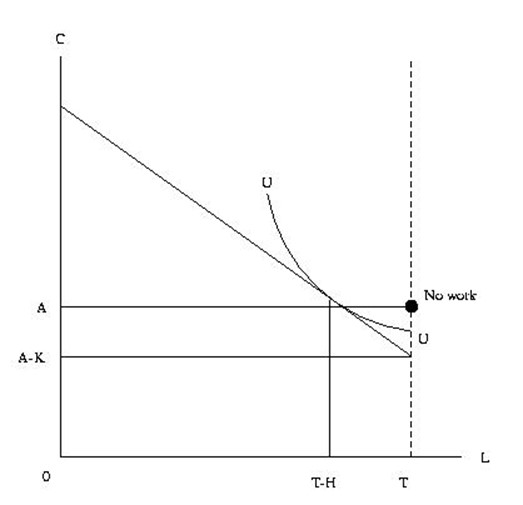


A worker will not accept a job offer or continue in a particular job unless they work sufficient hours so that these fixed costs of going to work are recovered along with receiving sufficient reward for giving up pursuing other job openings open now and in the future and for forgoing leisure and the option of making other uses of their time (Cogan 1981; Hamermesh and Donald 2007).

Cogan (1981) estimated that the average fixed time and money costs of married women entering the workforce was 28 per cent of their earnings, and also estimated that the minimum number of hours a married woman was willing to supply in the labour market was 1,300 hours per year.
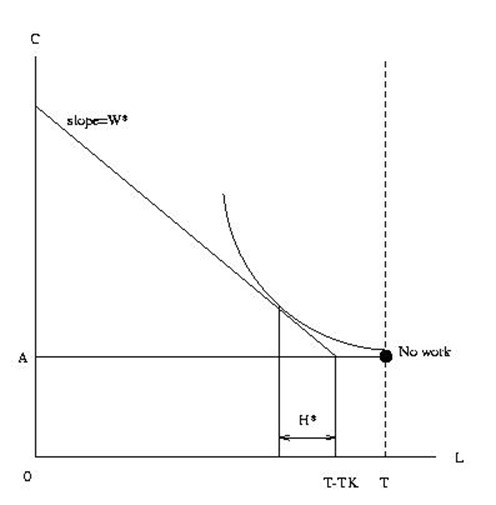

There may be a preference for fewer working days over fewer hours per day to reduce the time and money costs of going to work. Donald and Hamermesh (2009) estimated that fixed costs of going to work are equal to about 8 per cent of income. The fixed costs of working provide an incentive to workers to bunch activities.

The fixed timing costs of labour market entry

A surprisingly large part of the fixed costs of working comes from disruption in the ability to use spare time effectively (Donald and Hamermesh 2009, 2007). Entering or remaining in the workforce for any time at all significantly affects the effective allocation and enjoyment of time outside of working hours. This disruption to the effective use of the time that is left outside of working hours is the fixed timing cost of labour market entry.

One way to reduce this disruption from entering the labour force at all is to seek to reduce the number of days worked per week rather than the number of hours per day.

Leisure and other private uses of time are displaced if the individual takes or stays in even a small part-time job. Workers must use their reduced amount of remaining free time to catch-up on tasks, often at the weekend that they could have done if they were not working.

Leisure time may be the first to go because many personal tasks can be rescheduled but must be done eventually. These range from cooking, eating, and cleaning to personal upkeep, sleep and rest. Tasks must be hurried or done to a lower quality (Donald and Hamermesh 2009).

Routine – having the same schedule from day to day – saves time (Hamermesh 2005). Routine enables people to economise on the set-up costs of consumption, leisure and going to work.

Entering the work-force for any time at all to work even a small number of hours per day or per week calls for new daily and weekly routines and disrupts many existing routines that make better use of leisure, family and other uses of time (Hamermesh 2005).

Entering the workforce constrains the unfettered use of spare time. Working increases the fixed costs of coordinating family and leisure times. Workers must surround working times with buffers to ensure they are not late for work.

One reality of rising incomes is time become more valuable. A rise in wages raises the value of time because time is a finite and irreplaceable resource. Time cannot be stored or bought and sold but people can try and make better use of it.

With only 24 hours still in every day, the cost of time-intensive activities including working will rise as incomes increase. People shift away from time intensive activities and buy more of those products that are time saving or which are less time intensive to consume. Time is money and this maxim applies with greater resonance as incomes and wealth increase.

Another important fixed time costs of labour market entry is its impact on the efficiency of the remaining time devoted to leisure, household production and other activities when even a small amount of market work is undertaken. Spare time is of much less value if part of every day is to be spent at work.

Fixed timing costs arise because of a need to hurry to get to work on time and forego other activities to be rested for work the next morning. The requirement to attend work blocks out certain days from major other uses of that day and reduces the time available in any day of part-day work for leisure, family time and household production.

Household production refers to the goods and services made at home which could be purchased in the market from a third-party. These include food preparation, cooking, carer obligations, and household cleaning. There are also various other household tasks that must perform for one-self which are essentially personal maintenance and leisure.

Working even a few hours can reduce the worker’s efficiency in household production and other non-market activities and may require the worker to buy goods and services that were previously produced at home. This reduces the net financial rewards of working. Fewer full days of work, rather than fewer hours per day is less disruptive to leisure and the other uses of personal time.

The fixed time costs of market work might induce workers to engage in different mixes of other activities. The additional hours of work during the week affect the allocation of time on a non-working weekend day. They reduce leisure time on weekends and increase weekend time devoted to household production by those who do market work on week days. Workers catch up at the weekend on the household production that the rigidities of their market work prevented them from doing during the week.

Stress is an important fixed cost of working. Workers spend non-market time worrying or thinking about work-problems. Even a few hours of market work will place a worker at risk of some stress.

Floors and ceilings on the structure of the working week

The fixed costs of going to work and the fixed time cost of labour market entry both place constraints on the willingness of workers to accept a job offer involving a zero-hours contract. These contracts must offer something extra over competing job options.

The employer must offer something extra to prospective recruits to induce them to sign a zero-hours contract. There must be something substantial to overcome both the fixed costs of work, such as commuting, and the less obvious but still substantial fixed costs of labour market entry.

Any commitment to work, such as working on a zero hours contract, carries with it significant costs in terms of disruption to the rest of the day, the rest of the working week and the amount of the weekend that is spent on leisure versus resting from work and catching up on tasks that otherwise could have been done during the week but for work commitments.

A zero-hours contract must pay enough over the expected life time of the job to make up for the costs of going to work as well as the disruption and loss of leisure time and also the pure disutility of working before the worker breaks even on working.

As the Unite Union official noted, zero hours contracts appear to be most prevalent in the fast food sector. Job turnover rates in the sector can be several hundred per cent per year.

Many of the workers in the fast food sector, as the Unite union official himself noted, are young. Teenagers and young workers changed jobs frequently, particularly those who are studying part-time or full-time work, injuring the summer.

As such, zero-hours contracts in any particular job will have a short expected life over which the teenager or young worker would have to recoup for the fixed cost of working and the fixed cost of any labour market entry. Employers would have to offer some sort of premium or other implicit guarantee of regular work to induce prospective young recruits to sign a zero hours contract.

The type of workers who will profit from signing a zero hours contracts of those workers with few other demands on their time and flexible days. The workers who might find zero hours contract appealing will be those who do have much routine in their day. Workers who have a considerable amount of routine in their day such as because of family commitments will not find the wage offers in zero hours contracts appealing.

There will be job sorting: workers who have low fixed costs of working and low fixed costs of labour market entry will be attracted to zero-hours contracts.

Employers profit from offering zero hours contracts to workers who don’t want to make a regular commitment to come into work every day. Teenagers and students fall into this category, which makes it less surprising that zero hours contracts appear to be most common in the fast food sector.

There are mutual gains in the fast food sector to both employers and workers from zero hours contracts when there are peaks and troughs in product demand, and some teenagers and young workers have a low cost of coming into work at short notice.

Lindsay Mitchell – Labour’s Carmel Sepuloni: be careful what you ask for

The Truly Disadvantaged

Lindsay Mitchell has a nice blog today on the views of the new Labour Party spokesman on social development – the New Zealand ministerial portfolio covering social security and social welfare

Carmen Sepuloni disagrees with National Party’s policy of requiring solo mothers to look for work. She believed there should be support for sole parents to return to work, but not a strict compulsion:

It is a case by case basis. I don’t think it should be so stringent because it’s not necessarily to the benefit of their children.

The American sociologist James Julius Wilson in The Truly Disadvantaged (1987) and When Work Disappears (1996) wrote about how more children are growing-up without a working father living in the home and thereby gleaning the awareness that work is a central expectation of adult life:

. . . where jobs are scarce, where people rarely, if ever, have the opportunity to help their friends and neighbors find jobs. . . many people eventually lose their feeling of connectedness to work in the formal economy; they no longer expect work to be a regular, and regulating, force in their lives.

In the case of young people, they may grow up in an environment that lacks the idea of work as a central experience of adult life — they have little or no labor force attachment.

Carmel Sepuloni appears to believe that work is not a central expectation of adult life. Hard work used to be a core value of the Labour Party.

The toughest week of door knocking for the Labour Party in the 2011 general elections was after the Party promised that the in-work family tax credit should also be paid to welfare beneficiaries.

Voters in strong Labour Party areas were repulsed by the idea. These working-class Labour voters thought that the in-work family tax credit was for those that worked because they had earnt it through working on a regular basis. The party vote of the Labour Party in the 2011 New Zealand general election fell to its lowest level since its foundation in 1919 which was the year where it first contested an election.

When Sepuloni was on the Backbenchers TV show prior to the recent NZ general election, she was asked by the host whether she would support a $40 per hour minimum wage if that would mean equality. She did not hesitate to say yes.

Sepuloni does not seem to have noticed that wages must have something to do with the value of what you produce and the ability of your employer to sell it at a price that covers costs. 

Front Cover

The economic literatures (Heckman 2011; Fryer 201o) and sociological literatures (Wilson 1978, 1987, 2009, 2011), particularly in the U.S. is suggesting that skill disparities resulting from a lower quality education and less access to good parenting, peer and neighbourhood environments produce most of the income gaps of racial and ethnic minorities rather than factors such as labour market discrimination.

Front Cover

Grounds for optimism about the effectiveness of welfare reform in overcoming barriers to employment lie in the success of the 1996 federal welfare reforms in the USA.

The subsequent declines in welfare participation rates and gains in employment were largest among the single mothers previously thought to be most disadvantaged: young (ages 18-29), mothers with children aged under seven, high school drop-outs, and black and Hispanic mothers. These low-skilled single mothers who were thought to face the greatest barriers to employment. Blank (2002) found that:

At the same time as major changes in program structure occurred during the 1990s, there were also stunning changes in behavior. Strong adjectives are appropriate to describe these behavioral changes.

Nobody of any political persuasion-predicted or would have believed possible the magnitude
of change that occurred in the behavior of low-income single-parent families over this decade.

People have repeatedly shown great ability to adapt and find jobs when the rewards of working increase and eligibility for welfare benefits tighten.

via Lindsay Mitchell: Carmel Sepuloni: be careful what you ask for.

Richard Posner (1986) opines on comparable worth and commercial reality

Image

Benjamin Powell, In Defense of “Sweatshops”

via Benjamin Powell, In Defense of “Sweatshops” | Library of Economics and Liberty.

Some economics of zero hours contracts – part 2: the fixed costs of employment and minimum hours constraints

A good way to start the second part of my discussion of zero hours contracts is to focus on the economic rationale as to why they should not exist because of the fixed costs of employment. Under zero-hours contracts, employees agree to be available for work as and when it is required.

The fact that zero hours contracts do exist, and are growing in popularity, and many workers freely choose to sign onto these contracts, suggest they are an important labour market innovation with the gains of the shared between employers in terms of temporary above normal profits and higher wages.

The fixed costs of employment

Employers incur fixed costs of employment when they recruit and train new employees. These recruits must be expected to stay long enough to work sufficient hours for the firm to expect to recover these investments.[Oi (1962, 1983a, 1990), Idson and Oi (1999), Hutchens (2010), Hutchens and Grace-Martin (2006)]

These costs are fixed costs because they do not vary with how many hours the employee works or with how long an employee stays with their employer. On-going supervision, office space and other overheads can increase with the number of employees, not the hours they work per week. These fixed employment costs must be recouped over the expected job tenure of the employee with the firm.

Employers will not hire an additional worker unless they anticipate recovering the costs of doing do including fixed employment costs and other overheads. Hiring one more worker for 40 hours per week is cheaper than hiring two workers to work 20 hours per week each. These two part-timers would about double the recruitment and training costs to secure the same total additional supply of hours worked per week. Profits are a small share of the revenue earned on selling the output of each worker.

A small change in non-wage labour costs can have a large effect on profit margins. One full-time employee is cheaper than two part-timers because of fixed employment costs unless hourly wages paid to the two part-times adjust to offset the additional overheads of recruiting them both.

Fixed employment costs are higher when filling higher skilled vacancies because more time and resources are spent on recruiting more skilled workers (Oi 1983a; Idson and Oi 1999). Employers interview for longer and interview more applicants to find the best possible match. The applicants for more skilled vacancies have more diverse backgrounds and their jobs are more important to the success of the firm. Employers will invest more in training recruits to more skilled vacancies (Oi 1983a, 1983b, 1988, 1990; Hutchens and Grace-Martin 2004, 2006).

Useful estimates of the fixed costs of employment are rare. An illustration of the size of the fixed costs of employment is provided by Parsons (1987). He found that the investments of an employer he studied per employee increases rapidly with skill levels. The U.S. dollar investments by the manufacturing employer he studied were $911 for a least skilled worker, $5,715 semi-skilled workers, $13,353 for first-line managers, $53,413 for middle line managers, and $113,503 for top level managers (Parsons 1987).

Recouping overheads with minimum hours constraints

Fixed employment costs can explain minimum hours constraints and many other labour market puzzles. Examples are occupational differences in the stability of earnings, the uneven incidence of unemployment by skill levels in recessions, higher wages in large firms, the persistence of differential job turnover rates, overtime, joint investments in specific human capital, seniority pay and seemly discriminatory hiring and firing policies (Oi 1962, 1983a, Idson and Oi 1999).

The puzzle we are attempting to explain here is despite the fixed cost of recruiting and training an employee, the employer makes no commitment to employee this new recruitment for a minimum number of hours per week.

When a zero hours contract is in place, how is the employer to recover the costs of recruiting the employee, and the cost of initial training and orientation to the job where productivity is low?

Wages and the fixed costs of employment sum to the labour costs that their employers seeks to recoup from sale of their outputs. The higher are the fixed costs of employment, the longer are the hours that the employer will prefer the employee to work to generate enough revenue to recoup investments in recruitment and training (Oi 1962, 1983a, 1987; Hutchens and Grace-Martin 2004, 2006).

An employer often welcomes longer hours for employees with high fixed employment costs. The added output net of overtime paid contributes towards the recovery of investments in their recruitment and training (Oi 1962, 1988).

The more hours worked, the more hours over which can be spread the fixed costs of employment. When fixed employment costs are high, paying existing employees for longer hours is less expensive relative to hiring and training additional workers.

This cost differential can lead to a minimum hours constraint and the preference of employers for overtime over recruitment of more workers (Oi 1962, 1983a, 1990; Hutchens and Grace-Martin 2004, 2006).

Part-time jobs usually pay disproportionately less per hour than many full-time jobs (Hirsch 2000, 2005). Part-time workers can be more costly per hour than equally productive and qualified full-timers because their fixed costs of employment are spread over fewer total hours.

Early empirical studies of part-time work, after accounting for skill, occupation, age and other differences, found a part-time wage penalty of about 10 per cent, but more recent studies were unable to find a large part-time wage penalty (Hirsch 2000, 2005).

The more recent studies have found a small part-time wage gap for men but no gap for women after accounting for skill, occupational, age and other differences, and no much of a wage penalty for switches to or from part-time to full-time jobs in the same occupation or industry. [Rogers (2004), Booth and Wood (2006), Hirsch (2000, 2005, 2008), Manning and Petrongolong (2008) and Mumford and Smith (2009).

A major empirical finding about part-time jobs is that there are significant occupational and skills differences between full-time and part-time jobs (Hirsch 2000, 2005). These differences explain most of what are otherwise large raw gaps in hourly wages. Part-time jobs pay less because they usually require less human capital (Hirsch 2005).

Workers who have invested more extensively in human capital usually seek full-time jobs to work sufficient hours over their careers to recoup their investments in education and training.

There are part-time jobs that pay wage premiums (Hirsch 2005). These are limited to industries with seasonal and other short spikes in labour demand.

When product demand is fluctuating, full-times can be more costly because they are frequently idle. Shops, supermarkets and food outlets are examples of firms with within day highs and lows in sales and who profit from hiring part-timers. The cost savings induce these employers to pay a premium to find part-time workers.

Another reason for the lower hourly wages in part-time jobs is daily labour productivity of every workers is linked to the length of their working day. There are starting-up, planning, co-ordination and self-organisation tasks at the beginning of every working day before anything can be produced (Barzel 1973). Part-timers will produce relatively less per working day because an equally as long a part of their day is lost in starting-up costs. These fixed costs of starting the work day must be recouped over a shorter working day.

One conclusion that can be drawn here, in terms of zero hours contracts, is they should be confined to industries and jobs where the fixed cost of recruiting and training employees is low.

The firms that offer of zero hours contracts are likely to be employers subject to peaks and surges in product demand. Not surprisingly, zero hours contracts were pioneered by the retail sector, and in particular the food sector.

What can be said with some confidence is zero hours contracts are unlikely in jobs where workers must be provided with a dedicated workspace and other dedicated work tools. These dedicated resources would not be in use if the particular employee is not called in to work.

Workers on zero hours contracts must be interchangeable in terms of skills and experience and have no need to debrief each other as they change shifts. Starting-up, planning, co-ordination and self-organisation tasks at the beginning of each working day must be relatively low.

Fixed costs of employment increase with recruitment efforts and specialised training and the time spent supervising, co-ordinating and monitoring employees. Employers that hire lower skilled workers, offer less training, and which assign simple and easy to monitor tasks will incur lower fixed costs of employment (Hutchens and Grace-Martin 2004, 2006; Oi 1983a, 1983b).

Minimum hours of work constraints are more likely for skilled recruits and for those employees who have benefited from employer funded training [Oi (1962, 1983a, 1983b, 1988, 1990) and Hutchens and Grace-Martin (2004, 2006)]. Employers will invested more in finding the more skilled recruits because these workers have more specialised and they have varied backgrounds (Oi 1983, 1990, 1992; Idson and Oi 1999).

The more that is invested in training specialised to the firm, the more in fixed costs of employment that the employer must later recoup as additional employee output (Oi 1982, 1983a, 1987, 1988; Hutchens and Grace-Martin 2006). Employers are less likely to agree to requests for reduced from these types of trained employees unless their hourly pay reduction is large enough to keep recovering the fixed costs of their employment.

Employers will profit from structuring their recruiting choices and retention incentives in their employee compensation packages so that average job tenures at least break-even on investments in recruitment, training and supervision.

Longer staying employees will balance out the losses on those that quit early. Employers recoup investments in training by sharing some but not all of the added returns from the specialised training with the employee (Oi 1962, 1983a; Becker 1975). This wage premium over what the worker could earn elsewhere is a staff retention incentive that facilitates a long-term employment relationship. The longer is this employment relationship, the better are the chances for the employer of recovering fixed employment costs (Oi 1962, 1987; Becker 1964).

An employer with major upfront investments in recruitment and specialised training and from overheads from the co-ordination and management of staff has a good incentive to recruit and retain employees on the condition that they work a minimum number of hours per week. The fixed costs of employment increase with the number of workers employed rather than the number of hours they work. The fixed costs of employment for a part-timer and a full-timer will be similar.

The foregoing discussion suggests that zero hours contracts will be confined to jobs where recruitment costs are low, and training specialised to the job and firm are low. The recruit will be expected to come job ready with generalised training mobile across many jobs within their occupation and sector.

Big Box stores pay more

Image

61% of Dutch women work part-time!

A Dutch friend mentioned that Social Security eligibility in the Netherlands is based on paying Social Security tax on your earnings. If she was out of the Netherlands for more than two years, she lost her Social Security coverage.

This is just speculation: Dutch women  work part time to pay Social Security tax and thereby remain eligible  for various Social Security benefits.

Research by Jan van Ours, an excellent labour economist, shows that Dutch women are happy with their part-time work and only about 4% want to increase their hours of work to full-time.

Have changing household composition and retirement caused the decline in median household income? » AEI

earners

via Have changing household composition and retirement caused the decline in median household income? » AEI.

Some economics of zero hours contracts – part 1: concepts, definitions and initial puzzles

Unions say New Zealand employers are following trends overseas and adopting zero hour contracts: workers have to be available for work, but have no hours guaranteed. Unite Union national director Mike Treen said:

McDonald’s, KFC, Pizza Hut, Starbucks, Burger King, Wendy’s – all of the contracts have no minimum hours, and so people can be – and are – rostered anywhere from three to 40 hours a week, or sometimes 60 hours a week, and it depends a lot on how you get on with your manager.

No official figures are available on the number of people on zero hour contracts in New Zealand, but they are are available in the UK in the chart below. About 250,000 workers in the UK work on zero hours contracts.

These workers agree not to work for anyone else, but are not promised regular work at all with their new employer.

The question that must always be asked is why do people who are deemed competent to vote and drive cars sign zero hours contract? What is in it for them? David Friedman asked this question about the economics of restraint of trade agreements for employees:

…the employer who insists on an employee signing a non- competition agreement will find that he must pay, in additional wages or other terms of employment, the cost that the agreement imposes upon the employee, as measured by the employee and revealed in his actions.

It follows that the employer will insist on such an agreement only if he believes that its value to him is greater than its cost to the employee…

The contract is designed, after all, with the objective of getting the other party to sign it.

If I am designing the contract and offering it to many other parties, that may put me in a position to commit myself to insisting on terms that give me a large fraction of the benefit that the contract produces.

But it is still in my interest to maximize the size of that net benefit-which I do by only insisting on terms that are worth at least as much to me as they cost the other party.

The inherent inequality of bargaining power between employers and workers and the reserve army of the unemployed must not be all that they are cracked up to be these days if low paid workers have to sign legally enforceable restraint of trade agreements.

Obviously, the few members of the reserve army of the unemployed lucky enough to have a low pay, insecure job that offers no regular hours today have so many other job options that their employers must get them to agree not to quit and job-hop at will. Jobs must be readily available  to low paid workers for otherwise why do employers insist on this restraint of trade in employment agreements.

Why do workers sign these contracts, which can include a promise of exclusive services – not working for other employers? Several subsequent blog posts will attempt to answer this question

The inherent inequality of bargaining power between employers and workers doesn’t work too well here because  the worker is accepting this job as compared to these other options , which may include employment in an existing job.

Once a worker is on-the-job and has accumulated job specific human capital, issues of post-contractual opportunism come up on both sides.

An important function of the employment contract is to prevent attempts to renegotiate terms and conditions once one side of the other has committed to the relationship and will find it costly to go elsewhere.

Zero hours contracts are negotiated upfront, which makes them unappealing to anyone already has a job, unless the terms and conditions of a zero hour contract, including the wages paid are much more appealing than officious observers make out.

Richard Epstein made this point about the general operation of the labour market, which is of relevance to our search to the answers to the questions posed by this blog post:

Labour markets are not characterized by tricky externalities. They do not pollute streams or require the creation of public goods. They are not characterized by genuine breakdowns in information, as workers are in a position to observe the conditions of their employment on a day-to-day basis.

Left to their own devices, without explicit support from union activities, they will be highly competitive, and thus work hard to allocate scarce human capital to its most productive use.

Workers have the option to quit for higher wages, and employers can always seek out low cost techniques to reduce their labour costs.

Any short-term dislocation for firms or individuals is more than offset by the overall increase in the system productivity, spurred in part by clear signals that should increase investments in human capital.

Zero hours contracts are a new labour market phenomena . That is no reason to automatically default to monopoly explanations for their emergence, including their emergence in a highly competitive industries and highly competitive labour markets where  employees change jobs regularly.

As Coase said in the context of industrial organisation as a whole and novel business practices in particular:

One important result of this preoccupation with the monopoly problem is that if an economist finds something—a business practice of one sort or other—that he does not understand, he looks for a monopoly explanation. And as in this field we are very ignorant, the number of ununderstandable practices tends to be rather large, and the reliance on a monopoly explanation, frequent.

The next blog post arises out of my first exposure to the labour economics of working arrangements. Specifically, how the fixed costs of employment and the fixed cost of going to work  both lead to minimum hours constraints in most employment contracts.

Most of what I know about the  labour, personnel and organisational economics of working arrangements  was about explaining  why employers would expect an employee to work as a minimum number of hours if they were to employ them at all. Always good to start with explanations as to why zero hours should not exist, but they clearly do.

Subsequent blog posts will discuss zero hours contracts in the context of the team production and organisational architecture; and zero hours contracts, equalising differentials and job sorting.

Women graduates increasingly put their partner’s career first after they graduate | Daily Mail Online

R1412G_E

R1412G_F

Women are increasingly putting their husband’s career before their own, a controversial new study of Harvard Business School graduates has found.

It canvassed over 25,000 male and female students, and found 40 percent of Gen X and boomer women said their spouses’ careers took priority over theirs.

The researchers also said only about 20 percent of them had planned on their careers taking a back seat when they graduated.

This gender gap  found by Robin Ely, Colleen Ammerman and Pamela Stone can be better explained by the marriage market combined with assortative mating.

1. Harvard business graduates are likely to marry each other and form power couples.

2. There tends to be an age gap between men and women in long-term relationships and marriages of say two years.

This two year age gap means that the husband as two additional years of work experience and career advancement. This is highly likely to translate into higher pay and more immediate promotional prospects.

Maximising household income would imply that the member of the household with a higher income, and greater immediate promotional prospects stay in the workforce.

It is entirely possible that women to anticipate this situation both in their subject choices and career ambitions.

Claudia Goldin found that the wage gap between male and female Harvard graduates disappears in the presence of one confounding factor.

That confounding factor is obvious: the male in the relationship earns less. When this is so, Goldin found that the female in the relationship earns pretty much as do similar male Harvard graduates, except for the fact that they work less hours per week:

We identify three proximate factors that can explain the large and rising gender gap in earnings: a modest male advantage in training prior to MBA graduation combined with rising labour market returns to such training with post-MBA experience; gender differences in career interruptions combined with large earnings losses associated with any career interruption (of six or more months); and growing gender differences in weekly hours worked with years since MBA.

Differential changes by sex in labour market activity in the period surrounding a first birth play a key role in this process. The presence of children is associated with less accumulated job experience, more career interruptions, shorter work hours, and substantial earnings declines for female but not for male MBAs.

The one exception is that an adverse impact of children on employment and earnings is not found for female MBAs with lower-earning husbands.

This sociological evidence reported in the Daily Mail is entirely consistent with the choice hypothesis and equalising differentials as the explanation for the gender wage gap. As Solomon Polachek explains:

At least in the past, getting married and having children meant one thing for men and another thing for women. Because women typically bear the brunt of child-rearing, married men with children work more over their lives than married women.

This division of labour is exacerbated by the extent to which married women are, on average, younger and less educated than their husbands.

This pattern of earnings behaviour and human capital and career investment will persist  until women start pairing off with men who are the same age or younger than them.

via Women graduates increasingly put their partner’s career first after they graduate | Daily Mail Online.

What if We’re Looking at Inequality the Wrong Way? – NYTimes.com

Fig. 5


via What if We’re Looking at Inequality the Wrong Way? – NYTimes.com.

The labour economics of Woody Allen

Image

Milton Friedman on bargaining power in the labour market

Image

The link between paid parental leave generosity and a larger gender pay gap-updated

FT_gender1223

But it also turns out that some countries that offer more liberal parental leave policies have higher pay gaps among men and women ages 30 to 34, according to analyses of 16 countries conducted by the Organization for Economic Cooperation and Development.

OECD theorizes that this link may be  driven by the fact that women are more likely than men to actually use their parental leave, and that time out of the workforce is associated with lower wages.

It is rather obvious if you pay women not to work, they will accumulate less job experience and miss out on promotional and other career advancement opportunities in their prime of their career.

FT_13.12.17_WageGap

As this OECD paper in 2012 found with regard to paid parental leave and gender gaps in employment and earnings:

…the provision and gradual lengthening of paid leave have contributed to a widening in the gender pay gap of full-time employees.

This may reflect the fact that women experience slower career and earnings progression on returning from leave to full-time employment than men, much fewer of whom take leave.

In sum, the development of parental leave policies in most countries appears to have had a positive, albeit marginal, role in the rise of female employment, although women pay a price in the form of reduced earnings progression.

Claudia Golden found that in some high-powered professions, any career interruption at all, can greatly reduce lifetime earnings.

via The link between parental leave and the gender pay gap | Pew Research Center.

Previous Older Entries Next Newer Entries

The War on Prices

Celebrating humanity's flourishing through the spread of capitalism and the rule of law

The Bleeding Heart Libertarian

Celebrating humanity's flourishing through the spread of capitalism and the rule of law

More Stories from the Stories I Publish!

Celebrating humanity's flourishing through the spread of capitalism and the rule of law

In My Tribe

Celebrating humanity's flourishing through the spread of capitalism and the rule of law

Coordination Problem

Celebrating humanity's flourishing through the spread of capitalism and the rule of law

Libertarian Land

Celebrating humanity's flourishing through the spread of capitalism and the rule of law

Arin’s Substack

Celebrating humanity's flourishing through the spread of capitalism and the rule of law

David Andolfatto

Celebrating humanity's flourishing through the spread of capitalism and the rule of law

Monetary Non-Neutrality

Celebrating humanity's flourishing through the spread of capitalism and the rule of law

Reason Magazine

Celebrating humanity's flourishing through the spread of capitalism and the rule of law

Coyote Blog

Celebrating humanity's flourishing through the spread of capitalism and the rule of law

Thoughts from the North

Celebrating humanity's flourishing through the spread of capitalism and the rule of law

Fardels Bear

A History of the Alt-Right

Vincent Geloso

Econ Prof at George Mason University, Economic Historian, Québécois

Bassett, Brash & Hide

Celebrating humanity's flourishing through the spread of capitalism and the rule of law

Truth on the Market

Scholarly commentary on law, economics, and more

The Undercover Historian

Beatrice Cherrier's blog

Matua Kahurangi

Celebrating humanity's flourishing through the spread of capitalism and the rule of law

Temple of Sociology

Celebrating humanity's flourishing through the spread of capitalism and the rule of law

Velvet Glove, Iron Fist

Celebrating humanity's flourishing through the spread of capitalism and the rule of law

Why Evolution Is True

Why Evolution is True is a blog written by Jerry Coyne, centered on evolution and biology but also dealing with diverse topics like politics, culture, and cats.

NoTricksZone

Celebrating humanity's flourishing through the spread of capitalism and the rule of law

Homepaddock

A rural perspective with a blue tint by Ele Ludemann

Kiwiblog

DPF's Kiwiblog - Fomenting Happy Mischief since 2003

The Dangerous Economist

Celebrating humanity's flourishing through the spread of capitalism and the rule of law

Watts Up With That?

The world's most viewed site on global warming and climate change

The Logical Place

Tim Harding's writings on rationality, informal logic and skepticism

Doc's Books

A window into Doc Freiberger's library

The Risk-Monger

Let's examine hard decisions!

Uneasy Money

Commentary on monetary policy in the spirit of R. G. Hawtrey

Barrie Saunders

Thoughts on public policy and the media

Liberty Scott

Celebrating humanity's flourishing through the spread of capitalism and the rule of law

Point of Order

Politics and the economy

James Bowden's Blog

A blog (primarily) on Canadian and Commonwealth political history and institutions

Science Matters

Reading between the lines, and underneath the hype.

Peter Winsley

Economics, and such stuff as dreams are made on

A Venerable Puzzle

"The British constitution has always been puzzling, and always will be." --Queen Elizabeth II

The Antiplanner

Celebrating humanity's flourishing through the spread of capitalism and the rule of law

Bet On It

Celebrating humanity's flourishing through the spread of capitalism and the rule of law

History of Sorts

WORLD WAR II, MUSIC, HISTORY, HOLOCAUST

Roger Pielke Jr.

Undisciplined scholar, recovering academic

Offsetting Behaviour

Celebrating humanity's flourishing through the spread of capitalism and the rule of law

JONATHAN TURLEY

Res ipsa loquitur - The thing itself speaks

Conversable Economist

In Hume’s spirit, I will attempt to serve as an ambassador from my world of economics, and help in “finding topics of conversation fit for the entertainment of rational creatures.”

The Victorian Commons

Researching the House of Commons, 1832-1868

Books & Boots

Reflections on books and art