https://twitter.com/DavidLeyonhjelm/status/644022781634449408
@DavidLeyonhjelm on deregulating the Australian labour market
17 Sep 2015 1 Comment
in applied price theory, economic history, economics of regulation, industrial organisation, job search and matching, labour economics, minimum wage, survivor principle, unions Tags: Australia, employment law, employment protection law, federalism, labour market deregulation, labour market regulation, union power, unions
@arindube Paul Krugman on the minimum/living wage in 1998
11 Sep 2015 Leave a comment
in labour economics, minimum wage, poverty and inequality Tags: family tax credits, living wage, minimum wage, social insurance


Best 2 Minimum Wage Cartoons
21 Aug 2015 Leave a comment
in labour economics, minimum wage, politics - Australia, politics - New Zealand, politics - USA Tags: antimarket bias, expressive voting, Leftover Left, offsetting behaviour, rational ignorance, rational irrationality, The fatal conceit, The pretense to knowledge, unintended consequences
Best 2 Minimum Wage Cartoons Ever, from Henry Payne, Updated for Seattle's $15 "Economic Death Wish" @HenryEPayne http://t.co/vatUzkHMss—
Mark J. Perry (@Mark_J_Perry) August 18, 2015
Does the minimum wage increase unemployment?
20 Aug 2015 Leave a comment
in labour economics, minimum wage, unemployment Tags: College premium, compensating differentials, education premium, evidence-based policy, offsetting behaviour, The fatal conceit, The pretence to knowledge, unintended consequences
https://twitter.com/MiltonFriedmanS/status/630956276554444800/photo/1
#Australia:highest minimum wage in OECD relative to purchasing power. Increases #youthunemployment #auspol #jobsearch http://t.co/HML9l2rD7R—
Bob Day (@senatorbobday) August 11, 2015
Unemployment rates and the minimum wage in the European Union
08 Aug 2015 Leave a comment
in Euro crisis, job search and matching, labour economics, macroeconomics, minimum wage, unemployment Tags: employment law, equilibrium unemployment rates, Eurosclerosis, expressive voting, labour market regulation, natural unemployment rate, offsetting behaviour, rational irrationality, unintended consequences
Minimum wage scenarios across the OECD
04 Aug 2015 Leave a comment
in labour economics, minimum wage, politics - USA, unemployment Tags: aggressive voting, antimarket bias, living wage, offsetting behaviour, rational ignorance, rational irrationality, The fatal conceit, The pretence to knowledge, unintended consequences
Does a higher minimum wage really reduce employment? econ.st/1gp4Jbs http://t.co/WGMZGLKHmI—
The Economist (@EconBizFin) July 30, 2015
The living wage as an application of Director’s Law
30 Jul 2015 Leave a comment
in income redistribution, labour economics, minimum wage, politics - Australia, politics - New Zealand, politics - USA, population economics, poverty and inequality, Public Choice, rentseeking Tags: British politics, Director's Law, expressive voting, living wage, rational ignorance, rational irrationality
OBR's idea of who will benefit from National Living Wage http://t.co/ztxfW906Gg—
James Bartholomew (@JGBartholomew) July 08, 2015
Has there been any labour market deregulation ever in the UK, Australia or New Zealand?
29 Jul 2015 Leave a comment
in economic history, job search and matching, labour economics, labour supply, law and economics, minimum wage, politics - Australia, politics - New Zealand, politics - USA, unions Tags: Australia, British economy, employment law, employment law regulation
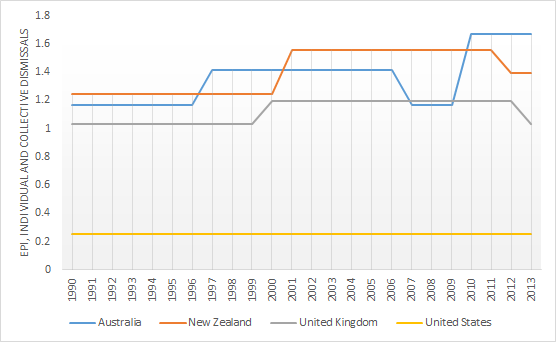
Major deregulations and re-regulations of the labour market in Australia and New Zealand did not move the employment protection inducts around that much in figure 1. All is been quiet on the labour market regulation front of the UK pretty much since the index was started.
Figure 1: OECD employment protection index (EPI), strictness of employment protection – individual and collective dismissals, USA, UK, Australia and New Zealand, 1990 – 2013
Source: OECD StatExtract.
The Work Choices legislation in Australia in 2006 was looked upon by the OECD as a somewhat minor deregulation not much more in scale than the deregulation introduced in 2008 with the election of the National Party led government.

Nobody told the unions that.
Hourly minimum wages before and after taxes, USA, UK, Canada, Australia, New Zealand and Japan
26 Jul 2015 Leave a comment
in labour economics, minimum wage, politics - Australia, politics - New Zealand, politics - USA, population economics, public economics Tags: Australia, British economy, Canada, Japan, social insurance, Social Security taxes, taxation and labour supply
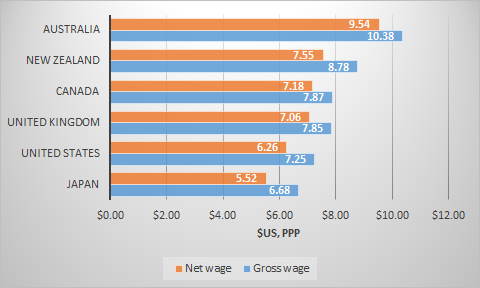
Figure 1: Hourly minimum wage before and after taxes, 2013, US dollars at purchasing power parities, single-person household
Source: OECD Focus on Minimum Wages after the crisis (2015).
When I worked at Marxism Today, my desire to earn a living proved to be somewhat déclassé.
26 Jul 2015 Leave a comment
in economics of crime, labour economics, law and economics, Marxist economics, minimum wage, poverty and inequality Tags: far left, Labour standards, Left-wing hypocrisy, Leftover Left, living wage, progressive left

Bernie Sanders Introduces Bill for $15 Minimum Wage, Pays Staff Only $12
24 Jul 2015 Leave a comment
in labour economics, minimum wage, politics - USA Tags: 2016 presidential election, Bernie Sanders, expressive voting, Left-wing hypocrisy, rational ignorance, rational irrationality

The impact of neoliberalism on labour market freedom in Argentina, Brazil, Chile and Venezuela
22 Jul 2015 Leave a comment
in development economics, economic history, economics of regulation, growth disasters, growth miracles, labour economics, labour supply, minimum wage, unions Tags: Argentina, Brazil, Chile, conspiracy theories, employment law, employment regulation, Index of Economic Freedom, Leftover Left, Mont Pelerin Society, neoliberalism, Twitter left, Venezuela
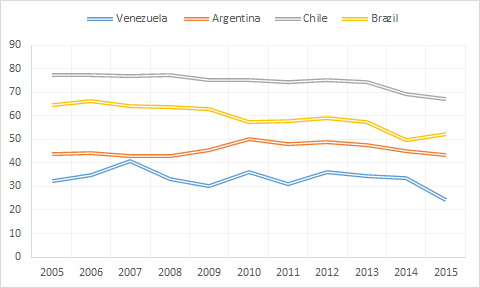
All was quiet on the neoliberalism front in Latin America for the last 20 years. In yet another defeat for the Mont Pelerin Society led transnational conspiracy, labour market freedom has declined in the four countries in figure 1. I’ve always had my doubts about the ability of a transnational conspiracy to be led by a society with such a crappy website.
Figure 1: Index of Economic Freedom, Argentina, Brazil, Chile and Venezuela, 95 – 2015
Source: Index of Economic Freedom 2015.
Trends in labour market freedom in the UK, USA, Germany and France – Index of Economic Freedom rankings
21 Jul 2015 Leave a comment
in economic history, economics of regulation, global financial crisis (GFC), job search and matching, labour economics, labour supply, law and economics, minimum wage, politics - USA, unions Tags: British economy, employment law, employment regulation, Eurosclerosis, France, Germany, Index of Economic Freedom
The writers of the Index of Economic Freedom at the Heritage foundation really loves the USA and didn’t think much of the Conservative Party – Liberal Democratic Party coalition government because labour market freedom actually fell in the UK during their administration. Bring back Tony Blair, all is forgiven. The information on their website throws no insight into why this reduction in labour market freedom in Britain happened.
Figure 1: Index of Economic Freedom, Argentina, Brazil, Chile and Venezuela, 95 – 2015 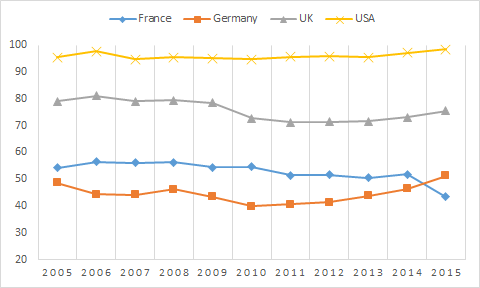
Source: Index of Economic Freedom 2015.
Fortunately for Germany, labour market freedom increased over the course of the global financial crisis and its aftermath. This helps explains low unemployment in Germany during that period. Nothing much happened in France in regard to labour market freedom.


Recent Comments