
If @NZsuperfund really could beat the market this is what they would be paid @JordNZ
13 Jan 2017 Leave a comment
What happened when a restaurant chain abolished tipping?
16 May 2016 Leave a comment
in labour economics, labour supply, managerial economics, minimum wage, occupational regulation, organisational economics, personnel economics, politics - USA, theory of the firm Tags: Edward Lazear, performance pay, tipping

Joe’s Crab Shack tested a no-tip model in 18 of its 130 restaurants. A 12-15% service charge replaced tips. Joe’s Crab capture is the first major restaurant chain to experiment with a tipping policy to experiment with abolishing it. The tipping minimum wage is far less than the federal, state and local minimum wages.

Joe’s Crab Shack had high hopes. The aims were customers would pay less, get a greater value experience, reduce labour costs and increase profits. The reactionary left represented by Salon and Huffington Post have quite strong views on tipping. Salon says
Tipping is a repugnant custom. It’s bad for consumers and terrible for workers. It perpetuates racism. Tipping isn’t even good for restaurants, because the legal morass surrounding gratuities results in scores of expensive lawsuits.
Tipping does not incentivize hard work. The factors that correlate most strongly to tip size have virtually nothing to do with the quality of service. Credit card tips are larger than cash tips. Large parties with sizable bills leave disproportionately small tips.
We tip servers more if they tell us their names, touch us on the arm, or draw smiley faces on our checks. Quality of service has a laughably small impact on tip size.
According to a 2000 study, a customer’s assessment of the server’s work only accounts for between 1 and 5 percent of the variation in tips at a restaurant.
Salon adds that federal and state law requires restaurants to ensure that tips bring employees up to minimum wage, but few diners know that.

Huffington Post managed to marshal 9 reasons why tipping should be abolished arguing that it was in no one’s interests either employers, employees or customers. The old efficiency at wage argument was rolled out arguing that employers gain in terms of diligent motivate employees by paying a straight wage rather than leaving it up to customer judgements of the services tended.
Not surprisingly this sounded like a business opportunity to Joe’s Crab Shack. Better customer service, better motivated employees and lower labour costs were promised by abolishing tips. You wonder why tipping survived in competition against alternative forms of restaurant service formats for all these decades?

Well, Joe’s Crab Shack got more than it bargained for when it abolished tipping. The pilot restaurants lost an average of 8-10% of customers during the test run.
The restaurant’s research showed that around 60% of customers disliked the policy because it took away an incentive for good service and that they don’t necessarily trust that management is passing along the money to workers.
The no tipping structure worked at four restaurants and will continue to work out why it succeeded there but failed at 14 other places.
What is even more interesting that the abolition of tipping lead to some workers quitting. This outcome at Joe’s Crab Shack is inconsistent with the notion that tipping is a by-product of the inequality of bargaining power between workers and employees. Turnover is supposed to reduce when tipping is abolished rather than increase with the employer losing their best workers.

Lazear found in data for Safelite Glass that average productivity will rise and the firm will attract a more able workforce will rise when it shifts to piece rates. The 44% increase in output per worker suggested the firm previously had a suboptimal compensation system. Half of the increase in labour productivity came from workers quitting when piece rates are introduced and being replaced by workers motivated to apply by the lure of piece rates. The average worker received a 10% increase in pay as a result of the switch to piece rates.
The only economic analysis of any value on tipping was written in 1985 by David Sisk at the Federal Trade Commission. He wrote a paper about both tipping and commissions. Sisk approached tipping not as a motivational device but a form of contracting.
Sisk points out that tipping takes the place of reputation as a way of guaranteeing good services are at a restaurant. Many do not plan to return to a restaurant so an alternative form of contracting emerges to ensure good service because the threat of taking future custom elsewhere does not work.
In the case of a tip, the buyer (or customer) is provided with a final means of automatic redress which serves to prevent unsatisfactory performance on the part of the seller.
The possibility of unsatisfactory performance arises when the brand-name, repeat purchase mechanism is not effective or because employees of the seller are too costly to monitor.
An example is tourists. They are protected from inferior service relative to the locals because they pay tips too and are well able to judge good and bad service.

Sisk argues that once a customer sits down at a restaurant, the customer commits ever increasing amounts of time and the restaurant commits ever increasing amounts of physical resources. As one commits more irrevocable resources, the greater is the incentive of the other to renege on the contract.
A tip allows the customer to withhold a portion of the price without further negotiation. The tip serves to protect the customer from bad service and to protect the restaurant from bad service by an errant employee
The system of tipping provides the motivation for the waiter to properly identify and accommodate the individual desires of customers subject to the profit maximizing constraint of the restaurant owner…
The tip protects the buyer from exploitation by a seller (when the brand-name mechanism is insufficient) or from exploitation by the shirking employees of the seller
The worst tippers are single males; the best are couples and groups. The biggest tippers are single males on a date.
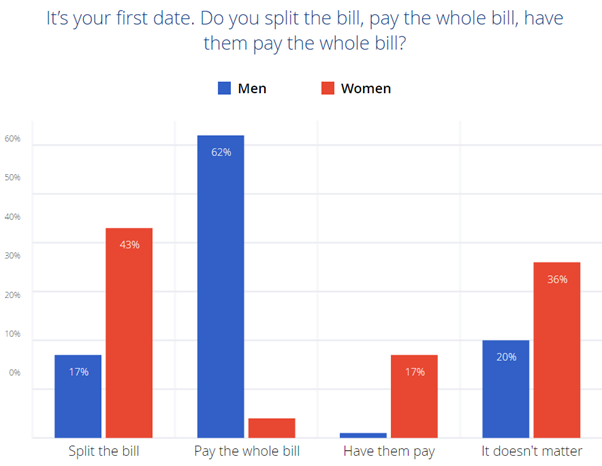
Source: OkCupid, A woman’s advantage.
Does labor market regulation really protect the interests of workers?
29 Apr 2016 Leave a comment
in economics of media and culture, economics of regulation, industrial organisation, labour economics, occupational regulation Tags: employment law, employment protection laws, employment regulation
What % of each occupation needs a license or certificate in the USA?
23 Apr 2016 1 Comment
in applied price theory, applied welfare economics, economics of regulation, labour economics, labour supply, occupational choice, occupational regulation, Public Choice, rentseeking Tags: adverse selection, barriers to entry, moral hazard, occupational licensing, occupational regulation
The 2015 Current Population Survey in the USA added a question about whether you needed a licence or a certificate to practice your occupation. One in 4 Americans say they need a licence or certificate. 22.4% need a license and 3.1% need a certificate among employed over the age of 16 in the USA.
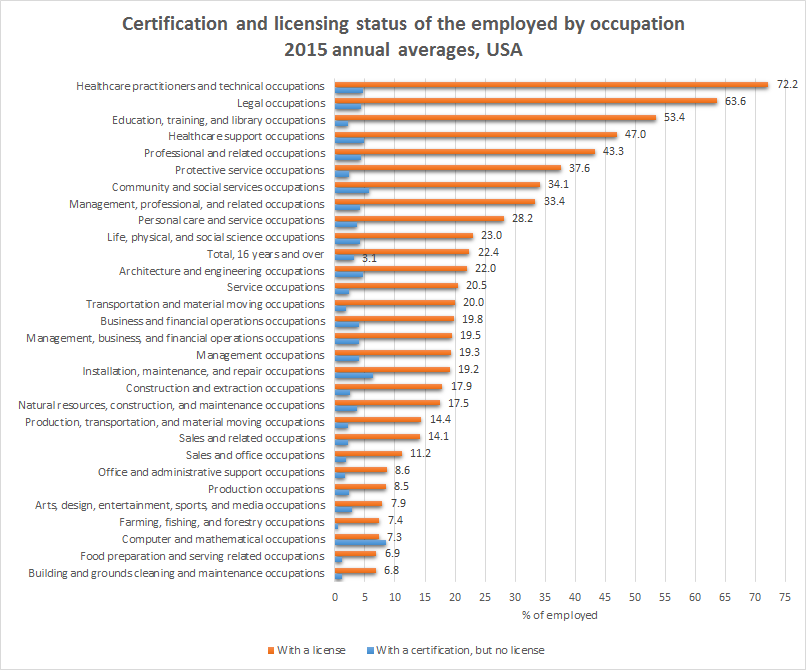
Source: Bureau of Labour Statistics, Labor Force Statistics from the Current Population Survey (2015), Certification and licensing status of the employed by occupation Table 5.
This estimate of 25% is less than the 30% estimated by Kleiner and Vorotnikov (2015) using a Harris Poll. Kleiner and Vorotnikov (2015) also found that some American states regulate twice as many occupations as others. This diversity in federalism strains any public interest explanation of occupational regulation.
Occupational regulation is more likely to be an issue for those who finished further education. It would have been better if the estimate by the Bureau of Labour Statistics was for adults and not have included teenagers.
The purpose of occupational regulation is to protect buyers from quacks and lemons – to overcome asymmetric information about the quality of the provider of the service.
The main issue with quacks in the labour market is whether there is a large cost of less than average quality service, and is there a sub-market who will buy less than average quality products in the presence of competing sellers competing on the basis of quality assurance. This demand for assurance creates opportunities for entrepreneurs to profit by providing assurance of quality.
Mostly disciplinary investigations and deregistrations under the auspices of occupational regulation are for gross misconduct and criminal convictions rather than the shading of quality.
% of workforce requiring license or certification by state– Corrected
13 Feb 2016 2 Comments
in applied welfare economics, economics of regulation, labour economics, occupational regulation, politics - USA
Some American states regulate twice as many occupations as others. This diversity in federalism strains any public interest explanation of occupational regulation.
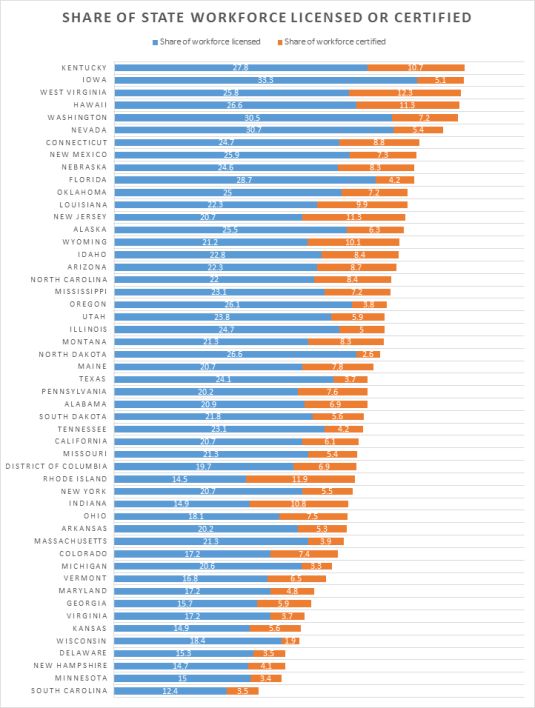
Source: Reforming Occupational Licensing Policies | The Hamilton Project – Kleiner and Vorotnikov (2015), based on an analysis of data from a Harris poll of 9,850 individuals conducted in the first half of 2013 (Harris Poll Interactive 2013).
The purpose of occupational regulation is to protect buyers from quacks and lemons – to overcome asymmetric information about the quality of the provider of the service.
Adverse selection occurs when the seller knows more than the buyer about the true quality of the product or service on offer. This can make it difficult for the two people to do business together. Buyers cannot tell the good from the bad products on offer so many they do not buy to all and withdraw from the market.
Any entrepreneur who finds ways of providing credible assurances of the quality of this service or work stands to profit handsomely. Brand names and warranties are examples of market generated institutions that overcome these information gaps through screening and signalling.
Screening is the less informed party’s effort, usually the buyer, to learn the information that the more informed party has. Successful screens have the characteristic that it is unprofitable for bad types of sellers to mimic the behaviour of good types. Signalling is an informed party’s effort, usually the seller, to communicate information to the less informed party.
The main issue with quacks in the labour market is whether there is a large cost of less than average quality service, and is there a sub-market who will buy less than average quality products in the presence of competing sellers competing on the basis of quality assurance. This demand for assurance creates opportunities for entrepreneurs to profit by providing assurance.
Mostly disciplinary investigations and deregistrations under the auspices of occupational regulation are for gross misconduct and criminal convictions rather than the shading of quality.
Where is it easiest to start a business?
20 Aug 2015 Leave a comment
in applied welfare economics, comparative institutional analysis, economics of regulation, industrial organisation, labour economics, occupational choice, occupational regulation Tags: cost of doing business, creative destruction, entrepreneurial alertness, freedom of entry
Where is it easiest to start a business? Explore the fully interactive map. buff.ly/1GPl5DM #progress http://t.co/YlN3vtfKpt—
HumanProgress.org (@humanprogress) June 18, 2015
What do American soldiers get paid
24 Jul 2015 Leave a comment
in defence economics, labour economics, occupational choice, occupational regulation Tags: military pay
Salaries of Active Duty US Military Personnel bit.ly/195NbKb http://t.co/3fNenWtcF2—
Catherine Mulbrandon (@VisualEcon) December 24, 2013
Doing business in the PIGS (Portugal, Italy, Greece and Spain) – World Bank rankings
03 Jul 2015 Leave a comment
in applied price theory, applied welfare economics, currency unions, economic growth, economics of bureaucracy, economics of regulation, Euro crisis, health and safety, income redistribution, industrial organisation, labour economics, law and economics, minimum wage, occupational regulation, property rights, Public Choice, rentseeking, survivor principle, unions, welfare reform Tags: cost of doing business, Eurosclerosis, Greece, Italy, PIGS, Portugal, Spain
Figure 1: Doing Business rankings, PIGS, 2014
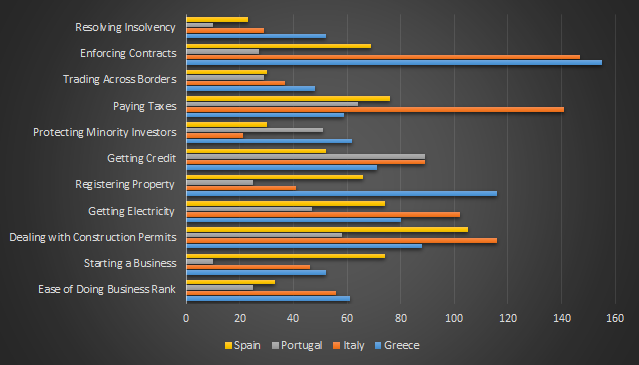
Source: World Bank Doing Business 2015.
All in all, Italy and Greece are a dog of a place to enforce a contract. The long-suffering taxpayer is better off paying taxes in Greece than in Italy! Not surprisingly, trading across borders is the greatest strength in doing business in the PIGS. The European Union does have some benefits.
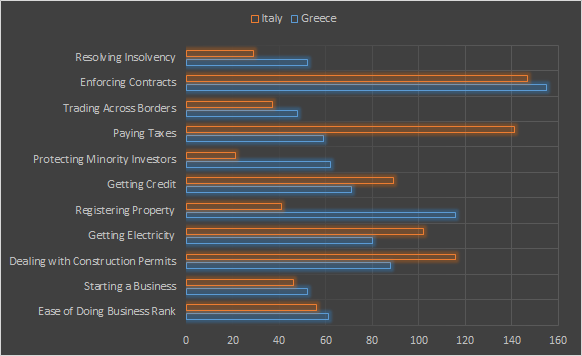
Figure 2: Doing Business rankings, Greece and Italy, 2014
Source: World Bank Doing Business 2015.
All in all, Italy and Greece are equally bad places to do business and Italy is much worse when it comes to taxes. About the only saving graces of Italy is the registration of property and the protection of minority interests in companies.
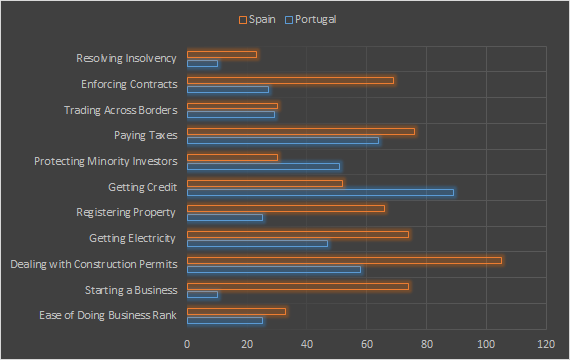
Figure 3: Doing Business rankings, Spain and Portugal, 2014
Source: World Bank Doing Business 2015.
Spain and in particular Portugal are much better places to do business than Italy and Greece.
Profits Are So High, Why Don’t More Farmers Switch To Organic?
02 Feb 2015 Leave a comment
in economics of information, economics of religion, health economics, occupational regulation Tags: compensating differentials, consumer fraud, entrepreneurial alertness, expressive voting, food snobs, organic farming, reputational capital, social norms

HT: Yet Again, Organic Ag Proves Just as Productive as Chemical Ag | Mother Jones.
The increase is partly because more farmers are taking advantage of the healthier profit margins and partly because organic marketing groups sell a health food mythology where cost is not a factor, so costs can rise along with more product. It is a miracle of capitalism.
But given a consumer-base that is wealthy and that is educated by advertising so completely, why don’t all farmers switch?It just takes paying for a sticker and promising to use an organic toxic chemical rather than a synthetic one, there is no testing of organic food, so it would be easy to just make more money.
The reason more don’t move to organic, according to a paper in the Journal of Marketing, is because conventional farmers know in their hearts and minds they are deceiving the public if they switch – making that change is like switching belief systems.
via “Chemical Farmers”: Profits Are So High, Why Don’t More Farmers Switch To Organic?.
Adam Smith wrote about religion in the Wealth of Nations in part because how it infused moral fibre into market dealings. Smith offered a theory explaining the participation of individuals in religion based on his theory of human capital.
In particular, businessmen want to signal to customers that they were moral upstanding people who will not cheat them because that would be against their own moral code and sense of self-respect.
For this reason, Adam Smith suggested that religious sects proliferating in cities because people wanted to join them as a way of signalling they were morally upstanding people. These sects were demanding and rigourously policed the morals of their membership and expelled those who fell in any way short.
A reputation for honesty is both an entrepreneurial investment as well as a way of living a decent life.
People value their reputations and self-respect for being a good and decent man or woman, but some do so more than others. This is why the wage premium under the theory of compensating differentials is large enough only for the trailing edge of the business community. What is that premium?
In 2011, [the] organic premium for a bushel of wheat was 52.2% after factoring in reduced yield per acre of organic production versus total [chemical] average yield per acre. In other terms, [chemical] wheat would have had to have yielded over 53 bushels [a two-thirds increase] per acre to match organic return per acre. (Ted Craig, Wyoming Department of Agriculture, personal communication)
Being an organic farmer is somewhat trendy these days and raises you in the eyes of many but not all. As such, self-respect rather than reputation would be the bigger driver of how large the compensating differential must be before more move to organic farming.
Stranger than fiction: The reason why Zinedine Zidane was almost sacked as main coach of real Madrid B
30 Jan 2015 1 Comment
in economics of regulation, occupational regulation, rentseeking, sports economics Tags: Eurosclerosis, occupational regulation, soccer, Spain

Zinedine Zidane is one of the top 5 soccer players of all time (World Cup 1998, Euro Cup 2000, etc).
He retired and became assistant coach for Real Madrid in 2013 and in August 2014, main coach for Real Madrid B.

A director of the Spanish National Football Coach Education Centre because he does not have a three year higher education degree in Soccer coaching.
Zinedine Zidane was fined and expelled from Spanish league. His lawyer found a loophole due to his French citizenship and saved the day.
Zidane made his professional debut aged 16. Too busy becoming one of the greatest players of all time to spend three years at university. He spent his first weeks at his first club mainly on cleaning duty as a punishment for punching an opponent who mocked his ghetto origins.
HT: Lee Ohanian via John Cochrane
Sorry, Conservatives—Basic Economics Has a Liberal Bias By Matthew Yglesias
22 Jan 2015 Leave a comment
in history of economic thought, occupational regulation Tags: academic bias, political bias
…here are some ideas that I’ve seen in most of the introductory economics textbooks I’ve looked at:
- Governments (typically through central banks) need to manage the demand level of national economies to prevent catastrophic recessions and mass unemployment.
- Absent carbon pricing, a market economy will massively overproduce greenhouse gases.
- Many industries, such as broadband Internet, are “natural monopolies” where an unregulated market will lead to higher prices and less investment than is socially optimal.
- Due to asymmetrical information, consumers in a market economy will be unable to bargain effectively with doctors and other providers of health care services.
- Due to adverse selection, consumers in a market economy will be unable to effectively insure themselves against health risks.
- Due to the declining marginal utility of money, taking $100 from a rich person and giving it to a poor one will increase human welfare.
- Increasing the number of immigrants, raising taxes on the rich, and making Social Security benefits more generous will make almost everyone better off.
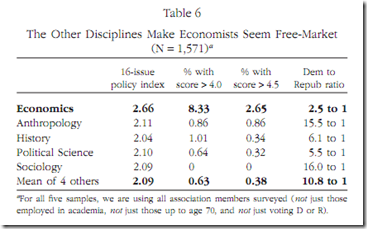
I could go on like this. But suffice it to say that one of the main reasons that so many economists are Democrats is that on a whole lot of issues the basic econ 101 view supports the liberal position.
via Economics is liberal: Chris House on conservative economics..
Be Afraid. Be A Little Afraid: The Threat of Terrorism from Western Foreign Fighters in Syria and Iraq | Brookings Institution
14 Jan 2015 Leave a comment
in economics of crime, managerial economics, occupational regulation, organisational economics, personnel economics Tags: Jihadists, war against terror
Complex Model of Foreign Fighter Radicalization

via The Threat of Terrorism from Western Foreign Fighters in Syria and Iraq | Brookings Institution.


Recent Comments