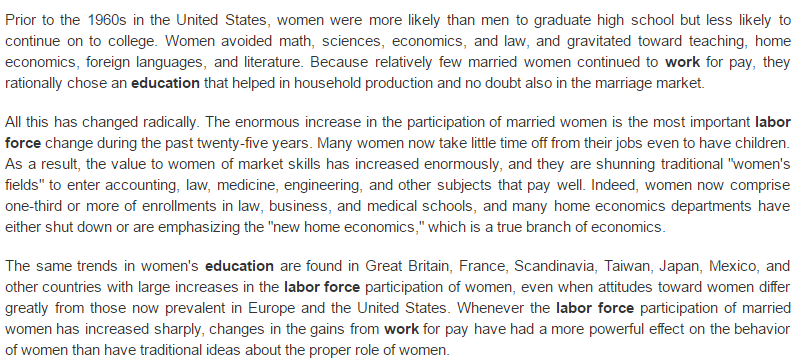
Source: The Adam Smith address: Education, labor force quality, and the economy. By: Becker, Gary S., Business Economics, Jan1992, Vol. 27, Issue 1
Celebrating humanity's flourishing through the spread of capitalism and the rule of law
08 May 2017 Leave a comment
in development economics, discrimination, economic history, Gary Becker, gender, human capital, labour economics, labour supply Tags: economics of culture, economics of tradition, gender wage gap, preference formation
Source: The Adam Smith address: Education, labor force quality, and the economy. By: Becker, Gary S., Business Economics, Jan1992, Vol. 27, Issue 1
06 May 2017 Leave a comment
in discrimination, economic history, gender, labour economics Tags: gender wage gap, New Zealand Greens

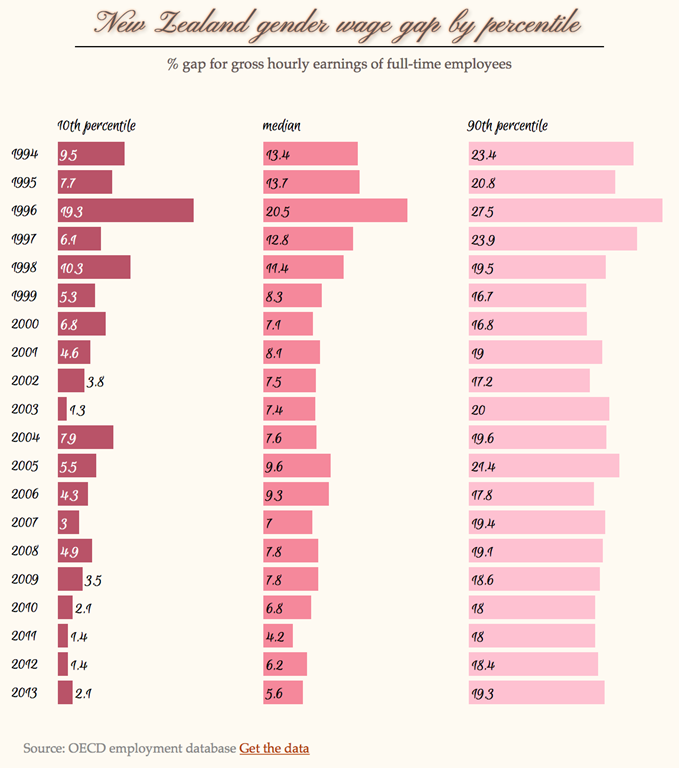

Source: Statistics New Zealand Measuring the gender pay gap.

Source: Statistics New Zealand Effect of motherhood on pay – summary of results.
06 May 2017 Leave a comment
in politics - New Zealand, politics - USA, welfare reform Tags: Bryan Caplan, universal basic income
06 May 2017 Leave a comment
in discrimination, gender, human capital, labour economics, labour supply, occupational choice Tags: economics of fertility, female labour force participation, gender wage gap, maternity leave, preference formation, statistical discrimination, Sweden, unintended consequences
The Swedes are supposed to be in a left-wing utopia. Welfare state, ample childcare and long maternity leave but their gender wage gap is almost as bad as in 1980. They must be a misogynist throwback.

Maybe Megan McArdle can explain:
There are countries where more women work than they do here, because of all the mandated leave policies and subsidized childcare — but the U.S. puts more women into management than a place like Sweden, where women work mostly for the government, while the private sector is majority-male.
A Scandinavian acquaintance describes the Nordic policy as paying women to leave the home so they can take care of other peoples’ aged parents and children. This description is not entirely fair, but it’s not entirely unfair, either; a lot of the government jobs involve coordinating social services that women used to provide as homemakers.
The Swedes pay women not to pursue careers. The subsidies from government from mixing motherhood and work are high. Albrecht et al., (2003) hypothesized that the generous parental leave a major in the glass ceiling in Sweden based on statistical discrimination:
Employers understand that the Swedish parental leave system gives women a strong incentive to participate in the labour force but also encourages them to take long periods of parental leave and to be less flexible with respect to hours once they return to work. Extended absence and lack of flexibility are particularly costly for employers when employees hold top jobs. Employers therefore place relatively few women in fast-track career positions.
Women, even those who would otherwise be strongly career-oriented, understand that their promotion possibilities are limited by employer beliefs and respond rationally by opting for more family-friendly career paths and by fully utilizing their parental leave benefits. The equilibrium is thus one of self-confirming beliefs.
Women may “choose” family-friendly jobs, but choice reflects both preferences and constraints. Our argument is that what is different about Sweden (and the other Scandinavian countries) is the constraints that women face and that these constraints – in the form of employer expectations – are driven in part by the generosity of the parental leave system
Most countries have less generous family subsidies so Claudia Goldin’s usual explanation applies to their falling gender wage gaps
Quite simply the gap exists because hours of work in many occupations are worth more when given at particular moments and when the hours are more continuous. That is, in many occupations earnings have a nonlinear relationship with respect to hours. A flexible schedule comes at a high price, particularly in the corporate, finance and legal worlds.
05 May 2017 Leave a comment
in economic history, politics - USA, poverty and inequality Tags: child poverty, family poverty, The Great Enrichment
04 May 2017 Leave a comment
in applied price theory, labour economics, politics - New Zealand
This Bill will increase the wages of employees paid more than the contracting out limit. Currently, these workers share the risk of a job match turning out not as hoped with their employer. Their employers respond by reducing the wages they offer because of this additional risk placed on them if the job match turns out a disappointment. Asking an employee of any pay level to take on more of the risks of an unsuccessful job match will only happen if you offer them more wages.
Employment protection laws make it costlier to fire an employee, employers will be more cautious about hiring and will pay less because they carry the burden if a job match going wrong.
Not all job matches turn out to be as hoped and the further up the management hierarchy you go, the more likely that the Peter principle, that employees are promoted one or two levels beyond the level of maximum competence. Successful employees may simply take that one promotion to many. This increases the risk premium in managerial and executive labour markets. The way in which this risk premium is shared between employer and recruit influences how much they are paid.
Employers who failed to treat workers fairly and pay them the going wage risk an increase in job quit rates. A standard literature review result is businesses spend about one-fifth of an employee’s annual salary to replace that worker. It is costly to replace workers because of the productivity losses when someone leaves a job, the costs of hiring and training a new employee, and the slower productivity until the new employee gets up to speed in their new job. With large fixed costs of recruitment and training, employers cannot afford to behave whimsically if they wish to survive in competition with the rivals with more competitive wage and employment policies.

The Centre for American Progress was good enough to document the very substantial costs of
recruiting and training a replacement employee. Employers have every reason to protect their investments in training and recruitment by minimising job turnover costs.

A policy designed to protect workers from dismissal, over time, will increase the duration of unemployment spells through a chilling effect on job creation. Employment protection laws are a tax on job creation. With fewer vacancies posted, the unemployed will take longer to find jobs. The far longer average duration of unemployment in countries in Europe with strong employment protection is shown that to be true time again. Fewer jobs are created fewer people fired so fewer vacancies open so the unemployed spend longer searching for new jobs.

There are very high outflow rates from unemployment among the Anglo-Saxon and Nordic economies. The economies of Continental Europe stand in stark contrast. Unemployment outflow rates in these economies lie below 10% at a monthly frequency.
Graduate textbooks in labour economics show that a wide range of studies have found the predicted negative effects of employment law protections on employment and wages and on investment and the establishment and growth of businesses:
1. Employment law protections make it costlier to both hire and fire workers.
2. The rigour of employment law has no great effect on the rate of unemployment. That being the case, stronger employment laws do not affect unemployment by much.
3. What is clear is that is more rigourous employment law protections increase the duration of unemployment spells. With fewer people being hired, it takes longer to find a new job.
4. Stronger employment law protections also reduce the number of young people and older workers working age who hold a job.
5. The people who suffer the most from strong employment laws are young people, women and older adults. They are outside looking in on a privileged subsection of insiders in the workforce who have stable, long-term jobs and who change jobs infrequently.
Trial periods are common in OECD countries. There is plenty of evidence that increased job security leads to less employee effort and more absenteeism. Some examples are:
Jacob (2013) found that the ability to dismiss teachers on probation – those with less than five years’ experience – reduced teacher absences by 10% and reduced frequent absences by 25%.
Studies also show that where workers are recruited on a trial, employers have to pay higher wages. For example, teachers that are employed with less job security, or with longer trial periods are paid more than teachers that quickly secure tenure.
Workers who start on a trial tend to be more productive and quit less often. The reason is that there was a better job match. Workers do not apply for jobs to which they think they will be less suited. By applying for jobs that the worker thinks they will be a better fit, everyone gains in terms of wages, job security and productivity.
The only thing that is special about chief executives and others paid more than $150,000 is they are higher risk recruitments because of the costs of it going wrong. They also pose great costs on the firm if they leave unexpectedly.
Bang Dang Nguyen and Kasper Meisner Nielsen looked at how share prices reacted to 149 cases of the chief executive or another prominent manager dying suddenly in American companies between 1991 and 2008. If the shares rise on an executive’s death, he was overpaid; if they fall, he was not. Only 42% of the bosses studied were overpaid. Those with the bigger pay packages gave the best value for money as measured by the share-price slump when they passed away unexpectedly.
Share prices do speak to the value of the company and the contribution of its CEO. The share price of Apple went up and down by billions on the back of rumours about the health of Steve Jobs.
In terms of splitting of what some call the labour surplus increase from a firm hiring an executive, these employees retain on average about 71% and their employer keeps 29%. Others call this rent sharing. 71% going to the CEO might initially sound high, “but it’s not like he’s taking home more than he produced for the company,” says Nguyen.
In summary, this bill will increase the salaries of those affected by it. It will make it easier for them to find jobs especially if from less conventional backgrounds.
04 May 2017 Leave a comment
in health and safety, labour economics, occupational choice, sports economics Tags: health and safety, offsetting behaviour, unintended consequences
03 May 2017 Leave a comment
in discrimination, gender, labour economics, law and economics, politics - New Zealand Tags: conspiracy theories, economics of fertility, gender wage gap, implicit bias, unconscious bias
The Minister for Women Paula Bennett and the Ministry of Women published excellent research in February showing there cannot be a gender wage gap driven by unconscious bias. The Minister has blamed a large part of the remaining gender wage gap on unconscious bias.
… up to 84 per cent of the reason for the Pay Gap, that’s right, 84 per cent, is described as ‘unexplained factors.’ That means its bias against women, both conscious and unconscious.
It’s about the attitudes and assumptions of women in the workplace, it’s about employing people who we think will fit in – and when you have a workforce of men, particularly in senior roles then it seems likely you’re going to stick with the status quo – whether they do that intentionally or just because “like attracts like”.
It’s because there is still a belief that women will accept less pay than men – they don’t know their worth and aren’t as good at negotiating.
The reason why this February 2017 research on the motherhood penalty contradicts earlier Ministry of Women research on unconscious bias and the gender wage gap is simple.
There is a large difference in the gender wage gap from mothers and for other women. As the adjacent graphic from Ministry of Women research shows, the gender wage gap for mothers is 17% but it is only 5% from other women.

Source: Effect of motherhood on pay – summary of results Statistics New Zealand and Ministry of Women February 2017.
We men, us dirty dogs all, have no way of knowing whether a female applicant is a mother. Remember we are dealing with unconscious bias, the raised eyebrow, the prolonged pause, the lingering glance, not a conspiracy or a prejudice of which we are self-aware and take overt steps to implement. Unconscious bias is unconscious by definition.
Because the bias against women is implicit and unconscious, we men, dirty dogs all, do not know we are biased, so we do not know we have to make further enquiries to check if the female applicant is a mother so we can discriminate against her more than we do for other women.That is before we consider other drivers of the gender wage gap such as whether there are relatively large spaces between the births of her children.
Large spaces between the birthdays of children greatly increases the gender wage gap because women spend much more time out of the workforce and part-time if they spread births. This reduces their accumulation of on-the-job human capital and encourages women who plan large families to choose occupations and educational majors that do not depreciate rapidly during career interruptions.
I have no idea how an unconsciously biased employer can discover if a woman has children with spaced out ages and therefore discriminate against an even more, unconsciously, of course. We men, dirty dogs all, do not know that in order to discriminate against them, especially in shortlisting for initial hiring when we have no information beyond the application about them.
Do women have more unconscious bias against women than men? If not, there should be differences in the gender pay gap in firms with more women managers or owners.
Becoming a mother and going part time is seriously bad for women's incomes ft.com/content/94e2e7… https://t.co/2bFfELztnX—
Chris Giles (@ChrisGiles_) August 23, 2016
Perhaps there is more unconscious biased in promotions because managers may have accidentally learnt are the ages of the children of female applicants and unconsciously taken a note to remember that when unconsciously discriminating against them in promotion. This unconscious bias involves a lot of very conscious data collection and retention.
All in all, the unconscious bias hypothesis simply cannot explain such a large difference between the gender wage gaps of parents and non-parents. There is too much evidence whose existence that is strictly forbidden by the hypothesis of unconscious bias against women in the workplace.
03 May 2017 Leave a comment
in discrimination, gender, politics - New Zealand Tags: affirmative action, implicit bias, New Zealand Labour Party, political correctness, racial discrimination, racism, sex discrimination, sexism, unconscious bias
Prominent New Zealand Labour Party stalwart Sunny Kaushal has resigned from the Party amidst allegations of hostilities and bullying from Party Membership and Party Hierarchy.

With the growing use of arguments about unconscious bias, it is near impossible to rebut an accusation of racism.
Certainly, once the accusation is spit at you, the onus is on you to prove to a stranger who never met you before beyond reasonable doubt that you are not a racist. One misfortunate glance, a raised eyebrow, a jumbled sentence is enough to undo a life of principle

Unconscious bias is the main driver of the gender wage gap if my betters are to be believed. Why not racism? What is the view of the New Zealand Labour Party on unconscious bias in proving racial discrimination and pay inequity?
The Labour Party wants to reverse the onus of proof in sexual assault trials. Certainly these standards should filter down into civil proceedings and pub conversations.

The Labour Party must be a cauldron of sexism if the only way it can get gender balance in caucus is quotas. Why is racism not any less insidious within Labour decision-making than sexism?
02 May 2017 Leave a comment
in development economics, gender, growth disasters, growth miracles Tags: engines of liberation, India, The Great Escape
01 May 2017 1 Comment
in discrimination, economics of education, gender, human capital, labour economics, labour supply, occupational choice Tags: College premium, gender way, reversing gender gap
On the upside, Goldin (2006) showed that women adapted rapidly over the 20th century to changing returns to working and education as compared to options outside the market. Their labour force participation and occupational choices changed rapidly into long duration professional educations and more specialised training in the 1960s and 1970s as many more women worked and pursued careers. The large increase in tertiary education by New Zealand after 1990 and their move into many traditionally male occupations is another example.
The key is what drives the rapid changes in the labour force participation and occupational choices of women. Some of the factors are global technology trends such rising wages and the emergence of household technologies and safe contraception and antidiscrimination laws. All of these increased the returns to working and investing in specialised education and training.
Up until the mid-20th century, women invested in becoming a teacher, nurse, librarian or secretary because these skills were general and did not deprecate as much during breaks. When expectations among women of still working at the age of 35 doubled, there were massive increases in female labour force participation and female investments in higher education and specialised skills (Goldin and Katz 2006). These trends continue to today.
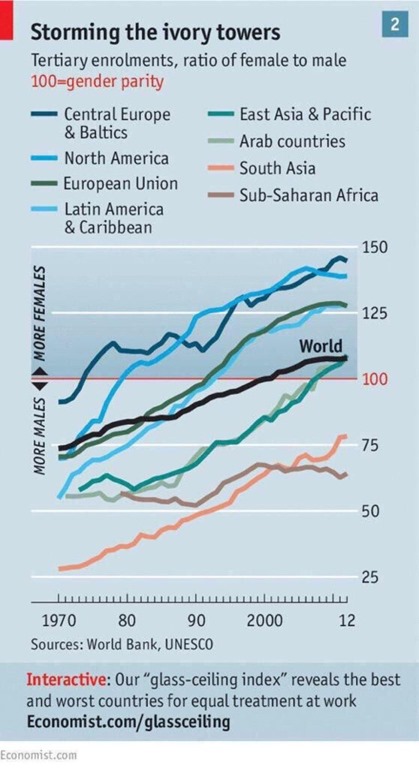 Women and in particular those women making education choices need good information on their prospects in different occupations. The evidence is they adapt rapidly to changing prospects (Goldin 2004, 2006). Goldin (2004, 2006) referred to a quiet revolution in women’s employment, earnings and education because the changes in female labour supply and occupational choices were abrupt and large.
Women adapted rapidly to changes in their expectations about their future working life, graduation rates, attainment of professional degrees, age of first marriage, and the timing and number of children. These expectations of women about their futures turned out the surprisingly accurate (Katz 2004, 2006). Young women are surprisingly good forecasters of their labour market involvement. Any gender policy options must be sensitive to the high level of responsiveness of women to changing educational opportunities and prospects and their precision to date as forecasters.
The complex decisions youth make about education and occupational choices is driven by many sources. Women are interested in issues that are of less importance to men such as work-life balance and the costs of career breaks to their earning power and human capital. Goldin (2004, 2006) argued that women who have a more accurate assessment of their future labour market involvement will invest more wisely in education and occupational choice.
The market process rewards the skills and commitment the men and women bring to the labour market. The differences in skills and commitment the men and women bring arise from a gendered division of labour and effort in the household and in raising families that appears to be open to only minor changes that are expensive in terms of growth and prosperity. This is because most gains in the status of women were the result of economic growth rather than legal interventions. Child care subsidies and parental leave arose after rising income made them and the modern welfare state fiscally affordable rather than the other way around.
Celebrating humanity's flourishing through the spread of capitalism and the rule of law
Celebrating humanity's flourishing through the spread of capitalism and the rule of law
Celebrating humanity's flourishing through the spread of capitalism and the rule of law
Celebrating humanity's flourishing through the spread of capitalism and the rule of law
Celebrating humanity's flourishing through the spread of capitalism and the rule of law
A History of the Alt-Right
Econ Prof at George Mason University, Economic Historian, Québécois
Celebrating humanity's flourishing through the spread of capitalism and the rule of law
Scholarly commentary on law, economics, and more
Beatrice Cherrier's blog
Celebrating humanity's flourishing through the spread of capitalism and the rule of law
Celebrating humanity's flourishing through the spread of capitalism and the rule of law
Celebrating humanity's flourishing through the spread of capitalism and the rule of law
Why Evolution is True is a blog written by Jerry Coyne, centered on evolution and biology but also dealing with diverse topics like politics, culture, and cats.
Celebrating humanity's flourishing through the spread of capitalism and the rule of law
A rural perspective with a blue tint by Ele Ludemann
DPF's Kiwiblog - Fomenting Happy Mischief since 2003
Celebrating humanity's flourishing through the spread of capitalism and the rule of law
The world's most viewed site on global warming and climate change
Tim Harding's writings on rationality, informal logic and skepticism
A window into Doc Freiberger's library
Let's examine hard decisions!
Commentary on monetary policy in the spirit of R. G. Hawtrey
Thoughts on public policy and the media
Celebrating humanity's flourishing through the spread of capitalism and the rule of law
Politics and the economy
A blog (primarily) on Canadian and Commonwealth political history and institutions
Reading between the lines, and underneath the hype.
Economics, and such stuff as dreams are made on
"The British constitution has always been puzzling, and always will be." --Queen Elizabeth II
Celebrating humanity's flourishing through the spread of capitalism and the rule of law
Celebrating humanity's flourishing through the spread of capitalism and the rule of law
WORLD WAR II, MUSIC, HISTORY, HOLOCAUST
Undisciplined scholar, recovering academic
Celebrating humanity's flourishing through the spread of capitalism and the rule of law
Res ipsa loquitur - The thing itself speaks
In Hume’s spirit, I will attempt to serve as an ambassador from my world of economics, and help in “finding topics of conversation fit for the entertainment of rational creatures.”
Researching the House of Commons, 1832-1868
Articles and research from the History of Parliament Trust
Reflections on books and art
Posts on the History of Law, Crime, and Justice
Celebrating humanity's flourishing through the spread of capitalism and the rule of law
Exploring the Monarchs of Europe
Cutting edge science you can dice with
Small Steps Toward A Much Better World
“We do not believe any group of men adequate enough or wise enough to operate without scrutiny or without criticism. We know that the only way to avoid error is to detect it, that the only way to detect it is to be free to inquire. We know that in secrecy error undetected will flourish and subvert”. - J Robert Oppenheimer.


Recent Comments