
Source: Measuring the quality of jobs in OECD countries | VOX, CEPR’s Policy Portal
Celebrating humanity's flourishing through the spread of capitalism and the rule of law
22 Apr 2016 Leave a comment
in labour economics, labour supply Tags: compensating differentials
21 Apr 2016 Leave a comment
in environmental economics, environmentalism, labour economics, labour supply, population economics Tags: doomsday prophecies, Earth Day, Paul Ehrlich

20 Apr 2016 Leave a comment
in applied price theory, economics of media and culture, entrepreneurship, job search and matching, labour economics, managerial economics, minimum wage, organisational economics, personnel economics, theory of the firm Tags: living wage, offsetting behavior, The fatal conceit
19 Apr 2016 Leave a comment
in labour economics, labour supply, managerial economics, market efficiency, organisational economics, personnel economics, politics - New Zealand Tags: British economy, British politics, employment law, employment regulation, fixed costs of working, part-time work, The fatal conceit, The pretense to knowledge, zero hours contracts
Revealed preference rules. Not only do about half of unemployed turned down offers of zero hour contract jobs, those that switch from a zero hours contract to minimum hours are not much different from the number of people in these type of jobs who would be quitting to another job anyway.
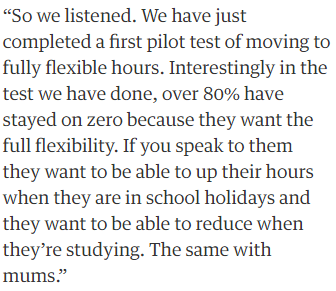
Source: McDonald’s Workers Are Just Lovin’ Their Zero Hours Contracts – Forbes and McDonald’s offer staff the chance to get off zero-hours contracts | UK news | The Guardian.
18 Apr 2016 Leave a comment
in fiscal policy, labour economics, labour supply, macroeconomics, poverty and inequality, public economics Tags: growth of government, income inequality, measurement error, Ricardian theory of budget deficits, Social Security, top 1%, wealth inequality
Markus Poschke and Barış Kaymak have just put out a paper arguing that increased social spending is a major driver of wealth inequality:
Another important and often overlooked third factor is the rise in the generosity of government transfers since 1960, mostly due to the expansion of public pensions (social security) and the introduction of public health insurance for the elderly (Medicare).
Combined spending on these two programs accounted for almost 9% of US GDP in 2010, up from less than 3% in 1960…
These government programmes tend to curb the need to rely on personal savings for retirement, especially among low and middle-income households, and might thus explain why their share in total wealth has declined.
This makes a good to good degree of sense. I have previously argued that using the arguments of Edward Prescott that it is not wise for people on ordinary income to save for their retirement when they can go down to the local Social Security office and claim an old age pension.
51% of nonretirees doubt they will receive Social Security… on.gallup.com/1NcwzEa #GallupDaily http://t.co/ZhKnHYtr1X—
(@GallupNews) August 13, 2015
It is even less wise to save that for retirement if those savings reduce your eligibility for an old age pension. Far better just to invest in a nicer house and pass it on to your children. Poschke and Kaymak note that measures of private wealth inequality miss these claims to old age pensions:
… statistics on wealth inequality that do not capture households’ claims on the public sector are incomplete and overstate top wealth shares.
This is not a new argument. Back when the Ricardian theories of budget deficits came to prominence and before that in debates on theories of the public debt, the more Keynesian sides of those arguments did argue that people were irrational for not including their old age pension entitlements under social security schemes in their calculations of their wealth.
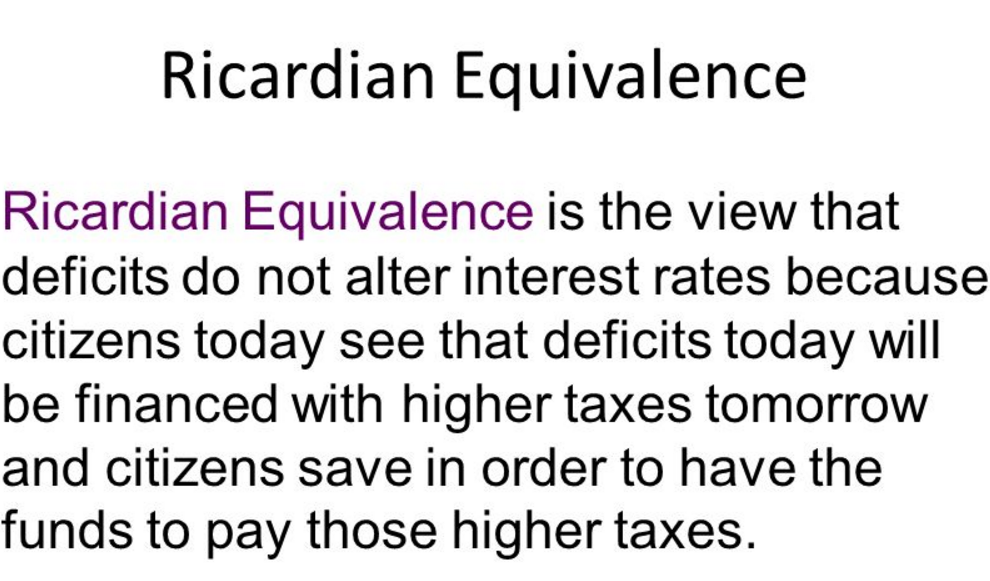
Some of their taxes were paying for their future old age pension and were another form of wealth rather than a tax. As such, taxpayers should regard this part of their taxes as investments and not cutting back their labour supply in response as they do to other taxes.
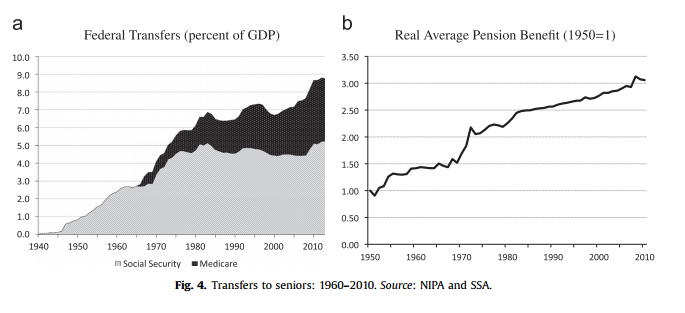
How much of the rise in wealth inequality is due to this failure to measure Social Security wealth as represented by old age pension entitlements? Their estimate is about 25%:
…technological factors play a dominant role not only for changes in income inequality, as is well known, but also for wealth inequality. As high-earning households save part of their additional income, their share of wealth also rises.
This channel accounts for about half of the total increase in wealth inequality. Tax cuts and the expansion of transfers each account for about half of the remainder…
While tax cuts encourage saving, larger transfers reduce saving incentives for retirement, in particular for low and middle income groups. This implies that these groups’ share of private wealth declines.
Note though that this is partly due to the fact that measures of private wealth inequality, like those compiled by Saez and Zucman, do not include claims to future government transfers, like social security, which constitute wealth for their owners.
18 Apr 2016 Leave a comment
in development economics, growth disasters, growth miracles, industrial organisation, international economics, labour economics, labour supply Tags: foreign direct investment, foreign investment, multinational corporations, Walter Bloch
18 Apr 2016 Leave a comment
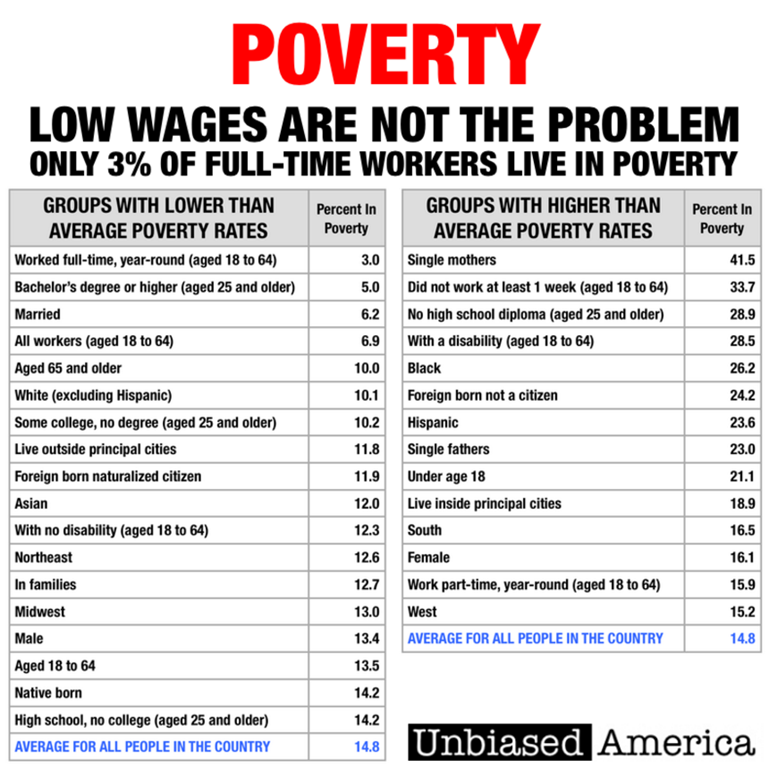
in labour economics, politics - USA, poverty and inequality Tags: child poverty, family poverty, single mothers, single parents, social insurance, unemployment benefit, welfare state
15 Apr 2016 Leave a comment
in applied price theory, economics of crime, labour economics, law and economics, occupational choice Tags: crime and punishment, law and order
Stealing soap is almost as good as stealing cash.
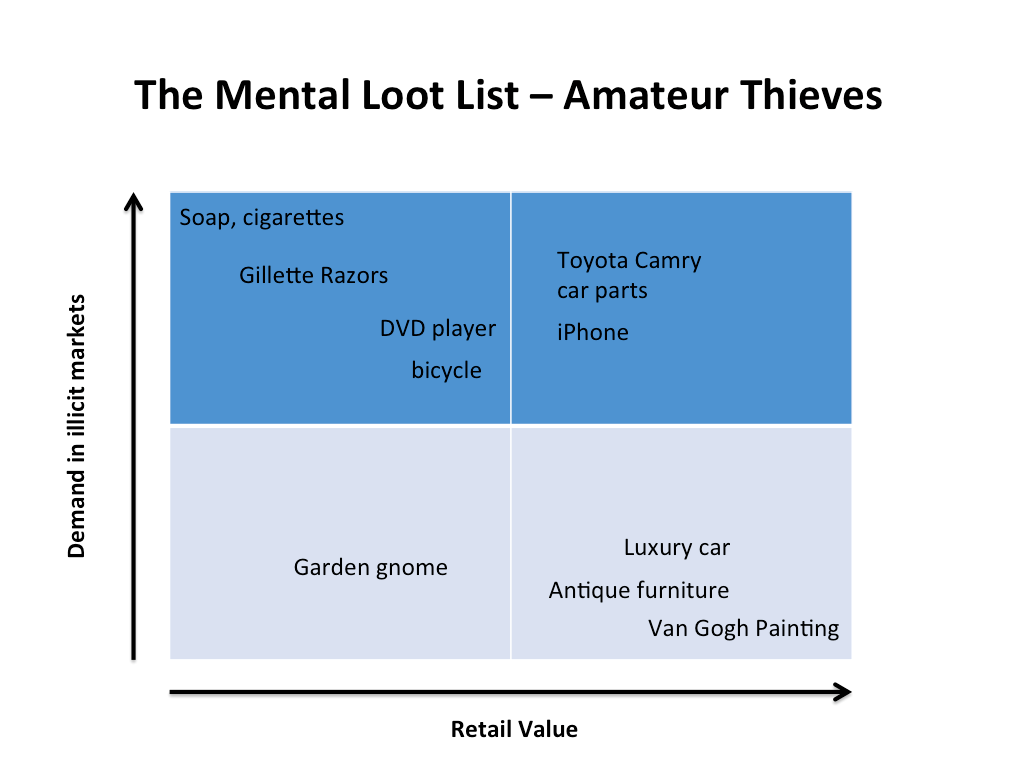
Soap and razor blades are surprisingly valuable to petty thieves because they are easy to offload at the pub or the local market stalls

Source: Why Thieves Steal Soap
15 Apr 2016 Leave a comment
in applied price theory, applied welfare economics, Austrian economics, labour economics, minimum wage Tags: living wage
14 Apr 2016 Leave a comment
#EqualPayDay This coupon graphically represents the statistical fairly tale that is being spread today http://t.co/xwQXCrWE4d—
Mark J. Perry (@Mark_J_Perry) April 14, 2015
13 Apr 2016 Leave a comment
in discrimination, economic history, gender, human capital, labour economics, labour supply, politics - Australia, politics - New Zealand, politics - USA, poverty and inequality Tags: Australia, British economy, gender wage gap
13 Apr 2016 Leave a comment
in applied welfare economics, labour economics, labour supply, politics - New Zealand, welfare reform Tags: expressive voting, rational irrationality, universal basic income
![clip_image002[4]](https://utopiayouarestandinginit.com/wp-content/uploads/2016/04/clip_image0024.gif "clip_image002[4]")
Source: Morgan Foundation (12 April 2016) Four Lessons for Labour on How to Sell the UBI.
I will contract out to Geoff Simmons of the Morgan Foundation my reply to the claim yesterday by the Morgan Foundation’s Susan Guthrie that there are no negatives from a Universal Basic income. Simmons said:
With an unconditional basic income, most beneficiaries would be no better off than they are now (in fact sole parents would almost certainly receive a lower benefit).
Single parents are $150 a week worse off and retirees are $50 worse off per week if their current income support were replaced by a Universal Basic Income of $11,000 per adult.
Both were entitled to much more under the current welfare benefit system and New Zealand Superannuation respectively. Unemployment, sickness and invalid beneficiaries are about 5% better off under a Universal Basic Income.
Labour’s background paper described a Universal Basic Income of $11,000 as not enough. Guthrie is even franker yesterday about how inadequate a Universal Basic Income is for the poor:
A basic income policy would provide everyone aged 18 and over with an unconditional, tax free survival-level of income each and every year.
I will contract out to Gareth Morgan (2011) why a Universal Basic Income that provides a “survival-level of income” is not good enough:
Rather than decreeing a minimum wage and discovering the consequences for jobs and top-up payments, let’s agree on what is a minimum income every adult should have in order to live a dignified life and then see what flows from that.
We begin by specifying the income level below which we are not prepared to see anyone having to live.
A survival-level of income and a minimum income on which every adult can live a dignified life are not the same thing.
Gareth Morgan’s universal basic income of $11,000 for adults makes most better off except those for whom the modern welfare state was established to protect.
Most of the evidence against the Universal Basic Income comes from examining the numbers put forward by its proponents such as the Morgan Foundation and its excellent online tool. Brian Easton (2015) put it well when he said:
Many advocates put the UMI forward without doing the sums.
Those who do, find that the required tax rates are horrendous or the minimum income is so low that it is not a viable means of eliminating poverty. Among the latter are New Zealanders Douglas, Gareth Morgan and Keith Rankin.
13 Apr 2016 Leave a comment
in applied price theory, applied welfare economics, discrimination, gender, labour economics Tags: gender wage gap
Source: Farmer Hayek: Equal Pay Day
13 Apr 2016 Leave a comment
in international economics, labour economics, minimum wage, politics - New Zealand, politics - USA Tags: antiforeign bias, antimarket bias, expressive voting, Leftover Left, living wage, makework bias, rational irrationality
12 Apr 2016 Leave a comment
in applied price theory, applied welfare economics, development economics, international economics, job search and matching, labour economics, labour supply, macroeconomics, politics - New Zealand Tags: antiforeign bias, free trade, makework bias, Paul Krugman, protectionism, tariffs, trade policy
Minister for everything Stephen Joyce wrote some nonsense in the paper today about how trade agreements and more exports will mean more jobs:
I would like to make the point that trade access is hugely important for a small country like New Zealand.
Without fair and equal trade access we can’t sell as much of our goods and we get less for them. And that means fewer jobs.
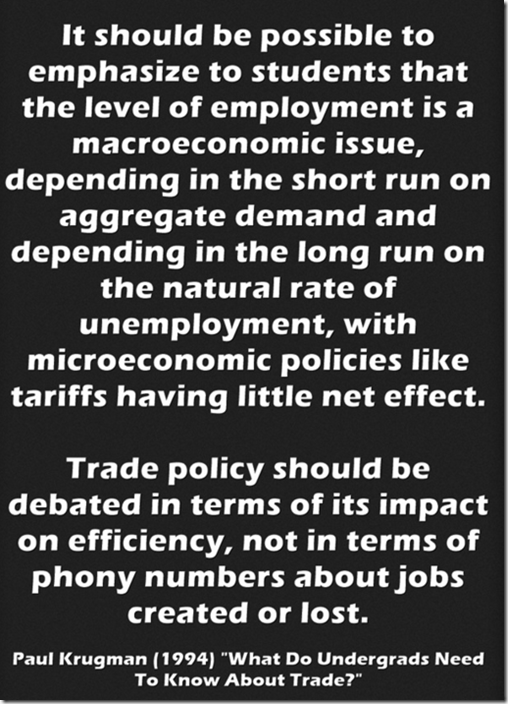
This make-work bias is as bad as those who oppose trade agreements on the grounds of an anti-foreign bias. Trade affects the composition of employment, not the number of jobs. Paul Krugman spent a good part of the 1990s trying to explain that to the general public and public intellectuals.
Celebrating humanity's flourishing through the spread of capitalism and the rule of law
Celebrating humanity's flourishing through the spread of capitalism and the rule of law
Celebrating humanity's flourishing through the spread of capitalism and the rule of law
Celebrating humanity's flourishing through the spread of capitalism and the rule of law
Celebrating humanity's flourishing through the spread of capitalism and the rule of law
A History of the Alt-Right
Econ Prof at George Mason University, Economic Historian, Québécois
Celebrating humanity's flourishing through the spread of capitalism and the rule of law
Scholarly commentary on law, economics, and more
Beatrice Cherrier's blog
Celebrating humanity's flourishing through the spread of capitalism and the rule of law
Celebrating humanity's flourishing through the spread of capitalism and the rule of law
Celebrating humanity's flourishing through the spread of capitalism and the rule of law
Why Evolution is True is a blog written by Jerry Coyne, centered on evolution and biology but also dealing with diverse topics like politics, culture, and cats.
Celebrating humanity's flourishing through the spread of capitalism and the rule of law
A rural perspective with a blue tint by Ele Ludemann
DPF's Kiwiblog - Fomenting Happy Mischief since 2003
Celebrating humanity's flourishing through the spread of capitalism and the rule of law
The world's most viewed site on global warming and climate change
Tim Harding's writings on rationality, informal logic and skepticism
A window into Doc Freiberger's library
Let's examine hard decisions!
Commentary on monetary policy in the spirit of R. G. Hawtrey
Thoughts on public policy and the media
Celebrating humanity's flourishing through the spread of capitalism and the rule of law
Politics and the economy
A blog (primarily) on Canadian and Commonwealth political history and institutions
Reading between the lines, and underneath the hype.
Economics, and such stuff as dreams are made on
"The British constitution has always been puzzling, and always will be." --Queen Elizabeth II
Celebrating humanity's flourishing through the spread of capitalism and the rule of law
Celebrating humanity's flourishing through the spread of capitalism and the rule of law
WORLD WAR II, MUSIC, HISTORY, HOLOCAUST
Undisciplined scholar, recovering academic
Celebrating humanity's flourishing through the spread of capitalism and the rule of law
Res ipsa loquitur - The thing itself speaks
In Hume’s spirit, I will attempt to serve as an ambassador from my world of economics, and help in “finding topics of conversation fit for the entertainment of rational creatures.”
Researching the House of Commons, 1832-1868
Articles and research from the History of Parliament Trust
Reflections on books and art
Posts on the History of Law, Crime, and Justice
Celebrating humanity's flourishing through the spread of capitalism and the rule of law
Exploring the Monarchs of Europe
Cutting edge science you can dice with
Small Steps Toward A Much Better World
“We do not believe any group of men adequate enough or wise enough to operate without scrutiny or without criticism. We know that the only way to avoid error is to detect it, that the only way to detect it is to be free to inquire. We know that in secrecy error undetected will flourish and subvert”. - J Robert Oppenheimer.


Recent Comments