Average years of schooling in US over time. Rise slowed in the 1970s. brook.gs/14C4Kmo http://t.co/abs2A8BvAx—
Richard V. Reeves (@RichardvReeves) January 09, 2015
The rise and rise of educational attainment
18 Jun 2015 Leave a comment
in economics of education, human capital, labour economics, labour supply, occupational choice Tags: educational attainment
The costs of teacher tenure in the USA
18 Jun 2015 Leave a comment
in economics of education, labour economics, labour supply, law and economics, managerial economics, occupational choice, organisational economics, personnel economics, rentseeking, unions Tags: employment protection laws
Education and single motherhood
18 Jun 2015 Leave a comment
in economics of education, gender, labour economics, labour supply, occupational choice, politics - Australia, politics - New Zealand, politics - USA, welfare reform Tags: single mothers
There's a clear increase in single-parent households for parents who haven’t gone to college: on.wsj.com/1B1Xeuq http://t.co/eW2fH8bX5O—
Real Time Economics (@WSJecon) May 17, 2015
% of workers working more than 50 hours per week across OECD
18 Jun 2015 1 Comment
in labour economics, labour supply, occupational choice Tags: compensating differentials, taxation and the labour supply
Figure 1: % of workers working more than 50 hours per week, OECD, 2013

Source: OECD Better Life Index 2015.
How great was the Great Depression unemployment? The official and Darby estimates of US unemployment in the 1930s
17 Jun 2015 Leave a comment
in business cycles, economic history, great depression, labour economics, macroeconomics, unemployment Tags: Euro sclerosis, measurement error, Michael Darby
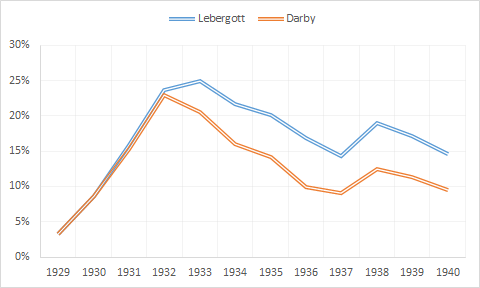
The graph below shows two different series for unemployment in the 1930s in the USA: the official BLS level by Lebergott; and a data series constructed famously by Michael Darby.
Figure 1: US unemployment rate, 1929 – 40: Darby and Lebergott estimates
Source: Robert Margot (1993).
Darby includes workers in the emergency government labour force as employed – the most important being the Civil Works Administration (CWA) and the Works Progress Administration (WPA). Once these workfare programs are accounted for, the level of U.S. unemployment fell from 22.9% in 1932 to 9.1% in 1937, a reduction of 13.8%.
For 1934-1941, the corrected unemployment levels are reduced by two to three-and-a half million people and the unemployment rates by 4 to 7 percentage points after 1933.
Not surprisingly, Darby titled his 1976 Journal of Political Economy article Three-and-a-Half Million U.S. Employees Have Been Mislaid: Or, an Explanation of Unemployment, 1934-1941. The corrected data by Darby shows stronger movement toward the natural unemployment rate after 1933.
From about 1935, the unemployment rate in the Great Depression in the USA is not much different from what it is in Europe in recent decades under Eurosclerosis.
In the 1930s in the USA, many unemployed were employed by the Civil Works Administration and the Works Progress administration. In contemporary Europe, the unemployed are simply paid not to work under their welfare state arrangements.
How to argue against employment protection laws while arguing for additional employment regulation
17 Jun 2015 Leave a comment
in human capital, job search and matching, labour economics, labour supply, macroeconomics, minimum wage, unions Tags: climate law, efficiency wage, employment at will, employment protection law, fixed costs of employment, fixed costs of working, flexible working hours, living wage, paid leave, Richard Ebstein
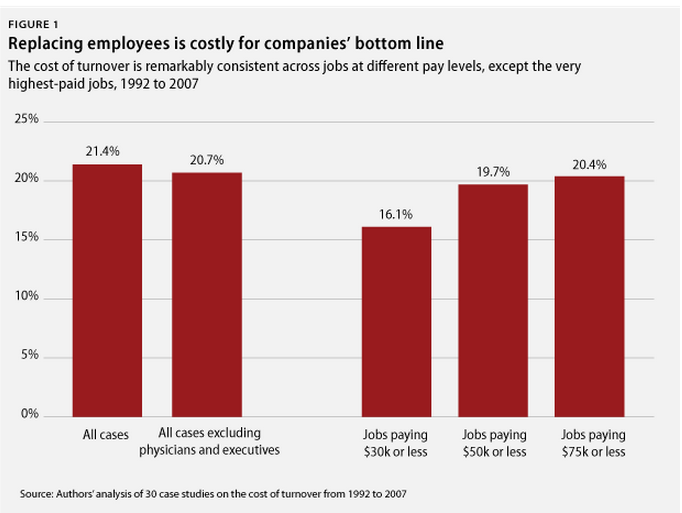
The Centre for American Progress recently published an excellent survey of the costs to employers of hiring and training new recruits. As the paper notes:
it is costly to replace workers because of the productivity losses when someone leaves a job, the costs of hiring and training a new employee, and the slower productivity until the new employee gets up to speed in their new job.
Our analysis reviews 30 case studies in 11 research papers published between 1992 and 2007 that provide estimates of the cost of turnover, finding that businesses spend about one-fifth of an employee’s annual salary to replace that worker.
The purpose of the research published by the Centre for American Progress was to argue there were large costs to employers from replacing even low paid workers and there are a workplace policies such as paid family leave and workplace flexibility will reduce these job turnover costs to employers.
Similar arguments are used to justify a living wage on efficiency grade wage grounds. A living wage would reduce job turnover and therefore the costs to employers of job turnover in the jobs.
The research published by the Centre for American Progress also illustrates the bargaining power of workers. Employers who failed to treat workers fairly and pay them the going wage risk an increase in job quit rates. These large costs of job turnover have been carefully documented by the Centre for American Progress.
Beyond jobs data: Industries w/ better pay have lower worker turnover rates equitablegrowth.org/news/looking-b… http://t.co/gug33EbYy3—
Equitable Growth (@equitablegrowth) July 03, 2015
Employers incur fixed costs of employment when they recruit and train new employees. These recruits must be expected to stay long enough to work sufficient hours for the firm to expect to recover these investments (Oi (1962, 1983a, 1990), Idson and Oi (1999), Hutchens (2010), Hutchens and Grace-Martin (2006)).
These costs are fixed costs because they do not vary with how many hours the employee works or with how long an employee stays with their employer. These fixed employment costs must be recouped over the expected job tenure of the employee with the firm. Employers will not hire an additional worker unless they anticipate recovering the costs of doing do including fixed employment costs and other overheads.
Central to arguments such as by Richard Epstein for employment at will is the threat of the employee to quit imposes a real cost on employers which the employer will seek to avoid by treating their employees well.
The best way to prevent exploitation of workers is to make hiring and firing easy, facilitate new entry by firms into all markets and promote full employment – a worker with other available job opportunities is difficult to exploit.
With large fixed costs of recruitment and training, employers cannot afford to behave whimsically if they wish to survive in competition with the rival firms with more competitive wage and employment policies.
By the same token, the large fixed costs of employment documented by the Centre for American Progress illustrate the large investments employers must risk to recruit a new employee.
If this large investment in recruitment doesn’t turn out well, but is difficult to get out of because of strict employment laws, employers will be more reluctant in the first instance to risk this investment because they are risking several months wages in fixed costs of employment. As Richard Epstein explained:
A second great advantage of the at-will system is that it supplies an informal method of bonding that keeps both sides in line.
The employer who tries to take advantage of the employee by altering working conditions for the worse will be met by the threat to quit, for now the deal is worth less to the employee than the wage received.
So long as markets are competitive the switching costs will be relatively low – lower in fact than they are in a highly regulated world where employers have to think twice before taking on a worker whom they may be unable to fire if things do not work out.
Yet on the other side, the employee who takes it easy on the job is faced with dismissal because he is no longer worth his wages.
But even here management will hesitate to dismiss for good reasons. One is the very substantial costs of recruiting and training a replacement who might or might not turn out to be better than the worker who was dismissed. The second is that unjust dismissals could induce other workers to leave while the going is good, thereby compounding the problem of recruitment and retention.
The Centre for American Progress was good enough to document the very substantial costs of recruiting and training a replacement employee. As the Centre for American Progress explained in their paper, employers have every reason to protect their investments in training and recruitment by minimising job turnover costs.
Every 20 years we worry about losing jobs to technology
17 Jun 2015 Leave a comment
in economics of education, entrepreneurship, human capital, industrial organisation, labour economics, labour supply, occupational choice, Public Choice, rentseeking, survivor principle Tags: antimarket bias, creative distraction, expressive voting, make-work bias, rational ignorance, rational irrationality, technological unemployment
Every 20 years we worry about losing jobs to tech. books.google.com/ngrams/graph?c… http://t.co/KW47Iwzsp9—
James Bessen (@JamesBessen) August 10, 2014
The education premium has immediate effects
17 Jun 2015 Leave a comment
in economics of education, human capital, labour economics, labour supply, occupational choice, poverty and inequality Tags: College premium, education premium, graduate premium, high school dropouts
http://t.co/t1Pym23Wgv—
EPI Chart Bot (@epichartbot) May 27, 2015
Gender differences in PISA scores, 2012, UK, USA, New Zealand and Australia
16 Jun 2015 Leave a comment
in economics of education, human capital, labour economics, occupational choice, politics - Australia, politics - New Zealand, politics - USA Tags: economics of personality traits, gender gap, PISA, reversing gender gap
Boys’ dominance just about endures in maths: at age 15 they are, on average, the equivalent of three months’ schooling ahead of girls. In science the results are fairly even.
But in reading, where girls have been ahead for some time, a gulf has appeared. In all 64 countries and economies in the study, girls outperform boys. The average gap is equivalent to an extra year of schooling.
Figure 1: : Gender differences (boys – girls) in student performance in reading, mathematics and science in PISA 2012

Source: OECD family database.
Why do these top 0.1 percenters get a pass from the Occupied Movement and Twitter Left?
15 Jun 2015 Leave a comment
in applied welfare economics, economics of media and culture, income redistribution, movies, politics - USA, poverty and inequality, Public Choice, TV shows Tags: comedy, Left-wing hypocrisy, Leftover Left, Occupy Wall Street, top 1%, Twitter left
The 25 richest comedians (or why not to go into standup comedy) from @randal_olson randalolson.com/2015/03/04/top… http://t.co/cp3lSnuPOf—
Tyler Vigen (@TylerVigen) March 17, 2015
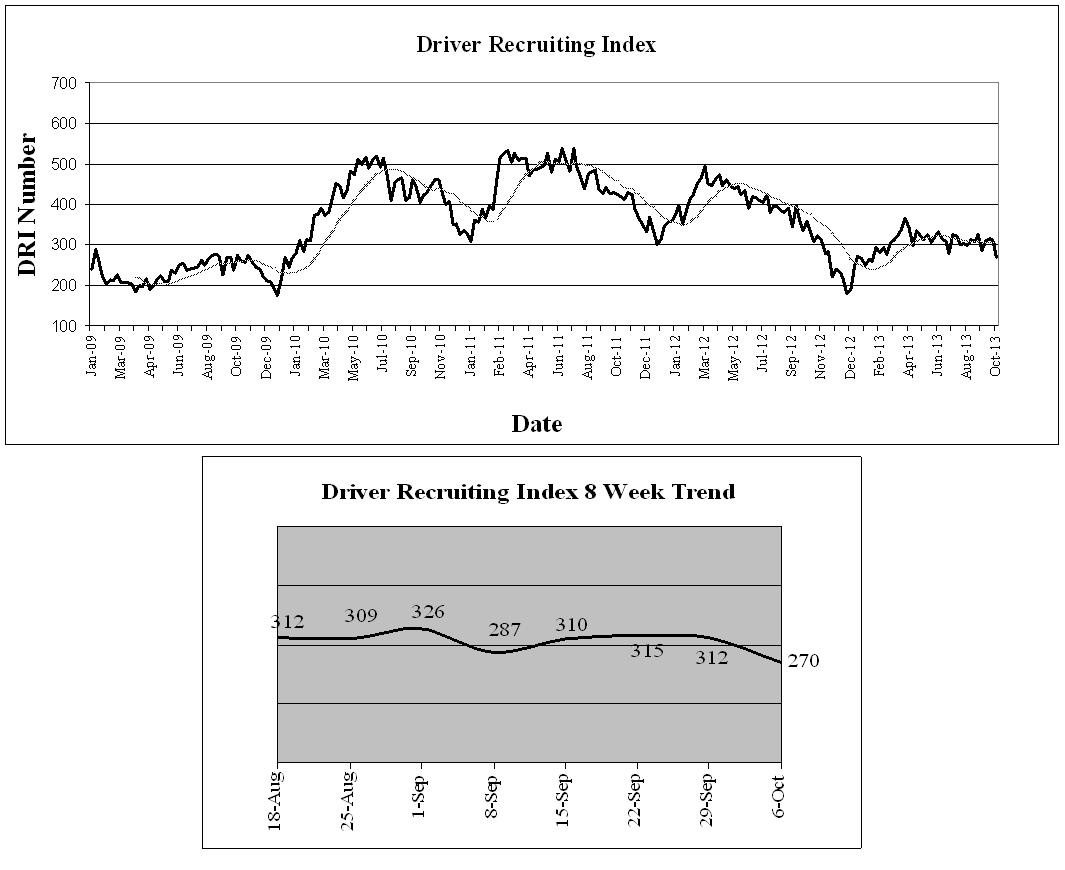
DRI-270 for week of 10-6-1: How is Job Safety Produced?
15 Jun 2015 Leave a comment
in health and safety, labour economics Tags: compensating differentials, The Great Escape
This an excellent summary

An Access Advertising EconBrief:
How is Job Safety Produced?
The best-selling book on economics in the 20th century was probably Free to Choose, the 1980 defense of free markets by Milton and Rose Friedman. It contained a chapter entitled, “Who Protects the Worker?” In it, the authors highlighted the tremendous improvement in the working conditions and living standards of workers from the Industrial Revolution onward. What, they inquired rhetorically, accounted for this? The Friedmans suggested “labor unions” and “government” as the likely top two answers to any poll taken on this subject.
One of the nation’s leading experts on the subject of risk and safety is W. Kip Viscusi, long an economics professor at Harvard, Duke and Vanderbilt universities and now affiliated with the Independent Institute. In an essay on “Job Safety” for the Fortune Encyclopedia of Economics, Viscusi wrote: “Many people believe that employers do not…
View original post 3,152 more words
Middle class stagnation versus food poverty
15 Jun 2015 Leave a comment
in politics - USA, population economics, poverty and inequality, technological progress Tags: good old days, middle class stagnation, The Great Enrichment, wage stagnation
CHART: As a share of income, spending on food has gone from 25% in 1930s to < 10% in 2013. http://t.co/pxRgf6tNOZ—
Mark J. Perry (@Mark_J_Perry) May 14, 2015
@phattonez Note that almost 50% of food expenditures are for now food away from home. http://t.co/zWAu0Zlw82—
Mark J. Perry (@Mark_J_Perry) May 18, 2015
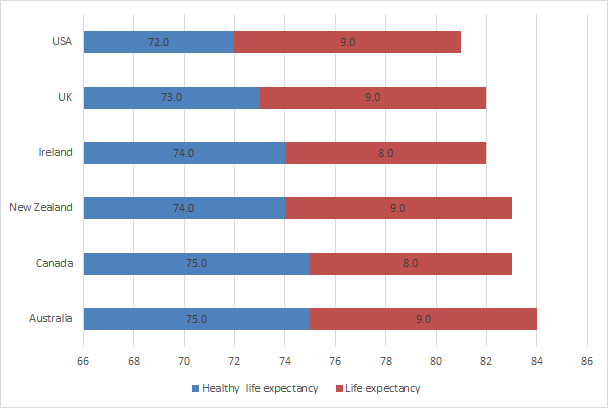
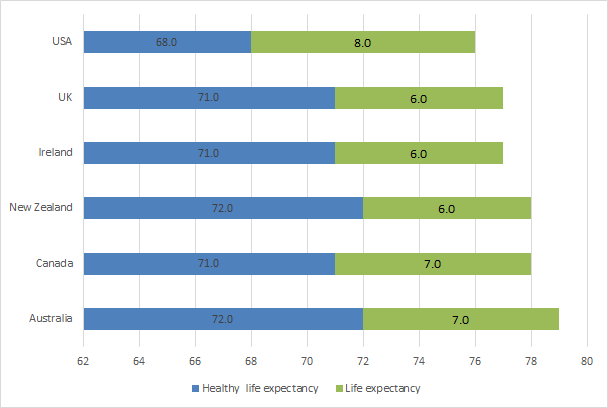
Life expectancy and healthy life expectancy by gender, Anglo-Saxon countries
15 Jun 2015 Leave a comment
in health economics, labour economics, politics - Australia, politics - New Zealand, politics - USA, population economics Tags: ageing society, healthy life expectancy, life expectancy, The Great Escape
Figure 1: life expectancy and healthy life expectancy of women, Anglo-Saxon countries, 2010
Source: OECD family database.
Figure 2: life expectancy and healthy life expectancy of men, Anglo-Saxon countries, 2010
Source: OECD family database
The reverse gender tertiary education gap for ages 25–34, Anglo-Saxon countries
14 Jun 2015 Leave a comment
in discrimination, economics of education, gender, human capital, labour economics, labour supply, occupational choice, politics - Australia, politics - New Zealand, politics - USA Tags: Australia, British economy, Canada, College premium, education premium, gender wage gap, Ireland
Figure 1: % population who have attained at least tertiary education, age 25 – 34 by gender (2012)
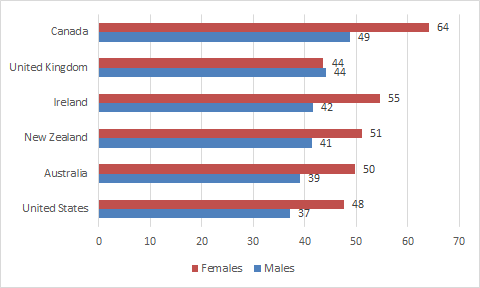
Source: OECD family database.
Figure 2 shows that the stark reversing of the gender gap in educational attainment shown in figure 1 was somewhat more recent in the US, UK and to a lesser extent in Ireland and Australia. In the UK and USA, educational attainment by gender was pretty equal for the earlier generation of graduates as compared to today’s 25 to 34-year-olds. The reversing of the gender gap in educational attainment dates back several decades in Canada and New Zealand.
Figure 2: % population who have attained at least tertiary education, age 45 – 54 by gender (2012)
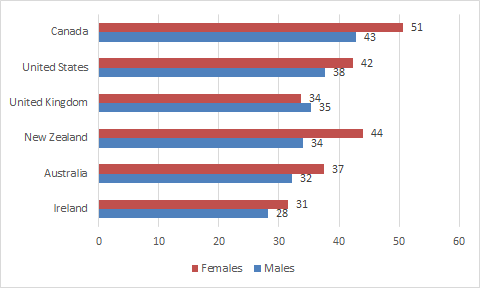
Source: OECD family database.


Recent Comments