The extreme economic outlier that is Greece, in 7 charts: 53eig.ht/1GMgIFU http://t.co/gb3zkgUqqJ—
(@FiveThirtyEight) July 04, 2015
Greece in 7 charts
06 Jul 2015 3 Comments
in budget deficits, business cycles, currency unions, economic growth, Euro crisis, fiscal policy, labour economics, labour supply, macroeconomics, unemployment Tags: Eurosclerosis, Greece
Nobel-Winning Scientists are Getting Older
05 Jul 2015 Leave a comment
in economic history, economics of education, human capital, industrial organisation, personnel economics Tags: death of the Renaissance man, Nobel prizes, rising burden of knowledge
Why Nobel-Winning Scientists are Getting Older:
priceonomics.com/why-nobel-winn… http://t.co/rNxCUS0xG2—
Priceonomics (@priceonomics) April 10, 2015
Dual income nation
05 Jul 2015 Leave a comment
in economics of love and marriage, labour economics, labour supply, politics - USA, poverty and inequality Tags: asymmetric marriage premium, dual income couples, economics of families, reversing gender gap
@MaxCRoser only one line in this chart about India matters
05 Jul 2015 Leave a comment
in comparative institutional analysis, constitutional political economy, development economics, economic history, growth disasters, growth miracles, poverty and inequality, Public Choice Tags: capitalism and freedom, extreme poverty, global poverty, India, Leftover Left, The Great Escape, The Great Fact, top 1%
In #India poverty is falling very, very rapidly – while inequality is rising.
More at: bit.ly/1KLT8Lh http://t.co/xTxlW1i06o—
Max Roser (@MaxCRoser) June 29, 2015
Haredi Jews and employment
05 Jul 2015 Leave a comment
in economics of religion, labour economics, labour supply, occupational choice Tags: economics of identity, female labour force participation, Israel, male labour force participation
Haredi Jews and employment: Eat, pray, don’t work econ.st/1QVeL48 http://t.co/gxTI56rrTv—
The Economist (@EconEconomics) June 27, 2015
The graduate premium for New Zealand is at the bottom of the OECD ladder
05 Jul 2015 Leave a comment
in economics of education, human capital, labour economics, occupational choice, politics - New Zealand Tags: College premium, education premium, graduate premium
The role of low wages in poverty
04 Jul 2015 Leave a comment
in labour economics, politics - USA, poverty and inequality Tags: expressive politics, Leftover Left, poverty, rational ignorance, rational irrationality
Gender wage gap, USA, UK, Australia and New Zealand since 2001
04 Jul 2015 Leave a comment
in discrimination, economic history, gender, labour economics, politics - Australia, politics - New Zealand, politics - USA Tags: Australia, British economy, gender wage gap
Figure 1: Gender wage gap (unadjusted % difference between median wages of male and female full-time employees)
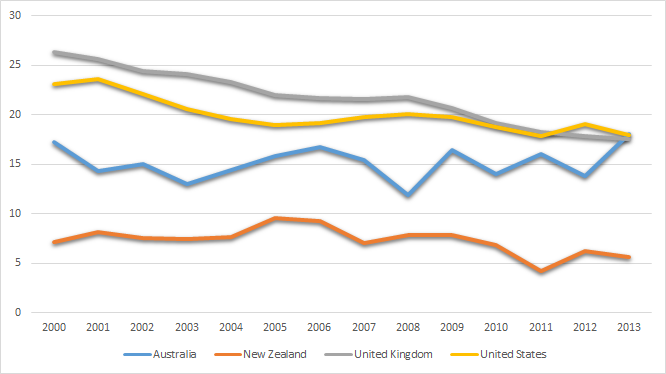
Source: OECD StatExtract.

The key skill of consultants
04 Jul 2015 Leave a comment
in labour economics, occupational choice, personnel economics, politics - Australia, politics - New Zealand, politics - USA Tags: charlatans, consultants, market for experts
Doing business in the PIGS (Portugal, Italy, Greece and Spain) – World Bank rankings
03 Jul 2015 Leave a comment
in applied price theory, applied welfare economics, currency unions, economic growth, economics of bureaucracy, economics of regulation, Euro crisis, health and safety, income redistribution, industrial organisation, labour economics, law and economics, minimum wage, occupational regulation, property rights, Public Choice, rentseeking, survivor principle, unions, welfare reform Tags: cost of doing business, Eurosclerosis, Greece, Italy, PIGS, Portugal, Spain
Figure 1: Doing Business rankings, PIGS, 2014
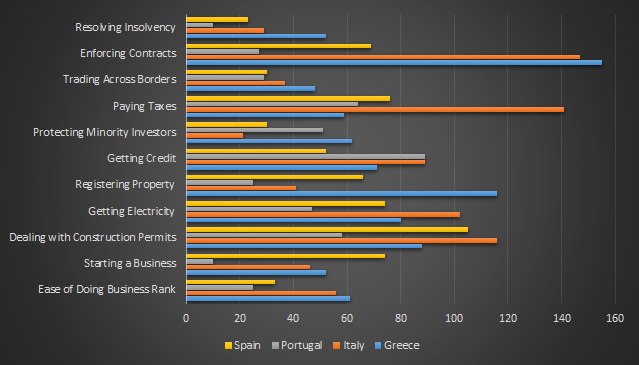
Source: World Bank Doing Business 2015.
All in all, Italy and Greece are a dog of a place to enforce a contract. The long-suffering taxpayer is better off paying taxes in Greece than in Italy! Not surprisingly, trading across borders is the greatest strength in doing business in the PIGS. The European Union does have some benefits.
Figure 2: Doing Business rankings, Greece and Italy, 2014
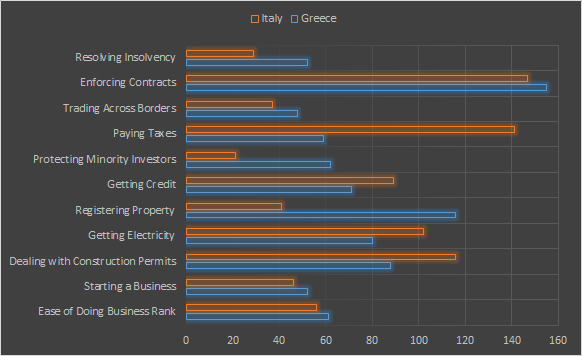
Source: World Bank Doing Business 2015.
All in all, Italy and Greece are equally bad places to do business and Italy is much worse when it comes to taxes. About the only saving graces of Italy is the registration of property and the protection of minority interests in companies.
Figure 3: Doing Business rankings, Spain and Portugal, 2014
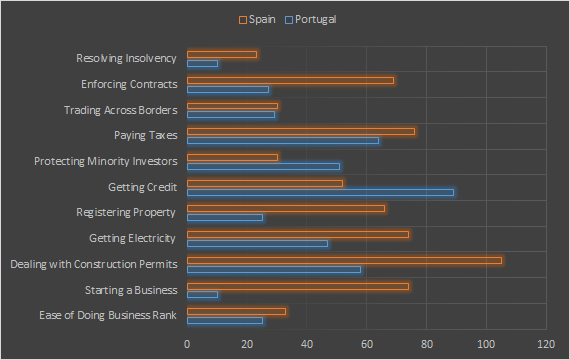
Source: World Bank Doing Business 2015.
Spain and in particular Portugal are much better places to do business than Italy and Greece.
The rise and fall of cosmetic surgery
03 Jul 2015 Leave a comment
in economics of information, economics of media and culture, gender Tags: cosmetic surgery, creative destruction, entrepreneurial alertness
The rise and fall of cosmetic surgeries in the US: samuelwbennett.com/health/the-ris… #dataviz http://t.co/X4IaBgiFtT—
Randy Olson (@randal_olson) March 01, 2015
Top performers in science by gender, USA, UK, Japan, Canada, Australia and New Zealand
02 Jul 2015 Leave a comment
in discrimination, economics of education, gender, human capital, labour economics Tags: Australia, British economy, Canada, Japan, lost boys, reversing gender gap
Why are Japanese 15-year-old girls as good at science as teenagers anywhere else in the world?
Figure 1: Percentage achieving the proficiency level 5 or higher in sciences by gender, USA, UK, Japan, Canada, Australia, New Zealand, 2012
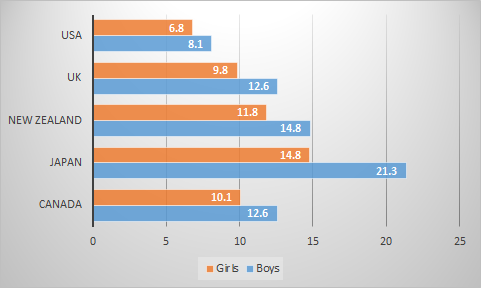
Source: OECD StatExtract.


Recent Comments