In Mexico, most cash-based public social benefits go to households in the highest income quintile, per OECD. http://t.co/xykkPkDVZs—
Catherine Rampell (@crampell) November 24, 2014
Australia has the most targeted welfare state
10 Apr 2015 2 Comments
in politics - Australia, politics - New Zealand, politics - USA, poverty and inequality, welfare reform Tags: welfare state
When will the New Zealand living wage exceed the median wage?
09 Apr 2015 Leave a comment
in labour economics, minimum wage, politics - New Zealand Tags: Leftover Left, living wage
The Left over Left have increased the living wage in New Zealand to $19.25 per hour for 2015. This increase was after a living wage of $18.80 for 2014 and $18.40 for 2013.
This latest increase increases the living wage by 2.39%, which is faster than the 1.7% increase in the median wage last year. This means sooner or later the living wage will grow to exceed the median wage in New Zealand.
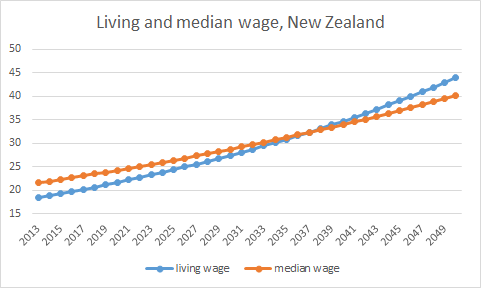
Sources: New Zealand Income Survey 2014 and Living Wage Movement.
If both the median and living wage is continuing to increase at the most recent year’s rates, as shown in the above graph, the overtaking point will be 2037.
According to the calculations of the Living Wage movement, earning the living wage in a full-time job in New Zealand with a second earner in the household working only 20 hours affords their two children, including a teenager, Sky TV, pets, international travel, video games and 10 hours childcare.
Gender distribution online
09 Apr 2015 Leave a comment
in economics of media and culture, gender Tags: gender gap
Gender distribution online http://t.co/3PlmRTn7D9—
The Prepaid Economy (@prepaid_africa) April 03, 2015
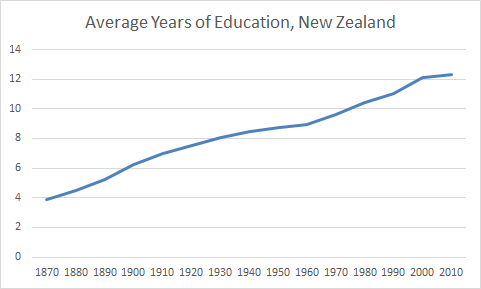
Finishing year 10 of high school was a very much a mid-20th century phenomenon
09 Apr 2015 Leave a comment
in economic history, economics of education, human capital, labour economics, occupational choice, politics - USA Tags: educational attainment
The demand and supply of quality family time
09 Apr 2015 Leave a comment
in economics of love and marriage, labour economics, labour supply Tags: child rearing, economics of family, family demographics, household division of labour
Time with kids is a normal good rather than means to improve child quality? @tylercowen @bryan_caplan @MargRev http://t.co/8ICuUFdv2A—
Ian (@ianmichaelbrown) March 29, 2015
Another gender wage gap that dare not speak its name
09 Apr 2015 Leave a comment
in discrimination, gender, labour economics, labour supply, occupational choice Tags: compensating differentials, gender wage gap, part-time work, reversing gender gap


The challenges of living in zero gravity in space
08 Apr 2015 Leave a comment
in health and safety, health economics, labour economics, occupational choice Tags: space, zero gravity
Everyone is at least 40% better off than 30 years ago and poverty has not increased
07 Apr 2015 Leave a comment
in labour economics, poverty and inequality Tags: poverty and inequality, The Great Enrichment, top 1%

Unemployment in the UK since 1860
07 Apr 2015 Leave a comment
Does money buy happiness?
07 Apr 2015 Leave a comment
in labour economics, labour supply, occupational choice Tags: compensating differentials, revealed preference
Life satisfaction rising with income – but interesting differences between different jobs.
( bit.ly/1xDklbn) http://t.co/b8ihg4LwVC—
Max Roser (@MaxCRoser) March 31, 2015
Immigration to the USA since 1820
06 Apr 2015 Leave a comment
in economic history, international economics, labour economics, labour supply, politics - USA Tags: economics of immigration
The origin of immigrants to the US since 1820
Source: bit.ly/1xjTubs http://t.co/km98cdAvTO—
Max Roser (@MaxCRoser) March 19, 2015
The obesity rates by occupation are surprising
06 Apr 2015 Leave a comment
in health and safety, health economics, labour economics, occupational choice Tags: compensating differentials, economics of obesity, obesity rates
Obesity by Occupation: In US police, firefighters, & security lead the pack. #dataviz
Source: wsj.com/articles/memo-… http://t.co/fPyQGKIUMk—
Randy Olson (@randal_olson) December 18, 2014


Recent Comments