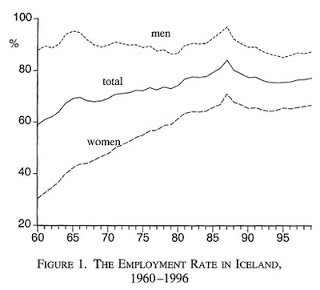
The move to a pay-as-you-earn income tax system in Iceland in 1988 made income earned in 1987 tax-free.
Icelandic GDP increased by 4.16% in 1987.
Total labour supply rose by 6.7% in 1987 over the average of 1986 and 1988.
This included an 8.6% increase in weeks of work supplied by those already in the labour market in 1986.
Notice in the graph the big kink in employment in 1987. A spike just for the year of no taxes. Labour supply then fell away.
Iceland in 1987 was a unique opportunity to study the labour supply response of individuals who were temporarily faced with a zero marginal-and average-income tax rate.
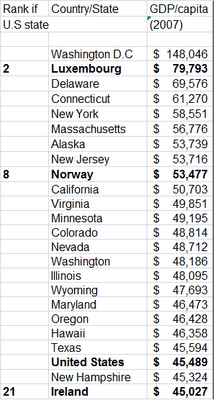
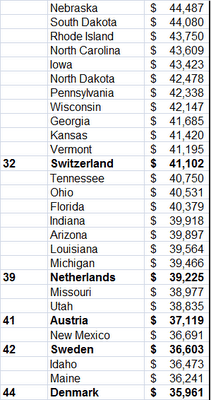
The French are poorer that the 3rd poorest American state: Arkansas. TheEU-15as a whole would qualify to be the 49th poorest American state.
The rich in Europe are poor by American standards. The poor in the USA are middle class by European standards. The European middle class has smaller houses, few cars and few consumers durables that the average poor in the USA.
The minimum wage is a rare policy bird. Its employment effects change at the whim of its latest proponents.
Minimum wages were initially introduced in the USA shortly after 1900 solely for women and children. The express aim was to price women out of jobs and raise men’s wages by enough so that they could provide for their families.
These days, some argue that minimum wages actually increase employment. Times change, and the slopes of supply and demand curves must change with them.
(1) Protect the biologically weaker sex from the hazards of market work;
(2) Protect working women from the temptation of prostitution;
(3) Protect male heads of household from the economic competition of women; and
(4) Ensure that women could better carry out their eugenic duties as “mothers of the race.”
The above photo from the Minnesota Posthas the following caption:
Fuelled by the Progressive Era, Minnesota becomes one of the first dozen states to pass a law establishing work standards for women and children and established a Minimum Wage Commission.
Women-only minimum wage laws were held unconstitutional by the Supreme Court in 1923 but were upheld by a Progressive-dominated Supreme Court in 1937. In the 1930s depression, single-sex, state minimum-wage laws were revived and flourished.
Xenophobia, race prejudice, and sexism should come as no surprise to any student of left-wing politics. Progressive politics in the first half of the 20th century was infested with racism:
The support of the Australian Labor Party (ALP), and in the USA, the Democratic Party, for vicious, state-sponsored racism is well known.
The ALP supported the passing of the White Australia policy with glee in 1901 by the newly formed Federal Parliament.
As Tim Leonard has shown, in days gone by, budding progressives not only revelled in exposes of capitalistic barons and attacks on laissez-faire economics by muckraking journalists, they also poured over racist tracts that drew on the latest anthropology, biology, psychology, sociology, eugenics, and medical science. Social Democrat Party Sweden practised eugenics until the 1960s.
Ben Jones in ‘The Burden of Knowledge and the Death of the Renaissance Man: Is Innovation Getting Harder? found that as knowledge accumulates as technology advances, successive generations of innovators may face an increasing educational burden.
Innovators can compensate through lengthening their time in education and narrowing expertise, but these responses come at the cost of reducing individual innovative capacities.
This has implications for the organization of innovative activity – a greater reliance on teamwork – and has negative implications for economic growth.
Jones found that the age at first invention, specialisation, and teamwork increased over time in a large micro-data set of inventors. Upward trends in academic collaboration and lengthening doctorates can also be explained in his framework.
Using data on Nobel Prize winners, Jones found that the mean age at which the innovations are produced to win the Prize has increased by 6 years over the 20th Century.
Before 1901, two-thirds of the Nobel laureates did their prize-winning work before the age of 40 and 20 per cent did it before age of 30.
By 2000, however, great achievements seldom occurred before the age of 40.
It’s now taking longer for scientists to get their basic training and start their careers. There is simply more to learn because knowledge in all fields has grown by quantum leaps in the past century.
Nobels are being handed out for different types of work than a century ago.
There has been a trend away from awarding prizes for abstract, theoretical ideas.
Now more honours are being bestowed on people who have made discoveries through painstaking lab work and experimentation – which takes a lot of time to do.
Jones’ theory provides an explanation for why productivity growth rates did not accelerate through the 20th century despite an enormous expansion in collective research effort and levels of education and many more graduates.
The more experienced readers of this blog might remember that the better of their professors seemed to be masters of the entire field of economics and could teach almost any subject.
These days, too many professors rely on textbooks with annual editions that come with the lecture notes, assignments and test-banks written for them by the publishing company.
Error 1: Use of Pre-Tax, Pre-Transfer Income to Measure Inequality. Throughout the report, the IMF uses the concept of “market income” to measure inequality. Market income is defined as income before taxes are paid to the government, and before transfers from the government to low-income individuals…
Error 2: More Inequality Leads to Lower Mobility. … Data from University of Ottawa professor Miles Corak on the United States, Canada, and Sweden suggest that more inequality is associated with higher mobility, not less mobility. Winship’s findings echo those of Harvard University economist Raj Chetty, who found little association between the share of income of the top one percent and mobility, either in the United States or between different countries…
Error 3: Tax Increases Lead to Higher Economic Growth… If transfers of income from one group to another succeeded in creating economic growth, the fastest-growing countries would be those with the highest top tax rates. As Nobel Prize-winning economist Edward Prescott has shown, the reverse is true.
In the National Review, Robert Doar set-out these from his time as commissioner of the New York City social service agency between 2007 and 2013:
Always promote personal responsibility.
Employment is far better than training and education.
Making work pay is welfare reform too.
Be honest about the importance of married two-parent families.
Caseworkers don’t cost much; benefits do.
Medicaid is where the money is.
Immigrants get welfare too.
Welfare recipients (and workers too) will try to "get over." "To get over" is a very New York expression meaning to steal
When it comes to the disabled, trust but verify.
Always cheer for the economy.
Figure 1: WELFARE CASELOADS AND RECIPIENTS (AFDC AND TANF PROGRAMS), IN THOUSANDS
Source: Administration for Children and Families, TANF caseload data, 2011.
I should add that after the 1996 federal welfare reforms in the USA that time limited life-time federal welfare receipt to 5-years, the 2/3rd decline in welfare participation and the gains in employment were largest among the single mothers previously thought to be most disadvantaged: young (ages 18-29), mothers with children aged under seven, high school drop-outs, and black and Hispanic mothers. These low-skilled single mothers were thought to face the greatest barriers to employment. Blank (2002) found that:
nobody of any political persuasion predicted or would have believed possible the magnitude of change that occurred in the behaviour of low-income single-parent families.
1. People have different motivations: wealth, power, pride, job satisfaction and so on. Incentive structures which suit one set of motives might not work for another.
2. Many things are true but not very significantly so.
3. Power matters: conventional economics under-states this.
4. Luck matters. The R-squareds in Mincer equations are generally low.
5. There is a great deal of ruin in a nation, and in an organization.
6. Individual rationality sometimes produces outcomes which are socially optimal as in Adam Smith’s invisible hand, and sometimes not.
7. Trade-offs between values are more common than politicians pretend, but are not ubiquitous.
8. Cognitive biases are everywhere.
9. Everything matters at the margin, but the margin might not be very extensive.
10. The social sciences are all about mechanisms. The question is: which ones work when and where? This means there are few if any universal laws in the social sciences; context matters.
11. Accurate economic forecasting is impossible. But time-varying risk premia might give us a little predictability.
12. Risk comes in many types. Reducing one type of it often means increasing exposure to another type.
In the U.S. and Japan, 15% of workers have their wages determined by unions. In Sweden and France, 90% of workers are covered by union collective agreements.
Social Democrats argue that unions and collective bargaining improve the earnings of the working class relative to the owners of capital.
Neoclassical economic theory predicts that competition among firms for workers ensures that they earn wages equal to the additional revenue that the firm earns by employing them.
Tino Sanandaji at his Super-Economy blog plotted the share of workers who are covered by collective bargaining agreements and the share of national factor costs that goes to labour as wages and other employee compensations:
The way the economy gets divided between capitalists and workers is virtually identical in weak union countries such as the U.S. as it is in countries with powerful unions, such as France and Sweden.
If anything, American workers with weak unions get a bigger share of the cake compared to European workers with strong unions. Due to high labour costs, European workers have to some extent been replaced by machines.
Few experts dispute that there is a wage gap, but differences in the life choices of men and women — such as women tending to leave the workforce when they have children — make it difficult to make simple comparisons.
…From a political perspective, the Census Bureau’s 77-cent figure is golden. Unless women stop getting married and having children, and start abandoning careers in childhood education for naval architecture, this huge gap in wages will almost certainly persist. Democrats thus can keep bringing it up every two years.
…There appears to be some sort of wage gap and closing it is certainly a worthy goal. But it’s a bit rich for the president to repeatedly cite this statistic as an “embarrassment.” …The president must begin to acknowledge that “77 cents” does not begin to capture what is actually happening in the work force and society.
In premiere episode of ‘Factual Feminist’ Christina Sommers explains how the gender wage gap is based on bogus statistics
When you actually experience education, though, it’s hard not to notice that most classes teach no job skills.
The labour market heavily rewards educational credentials even though academic curriculum is seriously disconnected from the jobs people actually do.
The best explanation for this strange fact is that education is a strong signal of pre-existing worker productivity.
Caplan argues with annoying persuasiveness that education signals desirable employee traits such as intelligence, conscientiousness, conformity and a willingness to learn boring things:
Most education is for sending a signal to employers that you can jump through hoops to show off your IQ, work ethic, and conformity.
Schools and universities do not to produce wisdom, information, critical thinking or human capital.
Subsidising education creates an arms race of credentialism as each student attempts to acquire more and more education than their rival job applicants.
His particular focus is the educational psychology literature on the transfer of learning. That literature started long ago with the question did learning Latin give you muscle to learn other subjects. The educational psychology literature has been looked at the transfer of learning for 100 years.
Educational psychologist found that Latin does not help much in studying other languages and other subjects. No significant differences were found in deductive and inductive reasoning or text comprehension among students with 4 years of Latin, 2 years of Latin, and no Latin at all.
The trouble is you do this in a race and many try to win the race by lengthening the race by going to and spending more time at university such as taking honours and master’s degrees etc.
Grades do not signal anything in Japan because everyone graduates with an A. It is the lecturer’s fault if you fail.
Japanese universities and employers make up for this everyone gets a A with strict entrance exams.
Getting into a top university signals intelligence and conscientiousness in preparing for their entrance exam. Few go to graduate school in Japan, preferring to learn more on the job.
Japanese students are lazy because everyone passes and therefore grades signal little in the way of intelligence, conscientiousness, conformity to employers.
I had great trouble getting my Japanese students to come to class. Other lecturers got around this by giving marks for attendance and replacing final exams with a pop quiz at the start of every class.
Nonetheless, something of value is acquired through 4-years at a Japanese university because otherwise why not skip straight from passing a university entrance exam to the employer exams.
The crucial objection to Caplan is that if most education expenditures are primarily about signalling, it should be possible to find other, cheaper ways to signal desirable traits to employers. As Bill Dickens noted:
For one thing I find it very hard to believe that we would waste so many resources on a nearly unproductive enterprise.
There are plenty of entrepreneurs out there trying to make money by selling cheaper, in time and money, versions of education and they aren’t very successful.
Mainstream schools have experimented with programmed learning, lectures on video, self-paced learning, etc. and none of the methods have caught on. Why wouldn’t they if they worked?
The spread of charter schools is an example of the rapid diffusion of an educational innovation valued by parents.
A major driver of the doubling of college tuition fees in the U.S. is demand for greater quality. As Becker and Murphy explain:
Indeed, it appears that the increases in tuition were partly induced by the greater return to college education. Pablo Peña, in a Ph.D. dissertation in progress at the University of Chicago, argues convincingly that tuition rose in part because students want to invest more in the quality of their education, and increased spending per student by colleges is partly financed by higher tuition levels
What specific and general skills are learnt at school and at university matters too, as Bill Dickens explains:
Education isn’t mainly about learning specific subject matter.
Rather education is mainly about practicing the sort of self-discipline that is necessary to be productive in a modern work environment.
High school allows you to practice showing up on time and doing what you are told.
College allows you to practice and work out techniques that work for you that allow you to take on and complete on time complicated multi-part tasks in an environment where you have considerable freedom about how you spend your time.
Some people may be more talented than others at this sort of thing (you come to mind as someone who is particularly talented at self-discipline), but this is also an acquired skill that one can develop with practice, and everyone needs to develop certain work habits that make one more productive at both types of tasks.
The debate really turns on the extent to which it is possible to find easier and cheaper ways to signal conscientiousness and conformity. As Bill Dickens noted as his fall-back position, which is based on comparative institutional analysis:
most of the return to education is due to it signalling desirable characteristics, but that there is no more efficient way to sort the capable from the incapable.
I also think that signalling performs a valuable sorting function that no alternative process can out-compete. But, as Caplan notes, a conventional education benefits from large government and private subsidies as compared to other sorting devices.
Table of Contents – The Case Against Education – Bryan Caplan
Introduction
Chapter 1: The Magic of Education
Chapter 2: Useless Studies with Big Payoffs: The Puzzle Is Real
Chapter 3: Signalling Explained
Chapter 4: Measuring Signalling
Chapter 5: Who Cares If It’s Signalling? The Private, Familial, and Social Returns to Education
Chapter 6: Is Education Good for the Soul?
Chapter 7: We Need Lots Less Education
Chapter 8: We Need More Vocational Education
Conclusion
The Book’s basic plot:
The labor market heavily rewards educational credentials even though academic curriculum is seriously disconnected from the jobs people actually do. The best explanation for this strange fact is that education is a strong signal of pre-existing worker productivity. (chapter 1)
While the return to education is often overstated, it remains high after making various statistical adjustments. Degrees in useless subjects really do substantially raise wages. (chapter 2)
Education signals a package of desirable employee traits: intelligence of course, but also conscientiousness and conformity. Many people dismiss the signalling model on a priori grounds, but educational signalling is at least as plausible as many widely accepted forms of of statistical discrimination. (chapter 3)
Empirically distinguishing signalling from human capital is notoriously difficult. But literatures on the sheepskin effect, employer learning, and the international return to education confirm that signalling is moderately to highly important. (chapter 4)
How much education should you get? The human capital-signalling distinction isn’t important at the individual level, but the policy implications are enormous. (chapter 5)
The non-pecuniary benefits of education are over-rated, and the non-pecuniary costs (especially boredom) are under-rated. There’s a massive selection bias because the kind of people who hate school rarely publicize their complaints. (chapter 6)
The most important implication of the signalling model is that we spend way too much money on education. Education spending at all levels should be drastically reduced, and people should enter the labor force at much younger ages. (chapter 7)
The education we offer should be more vocational. Especially for weaker students, vocational education has a higher private and social return than traditional academic education. (chapter 8)
Caplan has also posted this nice topology below to allow you to select your starting point:
Education may raise productivity by directly teaching job skills, but character formation, acculturation, etc. also count.
Pure Ability Bias
Zero
Zero
“Ability” includes not just pre-existing intelligence, but pre-existing character, acculturation, etc.
Pure Ability Bias is observationally equivalent to a Pure Consumption model of education.
Pure Signalling
WYSIWYG
Zero
Pure educational signalling can consist in (a) learning and retaining useless material, (b) learning but not retaining material regardless of usefulness, (c) simply wasting time in ways that less productive workers find relatively painful, leading to a positive correlation between education and productivity.
1/3 Pure Human Capital,
1/3 Pure Ability Bias,
1/3 Pure Signalling
2/3*WYSIWYG
1/3*WYSIWYG
A good starting position for agnostics.
0.1 Pure Human Capital,
0.5 Pure Ability Bias,
0.4 Pure Signalling
.5*WYSIWYG
.1*WYSIWYG
Caplan’s preferred point estimates. He knows they’re extreme, but his book will explain his reasons and try to win you over.
Why Evolution is True is a blog written by Jerry Coyne, centered on evolution and biology but also dealing with diverse topics like politics, culture, and cats.
In Hume’s spirit, I will attempt to serve as an ambassador from my world of economics, and help in “finding topics of conversation fit for the entertainment of rational creatures.”







Recent Comments