26 Jun 2015
by Jim Rose
in economic history, entrepreneurship, human capital, labour economics, labour supply, Marxist economics, occupational choice, politics - Australia, politics - USA, poverty and inequality
Tags: Australia, British economy, Canada, Leftover Left, top 0.1%, top 1%
Figure 1: top 0.1% share of gross income, Australia, UK, USA and Canada since 1946

Source: Chartbook of Economic Inequality.
The top 0.1% in Australia is earning not much more than it did in 1946. For most of the post-war period, the Australian top 0.1% earned less than what it earned in 1946. The only spike in the earnings of the Australian top 0.1% occurred after the top tax rate of 66% was reduced to 49% in 1986.
There were major cuts in the top tax rates in Australia,the USA and UK in the early 1980s. Figure 1 shows that these top tax rate cuts were matched with a spike in the earnings of the top 0.1% subsequent to those large tax cuts.
24 Jun 2015
by Jim Rose
in applied price theory, applied welfare economics, economic history, entrepreneurship, health and safety, human capital, industrial organisation, liberalism, Marxist economics, poverty and inequality, Rawls and Nozick, unions
Tags: capitalism and freedom, Class war, Joan Robinson, Joseph Schumpeter, social insurance, The Great Enrichment, top 1%, welfare state, withering away in the proletariat
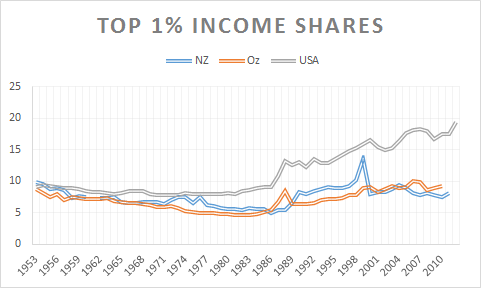
The top 1% in New Zealand really have been dropping the class war ball for at least a generation.
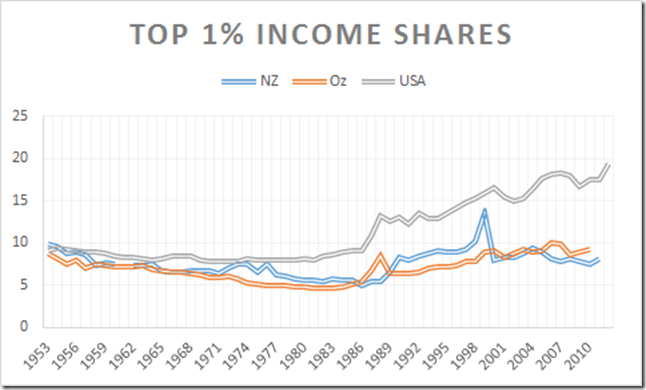
Source: The World Top Incomes Database.
Not only have the New Zealand top 1% been pretty miserable at increasing their share of incomes, hardly any change since 1990 and not much before that, the top 1% allowed inequality in both consumption and disposable income to actually fall since 1990 as shown by Treasury analysis published today.
Joan Robinson was on to this in the 1940s when she said the battle cry of Marxists would have to change from the 1848 version “rise up ye workers, rise up for you have nothing to lose but your chains” to “rise up ye workers, rise up for you have nothing to lose but the prospect of a suburban home and a motorcar”.

Today that battle cry of the Marxist revolution would have to be “rise up ye workers rise up for you have nothing to lose but your iPhone and your air points”. As Joan Robinson observed in the 1940s, that’s not much of a basis for a revolutionary movement.
22 Jun 2015
by Jim Rose
in labour economics, politics - Australia, politics - New Zealand, politics - USA, population economics, poverty and inequality, welfare reform
Tags: Australia, British economy, Canada, child poverty, economics of the family, family poverty, Ireland, single mothers, single parents
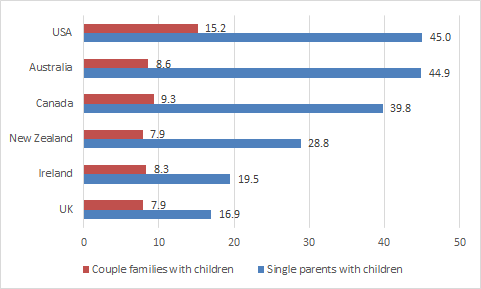
Figure 1: Child poverty rates by family type, Anglo-Saxon countries, 2010
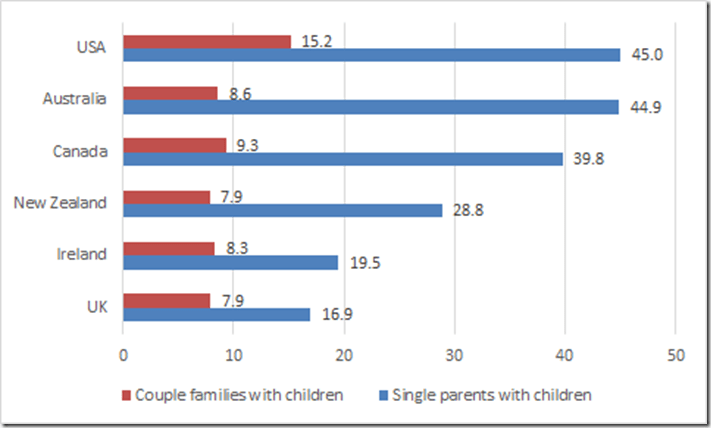
Source: OECD Family Database; Poverty thresholds are set at 50% of the median income of the entire population.
21 Jun 2015
by Jim Rose
in economics of love and marriage, labour economics, labour supply, law and economics, politics - Australia, politics - New Zealand, politics - USA, population economics, poverty and inequality, welfare reform
Tags: Australia, British economy, Canada, child poverty, economics of families, family poverty, Ireland, labour force participation, single parents
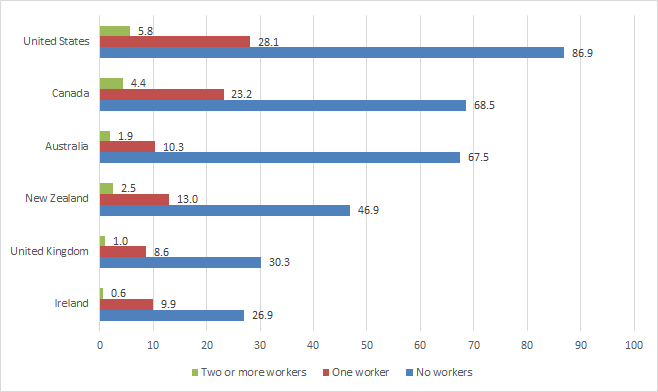
Figure 1: child poverty rates in couple families by employment status, Anglo-Saxon countries, 2010
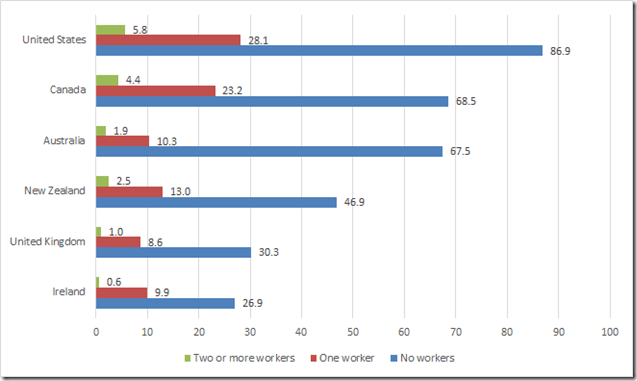
Source: OECD Family Database; Poverty thresholds are set at 50% of the median income of the entire population.
20 Jun 2015
by Jim Rose
in labour economics, politics - Australia, politics - New Zealand, politics - USA, poverty and inequality, welfare reform
Tags: Australia, British economy, Canada, child poverty, economics of the family, family poverty, female labour force participation rates, Ireland, maternal labour supply, single mothers, single parents
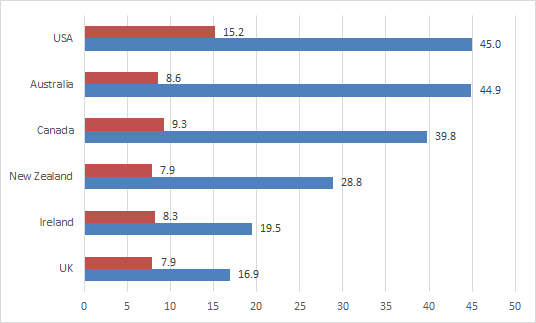
Figure 1: Child poverty rate by employment status of single parent, Anglo-Saxon countries, 2010
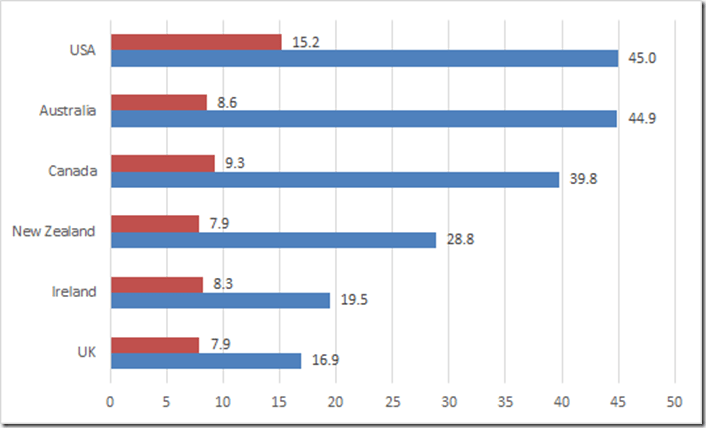
Source: OECD Family Database; Poverty thresholds are set at 50% of the median income of the entire population.
15 Jun 2015
by Jim Rose
in applied welfare economics, economics of media and culture, income redistribution, movies, politics - USA, poverty and inequality, Public Choice, TV shows
Tags: comedy, Left-wing hypocrisy, Leftover Left, Occupy Wall Street, top 1%, Twitter left
13 Jun 2015
by Jim Rose
in discrimination, gender, human capital, labour economics, labour supply, occupational choice, politics - Australia, politics - New Zealand, politics - USA, poverty and inequality
Tags: asymmetric marriage premium, Australia, British economy, Canada, gender wage gap, Ireland, labour demographics, maternal labour supply
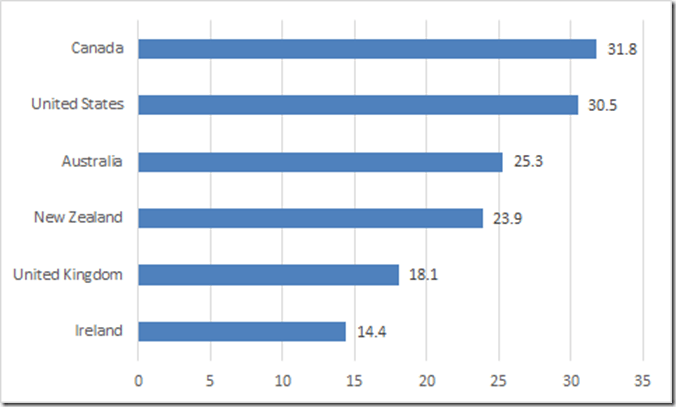
In another blow for the inherent inequality of bargaining power between workers and employers, and for the patriarchy, the wage gap is larger for tertiary educated female full-time workers aged 35-44 than it is for female full-time workers who just finished high school.
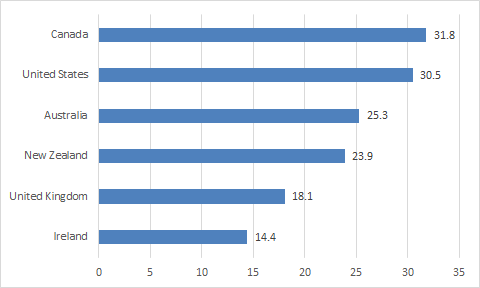
Figure 1: gender wage gap for mean full-time, full-year earnings for tertiary educated workers aged 35 – 44, 2012
Source: OECD family database.
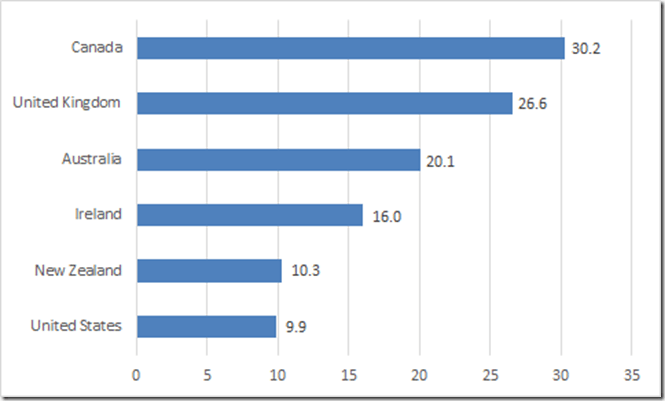
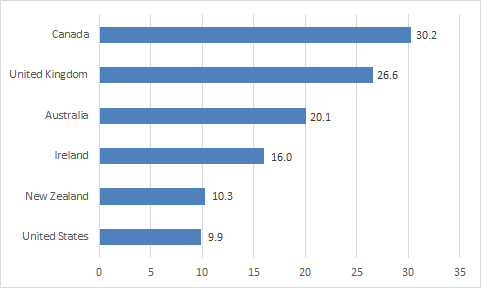
To add insult to injury, the gender wage gap further tertiary educated female workers is quite large in the USA but quite small for high school graduates.
Figure 2: gender wage gap for mean full-time, full-year earnings for below upper secondary educated workers aged 35 – 44, 2012
Source: OECD family database.
Canada seems to be a bit of a patriarchal hellhole while New Zealand does pretty well in gender wage gaps.
The gender gap in figure 1 and in figure 2 are unadjusted and calculated as the difference between mean average annual full-time, full-year earnings of men and of women as a percentage of men’s earnings.
Previous Older Entries Next Newer Entries


 Utopia, you are standing in it!
Recent Comments