Further evidence of the dynamic, deregulated nature of the New Zealand labour market

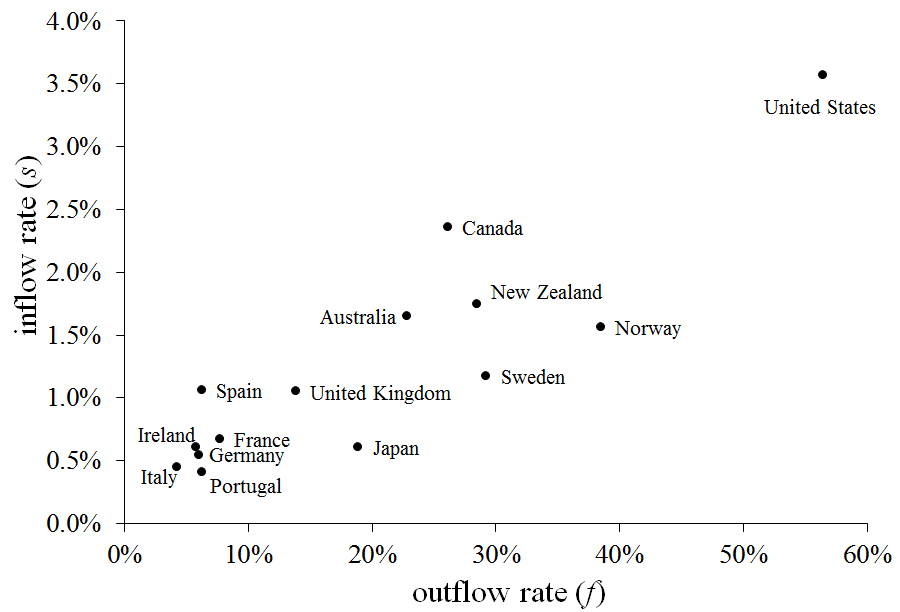
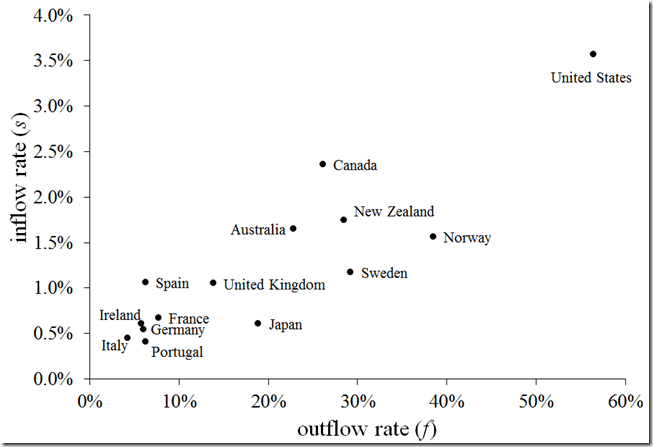
The chart below shows that New Zealand is far more flexible than Western Europe and is pretty near the USA in terms of people moving in and out of the unemployment pool every month with great ease. There are very high outflow rates from unemployment among the Anglo-Saxon and Nordic economies. The economies of Continental Europe stand in stark contrast. Unemployment outflow rates in these economies lie below 10% at a monthly frequency.

image

Source: Unemployment Dynamics in the OECD, Elsby, Hobijn  and Şahin (2013).

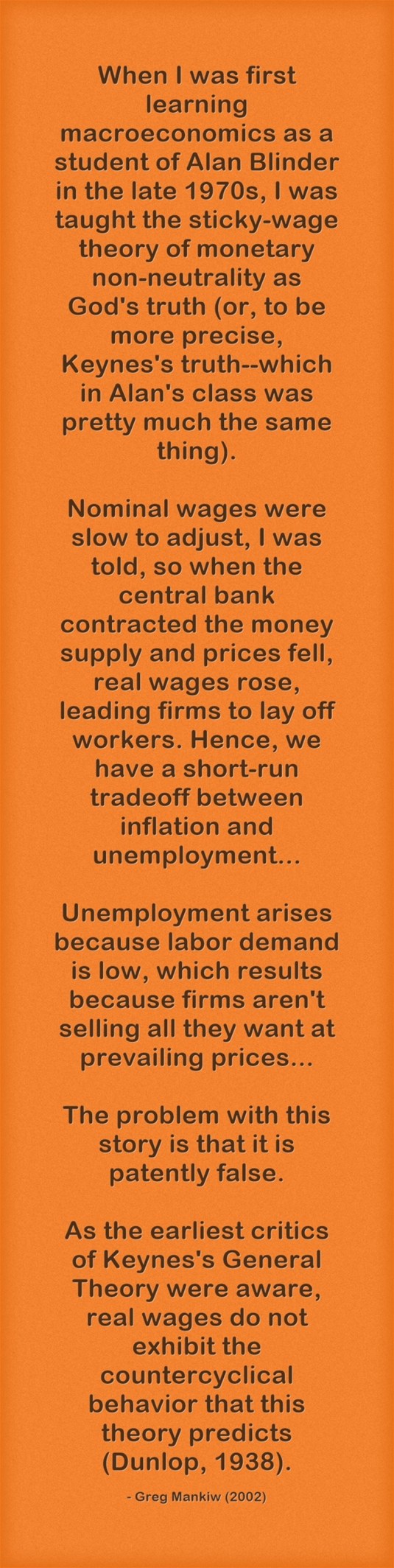
Greg Mankiw on the early problems of Keynesian macroeconomics

Image

WH Hutt on job search

Unemployment, job search, search and matching

Recessions as reorganisations

Most models of the shape of recoveries draw on a learning process. A long tradition in business cycle theory holds that limited knowledge of relative price changes can temporarily disrupt labour demand and supply because of errors in wage and price perceptions (Alchian 1969; Sargent 2007; Hellwig 2008).

Pricing, investment and production plans are made on the basis of incomplete and conflicting knowledge of constantly changing aggregate, industry and local conditions. Firms and workers will over- or under-supply when they misperceive wages and prices.

With imprecise information, it takes time for employers and workers to sort out temporary from permanent shifts in demand and supply, inflation-driven changes from real changes in prices and input costs, and general changes from the local changes that may be more important to particular firms. As Hayek explained in his Nobel prize lecture:

The true, though untestable, explanation of extensive unemployment ascribes it to a discrepancy between the distribution of labour (and the other factors of production) between industries (and localities) and the distribution of demand among their products.

This discrepancy is caused by a distortion of the system of relative prices and wages. And it can be corrected only by a change in these relations, that is, by the establishment in each sector of the economy of those prices and wages at which supply will equal demand.

Recoveries are shaped by the speed of entrepreneurial learning about the new labour and product market conditions, the relative cost of adjusting capital and labour rapidly or slowly and the costs and benefits of labour market search. This new learning is necessary because the old constellation of prices and wages is no longer valid.

It was a misdirection of resources brought about by the initial inflationary firm, as Hayek explained in a visit to Australia in 1950:

During a process of expansion the direction of demand is to some extent necessarily different from what it will be after expansion has stopped.

Labour will be attracted to the particular occupations on which the extra expenditure is made in the first instance.

So long as expansion lasts, demand there will always run a step ahead of the consequential rises in demand elsewhere.

And in so far as this temporary stimulus  to demand in particular sectors leads to a movement of labour, it may well become the cause of unemployment as soon as the expansion comes to an end…

If the real cause of unemployment is that the distribution of labour does not correspond with the distribution of demand, the only way to create stable conditions of high employment which is not dependent on continued inflation (or physical controls), is to bring about a distribution of labour which matches the manner in which a stable money income will be spent.

This depends of course not only on whether during the process of adaptation the distribution of demand is approximately what it will remain, but ‘also on whether conditions in general are conducive to easy and rapid movements of labour.

In a recession, employers and workers do not immediately know that demand has fallen elsewhere as well as in their own local markets and recognise the need to adjust to their poorer prospects everywhere, and it is not known how long the drop in demand will last (Alchian and Allen 1973).

The cost of learning about available opportunities restricts the speed of a recovery. Workers and entrepreneurs must gather information on the new state of demand and the location and nature of new opportunities. This information is costly and is quickly made obsolete by further changes, and the cost of acquiring information is more costly the faster the information is sought to be acquired (Alchian 1969; Alchian and Allen 1967).

The process of recovering from a recession would be a faster process if the new constellation of wages and prices that are the best alternative uses of resources was known immediately and was credible to firms and workers (Alchian and Allen 1973).

Workers and employers must first have sufficient time to discover what new knowledge they now need to know to serve their interests well, leave enough room for the unforeseeable and keep their knowledge fresh in ever-changing markets.

New wage levels must be created by workers and employers testing and retesting in the labour market the new relative scarcities of labour. Imbalances between the allocation of labour supply and demand to different firms and sectors and the new level and pattern of consumer demand are gradually remedied by changes in relative prices and wages, layoffs, business closures and job search.

Prices are a signal wrapped in an incentive. Growing demand induces higher employment and rising wages. Wages stagnate, and there are layoffs where there is an excess supply.

These changes give the unemployed an incentive to move to new uses and entrepreneurs to profitably hire the unemployed. The ensuing reorganisations are time-consuming and information-intensive because a job seeker and an employer with an apt vacancy take time to find each other.

Prices and wages must change sufficiently for firms to profitably create new jobs. New jobs require time to plan and build new job capital. This is the human, physical and organisational capital underlying a new job. There are also job creation costs when reopening existing positions that were mothballed during the downturn.

How is this to be done? Hayek explained again in 1950 in his speech in Australia:

Full employment policies as at present practised attempt the quick and easy way of giving men employment where they happen to be, while the real problem is to bring about a distribution of labour which makes continuous high employment without artificial stimulus possible.

What this distribution is we can never know beforehand. The only way to find out is to let the unhampered market act under conditions which will bring about a stable equilibrium between demand and supply.

Involuntary unemployment and the great vacation theories of the great depression and Eurosclerosis – updated again

Most Keynesian economists are convinced that something exists called involuntary unemployment and people can be unemployed through no fault of their own. They will accept the going wage but no employer is willing to offer it to them.

Lucas and Rapping’s (1969) paper, “Real Wages, Employment, and Inflation” provides the micro-foundations for an analysis of the labour suppl. They felt the need to reconcile the existence of unemployment with market clearing and referred to recent work of Armen Alchian (1969) on search explanations of unemployment.

Lucas and Rapping viewed unemployment as voluntary, including the mass unemployment during the great depression (Lucas and Rapping 1969: 748).

Lucas and-Rapping viewed current labour demand as a negative function of the current real wage. Current labour supply was a positive function of the real wage and the expected real interest rate, but a negative function of the expected future wage.

Under their framework, if workers expect higher real wages in the future or a lower real interest rate, current labour supply would be depressed, employment would fall, unemployment rise, and real wages increase.

Lucas and Rapping depicted labour suppliers as rational optimisers who engaged in inter-temporal substitution: working more when current wages were high relative to expected wages. The prevailing Keynesian approach assumed labour supply was passive, and movements in the demand for labour determined changes in employment.

Lucas and Rapping offered an unemployment equation relating the unemployment rate to actual versus anticipated nominal wages, and actual versus anticipated price levels. Unemployment could be the product of expectational errors about wages.

Lucas and Rapping’s model was poor at explaining unemployment after 1933 in terms of job search and expectational errors.

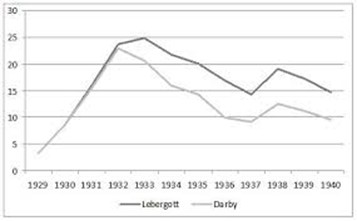
The graph below shows two different series for unemployment in the 1930s in the USA: the official BLS level by Lebergott; and a data series constructed famously by Darby. Darby includes workers in the emergency government labour force as employed – the most important being the Civil Works Administration (CWA) and the Works Progress Administration (WPA).

Once these workfare programs are accounted for, the level of U.S. unemployment fell from 22.9% in 1932 to 9.1% in 1937, a reduction of 13.8%. For 1934-1941, the corrected unemployment levels are reduced by two to three-and-a half million people and the unemployment rates by 4 to 7 percentage points after 1933.

Not surprisingly, Darby titled his 1976 Journal of Political Economy article Three-and-a-Half Million U.S. Employees Have Been Mislaid: Or, an Explanation of Unemployment, 1934-1941.

The corrected data by Darby shows stronger movement toward the natural unemployment rate after 1933. Darby concluded that his corrected date are suggests that the unemployment rate was well explained by a job search model such as that by Lucas and Rapping together with the wage fixing under the New Deal that kept real wages up and unemployment high.

Both the Keynesian approach to unemployment and the job search approach to unemployment view workers in emergency government work programs as employed and not as unemployed.

In the late 1970s, Modigliani dismissed the new classical explanation of the U.S. great depression in which the 1930s unemployment was mass voluntary unemployment as follows:

Sargent (1976) has attempted to remedy this fatal flaw by hypothesizing that the persistent and large fluctuations in unemployment reflect merely corresponding swings in the natural rate itself.

In other words, what happened to the U.S. in the 1930’s was a severe attack of contagious laziness!

I can only say that, despite Sargent’s ingenuity, neither I nor, I expect most others at least of the nonMonetarist persuasion,. are quite ready yet. to turn over the field of economic fluctuations to the social psychologist!

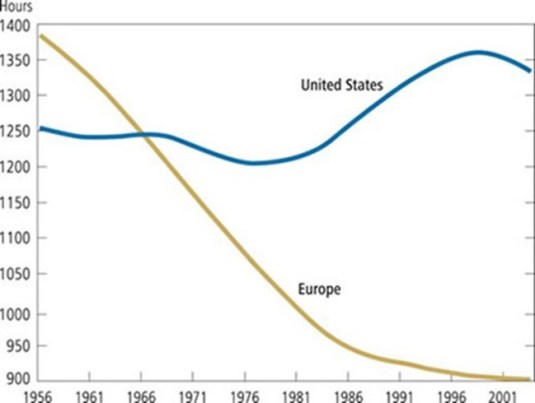
As Prescott has pointed out, the USA in the Great Depression and France since the 1970s both had 30% drops in hours worked per adult. That is why Prescott refers to France’s economy as depressed. The reason for the depressed state of the French (and German) economies is taxes, according to Prescott:

Virtually all of the large differences between U.S. labour supply and those of Germany and France are due to differences in tax systems.

Europeans face higher tax rates than Americans, and European tax rates have risen significantly over the past several decades.

In the 1960s, the number of hours worked was about the same. Since then, the number of hours has stayed level in the United States, while it has declined substantially in Europe. Countries with high tax rates devote less time to market work, but more time to home activities, such as cooking and cleaning. The European services sector is much smaller than in the USA.

Time use studies find that lower hours of market work in Europe is entirely offset by higher hours of home production, implying that Europeans do not enjoy more leisure than Americans despite the widespread impression that they do.

Richard Rogerson, 2007 in “Taxation and market work: is Scandinavia an outlier?” found that how the government spends tax revenues when assessing the effects of tax rates on aggregate hours of market work:

  1. Different forms of government spending imply different elasticities of hours of work with regard to tax rates;
  2. While tax rates are highest in Scandinavia, hours worked in Scandinavia are significantly higher than they are in Continental Europe with differences in the form of government spending can potentially account for this pattern; and
  3. There is a much higher rate of government employment and greater expenditures on child and elderly care in Scandinavia.

Examining how tax revenue is spent is central to understanding labour supply effects:

  1. If higher taxes fund disability payments which may only be received when not in work, the effect on hours worked is greater relative to a lump-sum transfer; and
  2. If higher taxes subsidise day care for individuals who work, then the effect on hours of work will be less than under the lump-sum transfer case.

Others such as Blanchard attribute the much lower labour force participation in the EU since the 1970s to their greater preference for leisure in Europe. An increased preference for leisure is another name for voluntary unemployment.

The lower labour force participation in higher unemployment in Europe is voluntary because of the higher demand for leisure among Europeans.  According to Blanchard:

The main difference [between the continents] is that Europe has used some of the increase in productivity to increase leisure rather than income, while the U.S. has done the opposite.

An unusual left-right unity ticket emerged to explain the great depression in the 1930s and the depressed EU economies from the 1970s: the great vacation theory.

A favourite line from Seinfeld

Second law of supply and demand alert: There is no such thing as a skills shortage – updated

Could you define both a severe skills shortage and a skills shortage?

  • How do these concepts differ from concepts such as rising demand, rapidly rising demand, and reduced and sharply reduced supply?
  • Are the phrases severe skills shortage and a skills shortage more precise than the phrases rising demand, rapidly rising demand, and reduced and sharply reduced supply?
  • Are the phrases severe skill shortage and a skill shortage more informative than referring to the short and long run elasticity of demand and supply as summed up in the second laws of demand and supply?
  • Why are rising demand, rapidly rising demand, and reduced and sharply reduced supply considered to be social problems. What causes rising demand, rapidly rising demand, and reduced and sharply reduced supply?
  • For whom are rising demand, rapidly rising demand, and reduced and sharply reduced supply considered to be problems? Employers? Employees? Others?
  • Should governments intervene to stop employers from competing to set wages to reflect increases in the marginal revenue product of labour?
  • Is not the purpose of short and long-term upward changes in relative prices or wages to induce people to buy less of a now scarcer resource and search for substitutes and additional sources of supply, and for new suppliers to enter the market in response to the higher prices or wages?

As a starter, I thought I would update Alchian and Arrow’s timeless 1958 analysis for the Rand Corporation of the purported shortage of engineers and scientists at the height of the missile gap in the cold war.

Alchian and Arrow tested the robustness of claims of a labour market shortage of scientists and engineers by investigating the sudden appearance of a servant shortage during World War II.

I will update this idea of a servant shortage to a purported shortage of nannies, as shown in figure 1 below which sets out the initial equilibrium and then an increase in demand.

Figure 1: the demand and supply for nannies by the old rich and power couples
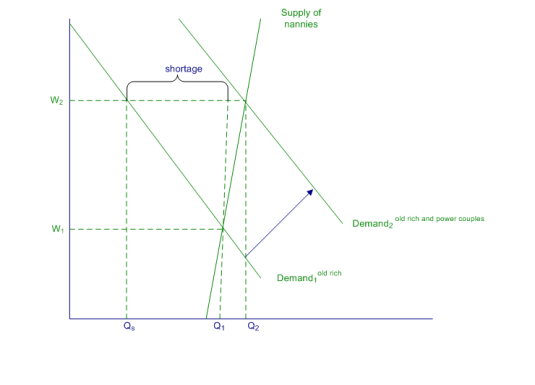

In the diagram above, the initial equilibrium has the old rich hiring Q1 nannies at a wage W1 with demand curve D1, and the supply curve for nannies.

  1. Power couples then enter the nannies market pushing total demand out to D2 with wages increasing to W2 and quantity supplied increasing a little to Q2;
  2. The old rich can now afforded to buy only Qs in nannies and power couples hire (Q2 – Qs) in nannies.

By construction, the quantity of nannies supplied increases slightly in the short-run, with a large increase in wages for nannies! (Q2 – Q1) new nannies enter the market, lured in by the higher wages.

The old rich now face a shortage of nannies equal to the quantity (Q1 – Qs). These nannies having switched to work for power couples on much better pay. (In the case of the original analysis Alchian and Arrow analysis, they switched into defence work or backfilled jobs of those that moved into defence work).

As with the wartime servant shortage, the old rich are unwilling to admit they are no longer able to keep themselves in the style they were accustomed too because the demand for domestic labour has increased.

Better to blame their loss of social status on a skills shortage in a poorly functioning market rather than accept the rise of middle class power couples outbidding them in the hire of domestic help. As Alchian and Arrow (1958, pp. 39-40) explain:

… Many people who formerly consumed some of the commodity or service in question and now find the price so high that they no longer want as much (or any) would describe the situation is one of “shortage”.

Actually, this is merely one way of saying that they can’t get the given commodity at its old price.

We can think of many examples of this use of the word “shortage”. For example, the “servant shortage” during World War II was a case in point.

Those with whom the increase in household servants wages were more than they could afford to pay, apparently found it more convenient to describe their change in circumstances as a result of a “shortage” than to admit baldly that they couldn’t afford to keep the servants…

It seems reasonable to explain a good deal of the current complaint about a shortage of scientists and engineers is a variant of the “servant shortage” phenomena.

Employers who find themselves losing engineers to other firms and at the same time find it uneconomic to try and keep these employees by offering them substantial salary increases may see the situation as a “shortage” rather than recognise that other firms can put these skills to more valuable uses…

While we lack specific evidence, we have the impression that the firms who have complained most consistently about “shortage” have been those whose demand has not increased or at least not increased as rapidly as that of other firms in their industry.

Why are people priced out of any market? Given a fixed income and the many other alternative uses of their incomes, any rise in price makes buying the old quantity no longer the best bargain.

Who will admit that they can no longer keep themselves in the style they were accustomed to when they complain of market failure, skill shortages and lack of government investment in skill formation.

Alfred Marshall’s comparative statics of price adjustment

The analysis of the time path of price adjustment for any commodity was developed by Alfred Marshall in 1890. He was concerned that time was an important factor in how the markets adjusted to demand and supply changes:

… markets vary with regard to the period of time which is allowed to the forces of demand and supply to bring themselves into equilibrium with one another, as well as with regard to the area over which they extend. And this element of Time requires more careful attention just now than does that of Space.

For the nature of the equilibrium itself, and that of the causes by which it is determined, depend on the length of the period over which the market is taken to extend.

We shall find that if the period is short, the supply is limited to the stores which happen to be at hand: if the period is longer, the supply will be influenced, more or less, by the cost of producing the commodity in question; and if the period is very long, this cost will in its turn be influenced, more or less, by the cost of producing the labour and the material things required for producing the commodity.

Marshall divided the price adjustment process into the market period, the short run, and the long run.

In the market period, production is fixed; and all factors of production are fixed in supply during this time period. The burden of price adjustment is on the demand side.

As the supply is fixed in the market period, it is shown as a vertical line SMP. It is also called as inelastic supply curve. When demand increases from DD to D1 D1, price increases from P to P1. Similarly, a fall in demand from DD to D2 D2 pull the price down from P to P2.

In the short run, supply to be partially adaptable, in the sense that increased production can occur but capital equipment and certain other overhead items are held constant.

SSP is elastic implying that supply can be increased by changing a variable input. Note that the corresponding increase in price from P to P1 for a given increase in demand from D to D1 is less than in the market period. It is because the increase in demand is partially met by the increase in supply from q to q1.

The short run is the conceptual time period in which at least one factor of production is fixed in amount and others are variable in amount. In the short run, a profit-maximising firm will:

  • increase production if marginal cost is less than marginal revenue;
  • decrease production if marginal cost is greater than marginal revenue;
  • continue producing if average variable cost is less than price per unit, even if average total cost is greater than price;
  • Shut-down if average variable cost is greater than price at each level of output.

In the long run, supply is fully flexible – there are no fixed factors of production. The Marshallian long-run allows for optimal capital stock adjustment.

The long period supply curve SLP is more elastic and flatter than that of the SSP. This implies the greater extent of flexibility of the firms to change the supply.

The price increases from P to P2 in response to an increase in demand from D to D1 and it is less than that of the market period (P1) and short period (P2). It is because the increase in demand is fully met by the required increase in supply. Hence, supply plays a significant role in determining the lower equilibrium price in the long run.

The market is cleared in the long run within a framework in which supply can be considered to be fully adaptable because all factors have adjusted to the new situation. Alfred Marshall explains:

In long periods on the other hand all investments of capital and effort in providing the material plant and the organization of a business, and in acquiring trade knowledge and specialized ability, have time to be adjusted to the incomes which are expected to be earned by them: and the estimates of those incomes therefore directly govern supply, and are the true long-period normal supply price of the commodities produced.

In addition, in the market period, the short run, and the long run, foresight is not perfect, information is not free, and the cost of adjusting something is not independent of the speed in which you wish to do so.

The 2nd laws of supply and of demand

Another way to discuss how time interacts with responsiveness of supply and demand are the second laws of supply and demand.

The Second Law of Supply states that supply is more responsive to price in the long run. The Second Law of Supply relates to how flexible producers are in terms of how much of a good they produce.

Supply is more elastic in the long run because given more time, producers can more easily adapt to the change in the price.

Within shorter periods of time, producers cannot as easily change the amount of a good they produce (since changes in production often require adjustments within factories, with workers etc.)

The Second Law of Demand states that demand is more responsive to price in the long run than in the short run. Initially, when the price of a good increases or decreases, consumption does not change drastically. However, when consumers are given more time to react to the change in price, consumption can either increase or decrease more dramatically. Demand is not only determined by price but also factors such as: income, tastes, and the price of related goods.

In the market period, any adjustment must be made through changes in price. This means that there could be initially a large price increase.

In the short run, there are some capability for more supply to come forward. This additional supply will temper the initial large price increase.

In the long run, producers are fully able to adapt their circumstances to the changing market conditions and higher prices. This will reduce prices as compared to the initial price spike when market conditions first changed.

In the long run, new firms can enter the industry and old firms can exit as required by the price change and their entrepreneurial expectations of the future of the industry.

Search and matching in a decentralised labour market

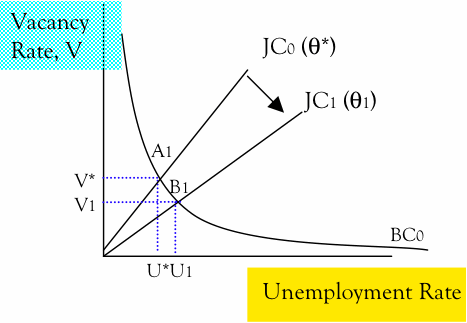
To cover off the bases, the simultaneous existence of vacancies and unemployed in a labour market is no evidence of either of surplus or shortage. It takes time for workers to locate vacancies and assess their competing job options. It takes time for employers to locate suitable workers to fill vacancies.

The simultaneous existence of vacancies and unemployed is the result of, as mentioned earlier, imperfect foresight, the fact that information is not free, nor freely available, and the costs of doing anything is not independent of the speed in which you wish to act. Searching for suitable vacancies, or suitable employees, is costly, and neither jobseeker nor employer knows whether any match will work out.

The one-price (one-wage) market that clears instantly will occur only where the cost of information about the prices (wages) offered by buyers and sellers is zero. As George Stigler observed in the opening paragraph of his famous 1961 paper The Economics of Information:

One should hardly have to tell academicians that information is a valuable resource: knowledge is power. And yet it occupies a slum dwelling in the town of economics.

Mostly it is ignored: the best technology is assumed to be known, the relationship of commodities to consumer preferences is a datum.

And one of the information producing industries, advertising, is treated with a hostility that economists normally reserve for tariffs or monopolists.

Job search cost are of two types: direct costs of gathering information about competing opportunities and the opportunity cost of being unemployed or staying in your current job at your current pay.

  • The benefit from job search is the expected gain in earnings that will result from waiting for a better wage offer.
  • The rational job searcher searches for better offers until the marginal benefit and cost of additional search are equal.
  • A significant cost of continued job search is the earnings foregone by not taking the previous best opportunity.

Unemployment can be a cost-effective method of searching for better employment opportunities and higher wage offers as David Andolfatto observed:

One frequently reads that “unemployment represents wasted resources.”

But if job search is an information-gathering activity, designed to locate a high quality job match, in what sense does such an activity necessarily constitute wasted resources? (Does the existence of single people in the marriage market also represent wasted resources?)

If the unemployment rate were to suddenly plummet because a large number of workers aborted their job search activity–accepting crappy jobs, or exiting the labour force–is this a reason to celebrate?

The behavioural responses of employers and workers to change are so pronounced because the cost of acquiring new information is profound (Alchian 1969). Many such costs impede wages from instantly fluctuating to rebalance labour supply with demand. Hicks (1932) explained this uncertainty and state of flux as follows:

For although the industry as a whole is stationary, some firms in it will be closing down or contracting their sphere of operations, others will be arising or expanding to take their place.

Some firms then will be dismissing, others taking on, labour; and when they are not situated close together, so that knowledge of opportunities is imperfect, and transference is attended by all the difficulties of finding housing accommodation, and the uprooting and transplanting of social ties, it is not surprising that an interval of time elapses between dismissal and re-engagement, during which the workman is unemployed.

A job seeker does not initially know the location of suitable vacancies, the wages for various skills, differences in job security and other factors. Job seekers must search for this information, keep this knowledge current and forecast whether better vacancies may open soon. Employers must search to learn the location, availability and asking wages of applicants. There is a tendency for unpredicted wage changes to induce costly additional job search. Long-term contracts arise to share risks and curb opportunism over sunken investments in relationship-specific human and organisation capital. These factors all lead to queues, unemployment, spare capacity, layoffs, shortages, inventories and non-price rationing in conjunction with wage stability (Alchian 1969; Alchian and Allen 1967, 1973; Klein 1984; Hashimoto and Yu 1980; Hall and Lazear 1979).

By acquiring more information, a job seeker learns more about their options and can improve their prospects of finding better-paid job matches. Job seekers and employers invest time and resources to find one another, size each other up and form a job match or try their luck elsewhere. A job match is a pairing of a worker with a particular employer.

Job seekers will apply for a portfolio of job vacancies that reflect their asking wage and their known alternatives. An asking wage is the minimum that a job seeker is willing to accept given their options.

  • The extent of job search depends on the costs of job-information production and acquisition, the income available to job seekers while searching, the frequency and the magnitude of shifts in the relative demand between different sectors, the costs of relocation and retraining, and the extent and frequency of declines in aggregate demand (Alchian and Allen 1967).
  • The more varied will be the potential job opportunities and the greater will be the gains to job seekers from continued job search, the greater are the rate of change in tastes and demand, the greater are the differences in the skills of job seekers and the requirements of job vacancies, and the greater are the costs of moving (Alchian and Allen 1967).

Employers face an information dilemma as well. If they wait a bit longer, hold a job vacancy open, a better job applicant may come a long and a more profitable and longer lasting job match may result.

Of course, the employer is taking a chance here on the job applicant pool improving with time. There are elements of luck involved for both employers and job seekers when filling vacancies and finding jobs.

The employer must balance the costs of holding the vacancy open with his estimation of the value and probability of a better applicant applying at a later date if he searches further the prospective recruits. But reducing your ignorance has costs as Stigler (1961) explained:

Ignorance is like sub-zero weather: by a significant expenditure its effects upon people can be kept within tolerable or even comfortable bounds, but it would be wholly uneconomical entirely to eliminate all its effects.

The rate at which job vacancies are filled and the rate at which people leave unemployment and change jobs is determined by the job search decisions of job seekers and the recruitment decisions of employers. The way in which the process works is well explained by Andolfatto’s analogy to the marriage market:

In many ways, the labour market resembles a matching market for couples.

That is, one is generally aware that the opposite side of the market consists of better and worse matches (we seldom take the view that there are no potential matches).

The exact location of the better matches is unknown, but may be discovered with some effort.

In the meantime, it may make sense to refrain from matching with ‘substandard’ opportunities that are currently available.

But since search is costly, it will generally not be optimal to wait for ones “soul mate” to come along. Furthermore, since relationships are not perfectly durable, there is no reason to expect the stock of singles to converge to zero over time

As in the labour market, there are marriages and divorces and young people come of age and look for the first time; people also link up for short-term relationships; and some relationships do better than others.

To say there is involuntary unemployment is to say there is also involuntarily unmarried people. But we can always marry the first person we meet in the street, if they’ll have us. Search and matching is a two sided affair. I doubt that our first encounter in the street would accept this offer of marriage from a stranger. I doubt that anyone would want to marry a stranger who would so willingly marry a stranger. I think both sides suspect that such a random pairing would not last long because the pairing occurred after so little mutual scrutiny and measured assessment of alternatives, current and prospective. The same principles apply to search and matching in the labour market.
The Best Minimum Wage Story Of The Day, Or, Yes, Wage Rises Really Do Kill Jobs

via http://www.forbes.com/sites/timworstall/2014/10/28/the-best-minimum-wage-story-of-the-day-or-yes-wage-rises-really-do-kill-jobs/?utm_source=twitterfeed&utm_medium=twitter

Idiosyncratic Whisk: Teen Employment and the Minimum Wage, 60 years of experience

Is there any other issue where the data conforms so strongly to basic economic intuition, and yet is widely written off as a coincidence?

via Idiosyncratic Whisk: Teen Employment and the Minimum Wage, 60 years of experience.

The impact of unemployment insurance eligibility extensions on long-term unemployment rates

Image

Recall and waiting unemployment

Time use surveys in a range of countries show that the unemployed spend maybe a few hours per week looking for a new job. Krueger and Mueller (2008) found that:

…average search time is highest in the U.S.A., at 32.3 minutes per day, closely followed by Canada.

Europeans search much less, but there is considerable variation across countries.

In France the unemployed search around 21 minutes a day compared with 3 minutes in Finland

A small amount of job search per week is rational for many of the unemployed because a major form of job search doesn’t involve any job search any time soon. Instead, they are waiting for a call.

Also, Anglo-Saxon labour market are  much more dynamic with many more vacancies opening every month  as compared with the Eurosclerosis dual labour markets. In the European Union’s dual labour markets, it is not rational to search for vacancies that will never be there.

Job searches is an entrepreneurial venture that can involve a considerable amount of biding your time. Job seekers must choose between wider job search that may involve switching to a new industry or new occupation and investing in availability for suitable vacancies in their local labour markets or a recall to employment by old employers.

A spell of unemployment followed by a rehire by an old employer is known as recall unemployment or a temporary layoff.

Demand is less stable and more seasonal in industries such as construction, manufacturing and agriculture. When demand rebounds, recalling an old employee is a faster and cheaper hiring process than screening unfamiliar applicants of uncertain quality and training recruits.

Recall is not certain. Temporary layoffs will forecast their chances of recall and review these forecasts as they discover more about the length of drop in local labour demand and the general state of the rest of the labour market.  the majority of unemployed who  regard themselves as temporary layoffs are indeed recalled  to their old job by their old employer after most downturns.

Better prospects of recall by old employers will reduce the intensity of job searches of temporary layoffs and increase their asking wages for other jobs. Workers with considerable industry and firm-specific human capital are likely to risk waiting longer for recall. Workers will search more intensively for other jobs as their forecasts of their chances of recall to old jobs become less encouraging.

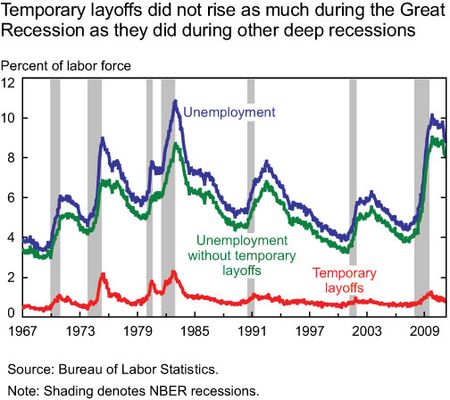
There are more temporary layoffs in milder recessions because the lull in demand is expected to be short and there are fewer business closures. The higher levels of recall unemployment will reduce downward pressure on asking wages and slow the filling of vacancies because many well qualified job applicants are waiting for recall to their old jobs rather than applying more widely for new jobs.

Dixon and Crichton (2006) found that 58% of New Zealand benefit-to-work transitions involved starting with a new employer, 30% continued with an employer for whom they worked part-time in the benefit spell and 12% returned to an employer they had worked for in the past 2 years. The prospect of a recall by an old employer has been important for unemployed workers in countries such as the US, Canada, Demark, Sweden, Austria and Norway.

In the context of work-for-the-dole schemes and activation programmes that involve intensive monitoring of job search by the unemployed on unemployment benefits, requiring  workers who are temporarily laid off to search for jobs is in many ways counter-productive.

Developing a screening mechanism to find these temporary layoffs and distinguishing them from permanent layoffs would be quite challenging. Countries which have unemployment insurance premiums spend a lot of try trying to adjust those premiums for temporary layoffs. This is so employers and employees do not take advantage of unemployment insurance to have a week or two off work in slack periods at the expense of the unemployment insurance system and top up their wages in the interim.

A cousin of recall unemployment is  rest unemployment or waiting unemployment – job seekers who are waiting for conditions in a depressed sector to improve (Hamilton 1988; Alvarez and Shimer 2008).

Some job seekers may wait for local labour market conditions to improve, rather than search for jobs in other industries and new occupations. A job seeker’s old industry may offer better wage and job finding prospects than other industries If the  newly unemployed worker waits a while. 

Rest unemployment or waiting unemployment strives to salvage as much of the occupation and industry-specific human capital  of the  newly unemployed worker as possible.

A significant share of job seekers have been found to be waiting for local labour market conditions to improve rather than searching further afield  in different industries or new occupations (Alvarez and Shimer 2008).

Again, rest unemployment or waiting unemployment is a type of job search that cannot be well handled by work-for-the-dole schemes and intensive monitoring of the job search of unemployed workers.

How flexible is the New Zealand labour market

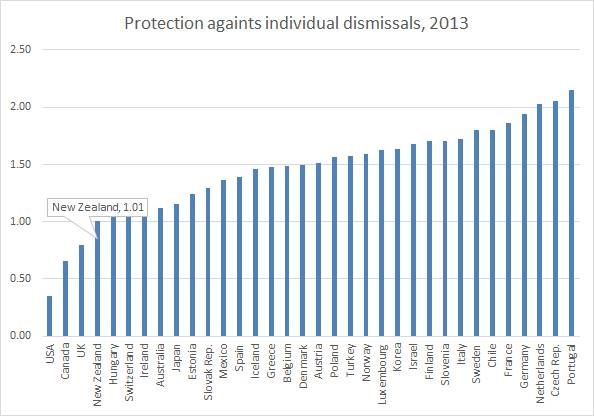
The first chart below shows that NZ is the 4th most deregulated labour market for individual dismissals.

clip_image002

Source: OECD employment protection index

The next figure below shows that NZ is top of the world for deregulation of lay-offs and redundancies.

clip_image002[7]

Source: OECD employment protection index

The chart below shows that New Zealand is far more flexible than in Western Europe and is pretty near the USA in terms of people moving in and out of the unemployment pool every month with great ease.

image

Source: Elsby, Hobijn  and Şahin (2013).

There are very high outflow rates from unemployment among the Anglo-Saxon and Nordic economies. The economies of Continental Europe stand in stark contrast. Unemployment outflow rates in these economies lie below 10% at a monthly frequency.

A major labour market reform in recent years in New Zealand was introduction of the option of a 90 day trial for new employees, initially in small businesses and then in all businesses.

The UK recently extended its trial period from one-year to two-years. Trial periods are common in OECD member countries.

There is plenty of evidence to back-up the notion that increased job security leads to less employee effort and more absenteeism. Some examples are:

· Sick leave spiking straight after probation periods ended;

· Teacher absenteeism increasing after getting tenure after 5-years; and

· Academic productivity declining after winning tenure.

The MBIE research into the actual operation of 90-day trials was highly favourable in terms of increased employment, the hiring of riskier applicants and lower costs of ending bad job matches (about 15-20% of trials did not work out). These outcomes are the usual importance of a test drive argument for employment trial periods.

Interestingly, the MBIE research also found that some employers hired new employees on 90-day trials for positions about which these employers were uncertain might be profitable. But for the option of the trial period, these jobs never would have existed.

This suggests that in some firms, 90-day trials are a decisively cheaper alternative to hiring an employee and perhaps making them redundant later if the new position does not pay for itself. No one’s fault: the market just did not sustain the expansion in staff as expected.

The MBIE research shows that winners from 90-day trials are new labour force entrants, the unemployed and beneficiaries, migrants and labour force re-entrants such as mothers.

I kept note of an interesting press report adding to this where Hospitality New Zealand Wellington president Jeremy Smith said he had hired dozens of staff he would not otherwise have considered. Because of the transient nature of the hospitality industry, it was often difficult to check references so a trial period “levelled the playing field”.

Will work-for-the-dole work in Australia?

One of the strongest empirical findings of modern labour economics is the benefit exhaustion spike. This is the large increase, shown in the diagram, in the probability of finding a job on the eve of exhausting unemployment benefits or unemployment insurance eligibility.

This benefit exhaustion spike is mobile: when unemployment  insurance eligibility is lengthened, the benefit exhaustion spike moves out to the new benefit exhaustion date. For example, from 26 weeks, then to 39 weeks, then 52 weeks and then to 99 weeks. There is also a benefit exhaustion spike where the generosity of unemployment or other insurance decreases after a certain time. The alleged decay in the human capital of the  long-term unemployed does not seem to affect this benefit exhaustion spike.

In addition, in the EU,  the job finding probability of unemployment insurance recipients eligible for other welfare schemes are less sensitive to changes in the level and duration of their unemployment benefits benefits.

The benefit exhaustion spike shows that job seekers have much more control over their re-employment prospects than is commonly granted even in the worst of economic conditions such as in Pittsburgh in the early 1980s in a major recession  and when US manufacturing industry industry was in  a  long-term decline.

The individual’s reservation wage (i.e. the  lowest wage wage at which individuals  will accept a job offer) decreases whilst search intensity increases as they approach unemployment benefit eligibility  exhaustion.

This reduction in reservation wages or the asking wages of job seekers increases the incentives for employers to post new vacancies because they can fill them at a lower cost. Both more intensive job search and more vacancies will see jobs filled faster, and more jobs created and filled.

A mechanism for reducing welfare programme entry rate while increasing welfare benefit exits is mandatory  minimum job search and mandatory work requirements such as those proposed this week for Australia. These minimum hours can be spent working part time, in study and training, work preparation and job search assistance or volunteering. A work requirement is a screening device that removes any advantage of moving on to welfare in terms of more leisure time.

The proposals announced this week in Australia are most job seekers will be required to look for up to 40 jobs per month and work for the dole will be mandatory for all jobseekers younger than 50. Job seekers younger than 30 would have to work 25 hours a week under the expanded programme, while those between 30 and 49 will be asked to do 15 hours work a week, and those aged 50-60, 15 hours a week.

At least 13 OECD member countries require at least monthly visits to a local employment office by unemployment beneficiaries to present job-search evidence and also perhaps to receive advice and even referrals to specific job openings.

Reforms in a range of overseas countries that introduced more intensive monitoring of job search and stronger sanctions on benefits for non-compliance significantly reduced unemployment spells.

One of the surprising results of more intensive monitoring of job search and a requirement to sign on regularly at the local employment office or Social Security office is the sheer horror of having to sign-on and talk to caseworker for five minutes encourages  5 to 10% of unemployed beneficiaries to find a job. When unemployment and sickness beneficiaries are required to undergo a full reassessment of their eligibility, it is common for up to 30% of them simply to not reapply.

The stronger monitoring of job search and the real prospect of stiffer sanctions for non-compliance encourages all benefit claimants, current and future, and not just those actually sanctioned to search harder for jobs. This anticipation of stricter monitoring and more frequent eligibility reviews has a much larger effect of welfare dependency than the actual sanctioning of the non-complaint. People review their options and marshalled their resources to find or stay in work.

The welfare exit effect and welfare entry deterrence arises from mandatory work requirements from the relative non-financial rewards of working and not working having changed in favour of staying in full-time and semi-work for persistent workers temporarily on a welfare benefit.

Persistent workers gain from anticipating the onerous nature of work requirements and searching more intensively for jobs which are more stable and enduring. These job seekers may reduce their asking wage to win a lower paid but steadier job.

Seasonal and temporary jobs will be less attractive if there are work requirements. The incentive to cycle between the benefit and part-time and full-time work including seasonal and temporary jobs are reduce because work requirements make welfare receipt more onerous. Those job seekers with fewer outside of the workforce obligations such as young children are the most likely to move to (stable) full-time work because of work requirements.

A work requirement  as a condition for a welfare benefit  receive unambiguously increases net labour supply and reduces the number of people relying on the welfare system now and into the future.

The number of people working increase and some leave welfare rather than comply with the mandatory work programmes. Work requirements make welfare receipt unambiguously less attractive and will close the gap between earning full-time wages and the net rewards of not working or part-time work and partial benefit receipt.

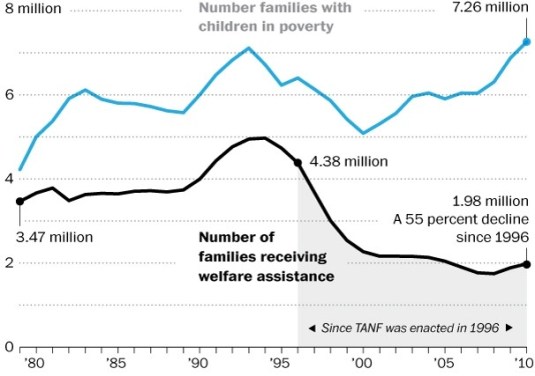
There was a more than 60% reduction in welfare caseloads after the 1996 federal welfare reform in the USA that introduced work requirement and  five year lifetime federal welfare eligibility time limits on a national basis. In the four decades preceding the 1996 welfare reform, the number of Americans on welfare had never significantly decreased.

The gains in U.S. employment after the 1996  Federal welfare reform were largest among the single mothers previously thought to be most disadvantaged: young (ages 18-29), mothers with children aged under seven, high school drop-outs, and black and Hispanic mothers. These low-skilled single mothers in the USA were thought to face the greatest barriers to employment.

The U.S. literature has many competing estimates of the relative effects of work requirements, lifetime time limits and a far more generous earned income tax credit  (EITC). It is agreed that work requirements and time limits reduced entry into welfare caseloads. The relative importance of time limits, work mandates and greater EITC generosity for exits is more disputed.

The Minnesota Family Investment Program (MFIP) had a more complex experimental design that allowed separate evaluation of the mandatory welfare-to-work program and the lower benefit reduction rate. The results indicated that the lower benefit abatement rates appear to have had little labour supply effect. The increase in labour supply seems to have come almost entirely from the mandatory welfare-to-work program and its associated sanctions.

Much was  initially made in the US empirical literature of the strong state of the American economy in the 1990s as an explanation for  part of the drop in welfare caseloads. The relevance of this faded when welfare caseloads did not increase again when the economy deteriorated after 2007 in the USA.

Is unemployment voluntary or involuntary?

Robert Lucas in a famous 1978 paper argued that all unemployment was voluntary because involuntary unemployment was a meaningless concept. He said as follows:

The worker who loses a good job in prosperous time does not volunteer to be in this situation: he has suffered a capital loss. Similarly, the firm which loses an experienced employee in depressed times suffers an undesirable capital loss.

Nevertheless the unemployed worker at any time can always find some job at once, and a firm can always fill a vacancy instantaneously. That neither typically does so by choice is not difficult to understand given the quality of the jobs and the employees which are easiest to find.

Thus there is an involuntary element in all unemployment, in the sense that no one chooses bad luck over good; there is also a voluntary element in all unemployment, in the sense that however miserable one’s current work options, one can always choose to accept them.

I agree that we all make choices subject to constraints. To say that a choice is involuntary because it is constrained by a scarcity of job-opportunities information is to say that choices are involuntary because there is scarcity.

Alchian said there are always plenty of jobs because to suppose the contrary suggests that scarcity has been abolished. Lucas elaborated further in 1987 in Models of Business Cycles:

A theory that does deal successfully with unemployment needs to address two quite distinct problems.

One is the fact that job separations tend to take the form of unilateral decisions – a worker quits, or is laid off or fired – in which negotiations over wage rates play no explicit role.

The second is that workers who lose jobs, for whatever reason, typically pass through a period of unemployment instead of taking temporary work on the ‘spot’ labour market jobs that are readily available in any economy.

Of these, the second seems to me much the more important: it does not ‘explain’ why someone is unemployed to explain why he does not have a job with company X. After all, most employed people do not have jobs with company X either.

To explain why people allocate time to a particular activity – like unemployment – we need to know why they prefer it to all other available activities: to say that I am allergic to strawberries does not ‘explain’ why I drink coffee. Neither of these puzzles is easy to understand within a Walrasian framework, and it would be good to understand both of them better, but I suggest we begin by focusing on the second of the two.

Another way to understand unemployment is to use a device at the start of Alan Manning’s book on labour market monopsony:

What happens if an employer cuts the wage it pays its workers by one cent? Much of labour economics is built on the assumption that all existing workers immediately leave the firm as that is the implication of the assumption of perfect competition in the labour market.

In such a situation an employer faces a market wage for each type of labour determined by forces beyond its control at which any number of these workers can be hired but any attempt to pay a lower wage will result in the complete inability to hire any of them at all

Suppose workers offered to work for 1 cent. Would employers accept? Many do because they have intern and work experience programmes for students, but is this result of general application?

Understanding the reallocation of labour at the end of the recession requires careful attention to the 1980s writing of Alchian on the theory of the firm. Alchian and Woodward’s 1987 ‘Reflections on a theory of the firm’ says:

… the notion of a quickly equilibrating market price is baffling save in a very few markets. Imagine an employer and an employee. Will they renegotiate price every hour, or with every perceived change in circumstances?

If the employee is a waiter in a restaurant, would the waiter’s wage be renegotiated with every new customer? Would it be renegotiated to zero when no customers are present, and then back to a high level that would extract the entire customer value when a queue appears?

… But what is the right interval for renegotiation or change in price? The usual answer ‘as soon as demand or supply changes’ is uninformative.

Alchian and Woodward then go on to a long discussion of the role of protecting composite quasi-rents from dependent resources as the decider of the timing of wage and price revisions.

Alchian and Woodward explain unemployment as a side-effect of the purpose of wage and price rigidity, which is the prevention of hold-ups over dependent assets. They note that unemployment cannot be understood until an adequate theory of the firm explains the type of contracts the members of a firm make with one another.

My interpretation is the majority of employment relationships are capital intensive long-term contracts. Employers spend a lot of time searching and screening applicants to find those that will stay longer. In less skilled jobs, and in spot market jobs, employers will hire the best applicant quickly because job turnover costs are low. Back to Manning again:

That important frictions exist in the labour market seems undeniable: people go to the pub to celebrate when they get a job rather than greeting the news with the shrug of the shoulders that we might expect if labour markets were frictionless. And people go to the pub to drown their sorrows when they lose their job rather than picking up another one straight away. The importance of frictions has been recognized since at least the work of Stigler (1961, 1962).

Whatever may be among these frictions, wage rigidity is not one of them. Wages are flexible for job stayers and certainly new starters.

See What can wages and employment tell us about the UK’s productivity puzzle? by Richard Blundell, Claire Crawford and Wenchao Jin showing that in the recent UK recession 12% of employees in the same job as 12 months ago experienced wage freezes and 21% of workers in the same job as 12 months ago experienced wage cuts. Their data covered 80% of workers in the New Earnings Survey Panel Dataset.

Larger firms lay off workers; smaller firms tended to reduce wages. This British data showing widespread wage cuts dates back to the 1980s. Recent Irish data also shows extensive wage cuts among job stayers.

See too Chris Pissarides (2009), The Unemployment Volatility Puzzle: Is Wage Stickiness the Answer? arguing the wage stickiness is not the answer since wages in new job matches are highly flexible:

  1. wages of job changers are always substantially more procyclical than the wages of job stayers.
  2. the wages of job stayers, and even of those who remain in the same job with the same employer are still mildly procyclical.
  3. there is more procyclicality in the wages of stayers in Europe than in the United States.
  4. The procyclicality of job stayers’ wages is sometimes due to bonuses, and overtime pay but it still reflects a rise in the hourly cost of labour to the firm in cyclical peaks

How do existing firms who will not cut wages survive in competition with new firms who can start workers on lower wages? Industries with many short term jobs and seasonal jobs would suffer less from wage inflexibility.

Robert Barro (1977) pointed out that wage rigidity matters little because workers can, for example, agree in advance that they will work harder when there is more work to do—that is, when the demand for a firm’s product is high—and work less hard when there is little work. Stickiness of nominal wage rates does not necessarily cause errors in the determination of labour and production.

The ability to make long-term wage contracts and include clauses that guard against opportunistic wage cuts should make the parties better off. Workers will not sign these contracts if they are against their interests. Employers do not offer these contracts, and offer more flexible wage packages, will undercut employers who are more rigid. Furthermore many workers are on performance pay that link there must wages to the profitability of the company.

How can downward wage rigidity be a scientific hypothesis if extensive international evidence of widespread wage cuts since the 1980s and 30%+ of the workforce on performance bonuses is not enough to refute it?

Alchian and Kessel in “The Meaning and Validity of the Inflation-Induced Lag of Wages Behind Prices,” Amer. Econ. Rev. 50 [March 1960]:43-66) tested the hypothesis that workers suffered from money illusion by comparing the rates of return to firms in capital intensive industries with those of labour intensive industries. Labour intensive industries were not more profitable than capital intensive industries. Employers in labour intensive industries should profit from the misperceptions of workers about wages and future prices, but they did not.  Alchian and Kessel found little evidence of a lag between wage and price changes.

In Canadian industries in the 1960s and 1970s, wage indexation ranged from zero to nearly 100%. Industries with little indexation should show substantial responses of real wage rates, employment and output to nominal shocks. Industries with lots of indexation would be affected little by nominal disturbances. Monetary shocks had positive effects but an industry’s response to these shocks bore no relation to the amount of indexation in the industry. Shaghil Ahmed (1987) found that those industries with lots of indexation were as likely as those with little indexation to respond to shocks.

If the signing of new wage contracts was important to wage rigidity, there should be unusual behaviour of employment and real wage rates just after these signings, but the results are mixed. Olivei and Tenreyro (2010) used the tendency of contracts to be signed at the start of years to show that monetary policy had significant effects in January but little effect in December because the effects were quickly undone.

Alchian (1969) lists three ways to adjust to unanticipated demand fluctuations:
• output adjustments;
• wage and price adjustments; and
• Inventories and queues (including reservations).

Alchian (1969) suggests that there is no reason for wage and price changes to be used regardless of the relative cost of these other options:
• The cost of output adjustment stems from the fact that marginal costs rise with output;
• The cost of price adjustment arises because uncertain prices and wages induce costly search by buyers and sellers seeking the best offer; and
• The third method of adjustment has holding and queuing costs.

There is a tendency for unpredicted price and wage changes to induce costly additional search. Long-term contracts including implicit contracts arise to share risks and curb opportunism over relationship-specific capital. These factors lead to queues, unemployment, spare capacity, layoffs, shortages, inventories and non-price rationing in conjunction with wage stability.

Next Newer Entries

Bassett, Brash & Hide

Celebrating humanity's flourishing through the spread of capitalism and the rule of law

Truth on the Market

Scholarly commentary on law, economics, and more

The Undercover Historian

Beatrice Cherrier's blog

Matua Kahurangi

Celebrating humanity's flourishing through the spread of capitalism and the rule of law

Temple of Sociology

Celebrating humanity's flourishing through the spread of capitalism and the rule of law

Velvet Glove, Iron Fist

Celebrating humanity's flourishing through the spread of capitalism and the rule of law

Why Evolution Is True

Why Evolution is True is a blog written by Jerry Coyne, centered on evolution and biology but also dealing with diverse topics like politics, culture, and cats.

Down to Earth Kiwi

Celebrating humanity's flourishing through the spread of capitalism and the rule of law

NoTricksZone

Celebrating humanity's flourishing through the spread of capitalism and the rule of law

Homepaddock

A rural perspective with a blue tint by Ele Ludemann

Kiwiblog

DPF's Kiwiblog - Fomenting Happy Mischief since 2003

The Dangerous Economist

Celebrating humanity's flourishing through the spread of capitalism and the rule of law

Watts Up With That?

The world's most viewed site on global warming and climate change

The Logical Place

Tim Harding's writings on rationality, informal logic and skepticism

Doc's Books

A window into Doc Freiberger's library

The Risk-Monger

Let's examine hard decisions!

Uneasy Money

Commentary on monetary policy in the spirit of R. G. Hawtrey

Barrie Saunders

Thoughts on public policy and the media

Liberty Scott

Celebrating humanity's flourishing through the spread of capitalism and the rule of law

Point of Order

Politics and the economy

James Bowden's Blog

A blog (primarily) on Canadian and Commonwealth political history and institutions

Science Matters

Reading between the lines, and underneath the hype.

Peter Winsley

Economics, and such stuff as dreams are made on

A Venerable Puzzle

"The British constitution has always been puzzling, and always will be." --Queen Elizabeth II

The Antiplanner

Celebrating humanity's flourishing through the spread of capitalism and the rule of law

Bet On It

Celebrating humanity's flourishing through the spread of capitalism and the rule of law

History of Sorts

WORLD WAR II, MUSIC, HISTORY, HOLOCAUST

Roger Pielke Jr.

Undisciplined scholar, recovering academic

Offsetting Behaviour

Celebrating humanity's flourishing through the spread of capitalism and the rule of law

JONATHAN TURLEY

Res ipsa loquitur - The thing itself speaks

Conversable Economist

Celebrating humanity's flourishing through the spread of capitalism and the rule of law

The Victorian Commons

Researching the House of Commons, 1832-1868

The History of Parliament

Articles and research from the History of Parliament Trust

Books & Boots

Reflections on books and art

Legal History Miscellany

Posts on the History of Law, Crime, and Justice

Sex, Drugs and Economics

Celebrating humanity's flourishing through the spread of capitalism and the rule of law

European Royal History

Exploring the Monarchs of Europe

Tallbloke's Talkshop

Cutting edge science you can dice with

Marginal REVOLUTION

Small Steps Toward A Much Better World

NOT A LOT OF PEOPLE KNOW THAT

“We do not believe any group of men adequate enough or wise enough to operate without scrutiny or without criticism. We know that the only way to avoid error is to detect it, that the only way to detect it is to be free to inquire. We know that in secrecy error undetected will flourish and subvert”. - J Robert Oppenheimer.

STOP THESE THINGS

The truth about the great wind power fraud - we're not here to debate the wind industry, we're here to destroy it.

Lindsay Mitchell

Celebrating humanity's flourishing through the spread of capitalism and the rule of law

Alt-M

Celebrating humanity's flourishing through the spread of capitalism and the rule of law

croaking cassandra

Economics, public policy, monetary policy, financial regulation, with a New Zealand perspective

The Grumpy Economist

Celebrating humanity's flourishing through the spread of capitalism and the rule of law

International Liberty

Restraining Government in America and Around the World