David Friedman on Hayek and Rothbard
27 Dec 2017 Leave a comment
in Adam Smith, Austrian economics, David Friedman, economic history, history of economic thought, law and economics Tags: economics of anarchy
David Friedman: Neglected Arguments in the Debate around Climate Change
21 Dec 2017 Leave a comment
in applied welfare economics, David Friedman, environmental economics, global warming Tags: climate alarmism
Lawrence of Arabia on the economics of Albanian blood feuds
26 Oct 2016 Leave a comment
in constitutional political economy, David Friedman, economics of crime, law and economics Tags: economics of feuds
About 3000 Albanian families are caught up in blood feuds; the adult males hunt each other down; the reasons are long forgotten.
These blood feuds are common in rural Albania, which is rather lawless. Efforts to resolve them are largely futile because each family wants to be the last to get revenge.
Observers, of course, look upon these feuds with horror. For those involved, they are the down side of a Doomsday machine that keeps order in rural lawless areas.
Proper film buffs will remember the great scene in Lawrence of Arabia where Anthony Quinn and his son rode into the camp of a rival tribe on their own to demand payment for the water they were using.
Lawrence asked why did they go in because they could be so easily killed. Anthony Quinn said he was in no danger because if he was killed there would be a blood feud between his clan and the offending clan. This kept order. The linked clip is just fascinating rather than the actual clip.
Of course, film buffs also remember that a blood feud almost destroyed the entire Arab revolt. Lawrence resolved it by executing the murder so that he neither died at the hand of the rival clan but the rival clan felt vengeance had been satisfied.
David Friedman wrote on how feuds are common in many legal systems in their early days:
Feud is one of the mechanisms by which legal rules are enforced. Its essential logic is simple: If you wrong me, I threaten to harm you unless you compensate me for the wrong. The critical requirement for it to work is some mechanism that makes my threat more believable when you actually have wronged me than when you have not, some way of converting right into might, in order to prevent the enforcement mechanism from being used instead for extortion.
For a simple example, consider the feud system of the Rominchal gypsies, the largest gypsy population in England. If you wrong me, I threaten to beat you up. Both of us know that if you have wronged me, as judged by the norms of our community, my friends will back me and your friends won’t back you, making it in your interest to either compensate me or leave town.
Feud system have existed in many human societies. In addition to the Rominchal, well recorded examples include saga period Iceland and traditional Somali. In the Icelandic case, the mechanism for converting right into might was an explicit law code and a court system. You sued the person who wronged you. If you won, the verdict was a damage payment he owed you. If he failed to pay, he was outlawed and had two weeks to leave Iceland, after which it was legal to kill him and tortious for anyone to defend him. That system functioned for about a third of a millennium, producing substantial amounts of violence only in the final fifty year period of breakdown.
The Somali version was somewhere between the Icelandic and the Rominchal, with customary law and customary mechanisms for setting up courts to arbitrate disputes, along with a fascinating system of prefabricated coalitions to deal with both paying damages and enforcing their members’ claims.
Feuds work well as a deterrent mechanism, but if someone triggers a feud, there is a lot of mayhem. That is why third-party arbitration comes into play to prevent abuse and escalation.
I am not too sure how feuds work well if someone is murdered without a witness or is poisoned or in some other way surreptitiously done away with.
David Friedman on “Future Imperfect”
02 Sep 2016 Leave a comment
in applied welfare economics, comparative institutional analysis, David Friedman, economics, law and economics
David Friedman on “Future Imperfect”
15 Jul 2016 Leave a comment
in applied price theory, David Friedman, law and economics
@jacindaardern @NZLabour’s Healthy Homes Bill will raise rents to poor tenants and students
05 May 2016 1 Comment
in David Friedman, economics of regulation, law and economics, politics - New Zealand Tags: avoiding difficult decisions, housing habitability laws, living standards, New Zealand Labour Party, offsetting, rent control, The fatal conceit, The pretense to knowledge, unintended consequences
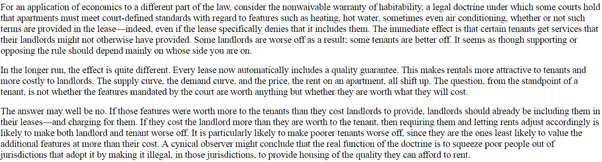
Source: David Friedman, Chapter 1: What Does Economics Have to Do with Law?
David Friedman explains incentive incompatibility and comparative institutional analysis
18 Jan 2016 Leave a comment
in applied price theory, comparative institutional analysis, constitutional political economy, David Friedman, industrial organisation, law and economics, property rights Tags: incentive incompatibility, public goods

Why do @NZGreens want NZ to lead the world by example on a carbon tax, but not unilateral free trade?
31 Jul 2015 Leave a comment
in David Friedman, environmental economics, global warming, international economics, Milton Friedman, Murray Rothbard, politics - New Zealand Tags: antiforeign bias, antimarket bias, carbon tax, carbon trading, climate treaties, expressive voting, free trade, global warming, left-wing double standards, Left-wing hypocrisy, New Zealand Greens, protectionism, rational ignorance, rational irrationality, unilateral free trade


NZ’s greenhouse gas emissions are high per person and unit of GDP but have fallen since 1990 oe.cd/10z http://t.co/f5BMLMvTjq—
OECD Publications (@OECD_Pubs) June 10, 2015
David Friedman on global warming, population and problems with the externality argument
02 Mar 2015 Leave a comment
in applied price theory, applied welfare economics, comparative institutional analysis, constitutional political economy, David Friedman, economic history, economics of information, economics of regulation, environmental economics, environmentalism, global warming, law and economics, population economics, property rights Tags: climate alarmism, competition as a discovery procedure, David Friedman, externalities, global warming, population bomb, The fatal conceit, The pretence to knowledge


David Friedman on the costs and benefits of prevention and adaptation to global warming
20 Nov 2014 Leave a comment
.@cgiarclimate Debate on climate change always neglect crucial role of CO2 in agriculture @ifadnews @careemergencies http://t.co/Y3Du5YnF56—
Golden Rice Now (@paulevans18) July 17, 2015


 Utopia, you are standing in it!
Recent Comments