Figure 1: registering property rankings, USA, UK, Germany and France – World Bank Doing Business rankings, 2014
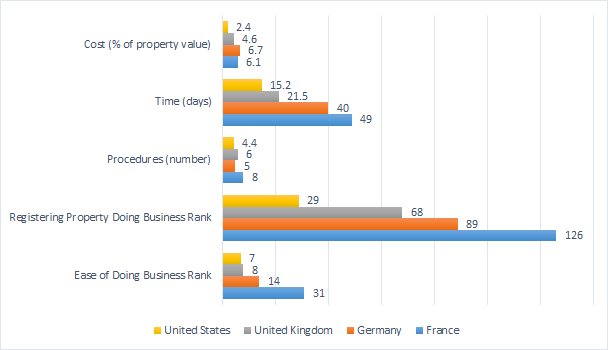
Source: Doing Business – Measuring Business Regulations – World Bank Group.
Celebrating humanity's flourishing through the spread of capitalism and the rule of law
13 Jul 2015 Leave a comment
in applied price theory, applied welfare economics, economics of religion, law and economics, politics - USA, property rights Tags: British economy, doing business, France, Germany
Figure 1: registering property rankings, USA, UK, Germany and France – World Bank Doing Business rankings, 2014
Source: Doing Business – Measuring Business Regulations – World Bank Group.
12 Jul 2015 Leave a comment
in discrimination, economics of love and marriage, gender, labour economics, labour supply, law and economics, occupational choice, politics - USA, poverty and inequality Tags: asymmetric marriage premium, British economy, Canada, gender wage gap, marriage and divorce, motherhood penalty
Figure 1: Female/male earnings ratio by partner status and motherhood, 2004 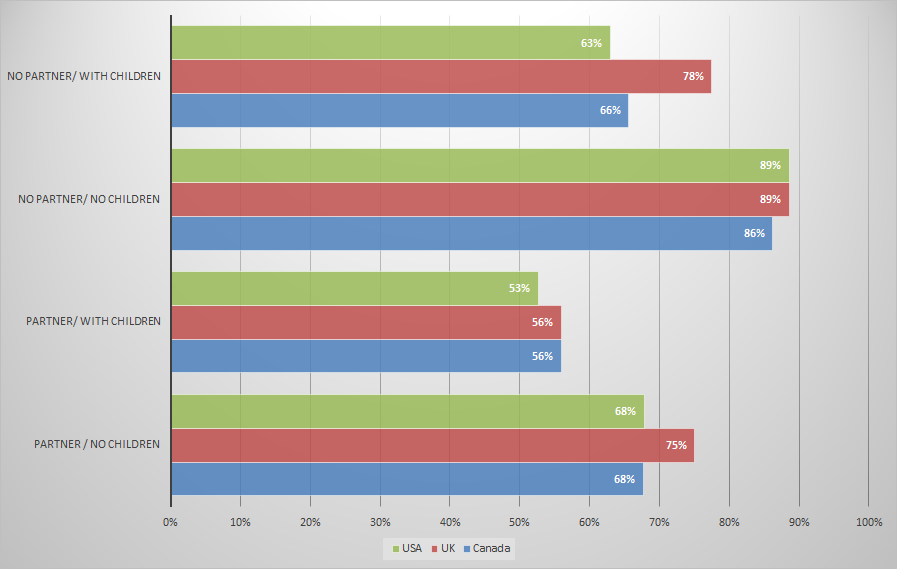 Source: LIS Cross-National Data Center in Luxembourg – Wave VI; individuals with positive earnings only. .
11 Jul 2015 Leave a comment
in constitutional political economy, international economics, law and economics, politics - New Zealand, property rights, Public Choice, rentseeking Tags: antiforeign bias, antimarket bias, left-wing populists, New Zealand First, New Zealand Labour Party, political opportunism, racism, rational ignorance, rational irrationality, right-wing populists, traditional labour voter, working class Tory
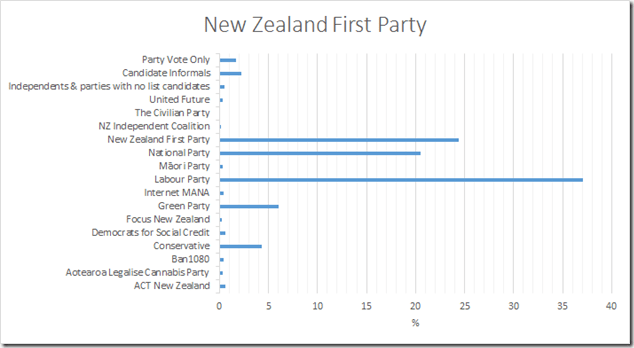
Figure 1: who won the electorate vote of New Zealand First party voters, 2014 New Zealand election
Source: Electoral Commission.
New Zealand First vote splitting data in Figure 1 suggests many more Labour voters vote New Zealand First than for the National Party with their electorate votes.
1/3rd of voters who gave their party vote to New Zealand First voted Labour with their electorate vote. This compares to one in five New Zealand First voters who gave their electorate vote to the National Party.
The Labour Party can win back some traditional Labour voters by borrowing populist policies from New Zealand First and its ageing leader such as prohibiting foreigners from buying New Zealand land.
Who mentioned Shane Jones?
In politics we don't pull our punches, unless you've got one of the world's best in town! http://t.co/Xiz2l36btg—
Winston Peters (@winstonpeters) August 08, 2013
11 Jul 2015 Leave a comment
in currency unions, economic history, Euro crisis, international economics, law and economics, macroeconomics Tags: Argentina, Greece, Russia, sovereign defaults

via Defaulting Debtors.
11 Jul 2015 Leave a comment
in applied price theory, applied welfare economics, comparative institutional analysis, economics of regulation, industrial organisation, law and economics, politics - USA, property rights Tags: British economy Doing Business, France, Germany, World Bank
Figure 1: Starting a business rankings, USA, UK, Germany and France – World Bank Doing Business rankings, 2014
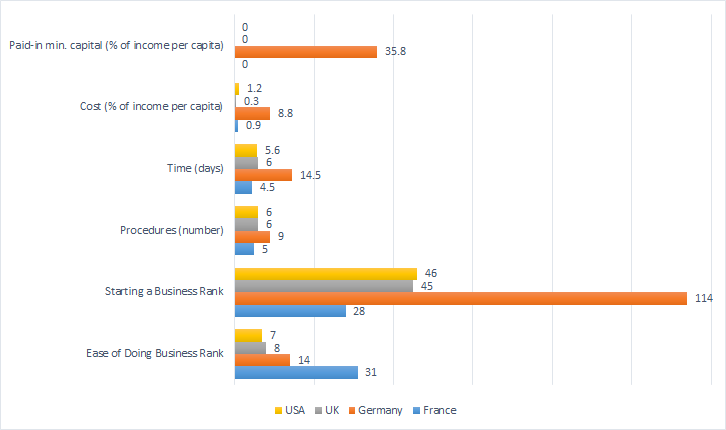
Source: Doing Business – Measuring Business Regulations – World Bank Group.
I have no idea why you have to pledge one third of German per capita income to start a business in Germany. It takes about a week and a half a dozen procedures to start a business in the other countries.
In New Zealand, you can start a business within the hour by registering for GST and registering your company online.
11 Jul 2015 Leave a comment
in economics of love and marriage, labour economics, labour supply, law and economics, politics - Australia, politics - USA, poverty and inequality, welfare reform Tags: Australia, British economy, Canada, child poverty, family poverty, marriage and divorce, single mothers, single parents
Figure 1: poverty rates by age of youngest child, 2004

11 Jul 2015 Leave a comment
in economics of crime, economics of education, managerial economics, occupational choice, organisational economics, personnel economics Tags: academic fraud, promotion tournaments, rate races
10 Jul 2015 Leave a comment
in business cycles, currency unions, economic history, economics of regulation, Euro crisis, financial economics, global financial crisis (GFC), law and economics, macroeconomics, monetary economics, property rights Tags: bank runs, banking crises, banking panic, financial crises, Greece, sovereign default
Financial crises surprisingly common, but few countries close their banks pewrsr.ch/1NQyz2P #Greece http://t.co/pK0sfB49Ka—
PewResearch FactTank (@FactTank) July 09, 2015
10 Jul 2015 Leave a comment
in applied welfare economics, economics of bureaucracy, economics of regulation, law and economics, politics - USA, property rights, Public Choice Tags: Canada, doing business, rule of law, World Bank
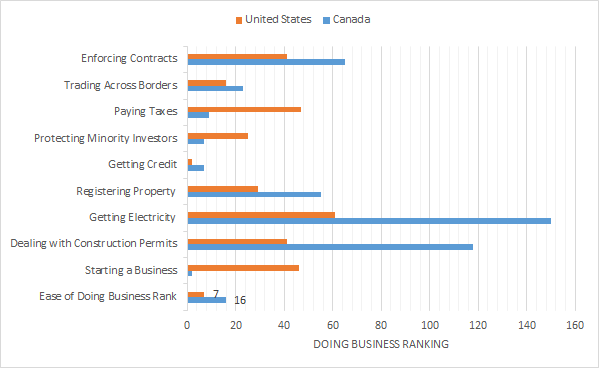
Figure 1: Doing Business in the USA, Canada, World Bank rankings, 2014
Source: Doing Business – Measuring Business Regulations – World Bank Group.
It’s easier to do business in the USA and Canada because of the difficulties with construction permits and getting electricity and few more problems with enforcing contracts and registering property. It is easy to open a business in Canada.
10 Jul 2015 Leave a comment
in economics of love and marriage, gender, labour economics, labour supply, occupational choice Tags: economics of family, female labour force participation, labour force participation, maternal labour force participation, my labour force participation, part-time work
American exceptionalism: U.S parents more likely to both be working full time than almost any other OECD country http://t.co/QYBEeUmws4—
Kay Hymowitz (@KayHymowitz) July 08, 2014
10 Jul 2015 1 Comment
in applied welfare economics, economics of regulation, industrial organisation, labour economics, law and economics, politics - New Zealand, poverty and inequality, property rights, survivor principle, urban economics Tags: consumer products standards, do gooders, economics of regulation, nanny state, offsetting behaviour, rent control, The fatal conceit, The pretence to knowledge, urban economics
The Government admits that its proposed insulation and smoke alarm standards for rental properties could push up rents by more than $3 a week. Under legislation to be introduced in October, social housing would have to be retrofitted with ceiling and underfloor insulation by next July, and all other rental homes by July 2019.

An important driver of lower quality housing in New Zealand is the restrictions on land supply. The costs of those restrictions, land makes up 60% of the cost of new houses rather than 40%. Land prices have doubled and tripled in a number of cities. As the Ministry of Business, Innovation and Employment has said:
The median price of sections has increased from $94,000 in 2003 to over $190,000 today (compared with $NZ 100,000 per section in the US), ranging from Southland ($82,000) to Auckland ($308,000)…
Section costs in Auckland account for around 60% of the cost of a new dwelling, compared with 40% in the rest of New Zealand.
The RMA is the Resource Management Act and was passed just before New Zealand housing prices started to rise rapidly.

Source: Dallas Fed; Housing prices deflated by personal consumption expenditure (PCE) deflator.
Higher land prices for new houses spill into the prices of existing houses, which are now much more expensive than they need to be but for the RMA inspired land supply restrictions in Auckland and elsewhere in New Zealand.

One way in which homeowners and landlords can keep costs down when buying a house either for their own use or as an investment property is not to invest in insulation and smoke alarms. Deposits are less, mortgages are less and rents are less. It all adds up.
$3 is not much for some but it is enough that some parents cannot find $3 or so per week to feed their children breakfast. Joe Trinder, the Mana News editor blogged about the great expense of feeding the kids for ordinary families.

Put simply, you cannot argue that a few dollars is a lot of money to people on low incomes but ignore the consequences for their welfare of a $3 per week increase in their rents.
If tenants were willing to pay for insulation, landlords would provide well-insulated rental properties to service that demand. Walter Block wrote an excellent defence of slumlords in his 1971 book Defending the Undefendable:
The owner of ghetto housing differs little from any other purveyor of low-cost merchandise. In fact, he is no different from any purveyor of any kind of merchandise. They all charge as much as they can.
First consider the purveyors of cheap, inferior, and second-hand merchandise as a class. One thing above all else stands out about merchandise they buy and sell: it is cheaply built, inferior in quality, or second-hand.
A rational person would not expect high quality, exquisite workmanship, or superior new merchandise at bargain rate prices; he would not feel outraged and cheated if bargain rate merchandise proved to have only bargain rate qualities.
Our expectations from margarine are not those of butter. We are satisfied with lesser qualities from a used car than from a new car.
However, when it comes to housing, especially in the urban setting, people expect, even insist upon, quality housing at bargain prices.
Richard Posner discussed housing habitability laws in his Economic Analysis of the Law. The subsection was titled wealth distribution through liability rules. Posner concluded that habitability laws will lead to abandonment of rental property by landlords and increased rents for poor tenants.
https://twitter.com/childpovertynz/status/618985237628858368
What do-gooder would want to know that a warranty of habitability for rental housing will lead to scarcer, more expensive housing for the poor! Surprisingly few interventions in the housing market work to the advantage of the poor.
Certainly, there will be less rental housing of a habitability standard below that demanded by do-gooders in the new New Zealand legislation. In the Encyclopaedia of Law and Economics entry on renting, Werner Hirsch said:
It would be a mistake, however, to look upon a decline in substandard rental housing as an unmitigated gain.
In fact, in the absence of substandard housing, options for indigent tenants are reduced. Some tenants are likely to end up in over-crowded standard units, or even homeless.
The straightforward way to increase the quality of housing in New Zealand without increasing poverty is to increase the supply of land.
As land prices fall, both homebuyers and tenants will be able to pay for better quality fixtures and fittings because less of their limited income is paying for buying or renting the land.
10 Jul 2015 Leave a comment
in applied price theory, applied welfare economics, comparative institutional analysis, economics of regulation, industrial organisation, law and economics, property rights Tags: British economy, doing business, France, Germany, World Bank
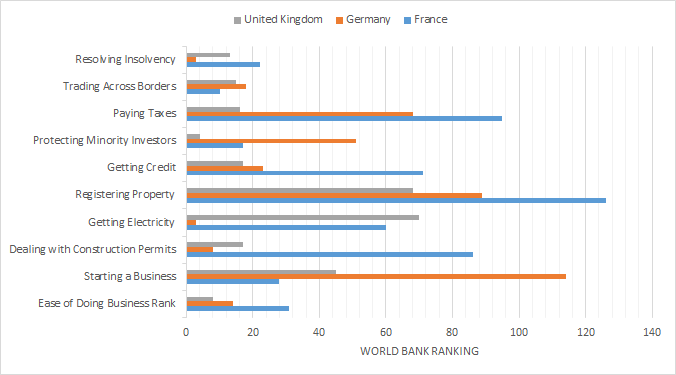
Figure 1: World Bank Doing Business rankings, France, Germany and the UK, 2014
Source: Doing Business – Measuring Business Regulations – World Bank Group.
Some things are decidedly harder to do in Germany and France than for businesses in the UK. On the other hand, it is surprisingly hard to register property in all three countries including the UK after 700 years of the blessings of the British common law.
Paying taxes in Germany and France are far harder than in the UK. Don’t have anything to do with construction permits in France unless you must. It is surprisingly hard to get the electricity on in the UK and France.
The European Union must have some benefits when it comes to trading across the borders of all three countries. Only problem is in Germany where it is very difficult to start a business in the first place. Why is for a later posting.
09 Jul 2015 Leave a comment
in economics of crime, law and economics Tags: crime and punishment, gun control
Gun related homicides http://t.co/BUZ4XIwTWY—
Charts and Maps (@ChartsandMaps) April 12, 2015
09 Jul 2015 1 Comment
in applied welfare economics, economic history, economics of regulation, labour economics, law and economics, politics - New Zealand, poverty and inequality, property rights Tags: Auckland urban limit, child poverty, Director's Law, expressive voting, family poverty, family tax credits, in-work tax credits, land use planning, median voter theorm, rational ignorance, rational irrationality, RMA, top 1%, working for families
Lindsay Mitchell put me onto a quote by veteran grumbler Max Rashbrooke that the child poverty rate doubled in New Zealand:
In a system where income goes disproportionately to the already well-off, ordinary workers are missing out on the rewards of their efforts, to the tune of billions of dollars a year. Welfare benefits, cut by a quarter in 1991 and increased just 8 per cent in the last budget, are far too low to meet people’s basic needs.
The result is a doubling of child poverty and the return of childhood diseases unknown in most developed countries – a national embarrassment, as one researcher described it.
Poverty, income and inequality data is collected in loving detail by Brian Perry every year for the Ministry of Social Development.
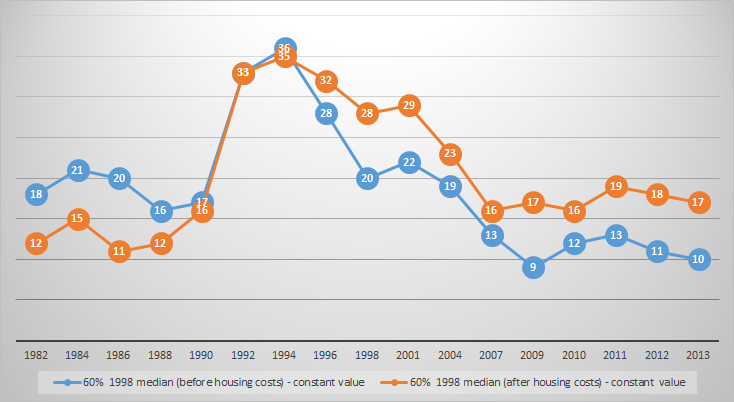
Figure 1: % child poverty in New Zealand (before and after housing costs), 60% 1998 median constant value, 1982 – 2013
Source: Bryan Perry, Household incomes in New Zealand: Trends in indicators of inequality and hardship 1982 to 2013. Ministry of Social Development (July 2014), Tables F.6 and F.7.
The only thing noticeable in the downward trend in child poverty in New Zealand since its doubling with the sharp recession in 1990 with double-digit unemployment rates is child poverty stop falling shortly after in-work family tax credits were introduced in the form of Working for Families in 2005.
New QV figures show Auckland house prices are up a massive 16.1% on last year, now estimated to reach $1m by Aug '16. http://t.co/DwAU79ozCy—
New Zealand Labour (@nzlabour) June 09, 2015
There was a break in trend in the long decline in child poverty as soon as in-work family tax credits were introduced in New Zealand. I’m sure this is a coincidence because, as Brian Perry said when discussing the introduction of Working for Families in 2005:
The 2004 to 2007 period was the only one in the 25 years to 2007 in which the incomes of low- to middle-income households grew more quickly than those of households above the median.
The real killer in New Zealand in terms of poverty and inequality are housing costs. Housing costs are wholly under the control of government through its control of the supply of land, which is restricted at the behest of the parties of the left.
Figure 2: real equivalised household incomes (before and after housing costs): changes at the top of lowest income decile, New Zealand, 1982 to 2013

Source: Bryan Perry, Household incomes in New Zealand: Trends in indicators of inequality and hardship 1982 to 2013. Ministry of Social Development (July 2014), tables D.2 and D.4.
Figure 2 shows that real equivalised household income after housing costs has not grown and in fact has fallen for the bottom 10% of the income distribution in New Zealand.
It is the left-wing parties who oppose measures to reduce housing costs and and increase the supply of land through reforms to the Resource Management Act and the relaxation of the Auckland metropolitan urban limit.

Labour and the Greens are in effect keeping the poor poor to win middle-class votes.
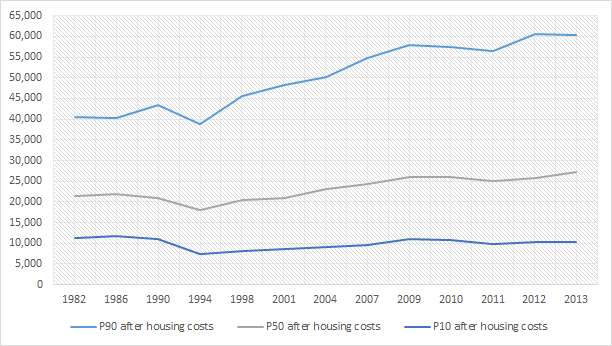
Figure 3: real equivalised household incomes (before and after housing costs): changes at the top of the top, middle and lowest lowest income deciles, New Zealand, 1982 to 2013
Source: Bryan Perry, Household incomes in New Zealand: Trends in indicators of inequality and hardship 1982 to 2013. Ministry of Social Development (July 2014), tables D.2 in D.4.
Figure 3 shows that those in the middle and higher deciles, a political territory rich in swinging voters, are still doing well after housing costs. The parties of the left are collaborating with a middle-class home owning voter while betraying the working class and its aspirations from home ownership and quite simply affordable housing costs when they rent.
The increases for all groups may be understated by the inability of living standards measures to adequately account for new goods, product upgrades and rising life expectancies.
09 Jul 2015 Leave a comment
in applied price theory, applied welfare economics, comparative institutional analysis, economics of regulation, industrial organisation, law and economics, politics - Australia, politics - New Zealand, politics - USA, property rights Tags: British economy, doing business, France, Germany, Italy, World Bank
Figure 1: Starting a business rankings – World Bank Doing Business rankings, OECD countries, 2014
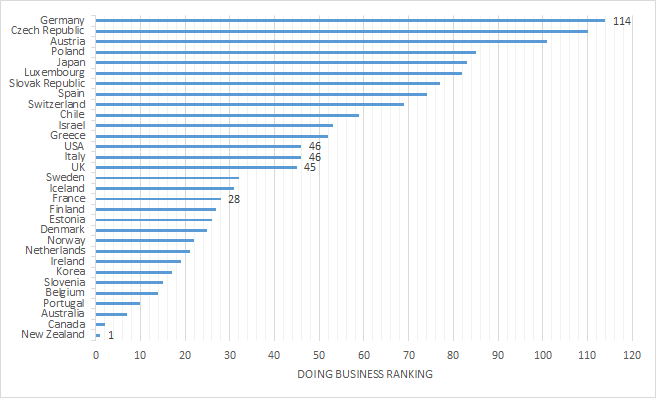
Source: Doing Business – Measuring Business Regulations – World Bank Group.
There is surprising wide range in the World Bank Doing Business ranking of the difficulty and delays in starting a business across the OECD.
Germany is ranked 114 from the world for starting a business. New Zealand is ranked first with the USA, Italy and the UK ranked in the mid 40s in the Doing Business database.
Econ Prof at George Mason University, Economic Historian, Québécois
Celebrating humanity's flourishing through the spread of capitalism and the rule of law
Scholarly commentary on law, economics, and more
Beatrice Cherrier's blog
Celebrating humanity's flourishing through the spread of capitalism and the rule of law
Celebrating humanity's flourishing through the spread of capitalism and the rule of law
Celebrating humanity's flourishing through the spread of capitalism and the rule of law
Why Evolution is True is a blog written by Jerry Coyne, centered on evolution and biology but also dealing with diverse topics like politics, culture, and cats.
Celebrating humanity's flourishing through the spread of capitalism and the rule of law
Celebrating humanity's flourishing through the spread of capitalism and the rule of law
A rural perspective with a blue tint by Ele Ludemann
DPF's Kiwiblog - Fomenting Happy Mischief since 2003
Celebrating humanity's flourishing through the spread of capitalism and the rule of law
The world's most viewed site on global warming and climate change
Tim Harding's writings on rationality, informal logic and skepticism
A window into Doc Freiberger's library
Let's examine hard decisions!
Commentary on monetary policy in the spirit of R. G. Hawtrey
Thoughts on public policy and the media
Celebrating humanity's flourishing through the spread of capitalism and the rule of law
Politics and the economy
A blog (primarily) on Canadian and Commonwealth political history and institutions
Reading between the lines, and underneath the hype.
Economics, and such stuff as dreams are made on
"The British constitution has always been puzzling, and always will be." --Queen Elizabeth II
Celebrating humanity's flourishing through the spread of capitalism and the rule of law
Celebrating humanity's flourishing through the spread of capitalism and the rule of law
WORLD WAR II, MUSIC, HISTORY, HOLOCAUST
Undisciplined scholar, recovering academic
Celebrating humanity's flourishing through the spread of capitalism and the rule of law
Res ipsa loquitur - The thing itself speaks
In Hume’s spirit, I will attempt to serve as an ambassador from my world of economics, and help in “finding topics of conversation fit for the entertainment of rational creatures.”
Researching the House of Commons, 1832-1868
Articles and research from the History of Parliament Trust
Reflections on books and art
Posts on the History of Law, Crime, and Justice
Celebrating humanity's flourishing through the spread of capitalism and the rule of law
Exploring the Monarchs of Europe
Cutting edge science you can dice with
Small Steps Toward A Much Better World
“We do not believe any group of men adequate enough or wise enough to operate without scrutiny or without criticism. We know that the only way to avoid error is to detect it, that the only way to detect it is to be free to inquire. We know that in secrecy error undetected will flourish and subvert”. - J Robert Oppenheimer.
The truth about the great wind power fraud - we're not here to debate the wind industry, we're here to destroy it.
Celebrating humanity's flourishing through the spread of capitalism and the rule of law
Celebrating humanity's flourishing through the spread of capitalism and the rule of law
Economics, public policy, monetary policy, financial regulation, with a New Zealand perspective
Celebrating humanity's flourishing through the spread of capitalism and the rule of law


 Utopia, you are standing in it!
Recent Comments