999 – World's first emergency telephone number – was introduced in London #OnThisDay 30 June 1937 #emergencyservices http://t.co/I4gbrwJ2Vp—
BT Archives (@BTArchives) June 30, 2014
1st 999 number introduced today 1937
30 Jun 2015 Leave a comment
in economic history, economics of crime, economics of media and culture, entrepreneurship, law and economics Tags: British economy, crime and punishment, London
Kids Create Cafeteria Black Market To Bypass Food Nannies
30 Jun 2015 Leave a comment
in economics of crime, economics of education, economics of regulation, entrepreneurship, health economics, industrial organisation, law and economics, survivor principle Tags: black markets, economics of prohibition, entrepreneurial alertness, food, nanny state, police, The fatal conceit, unintended consequences
Greece (61st) is ranked one above the Russia in the World Bank’s Doing Business Survey 2015
29 Jun 2015 Leave a comment
in economics of bureaucracy, economics of crime, economics of regulation, industrial organisation, labour economics, law and economics, property rights, Public Choice, rentseeking Tags: cost of doing business, Euroland, Greece, Russia, sovereign defaults, transitional economies, World Bank
Figure 1: Greek and Russian Doing Business sub-rankings, 2015
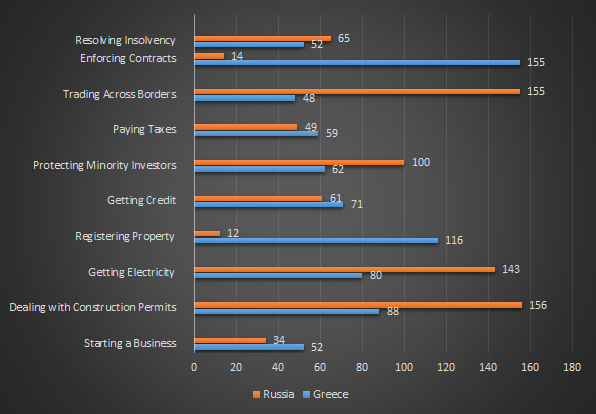
Source: World Bank Doing Business 2015.
As long as you’re not in a construction or export business, and don’t mind waiting for your electricity, it’s better to do business in Russia than in Greece! The main difference between Russia and Greece is its membership of the European Union makes it easy to export?
In Russia, it’s easier to start a business, register property and enforce contracts than it is in Greece!
How many congressmen are convicted of crimes?
27 Jun 2015 Leave a comment
in economics of crime, law and economics, occupational choice, politics - USA, Public Choice Tags: official corruption, political corruption
How drugs move all around the world.
27 Jun 2015 Leave a comment
in economics of crime, industrial organisation Tags: black markets, drug trade, economics of prohibition, maps
These three maps show how drugs move all around the world. bloomberg.com/news/articles/… via @sangwonyoon http://t.co/wIjUBEXyt7—
Bloomberg Markets (@markets) June 26, 2015
HL Mencken on the Harmful Digital Communication Bill
26 Jun 2015 Leave a comment
in applied price theory, applied welfare economics, comparative institutional analysis, constitutional political economy, economics of crime, economics of media and culture, economics of regulation, law and economics, liberalism, politics - New Zealand, Public Choice Tags: chilling effect, disorderly conduct, free speech, infotopia, Internet trolls, meddlesome preferences, nanny state, offsetting behaviour, The fatal conceit, The pretence to knowledge, unintended consequences
What Percentage of Your Country Smokes Marijuana?
25 Jun 2015 Leave a comment
in economics of crime, law and economics, liberalism, politics - Australia, politics - New Zealand, politics - USA Tags: marijuana decriminalisation, meddlesome preferences, nanny state
What Percentage of Your Country Smokes Marijuana?
priceonomics.com/what-percentag… http://t.co/t5ybdqNv4X—
Priceonomics (@priceonomics) April 21, 2015
Is investor state dispute settlement a form of overseas development assistance?
24 Jun 2015 Leave a comment
in comparative institutional analysis, constitutional political economy, development economics, growth disasters, growth miracles, international economic law, international economics, law and economics, property rights, Public Choice, rentseeking, Richard Posner Tags: European Court of Justice, free trade agreements, International Court of Justice, international law, investor state dispute settlement, ODA, overseas development assistance, preferential trade agreements, regional trade agreements, WTO
Would objections to the Investor State Dispute Settlement provisions in the proposed Trans-Pacific Partnership wilt away if the adjudicating body was the International Court of Justice? The left-wing opponents of investor state dispute settlement genuflect at the very mention of the International Court of Justice and international law generally (unless it is international economic law).

Disputes over the provisions of European union treaties are adjudicated by the European Court of Justice. The judgements of that court brought by individuals against member states so annoy the British that it is a leading reason for many British wanting to leave the European Union and replace the Human Rights Act 1998 with a British Bill Of Rights policed by British courts rather than by the European Court of Justice and European human rights law.
It is routine for any treaty to have some provision for arbitration of disputes. This includes trade and investment treaties.
The World Trade Organisation treaty includes a dispute settlement provision with arbitrators based in Geneva. Some of the more than 400 cases heard have been motivated by discrimination against imports on the basis of a breached environmental protection policies of the importing country.

A number of countries want to ban imports that are produced in ways that upset them. Others want to include labour and environmental standards in trade agreements to impose developed country standards on developing countries in what is a new form of colonialism.
I have previously said that investor State Dispute Settlement provisions have no place in trade and investment treaties between democracies. I must now admit there are good reasons to have arbitration clauses in treaties between democracies.
The puzzle is why refer these trade and investment disputes to a little-known arbitration body adjunct to the World Bank rather than the far more prestigious International Court of Justice.
Perhaps the reason is both sides want an arbitrator who is not too strong and not too credible. It would look very bad if the International Court of Justice was to rule against you.
William Landes and Richard Posner contended that judicial independence maximises the value of legislative deals with interest groups by enhancing the durability of those deals.
Why no International Court of Commercial Law? When deciding what type in judiciary to enforce international trade bargains, the signatories may prefer a less credible adjudication and enforcement mechanism in case they want to opt out of it or chip around the decision.
The jurisdiction of the International Court of Justice is to settle, in accordance with international law, legal disputes submitted to it by special agreement and matters specifically provided for in treaties and conventions in force.
UN member states are the parties to any litigation but that doesn’t stop them raising cases on behalf of individuals. That said, organizations, private enterprises, and individuals cannot have their cases taken to the International Court, such as to appeal a national supreme court’s ruling. Only the states can bring the cases and become the defendants of the cases.
The International Court of Justice is different from the European Court of Justice because individuals cannot easily bring complaints before it. One of the causes of action before the European Court of Adjusters is under European competition law over member states providing financial aid to industries.
Democratic countries with high levels of economic and social integration, such as the European union, do find it in advantage to set up a European wide Court to adjudicate disputes over rights under European law.
Why then would a democracy sign up to an investment protection treaty with a developing country? One reason is overseas development assistance.
Developing countries with corrupt and incompetent courts, politicians and bureaucracies sign international treaties as a way of assuring foreign investors and trading partners of some degree of security of their property rights and their ability to enforce contracts with suppliers and buyers.
By folding these assurances into trade treaties, the developing country has a stronger incentive to honour its promises. There will be domestic constituencies wanting to retain reciprocal export market access who will lobby for the honouring of the promises of legal protection to investors and businesses in their home country.
New Zealand signing up to the Trans-Pacific Partnership is an example of this form of overseas development assistance. Exporters and investors from the developing country who export and invest in New Zealand have another reason to support more secure property rights and better enforcement of contracts in their home country as a way of securing their treaty rights to export and invest in New Zealand.
The Left of the political spectrum should be keen on this form of overseas development considering their general belief in greatly increasing the amount spent on overseas development assistance. Rather than pay cash to the development country, the payment is in kind as reciprocal legal promises.
Trade treaties that include investor state dispute settlement are forms of governance assistance to developing countries. The reciprocal exchange of promises about investor protection and the enforcement of contracts and property rights improves the quality of governance in the developing country.
The countries most likely to be subject to investor state dispute settlement are those with weaker governance. Even in the European Union, the member states most likely to be sued are former communist countries. The most common course of action was the cancellation of a licence or permit.

Investor state dispute settlement clauses are no different from any other international treaty include environmental and human rights treaties. All these treaties require countries to give up part of their sovereignty.

Democracies give up their sovereignty in investor state dispute settlement in the hope that developing country partners to the treaty will improve the development potential of their country through better governance and more secure property rights.
That is an overseas development aid objective the Left of the political spectrum should support, but it does not. The Left of the political spectrum is happy to use trade agreements to impose developed country labour and environmental standards on poor countries desperate for access to rich country markets, but is not willing to give up anything in return.
% of children living with 2 parents
23 Jun 2015 Leave a comment
% of children living with 2 parents
Israel 92%
Egypt 89
Turkey 88
Brazil 72
US 69
S Africa 36worldfamilymap.org/2014/e-ppendix… http://t.co/GveypeU6tK—
Conrad Hackett (@conradhackett) June 22, 2014
Many American families face negative affected income taxes rates
23 Jun 2015 Leave a comment
in economics of love and marriage, labour economics, politics - USA, public economics Tags: earned income tax credit, economics of families, family tax credits
Should it be illegal for workers to accept a sub-minimum wage job?
22 Jun 2015 Leave a comment
in economics of crime, labour economics, law and economics, minimum wage Tags: Coase theorem, minimum wage
@Luke1732Mullen @ritholtz @TBPInvictus @futurepundit @workingwa @CafeHayek http://t.co/n3l26QPPd4—
Mark J. Perry (@Mark_J_Perry) May 24, 2015
What happened to black family formation in the 1970s?
22 Jun 2015 Leave a comment
in economics of love and marriage, labour economics, labour supply, law and economics, occupational choice Tags: child poverty, economics of the family, family poverty, single mothers, single parents
The War On Poverty has been a disaster for black kids. 2x kids living with unmarried mom. bit.ly/1alPWKB http://t.co/Cwi4C5NtHz—
Old Whig (@aClassicLiberal) April 12, 2015
The impact of parental employment on child poverty in couple families, Anglo-Saxon countries
21 Jun 2015 Leave a comment
in economics of love and marriage, labour economics, labour supply, law and economics, politics - Australia, politics - New Zealand, politics - USA, population economics, poverty and inequality, welfare reform Tags: Australia, British economy, Canada, child poverty, economics of families, family poverty, Ireland, labour force participation, single parents
Figure 1: child poverty rates in couple families by employment status, Anglo-Saxon countries, 2010
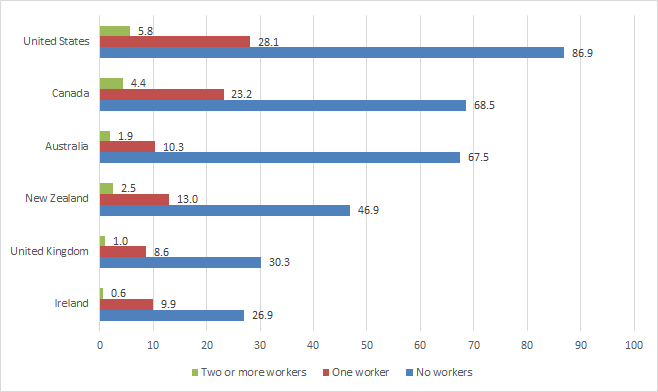
Source: OECD Family Database; Poverty thresholds are set at 50% of the median income of the entire population.
The GMO food die-hard GMO opponents love (and oppose a label for)
20 Jun 2015 Leave a comment
in economics of information, economics of media and culture, economics of regulation, environmental economics, health economics, law and economics, politics - USA Tags: antiscience left, expressive voting, food labelling, GMOs, product labelling, rational ignorance, rational irrationality
Per capita receipt of asylum seekers
19 Jun 2015 Leave a comment
in Economics of international refugee law, international economic law, International law, law and economics, politics - Australia, politics - New Zealand, politics - USA Tags: asylum seekers, economics of immigration
Sweden – the OECD's highest per capita recipient of asylum seekers bit.ly/1vfFEUh http://t.co/y6DmdJjAsE—
Guardian Data (@GuardianData) December 02, 2014
 Utopia, you are standing in it!
Recent Comments