#Dailychart: Fatal terrorist attacks in Western Europe since 2001 econ.st/1CnBN87 http://t.co/pu2LBS7Qb7—
The Economist (@ECONdailycharts) January 18, 2015
Fatal terrorist attacks in Europe since 2001
15 May 2015 Leave a comment
in economics of crime, law and economics Tags: European politics, terrorist attacks, war against terror
The main drivers of child poverty
15 May 2015 Leave a comment
in applied welfare economics, economics of love and marriage, gender, labour economics, labour supply, occupational choice, politics - Australia, politics - New Zealand, politics - USA, population economics, welfare reform Tags: child poverty, economics of the family, family poverty, marriage and divorce, single mothers, single parents
CHART: Black Illegitimacy Rate Went from < 20% in 1950 to 75.2% in 2010. Has Obama ever mentioned that? http://t.co/1UBUQ5aLRi—
Mark J. Perry (@Mark_J_Perry) May 12, 2015
Quotation of the Day from Charles Murray http://t.co/Y8W6xGjRPO—
Mark J. Perry (@Mark_J_Perry) May 12, 2015
The Rise and Rise of the Super Working Rich
15 May 2015 1 Comment
in economic history, entrepreneurship, financial economics, human capital, industrial organisation, labour economics, occupational choice, property rights, survivor principle, theory of the firm Tags: entrepreneurial alertness, Eugene Fama, Leftover Left, separation of ownership and control, super-rich, superstar wages, superstars, top 1%, Twitter left, working rich
The rise of the rentiers is nothing new. What is new is the degree of financial globalization and liberalization that has supercharged the fortunes of the super-wealthy even beyond robber baron levels. But it’s no mystery how to reverse this. It’s a matter of setting better rules for markets and taxing earners at the top a bit more.
In the course of a deranged rant against the entrepreneurs in society, the Atlantic collected an excellent set of information suggesting that the working rich have replaced rentiers as the super-rich. Rentiers are the idle rich. A rentier is a person or entity receiving income derived from patents, copyrights, interest, etc.

In The Evolution of Top Incomes: A Historical and International Perspective (NBER Working Paper No. 11955), Thomas Piketty and Emmanuel Saez concluded that:
While top income shares have remained fairly stable in Continental European countries or Japan over the past three decades, they have increased enormously in the United States and other English speaking countries.
This rise in top income shares is not due to the revival of top capital incomes, but rather to the very large increases in top wages (especially top executive compensation). As a consequence, top executives (the “working rich”) have replaced top capital owners at the top of the income hierarchy over the course of the twentieth century…

The Twitter Left claim that the surge in top compensation in the United States is attributable to an increased ability of top executives to set their own pay and to extract rents at the expense of shareholders. Obviously, from the chart below the pay the top 0.1% goes up and down with the share market. Top wages do not seem to have any independent power to dupe shareholders into overpaying them in bad times.

Xavier Gabaix and Augustin Landier found back in 2008 that what a major company’s CEO earns is directly proportional to the size of the firm that they are responsible for running. Executive compensation closely track the evolution of average firm value. During 2007 – 2009, firm value decreased by 17%, and CEO pay by 28%. During 2009-2011, firm value increased by 19% and CEO pay by 22%.
Xavier Gabaix and Augustin Landier also found that compensation for executives has risen with the market capitalization. From 1980 to 2003, the average value of the top 500 companies rose by a factor of six. Two commonly used indexes of chief executive compensation show close to a proportional six-fold matching increase.
Better executive decisions create more economic value. If the number of big companies is greater than the number of good chief executives, competitive bidding will push up executive pay to reflect the value of the talent that is available.
What happens to share prices when there is a surprise CEO resignation? Up or down? Apple went up and down in billions on news of Steve Jobs’ health.
When Hewlett Packard’s CEO Mark Hurd resigned unexpectedly, the value of HP stock dropped by about $10 billion! This makes his $30 million in annual compensation a bargain for shareholders. The fall in share price represents the difference between what the market expected from Hurd as Hewlett Packard’s CEO and what the market expects from his successor. Was Hurd under-paid?
There is an easy way to test for whether top executives cheat public shareholders. Compare the pay of large private companies, and public companies with a large or a few share holders, with public companies with diffuse share holdings. Private equity typically also pay its top executives very well, even though the capacity to dupe public shareholders are not a factor.
The burst of takeovers and leverage buyouts in the 1980s were very much driven by opportunities to profit from reducing corporate slack and downsizing flabby corporate headquarters of large publicly listed companies.
The response of the Left over Left of the day was support regulation to stop these mergers and takeovers rather than applauding them as giving lazy capitalists their comeuppance. This regulation undermined the market the corporate control rather than strengthened it as Michael Jensen explains:
This political activity is another example of special interests using the democratic political system to change the rules of the game to benefit themselves at the expense of society as a whole.
In this case, the special interests are top-level corporate managers and other groups who stand to lose from competition in the market for corporate control. The result will be a significant weakening of the corporation as an organizational form and a reduction in efficiency.
Central to the hypothesis of the Twitter Left of CEOs overpaying themselves is there is free cash within the business they pocket in pay rises, fringe benefits and lavished corporate headquarters rather than pay out in dividends or invest in profitable investments.

The interests and incentives of managers and shareholders frequently conflict over the optimal size of the firm and the payment of free cash to shareholders. What to pay the top executives is a minor manifestation of this common entrepreneurial difference of opinion the future of the business.
These conflicts in entrepreneurial judgements are severe in firms with large free cash flows–more cash than profitable investment opportunities. Jensen defines free cash flow as follows:
Free cash flow is cash flow in excess of that required to fund all of a firm’s projects that have positive net present values when discounted at the relevant cost of capital. Such free cash flow must be paid out to shareholders if the firm is to be efficient and to maximize value for shareholders.
Payment of cash to shareholders reduces the resources under managers’ control, thereby reducing managers’ power and potentially subjecting them to the monitoring by the capital markets that occurs when a firm must obtain new capital. Financing projects internally avoids this monitoring and the possibility that funds will be unavailable or available only at high explicit prices.
Michael Jensen developed a theory of mergers and takeovers based on free cash flows that explains:
- the benefits of debt in reducing agency costs of free cash flows,
- how debt can substitute for dividends,
- why diversification programs are more likely to generate losses than takeovers or expansion in the same line of business or liquidation-motivated takeovers,
- why bidders and some targets tend to perform abnormally well prior to takeover.
Michael Jensen noted that free cash flows allowed firms’ managers to finance projects earning low returns which, therefore, might not be funded by the equity or bond markets. Examining the US oil industry, which had earned substantial free cash flows in the 1970s and the early 1980s, he wrote that:
[the] 1984 cash flows of the ten largest oil companies were $48.5 billion, 28 percent of the total cash flows of the top 200 firms in Dun’s Business Month survey.
Consistent with the agency costs of free cash flow, management did not pay out the excess resources to shareholders. Instead, the industry continued to spend heavily on [exploration and development] activity even though average returns were below the cost of capital.
Jensen also noted a negative correlation between exploration announcements and the market valuation of these firms—the opposite effect to research announcements in other industries. Not surprisingly, after a successful corporate takeover, there is major changes to realise the untapped benefits they saw in the company that the incumbent management were not seizing capturing:
Corporate control transactions and the restructurings that often accompany them can be wrenching events in the lives of those linked to the involved organizations: the managers, employees, suppliers, customers and residents of surrounding communities.
Restructurings usually involve major organizational change (such as shifts in corporate strategy) to meet new competition or market conditions, increased use of debt, and a flurry of recontracting with managers, employees, suppliers and customers.
All modern theories of the focus in part or in full on reducing opportunistic behaviour, cheating and fraud in employment and commercial relationships. The market the corporate control, and mergers and takeovers realise large benefits from displacing underperforming manager teams. Premiums in hostile takeover offers historically exceed 30 percent on average. Acquiring-firm shareholders on average earn about 4 percent in hostile takeovers and roughly zero in mergers.

In terms of corporate control, Eugene Fama divides firms into two types: the managerial firm, and the entrepreneurial firm.
The entrepreneurial firms are owned and managed by the same people (Fama and Jensen 1983b). Mediocre personnel policies and sub-standard staff retention practices within entrepreneurial firms are disciplined by these errors in judgement by owner-managers feeding straight back into the returns on the capital that these owner-managers themselves invested. Owner-managers can learn quickly and can act faster in response the discovery of errors in judgement. The drawback of entrepreneurial firms is not every investor wants to be hands-on even if they had the skills and nor do they want to risk being undiversified.
The owners of a managerial firm advance, withdraw, and redeploy capital, carry the residual investment risks of ownership and have the ultimate decision making rights over the fate of the firm (Klein 1999; Foss and Lien 2010; Fama 1980; Fama and Jensen 1983a, 1983b; Jensen and Meckling 1976).
Owners of a managerial firm, by definition, will delegate control to expert managerial employees appointed by boards of directors elected by the shareholders (Fama and Jensen 1983a, 1983b). The owners of a managerial firm will incur costs in observing with considerable imprecision the actual efforts, due diligence, true motives and entrepreneurial shrewdness of the managers and directors they hired (Jensen and Meckling 1976; Fama and Jensen 1983b).
Owners need to uncover whether a substandard performance is due to mismanagement, high costs, paying the employees too much or paying too little, excessive staff turnover, inferior products, or random factors beyond the control of their managers (Jensen and Meckling 1976; Fama and Jensen 1983b, 1985).
Many of the shareholders in managerial firms have too small a stake to gain from monitoring managerial effort, employee performance, capital budgets, the control of costs and the stinginess or generosity of wage and employment policies (Manne 1965; Fama 1980; Fama and Jensen 1983a, 1983b; Williamson 1985; Jensen and Meckling 1976). This lack of interest by small and diversified investors does not undo the status of the firm as a competitive investment nor introduce slack in the monitoring of payments to top executives.

Large firms are run by managers hired by diversified owners because this outcome is the most profitable form of organisation to raise capital and then find the managerial talent to put this pool of capital to its most profitable uses (Fama and Jensen 1983a, 1983b, 1985; Demsetz and Lehn 1985; Alchian and Woodward 1987, 1988).
More active investors will hesitate to invest in large managerial firms whose governance structures tolerate excessive corporate waste and do not address managerial slack and and overpaid executives. Financial entrepreneurs will win risk-free profits from being alert and being first to buy or sell shares in the better or worse governed firms that come to their notice.
The risks to dividends and capital because of manifestations of corporate waste, reduced employee effort, and managerial slack and aggrandisement in large managerial firms are risks that are well known to investors (Jensen and Meckling 1976; Fama and Jenson 1983b). Corporate waste and managerial slack also increase the chances of a decline in sales and even business failure because of product market competition (Fama 1980; Fama and Jensen 1983b).
Investors will expect an offsetting risk premium before they buy shares in more ill-governed managerial firms. This is because without this top-up on dividends, they can invest in plenty of other options that foretell a higher risk-adjusted rate of return. The discovery of monitoring or incentive systems that induce managers to act in the best interest of shareholders are entrepreneurial opportunities for pure profit (Fama and Jensen 1983b, 1985; Alchian and Woodward 1987, 1988; Demsetz 1983, 1986; Demsetz and Lehn 1985; Demsetz and Villalonga 2001).
Investors will not entrust their funds to who are virtual strangers unless they expect to profit from a specialisation and a division of labour between asset management and managerial talent and in capital supply and residual risk bearing (Fama 1980; Fama and Jensen 1983a, 1983b; Demsetz and Lehn 1985). There are other investment formats that offer more predictable, more certain rate of returns.
Competition from other firms will force the evolution of devices within the firms that survive for the efficient monitoring the performance of the entire team of employees and of individual members of those teams as well as managers (Fama 1980, Fama and Jensen 1983a, 1983b; Demsetz and Lehn 1985). These management controls must proxy as cost-effectively as they can having an owner-manager on the spot to balance the risks and rewards of innovating.
The reward for forming a well-disciplined managerial firm despite the drawbacks of diffuse ownership is the ability to raise large amounts in equity capital from investors seeking diversification and limited liability (Demsetz 1967; Jensen and Meckling 1976; Fama 1980; Fama and Jensen 1983b; Demsetz and Lehn 1985). Portfolio investors may know little about each other and only so much about the firm because diversification and limited liability makes this knowledge less important (Demsetz 1967; Jensen and Meckling 1976; Alchian and Woodward 1987, 1988).
It is unwise to suppose that portfolio investors will keep relinquishing control over part of their capital to virtual strangers who do not manage the resources entrusted to them in the best interests of the shareholders (Demsetz 1967; Williamson 1985; Fama 1980, 1983b; Alchian and Woodward 1987, 1988).
Managerial firms who are not alert enough to develop cost effective solutions to incentive conflicts and misalignments will not grow to displace rival forms of corporate organisation and methods of raising equity capital and loans, allocating legal liability, diversifying risk, organising production, replacing less able management teams, and monitoring and rewarding employees (Fama and Jensen 1983a, 1983b; Fama 1980; Alchian 1950).
Entrepreneurs will win profits from creating corporate governance structures that can credibly assure current and future investors that their interests are protected and their shares are likely to prosper (Fama 1980; Fama and Jensen 1983a, 1983b, 1985; Demsetz 1986; Demsetz and Lehn 1985). Corporate governance is the set of control devices that are developed in response to conflicts of interest in a firm (Fama and Jensen 1983b).
At bottom, the private sector is highly successful designing forms of organisation that allow large sums of money, billions of dollars to be raised in the capital market and entrusted to management teams.
via The Rise and Rise of the Super-Rich – The Atlantic and How the Richest 400 People in America Got So Rich – The Atlantic.
Public confidence in the police in America
14 May 2015 Leave a comment
in economics of bureaucracy, economics of crime, politics - USA Tags: crime and punishment, law and order, police, voter demographics
Why is the gender gap so large and the glass ceiling so thick in Sweden?
14 May 2015 1 Comment
in discrimination, economics of love and marriage, gender, human capital, labour economics, occupational choice, politics - USA Tags: asymmetric marriage premium, do gooders, economics of families, gender wage gap, maternity leave, Sweden, The fatal conceit, unintended consequences
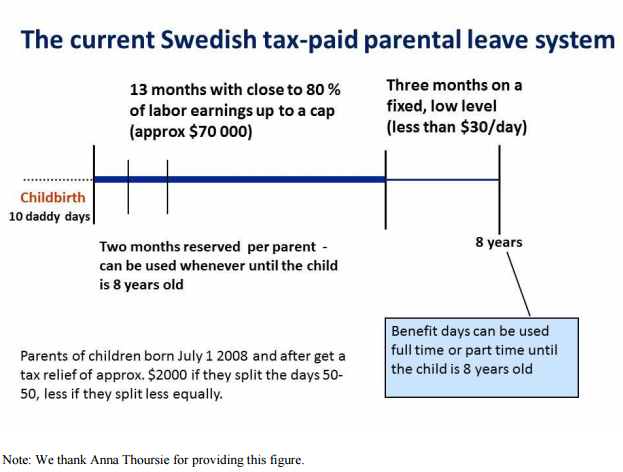
The gender wage gap is no better than the OECD average, despite generous maternity and paternity leave. What gives?
America: one day a year celebrating mothers, fathers.
Sweden: 480 days paid leave per child. vox.com/2014/5/12/5708… http://t.co/weFDrTj7Jb—
Ezra Klein (@ezraklein) May 11, 2015
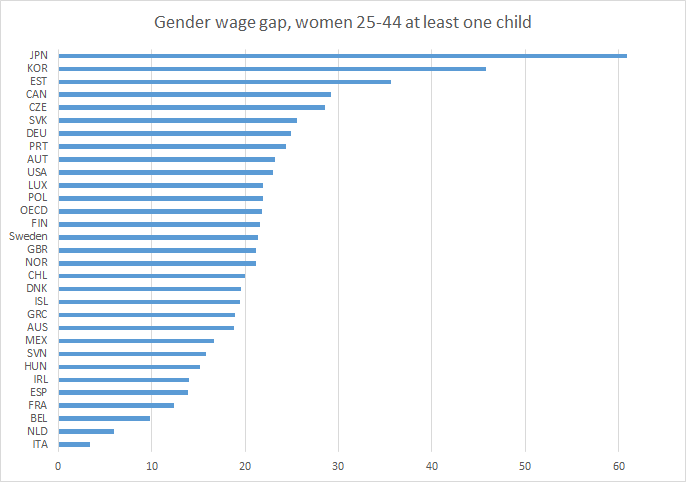
Source: Closing the gender gap: Act now – http://dx.doi.org/10.1787/9789264179370-en
How big is the wage gap in your country? bit.ly/18o8icV #IWD2015 http://t.co/XTdntCRfDQ—
(@OECD) March 08, 2015
One important question is whether government policies are effective in reducing the gap. One such policy is family leave legislation designed to subsidize parents to stay home with new-born or newly adopted children.
One of the RLE articles shows that for high earners in Sweden there is a large difference between the wages earned by men and women (the so-called “glass ceiling”), which is present even before the first child is born. It increases after having children, even more so if parental leave taking is spread out.
These findings suggest that the availability of very long parental leave in Sweden may be responsible for the glass ceiling because of lower levels of human capital investment among women and employers’ responses by placing relatively few women in fast-track career positions. Thus, while this policy makes holding a job easier and more family-friendly, it may not be as effective as some might think in eradicating the gender gap.
via New volume on gender convergence in the labour market | IZA Newsroom.
Child poverty and single parenthood
13 May 2015 Leave a comment
in economics of love and marriage, gender, labour economics, labour supply, occupational choice, poverty and inequality, welfare reform Tags: child poverty, economics of marriage, family poverty, marriage and divorce, single mothers, single parents, welfare reform
Over half of all births to young adults in the U.S. now occur outside of marriage. bit.ly/1qONO10 http://t.co/KXl4sFd122—
Isabel Sawhill (@isawhill) September 17, 2014
Despite forgoing #marriage, young Americans are not forgoing parenthood. bit.ly/1sMG2bJ http://t.co/1aSELaJlfg—
Isabel Sawhill (@isawhill) October 31, 2014
Despite forgoing #marriage, young Americans are not forgoing #parenthood. bit.ly/1xLa1AJ http://t.co/fetnPAiCPG—
Isabel Sawhill (@isawhill) October 13, 2014
Almost 60% of births to women with only a high school degree occur out of wedlock. bit.ly/1sMG2bJ http://t.co/zomTFjZwA2—
Isabel Sawhill (@isawhill) October 14, 2014
Do violent protests win votes for your cause?
12 May 2015 Leave a comment
in constitutional political economy, economic history, economics of crime, law and economics, politics - Australia, politics - New Zealand, politics - USA, Public Choice Tags: 1960s, activists, civil disobedience, Democratic Party, George Wallace, nonviolent protest, Richard Nixon, riots, Vietnam war, violent protests
Monkey Cage blogged on a very timely study on the impact of violent and nonviolent protests on voting behaviour. Non-violent protest in the 60s enticed sympathy and increased voter support for the Democratic Party in the 1964, 1968 to 1972 presidential elections:
Black-led nonviolent protests… exhibit a statistically significant positive relationship with county-level Democratic vote-share in the same period.
This is not surprising because nonviolent protest acknowledge fidelity to law and democratic equality. No one likes to be bullied and one of the purposes of the secret ballot is to prevent voters from being bullied because no one knows how you voted.
Indeed, there is a long history of anonymous pamphleteering, which has evolved into anonymous trolling as a way of people expressing their political views without facing backlash from both the majority and a vindictive minority.
In a democracy, it’s up to me to persuade you to change your mind – that what you took for granted for so long is not so. That’s how liberal democracies work: by trying to persuade each other and voting.
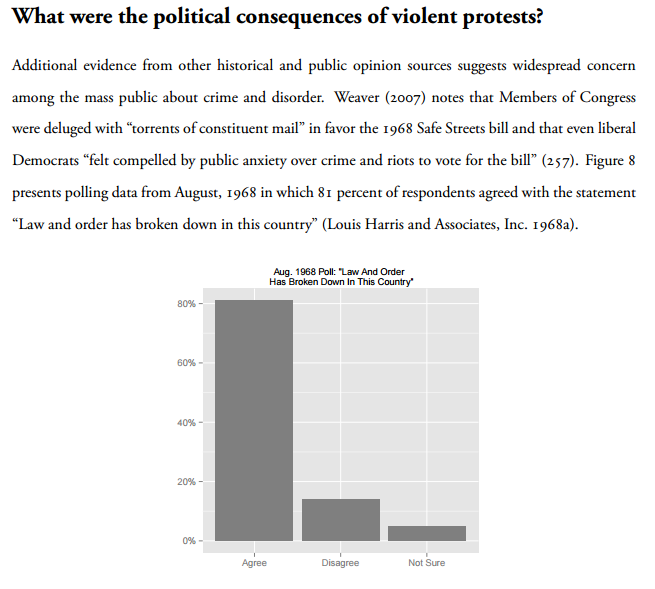
Violent protests had the exact opposite effect to peaceful protests on Democratic Party voting shares in the 1964, 1968 in 1972 presidential elections. There was a law and order backlash among voters against what were relatively widespread rioting and civil disorder:
…black-led protests in which some violence occurs are associated with a statistically significant decline in Democratic vote-share in the 1964, 1968 and 1972 presidential elections.
This is a roundabout way of saying that a Republican won the 1968 election on a law and order platform, not a Democrat on a peace platform. The country was convinced, including Liberal Democrats, that law and order had broken down and that the Democratic Party could not restore law and order.
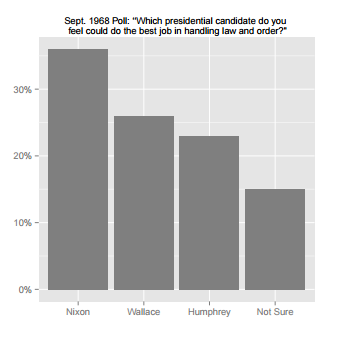
In the 1968 presidential election, there is a third party candidate, George Wallace, who won won almost ten million popular votes and 46 electoral votes, including in the electoral college on an even harsher law and order platform than Nixon.
Wallace was a racist Southern Democrat the Democratic Party would prefer us to forget and a nasty political opportunist to boot. His political rhetoric included the only words four letter words the protesters didn’t know was work and soap.
As I recall warmed over Marxism, the idea of violent protests is to provoke a law and order backlash, initially with popular support of the working class. The resulting police repression will overreach and cause the proletariat to breakthrough their false consciousness to see that capitalists for whom they are and rise up to overthrow them.

Rise up ye workers, rise up for you have nothing to lose but your chains. These days that call to the barricades would have to be rise up ye workers, rise up for you have nothing to lose what your smart phone and air points.
Hypocritical Greens betray NZ sovereignty to US court decision but oppose investor state dispute settlement on sovereignty grounds
10 May 2015 Leave a comment
in defence economics, economics of crime, international economic law, international economics, International law, law and economics, politics - New Zealand, politics - USA Tags: foreign policy, free trade agreements, green hypocrisy, green party, investor state disputes settlement, national security, preferential trading agreements, war against terror
The Greens are happy to betray New Zealand’s sovereignty to a US court where New Zealand’s side of the story was not heard, New Zealand was not a litigant, New Zealand was not named in the proceedings and New Zealand had not agreed to waive its sovereign immunity under US law.

The Greens on the other hand are hysterical about the prospect of New Zealand voluntarily submitting to investor state disputes settlement through an international treaty. International treaties normally are about trading in sovereignty: you give up some form of sovereignty return for something you value more.
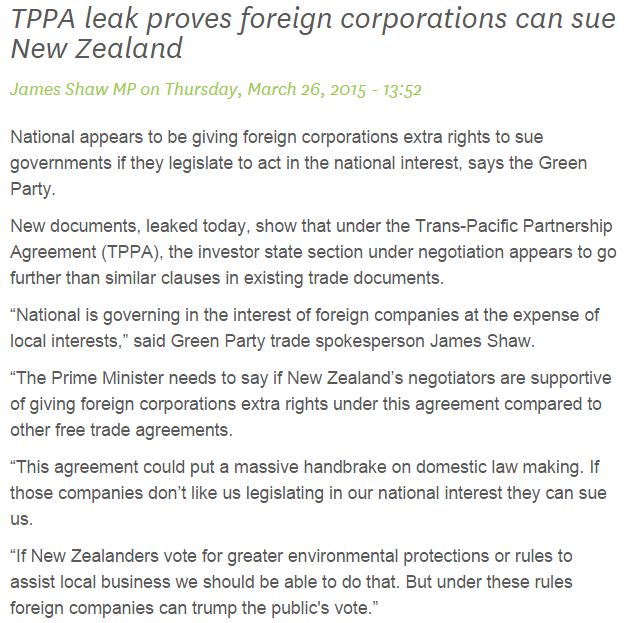
It is thoroughly hypocritical of the Greens to argue the New Zealand should bow down to a foreign court when that court rules in a way that it favours its ideological agenda but refuse to support the principle of international arbitration in circumstances where that may advance New Zealand’s national interests.
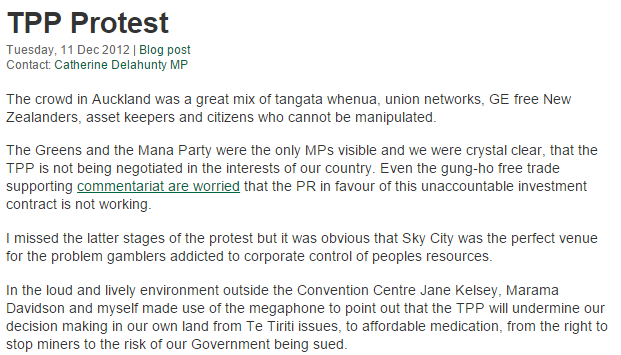
At a minimum, New Zealand itself chose to give up its sovereignty if it agrees to investor state dispute settlement in a trade agreement. The decision was not imposed by a foreign court where it was not heard nor was a party.


Of particular concern to the Greens is international arbitration could "trump the public’s vote vote". New Zealand has repeatedly elected parties that support the alliance with America, and support a robust security and intelligence policy, including electronic surveillance as part of the war on terror.
The last week of the 2014 general election campaign was dominated by the Government Security Communications Bureau and its cooperation with the National Security Agency and the extent to which New Zealand security services engaged in electronic surveillance in New Zealand and abroad.

The Greens want to subvert that democratic decision that has been repeated over many New Zealand elections about national security and foreign relations to defer to an American court when New Zealand didn’t even appear as a party.

The US Court of appeal was deciding an issue of statutory interpretation of the Patriot Act. There was no constitutional issues at hand.
The Patriot Act expires in a month unless it is extended. Congress has ample opportunity to amend the renewed law to overturn the appeal court’s decision for the future operation of its security and intelligence laws.
The Greens want a Court of Appeal interpretation of the American Patriot Act to extend to New Zealand without a vote of the New Zealand people or the parliament having any say on whether to give up New Zealand’s sovereignty or waive sovereign immunity in American courts.
.
Senator Warren made a good case against Investor-State Dispute Settlement in the TPP
09 May 2015 Leave a comment
in economic history, economics of regulation, entrepreneurship, industrial organisation, international economic law, international economics, law and economics, politics - Australia, politics - New Zealand, politics - USA, property rights Tags: Australian productivity commission, free trade agreements, investor state disputes settlement, Leftover Left, preferential trade agreements, Senator Elizabeth Warren, Twitter left
In the Washington Post a few months ago, Senator Elizabeth Warren made a balanced case against investor state dispute settlement, not only in the Trans-Pacific Partnership. But in any trade agreement.
Apart from a few rushes of blood in rhetoric to appeal to her base, she made reasoned arguments, good use of history, and put up constructive alternatives to what she was criticising. Furthermore, she put forward arguments that appealed to every point in the political spectrum. The Left over Left critics of investor state disputes settlement clauses in trade agreements in New Zealand never do that.
She echoed arguments I have made the at investor state disputes settlement clauses have no place in trade agreements between liberal democracies.
Liberal democracies have independent courts and honest politics where everyone gets a fair go. That means sometimes you’re on the losing side of politics, but you as free to persuade the majority that they are mistaken. That is democracy in action: sometimes you win, sometimes you lose and there is an election in a few years where you can get another go.
New Zealand has a Closer Economic Relations Agreement with Australia. One provision is a requirement that in most cases New Zealanders are treated the same as Australians under Australian law.
To explain this, some years ago, a New Zealand television production company successfully sued the Australian television regulator to have New Zealand made television shows recognised as Australian content under the 50% Australian content regulations for free-to-air television in Australia.
Note the New Zealand business sued in the Federal Court of Australia and won. They had their day in court.
Senator Warren makes the point that if a business in the USA is unhappy with a regulation, they can challenge by normal democratic and legal means, which investor state disputes settlement undermines:
If a foreign company that makes the toxic chemical opposes the law, it would normally have to challenge it in a U.S. court. But with ISDS, the company could skip the U.S. courts and go before an international panel of arbitrators. If the company won, the ruling couldn’t be challenged in U.S. courts, and the arbitration panel could require American taxpayers to cough up millions — and even billions — of dollars in damages.
Senator Warren also provides a good history of the emergence of investor state disputes settlement and the relevance of that history to contemporary developments:
But after World War II, some investors worried about plunking down their money in developing countries, where the legal systems were not as dependable. They were concerned that a corporation might build a plant one day only to watch a dictator confiscate it the next. To encourage foreign investment in countries with weak legal systems, the United States and other nations began to include ISDS in trade agreements.
Investor state disputes settlement were indeed created to protect businesses that did not have robust democracies and legal systems. Would be international investors in one of these countries were promised international redress if there was a coup, a takeover of their investments or some other unforeseen negative impact because sovereign risk.
She then asked why are these provisions in trade agreements with liberal democracies where they have no relevance:
Those justifications don’t make sense anymore, if they ever did. Countries in the TPP are hardly emerging economies with weak legal systems. Australia and Japan have well-developed, well-respected legal systems, and multinational corporations navigate those systems every day, but ISDS would pre-empt their courts too.
Senator Warren also makes a good point that investor state disputes settlement undermines competition between legal jurisdictions and the rewards for having a sound legal system:
…to the extent there are countries that are riskier politically, market competition can solve the problem. Countries that respect property rights and the rule of law — such as the United States — should be more competitive, and if a company wants to invest in a country with a weak legal system, then it should buy political-risk insurance.
Political risk is is an entrepreneurial opportunity for the insurance market. The World Bank’s Multilateral Investment Guarantee Agency provides insurance to those investing in developing countries against expropriation (including indirect expropriation), as well as acts of war and terrorism. Export Finance schemes of many governments offer political risk Insurance. Anyone who travels in the less safe countries of the world routinely buys travel insurance.
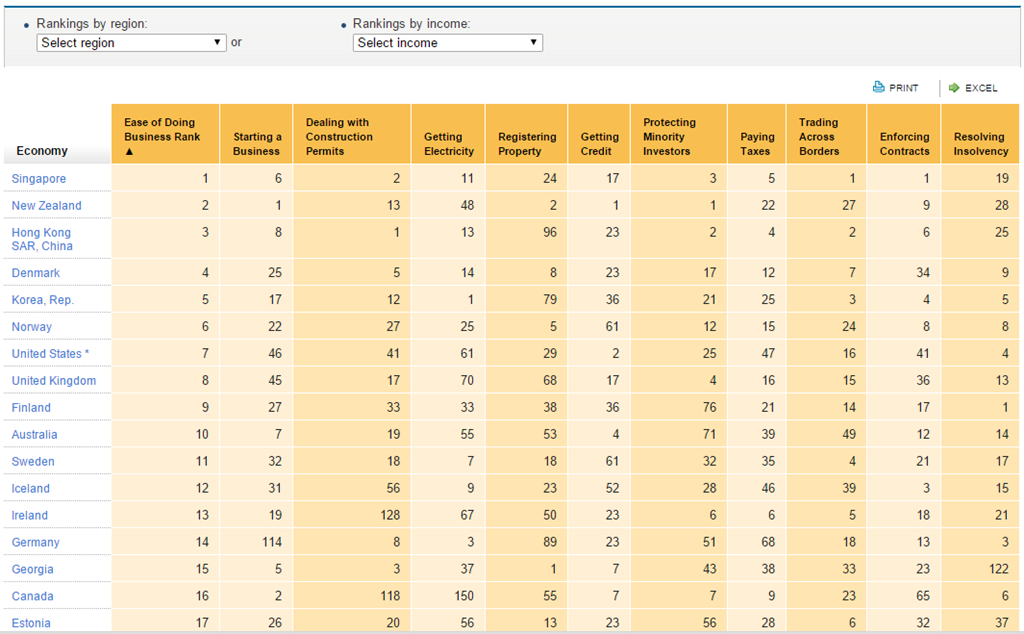
The World Bank puts out an annual index on ease of doing business in every country of the world so foreign investors can’t say they won’t warned of the risks they were taking for the profits they sought.
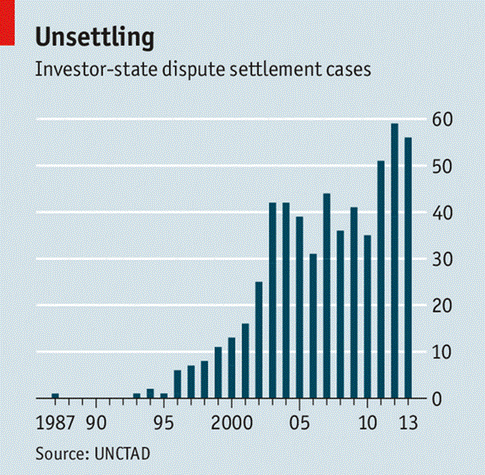
Investor state disputes that were indeed referred to international arbitration used to be rare. Now they are more common as Senator Warren explains:
From 1959 to 2002, there were fewer than 100 ISDS claims worldwide. But in 2012 alone, there were 58 cases.
Recent cases include a French company that sued Egypt because Egypt raised its minimum wage, a Swedish company that sued Germany because Germany decided to phase out nuclear power after Japan’s Fukushima disaster, and a Dutch company that sued the Czech Republic because the Czechs didn’t bail out a bank that the company partially owned. U.S. corporations have also gotten in on the action: Philip Morris is trying to use ISDS to stop Uruguay from implementing new tobacco regulations intended to cut smoking rates.
In a response to Senator Warren’s op-ed, Gary Clyde Hufbauer said:
…only 13 ISDS cases have been brought to judgment against the United States. The United States has not lost a single case.
Why? Because the United States does not expropriate private property without compensation, and the United States does not enact arbitrary or discriminatory laws against foreign firms. Contrary to what the Senator implies, American taxpayers have not had to cough up millions and even billions of dollars in damages. They have not had to cough up anything.
The best part of Senator Warren’s op-ed is when she appeals to all points of the political spectrum based on arguments that do indeed appealed to them:
Conservatives who believe in U.S. sovereignty should be outraged that ISDS would shift power from American courts, whose authority is derived from our Constitution, to unaccountable international tribunals. Libertarians should be offended that ISDS effectively would offer a free taxpayer subsidy to countries with weak legal systems. And progressives should oppose ISDS because it would allow big multinationals to weaken labour and environmental rules.
Senator Warren did make a good case against investor state disputes settlement, particularly between liberal democracies. Foreign investors should take their chances in domestic politics and the courts like the rest of us. They’ve invested in a liberal democracy with independent courts, honest politicians and a commitment to a market economy.

Investor state disputes settlement clauses in trade agreements allow foreign investors to sue the host country for laws, policies, or court decisions they find objectionable. This gives foreign investors more rights than local investors; more influence than local citizens. That is contrary to equality before the law, which is the essence of liberalism.

The point that the Twitter Left rarely makes against investor state disputes settlement, and Senator Warren goes a way towards making is the shield offered by investor state disputes settlement clauses against predatory, corrupt governments in underdeveloped countries, many of which were socialist kleptocracies, has become a sword against regulations that arise in any liberal democracy that were sought and obtained through normal democratic means.
The Australian Productivity Commission held a public inquiry into regional and bilateral trade agreements in 2010. The commission specifically addressed investor state disputes settlement in its subsequent report:
1. There does not appear to be an underlying economic problem that necessitates the inclusion of ISDS provisions within agreements. Available evidence does not suggest that ISDS provisions have a significant impact on investment flows.
2. Experience in other countries demonstrates that there are considerable policy and financial risks arising from ISDS provisions.
The Productivity Commission concluded that investor state dispute settlement provisions are just not worth bargaining coin:
Nor, in the Commission’s assessment, is it advisable in trade negotiations for Australia to expend bargaining coin to seek such rights over foreign governments, as a means of managing investment risks inherent in investing in foreign countries. Other options are available to investors.
The Australian Productivity Commission was quite right to question the advantages of setting up a preferential legal system for anyone:
…a bilateral arrangement with Australia to provide a ‘preferential legal system’ for Australian investors is unlikely to generate the same benefits for that country than if its legal system was developed on a domestic non-preferential basis.
To the extent that secure legal systems facilitate investment in a similar way that customs and port procedures facilitate goods trade, there may be a role for developed nations to assist through legal capacity building to develop stable and transparent legal and judicial frameworks.
When the Left over Left usually argues against investor state disputes settlement provisions they get so carried away with the conspiratorial rhetoric that they overlook a much better argument.
Investor state disputes settlement provisions are bad deal from liberal democracies. Liberal democracies with the rule of law, a market economy and private property rights offer ample protections to any foreign investor.

In trade agreements with less democratic countries, the need for reciprocal promises may not be worth the price when there are other options for investment protection, such as political risk insurance.
The question must be asked as to who lobbies for these agreements considering how much is opposition they provoke, and how useful they are as a mobilisation tool for the Twitter Left in their relentless campaign against lower prices and higher living standards.
Labour Party betrays working class again: nanny state obligations to enrol to vote
09 May 2015 Leave a comment
in constitutional political economy, politics - New Zealand, politics - USA, Public Choice, Richard Posner Tags: compulsory voting, expressive voting, Internet, Joseph Schumpeter, Labour Party, nanny state, non-voting, rational ignorance, rational irrationality, Richard Posner, Robert McCormick, Robert Tollison, voter demographics, William F. Shughart

Extraordinary. Political junkies don’t realise that there are people out there that have better things to do with their lives than take an interest in politics.

It’s a free society. They are free not to listen, not engage and not vote for anyone. Free speech includes a right not to speak and not to participate. If you disappointed with that political apathy, put forward a party platform that excites them enough to vote. Get out the vote by being worth voting for.
What is more extraordinary is a party that claims to speak for the working class first opposed obligations on welfare benefit receipt regarding looking more intensively for work and paying court fines and so forth, but it is happy to use the same provisions for their own political advantage because they are on the ropes. The New Zealand Labour Party’s party vote at the last election was at record low levels. It is still at the same level in the opinion polls.
As for voter registration drives in working-class electorates, the New Zealand Labour Party has no large donors apart from unions. The reason for this is as their former president, Mike Williams says " if you don’t ask, you don’t get ".
Voter registration is voluntary in the USA and for all its flaws, and I think there are far fewer than people say, Richard Posner could still give an excellent defence of political participation in the USA:
American democracy enables the adult population, at very little cost in time, money or distraction from private pursuits commercial or otherwise, to punish at least the flagrant mistakes and misfeasances of officialdom, to assure an orderly succession of at least minimally competent officials, to generate feedback to the officials concerning the consequences of their policies, to prevent officials from (or punish them for) entirely ignoring the interests of the governed, and to prevent serious misalignments between government action and public opinion.
Too many as Richard Posner has argued well in his writing want to remake democracy with the faculty workshop as their model. Such deliberation has demanding requirements for popular participation in the democratic process, including a high level of knowledge and analytical sophistication and an absence, or at least severe curtailment, of self-interested motives.
Much empirical research demonstrates that citizens have astonishingly low levels of political knowledge. Most lack very basic knowledge of political parties, candidates and issues, much less the sophisticated knowledge necessary to meet the demands of a deliberative democracy.
One reason for these low levels of political knowledge is a large number of people are simply not interested in politics even if they have the time to take an interest.
Because of this political ignorance and apathy, Posner championed Schumpeter’s view of democracy. Schumpeter disputed the widely held view that democracy was a process by which the electorate identified the common good, and that politicians carried this out:
- The people’s ignorance and superficiality meant that they were manipulated by politicians who set the agenda.
- Although periodic votes legitimise governments and keep them accountable, their policy programmes are very much seen as their own and not that of the people, and the participatory role for individuals is limited.
Schumpeter’s theory of democratic participation is that voters have the ability to replace political leaders through periodic elections. Citizens do have sufficient knowledge and sophistication to vote out leaders who are performing poorly or contrary to their wishes.
The power of the electorate to turn elected officials out of office at the next election gives elected officials an incentive to adopt policies that do not outrage public opinion and administer the policies with some minimum honesty and competence.
The outcome of Schumpeterian democracy in the 20th century, where governments are voted out rather than voted in, is that most of modern public spending is income transfers that grew to the levels they are because of support from the average voter.
Political parties on the Left and Right that delivered efficient increments and stream-linings in the size and shape of government were elected, and then thrown out from time to time, in turn, because they became tired and flabby or just plain out of touch.
I wouldn’t revel too much on the higher voter turnout as as yet another saviour on the horizon to bring the Left over Left back from the political wilderness. The most votes ever won by a political party in the UK was 14 million by John Major’s Tory party in 1992 when the shy Tories came out in force to re-elected the incumbent government much the surprise of the opinion polls.
Higher voter turnout is not necessarily always a good thing in terms of good governance. William Shughart found that voter participation increases in gubernatorial elections in the USA when evidence of corruption mounts. Candidates, political parties, and interest groups have incentives to invest in mobilising support on Election Day.
Those who stand to gain from being office through their corruption invest considerable resources in mobilising voter turnout that is in their favour. Corruption increase the value of winning public office and strengthens the demand-side efforts to build winning coalitions.
In a prophetic article at the dawn of the Internet, Robert Tollison, William F. Shughart II, and Robert McCormick wrote in 1999 about how voting is not the only way in which people express their political preferences effectively.
Observers of American democracy complain that voter turnout and voter registration are low and had been low from 50 years. Tollison, Shughart, and McCormick reminded these critics that:
Voters now have more political information available to them than ever before, and they are no longer confined to expressing their political preferences at the polls once every two or four years.
Newly available technologies have lowered voters’ costs of becoming informed about political issues and of communicating with their political representatives.
Voter registration and voter turnout is lowest among young people who also happen to be the most Internet savvy. This is not surprising considered the prophetic observation of Tollison, Shughart, and McCormick in 1999 that:
What is more important, the opinions voters form on the basis of the information available to them can be communicated to policy makers rapidly and effectively.
E-mails, faxes, and phone calls are substitutes for ballots. By the time an election rolls around, politicians and policy makers already know what the voters think and, hence, their wishes have already been incorporated into laws and policies.
Tollison, Shughart, and McCormick asked why vote when you have already influenced political outcomes through alternative means between elections such as social media:
Having affected policy outcomes, voters are naturally less interested in voting on candidates. Low turnout rates on election day may paradoxically be evidence of greater voter participation in the political process.
In fact, we are fast approaching a return to the town meeting, where individuals register their preferences on specific policy proposals and politicians can assess the intensities of those preferences by reading their e-mail. Indeed, voters can vote as much and as often as they want in the information age.
It is not surprising therefore in this prophetic article that Tollison, Shughart, and McCormick predicted that politicians would pay close regard to social media, and if they did, democracy works:
As long as politicians are good agents who read their faxes and e-mails correctly, voters will correspondingly have less need to go to the polls.
Voters will vote only when their representatives ignore their electronic opinions. Indeed, that is the implicit threat.
And because voters don’t have to go to the barricades to voice those opinions, political discourse should become more civil and political protests less frequent and disruptive.
HT: Nick Kearney
Study: Men are lazy to their core
08 May 2015 Leave a comment
in economics of love and marriage, gender, labour supply Tags: child rearing, childcare, gender gap, household production, marital division of labour

Adding it all up — both paid work and unpaid housework, including childcare — the average man’s work week was three hours longer than his partner’s before birth, but after parenthood he worked 8.5 hours less than his partner.
This is particularly interesting, given that this is a socio-economic cohort — wealthy and educated — that generally says equality of household labour is important in a relationship.
via Study: Men are lazy to their core – The Washington Post.
The history of Mexican sovereign debt
08 May 2015 Leave a comment
in financial economics, international economics, law and economics, politics - USA Tags: bond markets, Mexico, sovereign debt, sovereign default
Cinco de Mayo celebrates Mexico's victory in a battle sparked by debt. Could it happen again? econ.st/1JNWd1f http://t.co/xN47SVYxZN—
The Economist (@EconBizFin) May 05, 2015
Freedom of the press in 2015
07 May 2015 Leave a comment
in law and economics, liberalism Tags: freedom house, Freedom of the press
 Utopia, you are standing in it!
Recent Comments